
When First Colony Mall opened in 1996, four department stores held its corners: Foley's, Dillard's, JCPenney, and Mervyn's California.
Three of those anchor spaces have stayed occupied since opening.
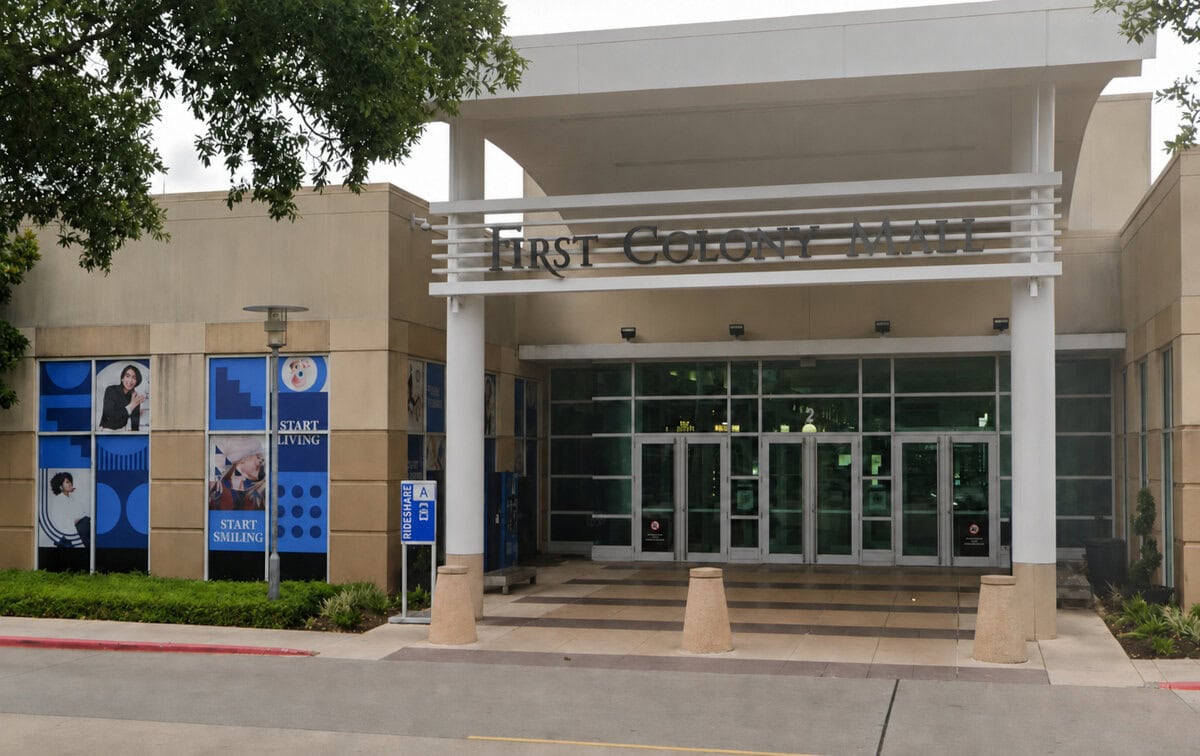
The mall stands at 16535 Southwest Freeway in Sugar Land, Texas, the first full regional mall in Fort Bend County and one of the last traditional department-store malls Houston ever got.
It grew out of a 7,500-acre Sugarland Industries land sale to a Hines-led venture in 1973.
Sugarland Properties Inc. later developed First Colony.
Mervyn's left in 2006, and its old box later became a second Dillard's store.
Foley's turned into Macy's the same year. JCPenney never moved.
Dick's Sporting Goods later filled a parking lot near the food court, and Barnes & Noble anchored a new outdoor wing.
That kind of anchor stability put First Colony ahead of most older Houston-area malls.
Here's how the place earned it, tornado and all.
A 7,500-acre bet placed in 1972
In 1972, Sugarland Industries moved to sell 7,500 acres, and the tract closed with Gerald D. Hines, the Houston tower builder, in 1973 for $44 million.
At the time, it was farmland and prairie southwest of the city, a long drive from Houston's big regional malls.
The plan was called First Colony, and it kept growing.
The development entity, Sugarland Properties Inc., later had a Royal Dutch Shell pension fund as Hines' partner, and the footprint swelled toward 10,000 acres across Sugar Land and Missouri City.
Houses came first. The 1970s, the 1980s, then the 1990s, subdivision after subdivision.
By 1982, First Colony had its own community services association to provide amenities and enforce deed restrictions.
What the place still lacked was a regional mall, somewhere to shop without driving into Houston.
The "Town Center" that took nine years to open
By 1987, there was a plan on paper.
A regional mall at the southeast corner of Highway 6 and U.S. 59, more than 1 million square feet, three department stores, room for a fourth in a second phase.
Early sketches floated an ice rink and a wish list of upscale anchors: Lord & Taylor, Macy's, Foley's, Marshall Field, Neiman Marcus.
Then nothing happened for years.
The Houston region was still digging out of the 1980s energy downturn, and the anchors First Colony wanted were hard to sign.
A separate mall proposal near U.S. 59 and the Grand Parkway, in the New Territory area, was also in the mix during that period.
That project never opened as a mall; the area later became River Park.
The First Colony plan finally turned real in October 1994.
Hines and Sugarland Properties committed, Foley's signed on as the headline anchor, and Connecticut General Life Insurance put up the money.
RTKL Associates of Dallas drew the building.
Construction was set to start around the end of the year.
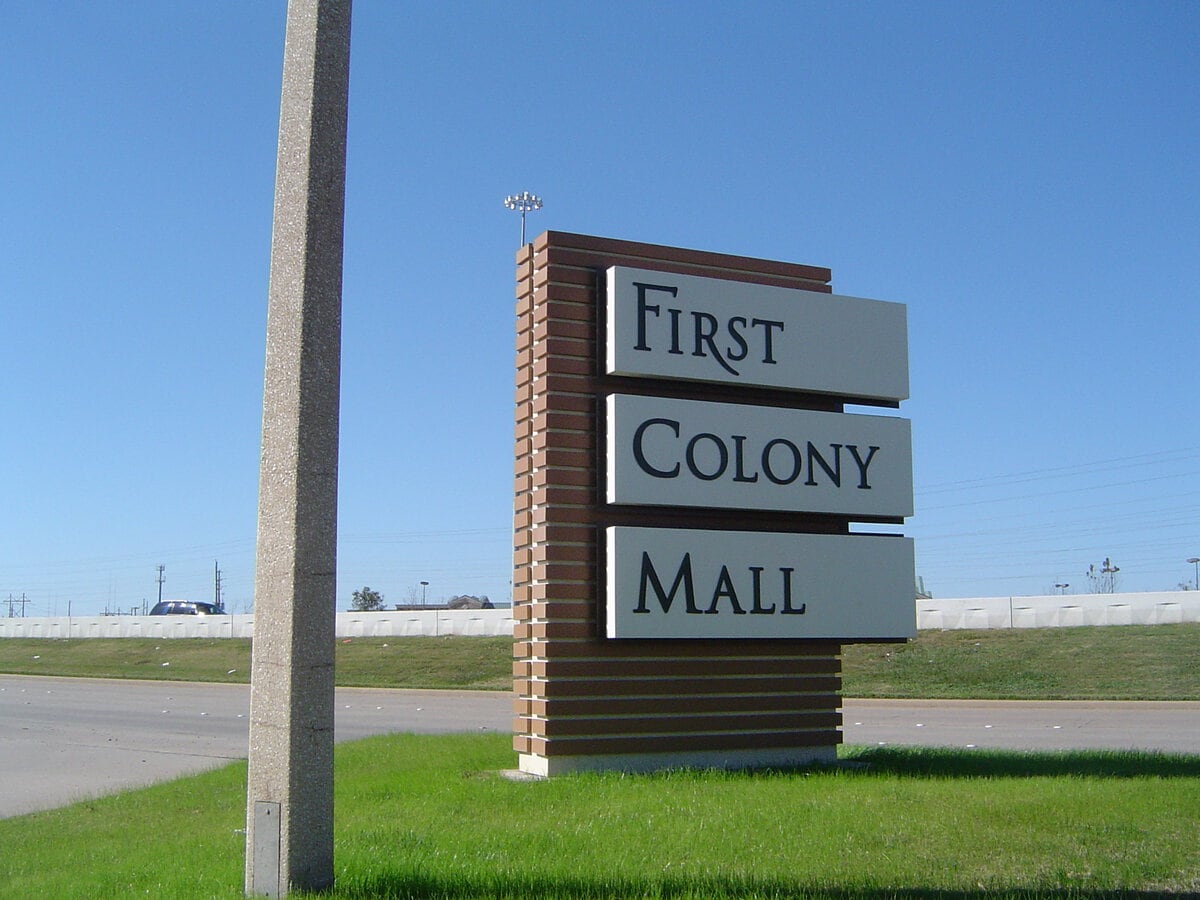
What opened on March 14, 1996
First Colony Mall opened with four anchors: Foley's, Dillard's, JCPenney, and Mervyn's California.
More than 100 specialty stores filled the inline space, and a food court called Sugar Land Cafes sat in the middle of it.
It was the first full regional mall in Fort Bend County.
It was also one of the last traditional department-store malls the Houston area would ever build.
The building was a single level, one long enclosed concourse bent into a crescent.
Carpeted walkways and skylights ran under two-level anchor stores, with surface parking wrapped around the building.
The food court leaned into a 1950s roadside-diner theme, with wall graphics and floor inlays tied to the Sugar Land Cafes name.
No Sears. No Montgomery Ward.
For a Houston mall of that era, leaving out Sears was a real departure, but Sears already sat in Westwood Mall and West Oaks Mall, and First Colony's lineup tilted toward fashion stores instead.
Pulling shoppers off the freeway and out of Houston
Before First Colony, a Sugar Land family shopping for a regional mall drove to Sharpstown Center, Westwood Mall, or West Oaks Mall.
All of them in Houston. All of them a haul.
The new mall sat right where the freeway, Highway 6, the new neighborhoods, and the planned commercial core all met.
It pulled Fort Bend County's shopping trips back home.
The older malls were already facing their own pressures.
Westwood Mall later became an office complex.
Sharpstown and West Oaks also had to compete for shoppers in a retail market that was spreading farther southwest.
The tornado that hit before the mall turned two
On February 16, 1998, a tornado touched down at or near the mall.
It damaged the Dillard's anchor, including a downwind wall, did minor structural damage to other stores, and hit the nearby Sugar Land ice facility.
The damage was repaired, and the anchor survived.
It stuck in the mall's history mostly because of the timing.
Less than two years old, one of its four original department-store buildings torn into by a storm, and it kept going anyway.
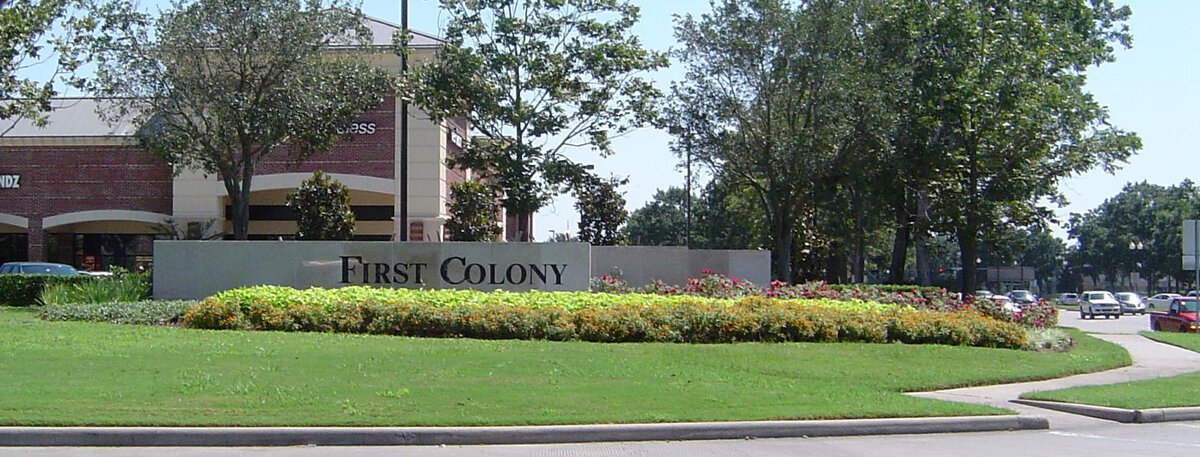
Mervyn's leaves, and the doors start changing names
January 2006. Mervyn's closed as the chain pulled out of Houston entirely.
That left a hole in one of the four original anchor positions.
Then the dominoes.
In September 2006, Foley's became Macy's after Federated bought May Department Stores and retired the Foley's name.
Same store, same address, new sign over the door.
Dillard's solved the Mervyn's vacancy by splitting itself into two.
By 2009, it had moved men's and home departments into the old Mervyn's building and kept women's and children's in its original space.
Two Dillard's stores at one mall, which is still how it works today.
Three of the four original anchor spots never went dark.
That record put First Colony ahead of most older Houston-area malls, where empty anchor boxes became the whole story.
They tore up the front parking lot and built an outdoor wing
The biggest change to the building came in 2006.
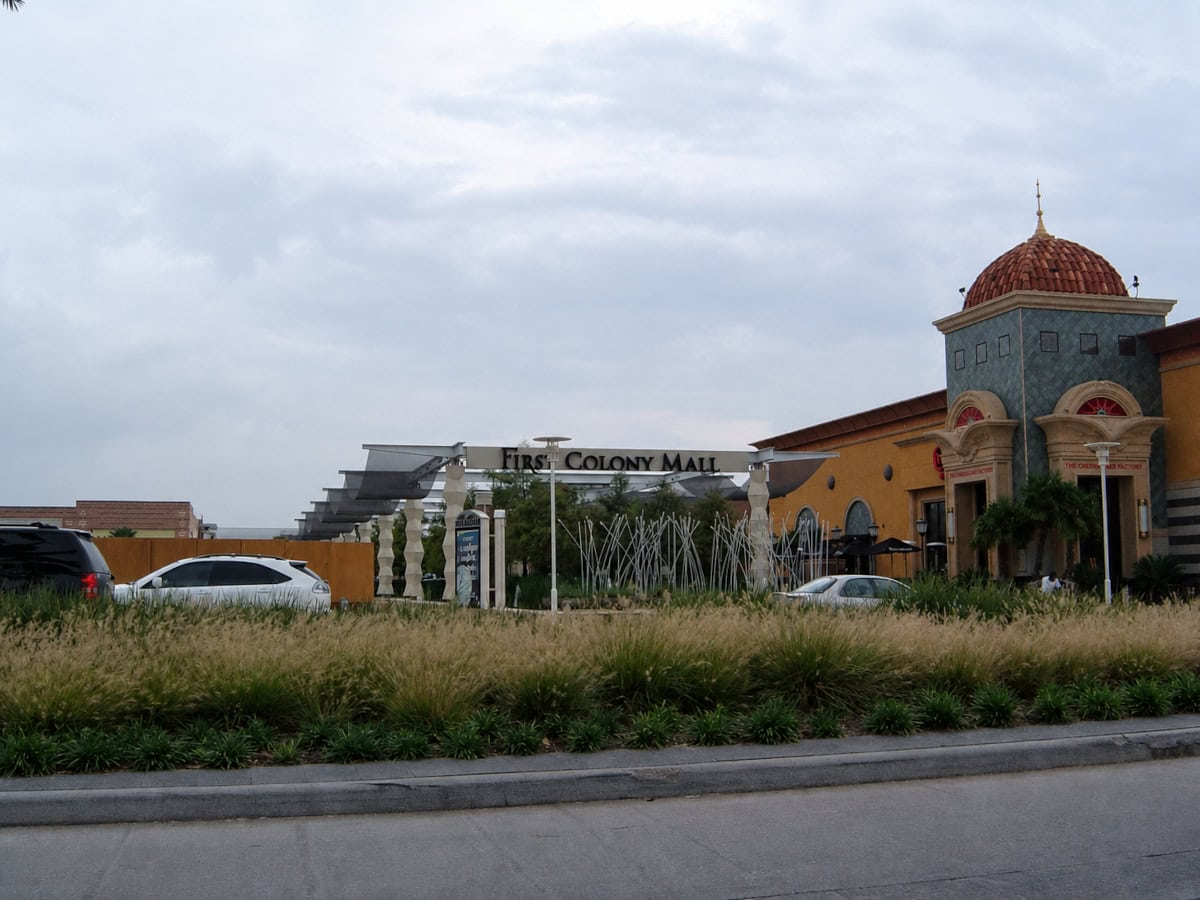
The mall took part of its front parking field and built an open-air wing facing Highway 6 and the Town Center side.
The wing brought Barnes & Noble, sit-down restaurants, and a row of outdoor-facing storefronts.
After a decade of being a box you walked into, the mall grew a front porch.
That meant new traffic problems.
A parking garage went up near Dillard's in 2006, another near Macy's by 2008, and traffic lights went in at Town Center Boulevard North to handle the crush around the new wing.
The lawn outside Entrance 3, next to The Cheesecake Factory, became a public seating and restaurant area.
It's the part of the property that now does most of the work the food court used to.
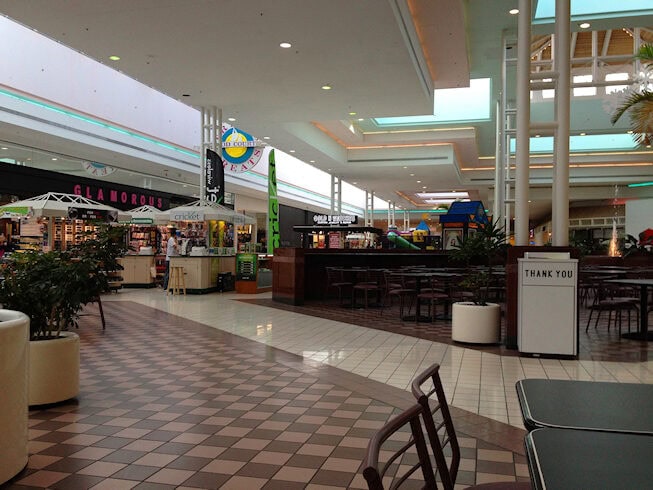
A sporting goods box lands near the food court in 2016
On October 21, 2016, Dick's Sporting Goods kicked off its First Colony grand opening as part of the chain's first wave of Houston-area stores, a group that included Baybrook, Deerbrook, Willowbrook, The Woodlands, and a Katy location.
The store went up on former parking-lot land near the food court entrance, wedged between the old Mervyn's-turned-Dillard's section and the food court side.
It changed how people approached that part of the building and shrank an earlier outdoor dining area near that entrance.
The food court itself kept its bones.
Sugar Land Cafes still carried its diner-style graphics, decorative signs, and floor inlays decades after opening, even as the ad panels and storefronts around them turned over.
Who actually owns the place
For its first stretch, First Colony belonged to the joint venture that built it, the one tied to Hines, Sugarland Properties, and Connecticut General Life Insurance.
General Growth Properties bought it in 2002 and held it through the years that mattered most.
The property ran under First Colony Mall LLC, then under the wider Brookfield/GGP retail network.
In 2018, the corporate roof changed again.
Brookfield Property Partners finished buying GGP Inc. on August 28, 2018, a deal worth $9.25 billion in cash to security holders, and GGP's stock came off the New York Stock Exchange.
First Colony landed inside Brookfield's U.S. retail business, now branded GGP.
The mall still uses its own name and its own front door.
A regional draw in a county that filled up around it
The mall now pulls more than 6 million shoppers a year from the southwest Houston market.
Its trade area held a population of 1.2 million in 2024, with an average household income of $126,000.
Within 7 miles, nearly half of the adults hold a bachelor's degree or higher.
Those are healthy numbers. They also describe a problem.
The Fort Bend retail market that First Colony opened in 1996 barely exists anymore.
Big-box centers, grocery-anchored strips, town-center projects, hospital-area retail, and a string of newer developments along the Grand Parkway now slice the county's shopping trips a dozen ways.
The mall that once had Fort Bend's regional traffic to itself competes for every visit.
Its answer has been to hold the department-store base, lean on restaurants and the open-air wing, and keep cycling in newer tenants.
The brands turning over right now
Late 2024 and 2025 brought a wave of new names.
Aerie/OFFLINE opened in the main building.
Uniqlo moved in next door after Memorial City, making First Colony one of the early Texas homes for the Japanese chain.
Pop Mart opened near Dillard's, ZT Records near Dick's.
Some of that churn came from elsewhere falling away.
F21 OpCo, the U.S. operator of Forever 21 stores, filed Chapter 11 in March 2025 and began closing out its U.S. operations.
Its First Colony store went with it, and Q Fashion took the old space.
Francesca's Acquisition, LLC filed for Chapter 11 in February 2026.
Lululemon, meanwhile, kept investing.
The chain had an $810,000 remodel on the books in 2025, then relocated to a larger space in March 2026.
Warby Parker started building out a new storefront the same spring, due to open mid-2026.
What the lawn is for now
The mall's newest money isn't going into the concourse.
It's going outside.
In March 2025, Sugar Land's 4B Corporation approved the first award under a new commercial grant program: a $360,000 outdoor play area, with picnic tables and more pedestrian seating, the city reimbursing up to $72,000 of it.
The work pushed into early 2026.
Then in December 2025, Sugar Land launched a Social District across Town Square and the mall, allowing patrons to carry drinks from participating businesses through posted outdoor areas during district hours.
Thirty years on, the enclosed mall is still the core: 160+ shops, 27 places to eat, Macy's in the old Foley's spot, JCPenney, one original Dillard's, and a second Dillard's in the old Mervyn's box.
But the play equipment, the picnic tables, the lawn by The Cheesecake Factory, the marked cup you can carry within the Social District, that's where Sugar Land actually gathers now.
Independent Publisher Notice
BestAttractions is an independent editorial publisher. We are not affiliated with, endorsed by, or acting on behalf of any location, business, property owner, manager, government agency, or organization described in this article.
Comments posted on this page are not forwarded to, reviewed by, or acted upon by any entity mentioned in the article.
For official inquiries, complaints, applications, bookings, or other requests, please contact the relevant entity directly through its official website or other verified channels.