
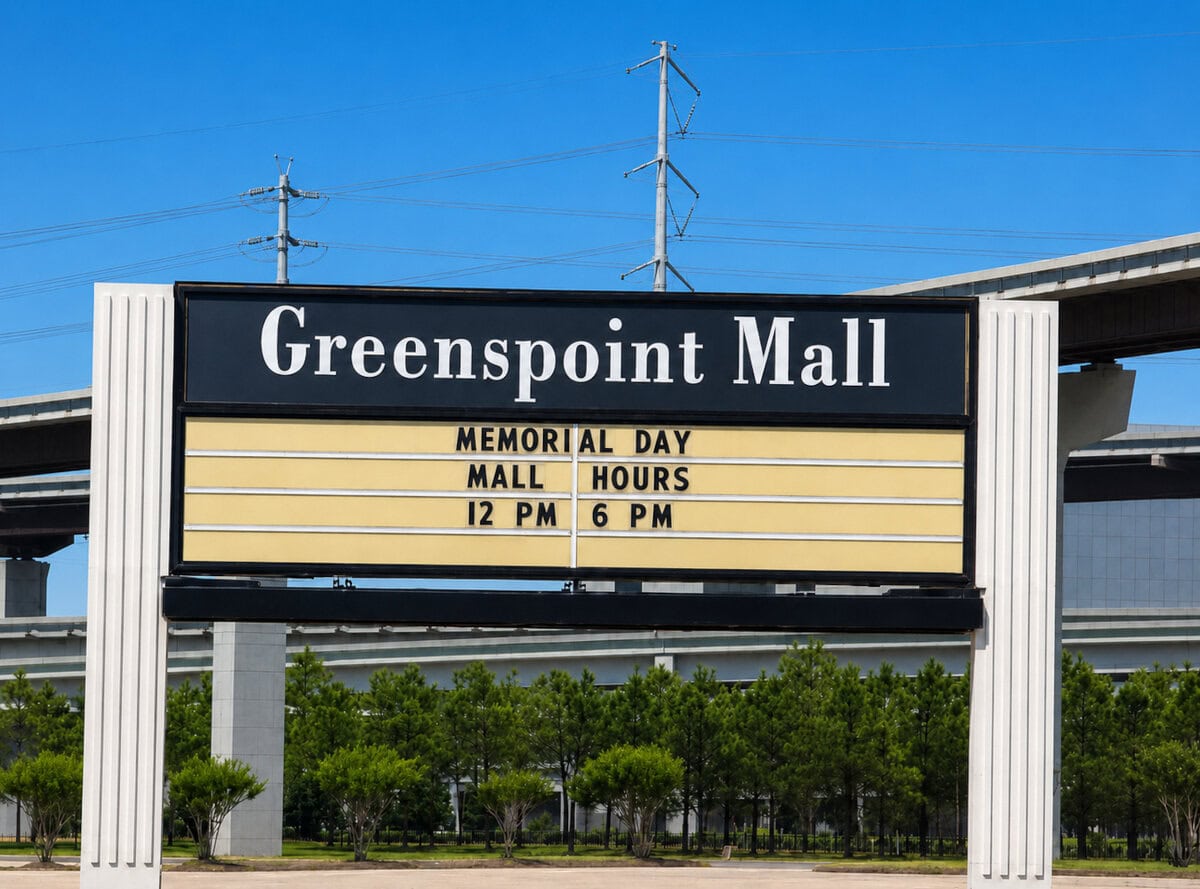
Greenspoint Mall was a large indoor shopping mall in north Houston, near the point where Interstate 45 meets Beltway 8.
It opened in 1976 and, for a long stretch, was the main shopping center for everyone living north of the city.
A mall like this runs on its big department stores.
They are located at the ends and attract the crowds; the smaller shops in the middle rely on those visitors.
Greenspoint had an unusual number of them, including an upscale national name most Houston suburbs never got.
At its largest, it held more than 160 stores.
For decades, it was a shopping center, a meeting place, and a worry about the parking lot, often at once.
How it got from there to here is the longer story.
Inside Greenspoint Mall in 1976: Trees, Skylights, and a Water Sculpture
Moving water ran through a sculpture of counterbalanced tubes and filled one of the courts with sound.
The piece, "Almost Calculated," came from two Baltimore sculptors, Bill Powell and Dan Sellers, and its water-activated brass instruments.
Full-grown trees stood under the skylights.
The floor was laid to look like a brick street.
In another court, a bronze group by the local artist G. Pat Foley showed children on a swing.
The art and the courts were meant to make the mall a public place and not only a row of shops.
This was the inside of Greenspoint Mall when it opened in north Houston in August 1976.
Federated Stores Realty built it at Interstate 45 and the North Belt, the center of a 375-acre commercial and residential development meant to fill in over the years.
The announced size was 1.2 million square feet.
The finished building reached 1.4 million square feet and 140 stores.
Skylights and clerestory windows let daylight into the corridors.
The idea was an enclosed, air-conditioned version of a downtown shopping street, with the trees and courts giving shoppers somewhere to stop.
Greenspoint Mall's Location: The Freeway, the Airport, and the Drive South
Before 1976, a north-side family that wanted a department store drove south to Northline Mall or Northwest Mall.
Greenspoint changed that.
It sat at 12300 North Freeway, at the Interstate 45 and Beltway 8 interchange, near the North Sam Houston Parkway, on the side of Houston that was growing fastest along the freeways.
It pulled from Aldine, Spring, the north Houston neighborhoods, and the suburbs past them.
George Bush Intercontinental Airport was close, which brought offices, hotels, and distribution buildings into the area and made the corner a strong site for a regional mall.
Opening Day 1976 and the Stores That Opened Greenspoint Mall
Thousands came through on the first day, and the north side treated the mall as a landmark.
Foley's, Sears, and Palais Royal opened it.
Foley's was the Houston name and gave the place its standing.
Sears brought the middle-market floors and a hard-goods department.
Palais Royal was the local store that people already knew.
The first list of tenants ran from national chains to small specialty shops, with food and services among them.
Its scale and air-conditioned floors made it an alternative to the older malls.
A General Cinema with five screens ran inside, so an afternoon could be a store, a meal, and a movie without going back out the doors.
The Boom Years: Expansion, 160 Stores, and TV Visits
The anchors kept coming.
Montgomery Ward arrived in 1978, Lord & Taylor in 1979, an upscale national store that most Houston suburbs did not have, and Joske's at the south end in 1980.
By then, the mall had more than 160 stores, JCPenney had joined the anchors, and a few enclosed centers in the area carried as many.
The district was filling with apartments, offices, and hotels, the oil economy was still climbing, and Greenspoint was where north-side teenagers and families went to meet, shop, and pass an afternoon.
In the 1980s, actors from network television shows came for appearances, and the holidays drew the year's biggest crowds.
Oil Money, the Bust, and an Area That Turned to Warehouses
The mall put people to work in the department stores, the theater, maintenance, security, and the seasonal jobs that came with the holidays, and it fed the restaurants and services nearby.
The district around it ran on offices, hotels, apartments, and highway businesses spread along I-45 and Beltway 8.
Then the oil price fell in the 1980s.
Apartment complexes thrown up during the boom sat with empty units and falling rents, the commercial ground under the mall got less steady, the customer base shifted, and property and safety problems followed.
By the 2010s and 2020s, the district had turned toward warehouses and distribution.
Large logistics and manufacturing users came to matter more than the mall did, and the mall was no longer the thing the area grew around.
Greenspoint Mall's Reputation and the Trouble in the Parking Lot
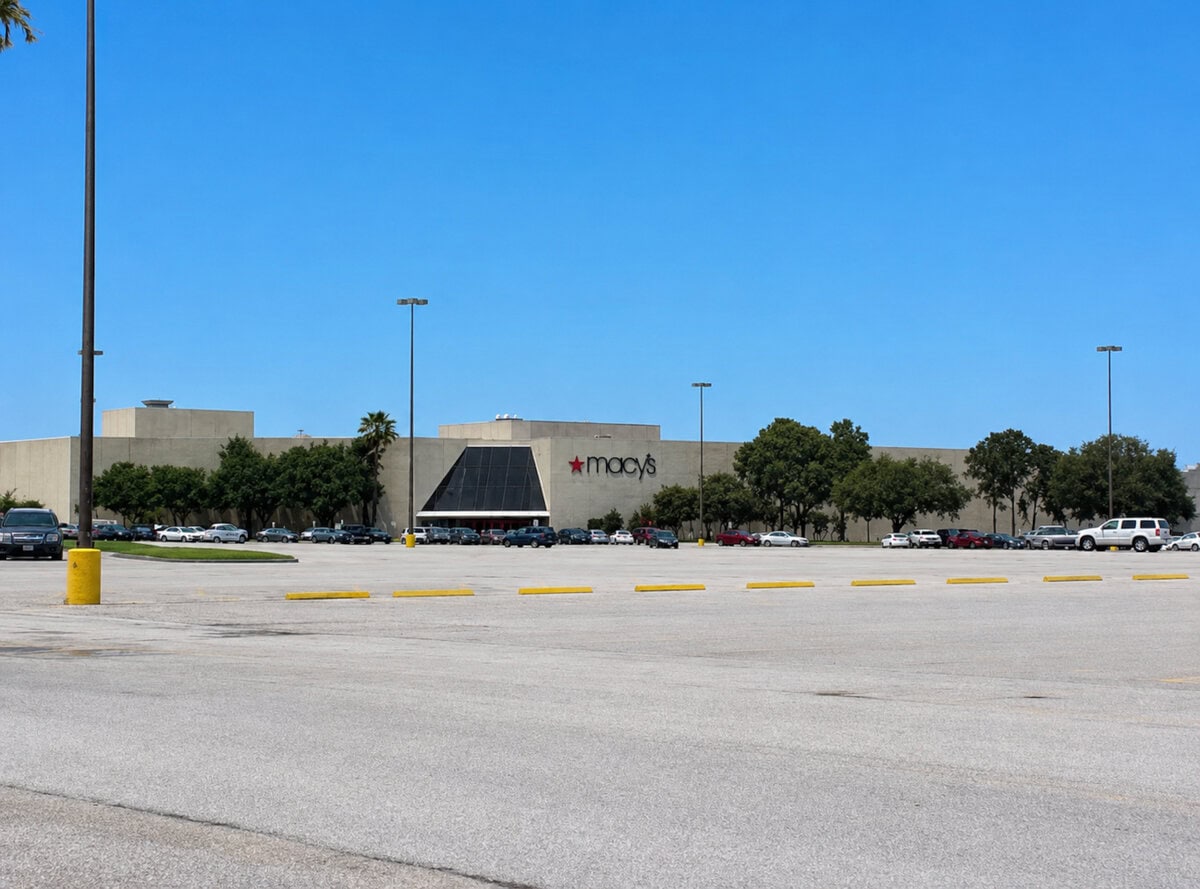
In 1986, police ran bait cars at Greenspoint and other Houston malls.
Greenspoint had one of the highest counts of mall vehicle theft in the area.
Worse followed.
In 1991, Harris County Deputy Roxyann Allee left a shift at the county jail and was forced into a van at gunpoint in the parking lot; she was later found dead.
A little over a year after that, taxi driver Larry D. Gipson was shot near a store outside the mall.
In 2007, Joanna Starr Gonzales, a 20-year-old store clerk, was killed inside the mall by a gunman as she opened her shop for the morning.
The North Houston District was created in 1991 to handle public safety, planning, and development across the commercial zone around the interchange.
A public-safety center opened at the mall in 1994, with Houston police and Harris County personnel on site, and crime and response times improved across the district.
Crime totals fell in several categories over the following decade.
Renaissance at Greenspoint and a Property With Too Many Owners
A renovation was planned in the late 1980s, as the building passed its first decade and newer malls came into the market.
The larger plan came in the 2000s under the name Renaissance at Greenspoint: part enclosed, part open-air, with outward-facing shops, restaurants, and entertainment, and counting on tearing down or reusing empty anchor space.
The concept was priced at $32 million.
A 2008 and 2009 phase of site work and alterations was estimated at $7 million, with Hermes Architects on the design.
One piece of it got built.
Premiere Renaissance 15 opened in May 2011 on the old JCPenney site and replaced the General Cinema fiveplex that had run inside the mall.
A Jimmy Jazz build-out was registered in 2010, so the place still drew specialty tenants finishing out space.
It gave the mall a new entertainment anchor for a while, but the rest of the plan stayed on paper.
The theater closed for good after the pandemic shutdown in March 2020.
The owner did not control the whole property.
Sears, Macy's, and Dillard's held their anchor buildings separately, so no single plan could take in all of it.
The mall went up for sale in 2016 and 2017, and a buyer group tied to Global Plaza Union, WIT Union, and China-based investors looked at a mixed-use conversion.
The deal never closed.
Anchors Out, Doors Shut: The Mall's Last Years
The names had been changing for years. Joske's became Dillard's in the department-store reshuffling of the late 1980s.
Lord & Taylor was sold and reopened as Mervyn's.
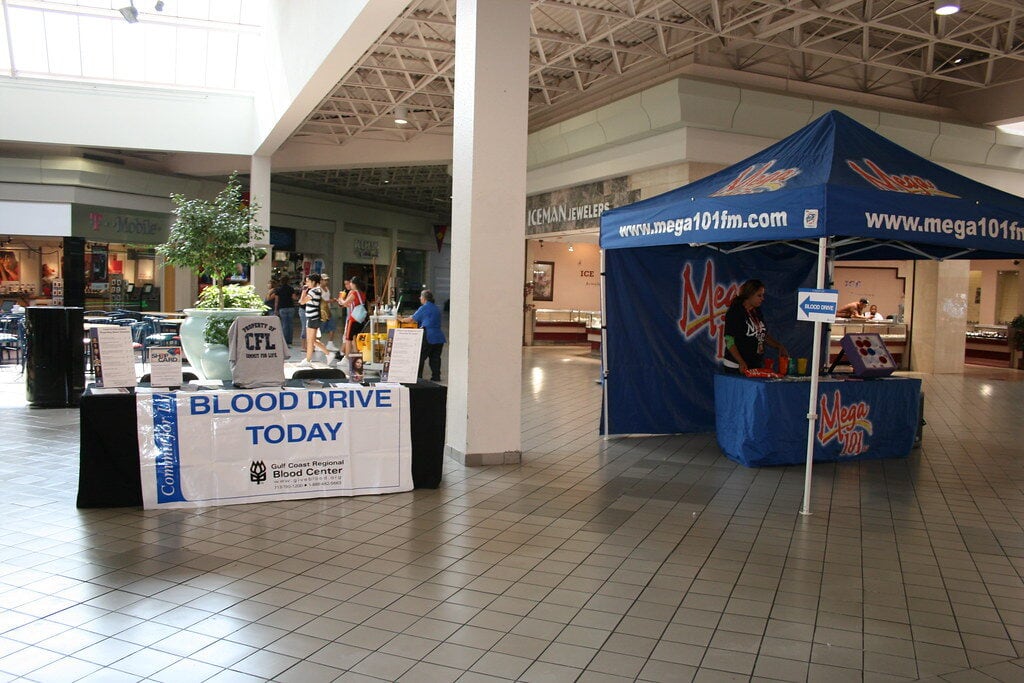
Foley's, the store people had shopped since opening day, became Macy's when Federated changed over its regional names.
Then the stores left for good.
Willowbrook, Deerbrook, and The Woodlands had opened nearer the growing suburbs and pulled away shoppers that Greenspoint used to keep.
Mervyn's and JCPenney were gone by the late 1990s, and Montgomery Ward closed in 2000 along with the rest of the chain.
Sears followed in 2010.
Macy's closed in 2017, and that September, after Hurricane Harvey, the American Red Cross used the empty store as a shelter.
Dillard's had already been reduced to a clearance center and was gone by the late 2010s, while Palais Royal also ended its run in the late 2010s, and the Palais Royal space became a Uniform Superstore.
Shopping was moving online and to big-box and open-air centers, and a large enclosed mall with weak anchors and an old reputation cost a lot to keep cool and was difficult to sell.
Regular operations ended June 30, 2024. Tenants were told to be out by July 31.
A handful moved into 33,500 square feet of the old Palais Royal and Uniform Superstore space on short leases and kept trading for a time.
Apartments on the Old Sears Lot, and an Empty Mall
In 2021, the Houston City Council approved a $14.9 million performance-based loan, drawn from disaster-recovery funds, for Summit at Renaissance Park.
It is a 325-unit midrise rental community at 12121 Greenspoint Drive, on part of the old mall site near the former Sears Auto Center.
The units are for low- and moderate-income households, set at 30, 50, and 60 percent of area median income, on a 40-year affordability term, and they run from one to four bedrooms.
It was planned with a pool, a fitness center, community gardens, playgrounds, a dog park, and 17,000 square feet of ground-floor retail.
The community was leasing by 2026.
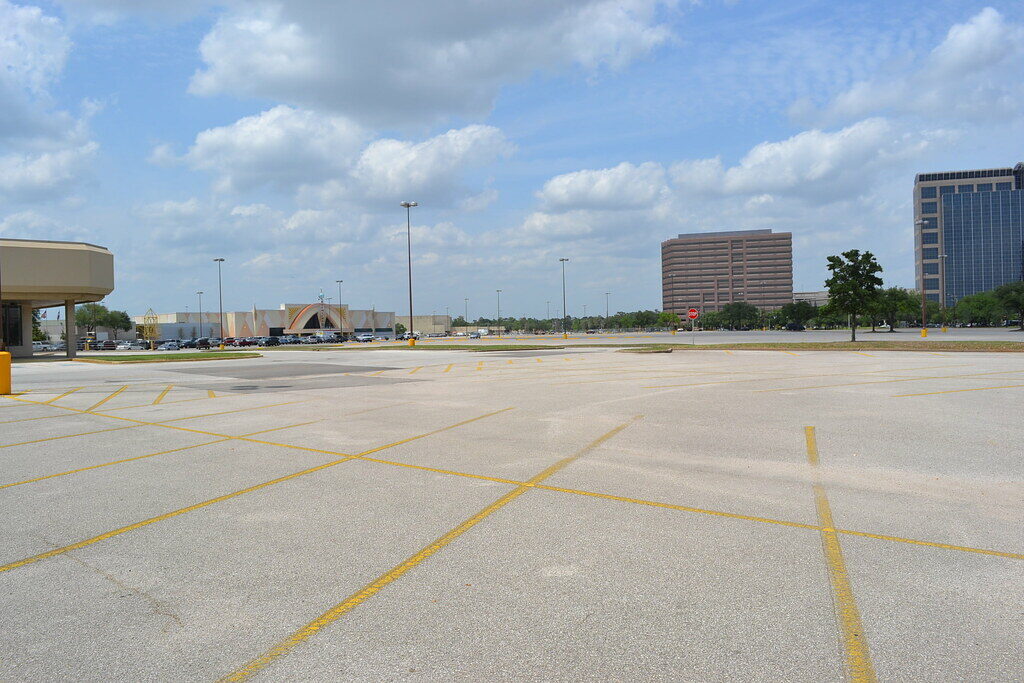
The enclosed mall is still there and still empty.
A building that size costs a great deal to take down or convert; the anchor parcels are still held separately, and no full reuse has been financed.
Newer retail nearby, like CityNorth, shows the area can still draw stores; the old building is a harder problem.
Fitness Connection stayed on, its lease running into 2030.
A youth and fitness use, CDM Youth and Wellness, kept a space.
In 2026, police looked into a shooting at an unsanctioned car meet in the parking lot, and one person did not survive.
The trees, the courts under the skylights, the sculpture that ran on water, the cinema, the crowds: gone.
What stands is an empty mall, a gym, a few short-lease shops, and a parking field.
On the ground where cars once pulled into the Sears Auto Center, families are moving into 325 apartments.
Independent Publisher Notice
BestAttractions is an independent editorial publisher. We are not affiliated with, endorsed by, or acting on behalf of any location, business, property owner, manager, government agency, or organization described in this article. Comments posted on this page are not forwarded to, reviewed by, or acted upon by any entity mentioned in the article. For official inquiries, complaints, applications, bookings, or other requests, please contact the relevant entity directly through its official website or other verified channels.