
Cibolo makes more sense once you stop picturing it as one compact suburb.
Everyday life is spread across a few very different pieces: the older railroad core around Main Street and FM 78, newer neighborhoods running north toward Interstate 35, newer development pushing south toward Interstate 10, and Schertz sitting so close on the west that many errands barely register as "leaving town."
That geography matters more than a list of amenities. A commute that looks reasonable on paper can change character once school traffic, construction, and the I-35 work zone enter the picture.
Cibolo is still growing into the city it has already become, and you feel that in ordinary routines.
FM 1103 is the road you learn to plan around
If there is one road that explains modern Cibolo, it is FM 1103.
It runs north-south through the part of town where many newer neighborhoods, schools, and businesses have collected, then feeds toward I-35.
Cibolo Valley Drive handles plenty of neighborhood movement too, while FM 78 is the older east-west seam through town.
Even trips that do not end on FM 1103 often depend on crossing it or using part of it.
In practice, time windows matter more than mileage. A short drive in the middle of the day can be routine.
The same trip near school release or the evening commute can take noticeably more patience.
The Census Bureau puts the city's mean travel time to work at 29.1 minutes for 2020-2024, but that average hides the important part: where you are starting, which side of town you need to reach, and whether your route funnels toward I-35.
In 2026, road work is part of that calculation.
The FM 1103 widening from I-35 toward Rodeo Way has brought lane shifts and utility work, while the much larger I-35 Northeast Expansion is still under construction farther into the northeast San Antonio corridor.
The current I-35 schedule stretches major phases into late 2027 and 2028.
That means Cibolo commuters can clear their own neighborhood streets and still meet construction before the drive really gets going.
The practical habit is to avoid treating a familiar route as a fixed-time route.
For an appointment, school pickup, airport run, or early shift, a little margin matters more here than the map mileage suggests.
Cibolo and Schertz blend together in daily life
Municipal boundaries matter for taxes, schools, services, and voting. They matter much less when you are deciding where to pick up dinner.
Cibolo and Schertz sit shoulder to shoulder, and the practical shopping area works that way.
The H-E-B on FM 1103 gave nearby neighborhoods a major grocery stop inside Cibolo in 2023.
North toward I-35, Cibolo Crossing adds the Santikos entertainment complex and other retail.
Cross into Schertz and the selection expands again without feeling like a separate outing.
That overlap is one of the easiest things to misunderstand from a map.
Cibolo is not a place where every daily need stays neatly inside the city limits.
It is more like a set of residential pockets plugged into the broader Schertz-Cibolo corridor.
You may live in Cibolo, fill up in Schertz, meet someone for lunch back in Cibolo, and never feel that you made an intercity trip.
The result is convenient, but it also reinforces how car-based most ordinary trips are. Errands are not difficult. They are simply spread out.
Old Town feels different because it really is different
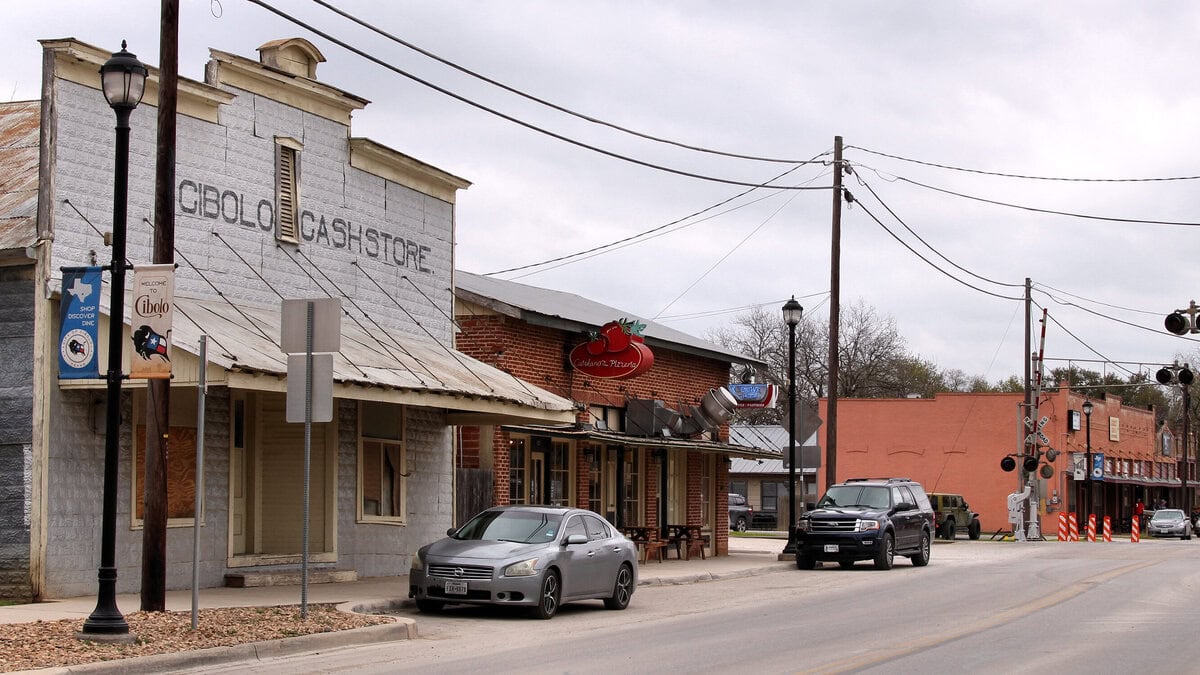
Main Street and the railroad tracks are the part of Cibolo that still reads as a small Texas town rather than a newer suburb.
The older commercial buildings, City Hall area, 1916 former schoolhouse, and the tracks give this pocket a physical identity that the subdivision corridors do not have.
It is not a large downtown, and most residents do not live within an easy walk of it.
That is part of its appeal. Old Town works better as a change of pace than as the center of every daily task.
You go there for a meal, a local event, a meeting, or simply because it feels less interchangeable than a highway shopping center.
The railroad is not decorative background.
The tracks cut through the old core, and current planning still has to deal with crossings and pedestrian access.
You notice the contrast within a few minutes: brick storefronts and older streets around Main, then newer residential roads and wider commercial corridors as you move away.
The city has grown fast without erasing the place where it started.
School traffic is part of the clock, even if you do not have kids
More than one in four Cibolo residents is under 18. You do not need the Census number to notice that on a weekday afternoon.
School arrival and dismissal put a real pulse into local traffic.
Streets that are calm at 10:30 a.m. can feel completely different around pickup time, especially near neighborhood campuses and the main north-south routes.
Youth sports, practices, and school events add another layer to evenings and weekends.
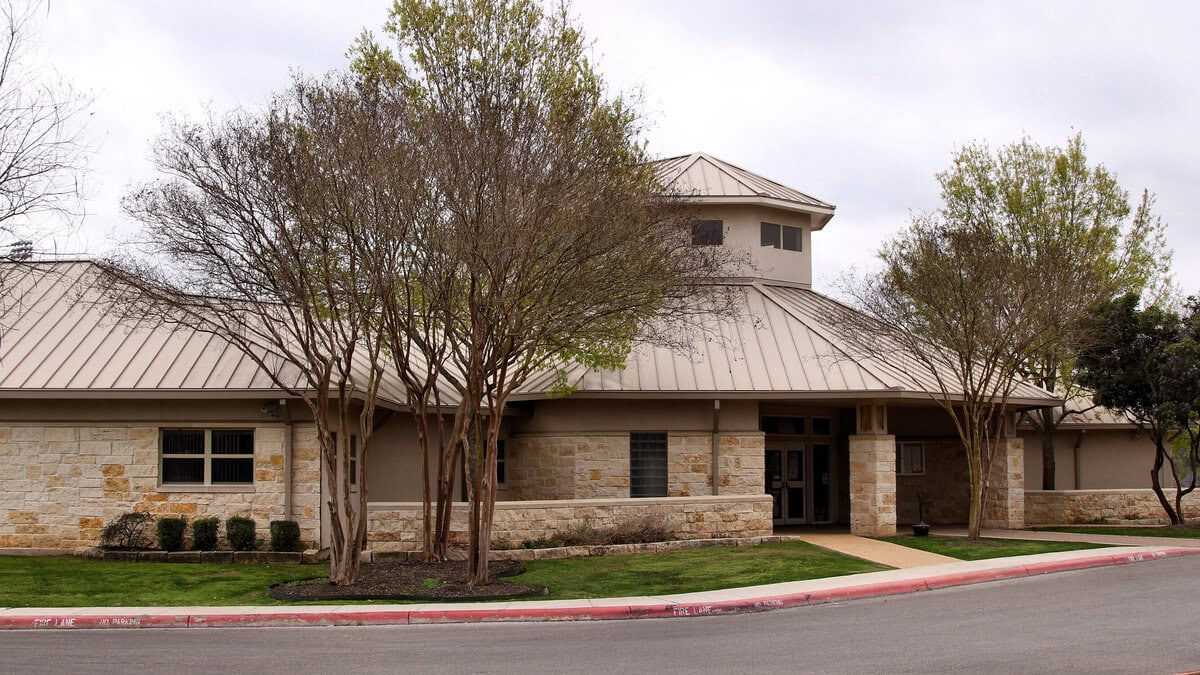
This is also why small neighborhood parks get used like everyday infrastructure rather than special destinations.
Schlather Park is the kind of place you use for a walk, playground time, or disc golf without turning it into a whole-day plan.
Veterans Memorial Park works well for a playground or basketball stop. Niemietz is the older park along FM 78.
Al Rich sits between a school and a neighborhood and feels more like a local pocket than a citywide attraction.
The scale fits Cibolo. Recreation is often close to home, casual, and built around the rest of the day's schedule.
Summer changes the hours you actually want to be outside
The calendar says evening long before the temperature agrees. Cibolo shares the hot South Texas summer pattern of the San Antonio area.
At San Antonio International, the regional climate station, the average daily high in August 2026 was 99.7 degrees Fahrenheit.
That helps explain a common summer adjustment: outdoor time moves toward early morning, later evening, shade, or water.
A park that is comfortable in March can be something you save for after dinner in July. Dog walks get earlier.
Yard work gets split into shorter sessions. The car's air conditioning stops feeling like a convenience and starts feeling like part of the routine.
The pleasant counterpoint comes in the cooler months, when the same neighborhood sidewalks and parks become much easier to use without planning around the heat.
Cibolo does not have dramatic seasonal scenery, but it does have a very real seasonal change in when people want to be outside.
Growth shows up as unfinished edges
Cibolo had 15,349 residents in 2010 and 32,276 in 2020. The July 2025 Census estimate was 39,019.
The city also expanded outward sharply during that period.
Those numbers matter because the growth is visible in ordinary places.
One stretch has mature homes and established trees; another has fresh fences, construction entrances, and new retail pads.
South of FM 78, utility and industrial expansion is changing land that still feels less built out than the north side.
Along major roads, today's improvement project often exists because yesterday's two-lane route is carrying a much larger city.
This can make Cibolo feel younger than its old core suggests. The city is not just adding houses.
It is still adding the roads, sidewalks, utility capacity, parks, and commercial spaces needed to make a larger population work.
That stage of growth has a small daily cost: traffic patterns change, streets get rehabilitated, and familiar intersections can spend months looking temporary.
At the same time, more errands that once required leaving Cibolo can now happen close to home.
Weekends are usually local, but not confined to city limits
Cibolo is easy to overstate in either direction. It is not a sleepy rural town anymore, but it is also not a self-contained urban center.
A normal Saturday can stay very close to home: grocery run on FM 1103, a park, a youth game, lunch or dinner around Old Town, then a movie at Cibolo Crossing.
If you want more shopping, a larger restaurant pool, or a bigger event, Schertz and the rest of the northeast San Antonio corridor are already part of the practical map.
That is the most accurate way to describe living here.
Cibolo gives you quieter residential streets and a recognizable old core, but everyday life is tied to a wider northeast San Antonio network.
The local knowledge is practical: which roads matter, which hours are easy, when the heat changes your plans, and when Schertz is simply the shortest way to get something done.
Cibolo feels most like itself in those small adjustments: FM 1103 at the wrong time changing your afternoon, Old Town giving you a reason to slow down, and new road work reminding you that the city is still building for the population it already has.
Those details tell you more about daily life than any tidy relocation checklist.
Sources and further reading
- U.S. Census Bureau QuickFacts: Cibolo city, Texas
- U.S. Census Bureau ACS commuting characteristics for Cibolo
- NOAA/NCEI 1991-2020 monthly climate normals for San Antonio International Airport
- National Weather Service August 2026 climate report for San Antonio
Independent Publisher Notice
BestAttractions is an independent editorial publisher. We are not affiliated with, endorsed by, or acting on behalf of any location, business, property owner, manager, government agency, or organization described in this article. Comments posted on this page are not forwarded to, reviewed by, or acted upon by any entity mentioned in the article. For official inquiries, complaints, applications, bookings, or other requests, please contact the relevant entity directly through its official website or other verified channels.