
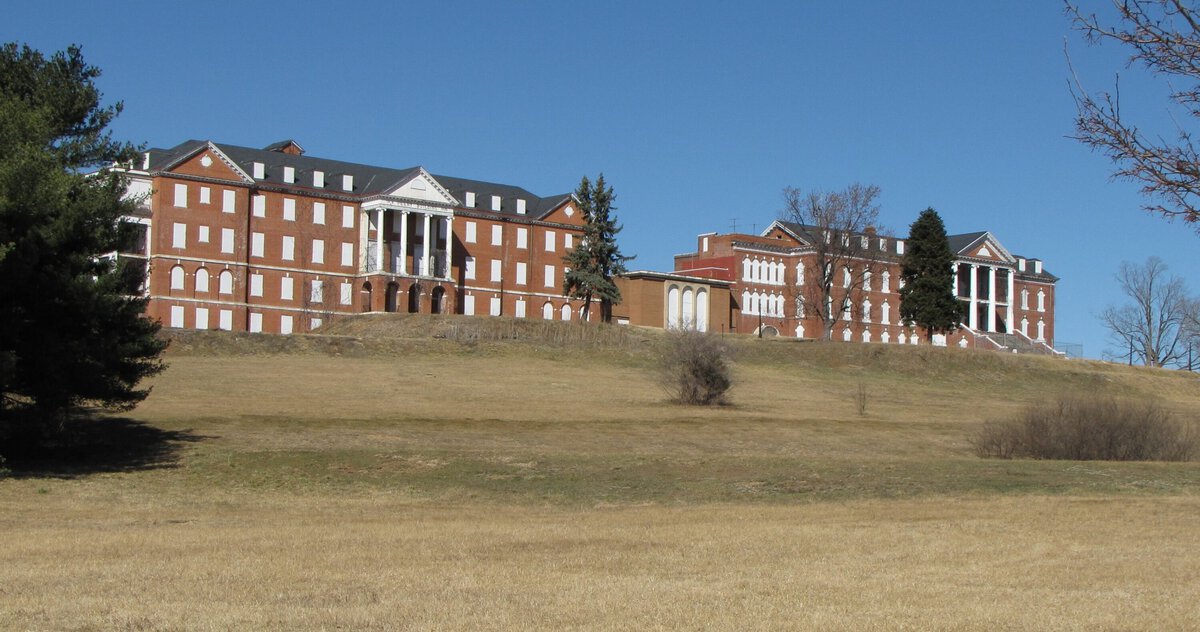
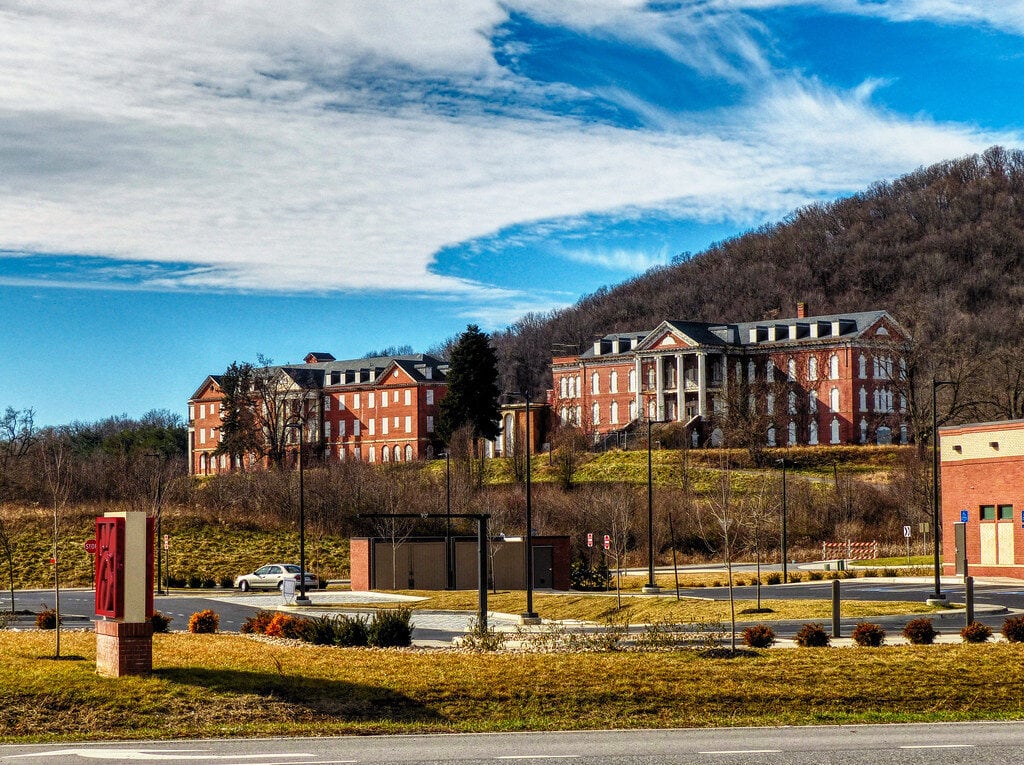
DeJarnette Sanitarium is a former psychiatric hospital on a hill above Richmond Avenue in Staunton, Virginia.
It opened in 1932 as the special-pay unit of Western State Hospital, a residential hospital for adults who could pay. Its grounds later included tennis courts and a golf course.
It was named for Joseph Spencer DeJarnette, who ran Western State and who sterilized 33 women and 60 men, plus five by X-ray exposure, by 1930 and testified for the state in Buck v. Bell.
The hospital outlived him by decades. It turned into a children's center in 1975, closed its old campus in 1996, and lost his name in 2001.
The building that opened as a hospital for paying adults now sits boarded at 1290 Richmond Avenue.
The property is tied to the American Frontier Culture Foundation and the Frontier Culture Museum of Virginia.
No public final plan has been announced for what happens to it.
DeJarnette Sanitarium opened as a hospital for adults who could pay
In 1932, a red-brick building opened on high ground above Richmond Avenue in Staunton, Virginia, and began taking in adults who could pay for psychiatric care.
It was the special-pay unit of Western State Hospital, built so middle-income patients could be treated apart from the main hospital population.
The man it was named for ran Western State, and his eugenics record would later make the name too toxic to keep.
The spot next to Western State did the work: it tied the new hospital to the institution DeJarnette already ran while keeping paying adults apart from the state hospital.
The setup was residential, with tennis courts and a golf course on the grounds.
These patients paid.
The superintendent whose name became a liability
Joseph Spencer DeJarnette was born in Spotsylvania County in 1866, graduated from the Medical College of Virginia in 1888, and joined the Western Lunatic Asylum in Staunton the next year.
He became its superintendent in 1906.
Some of what he did matched the reform thinking of his era.
He banned physical restraints, unlocked many patient rooms, pushed for gentler treatment than the old custodial asylum, and shaped several of the buildings.
That record sits beside another. DeJarnette was central to Virginia's eugenics program.
In 1908 he recommended the state restrict marriage for people he labeled insane, alcoholic, epileptic, syphilitic, tubercular, or feebleminded.
Virginia passed its sterilization law in 1924, and DeJarnette testified for the state in Buck v.
Bell, the case the U.S. Supreme Court used to uphold the law on May 2, 1927.
By May 1930 he had sterilized 33 women by tubal ligation and 60 men by vasectomy, plus five by X-ray exposure, and he wanted the system doing hundreds a year.
In the 1930s he praised Germany's far larger program in public and complained that Virginia was moving too slowly.
How long the program lasted
By 1980, about 8,300 Virginians had been sterilized through Virginia's program, part of roughly 60,000 across the United States.
The General Assembly denounced the program in 2001, and DeJarnette's name came off the children's hospital that carried it.
The building he opened kept running after the law was gone, until the old campus closed in 1996.
DeJarnette Sanitarium kept itself afloat under a shifting name
DeJarnette Sanitarium lived on patient payments rather than state funding, and stayed self-supporting until 1975.
The adult population included people in psychiatric treatment and people dealing with alcoholism or drug addiction.
The name kept changing. In 1934 the General Assembly renamed it DeJarnette State Sanatorium.
In 1946, special legislation separated it from Western State to run as an independent sanatorium.
DeJarnette's own exit was rough.
In 1943 he was criticized before the State Hospital Board over his management and the condition of Western State, and that November he was removed as superintendent.
He kept running the sanatorium that bore his name until 1947, and lived out his last years in Staunton, where his life ended in 1957.
Georgian brick that grew one wing at a time
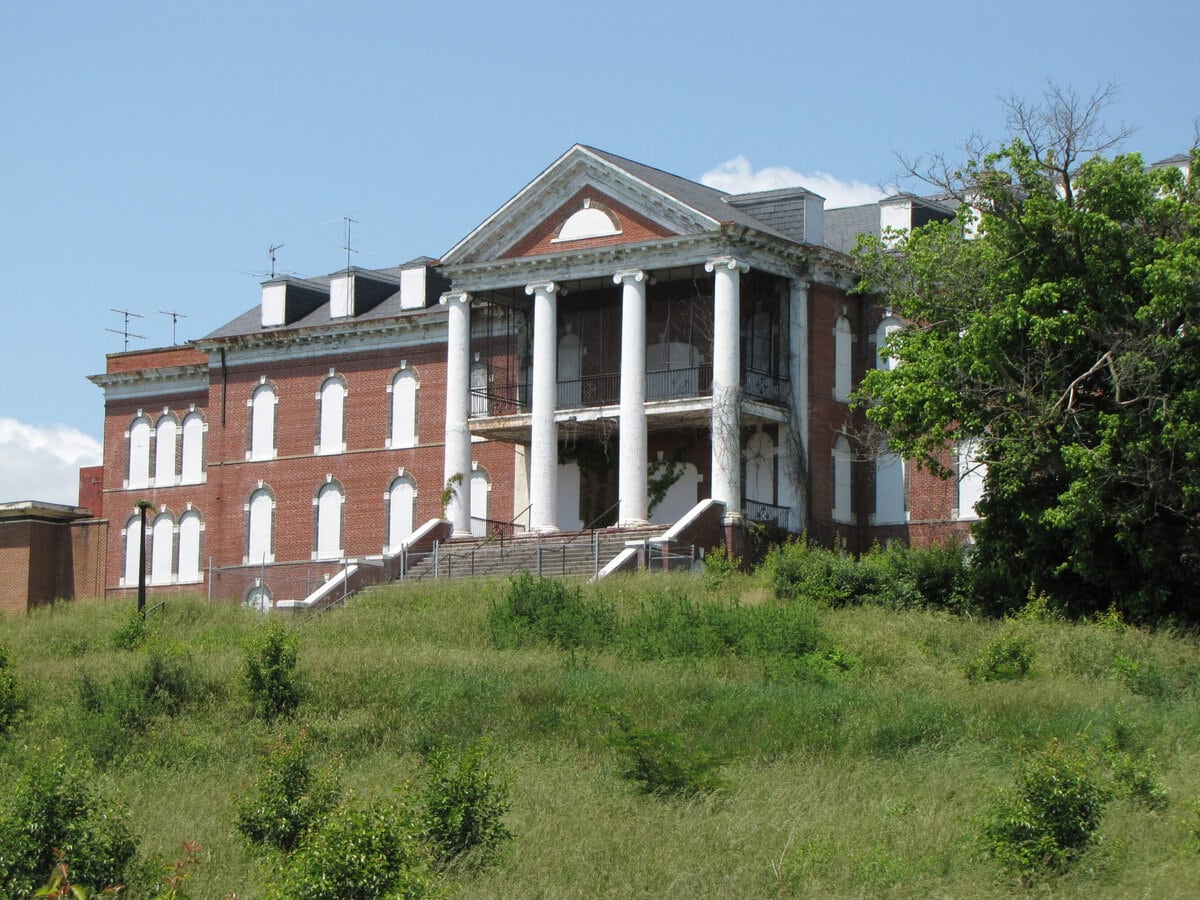
The campus was a red-brick complex with Georgian Revival touches: symmetrical fronts, formal entrances, separate blocks later connected.
The Peery Building went up on the south side in 1938, and the adult sanatorium eventually held 171 beds.
Behind the main structures sat a brick laundry and power-plant building.
A later one-story brick-and-concrete connector tied the 1932 main building and the Peery Building into one complex.
When the adults moved out and the children moved in
The sharpest turn came in the 1970s.
A state commission recommended in 1972 that DeJarnette be used for children and youth with severe behavioral disorders.
The first full year as a children's facility was 1975, when the renamed DeJarnette Center for Human Development got a special appropriation for a 65-bed weekday residential program and a 35-student day-student program.
Patients over 21 were moved out, with secondary histories placing them at Western State's newer campus near Richmond Road.
The name on the hilltop stayed, but the work inside was now a state-run psychiatric center for children and adolescents instead of a semi-private adult sanatorium.
The early program sent kids home on weekends, to parents or therapeutic foster homes.
A center that kept taking on more
The children's center didn't stay small.
In 1981 it ran its first year-round, seven-day program and took its first emergency admissions.
In 1982 the 15-bed Adolescent Unit from Western State transferred over with 22 staff, turning the hilltop into a fuller child and adolescent center.
A concrete above-ground pool went in too, but later accounts are thin on exactly when it closed and why.
Accreditation came in 1985, the center's first from the Joint Commission, and planning for a replacement started the same year.
In 1989 a 13-bed unit for children with autistic disorders moved to the Southeastern Virginia Training Center, and DeJarnette turned those into 14 adolescent beds.
Then the money got tight.
In 1990, economic pressure forced support services to share with Western State, cut 29 jobs, and imposed a 22 percent budget reduction.
A 1992 bond referendum approved $7.2 million for a replacement, and by 1994 the old site was marked as future surplus land.
The land was surplus before the new building existed
State planning treated the hilltop as future surplus while it was still in use.
In 1994 the site was listed as a 41-acre tract valued at roughly $2.05 million.
The replacement opened in 1996 as a 48-bed children's psychiatric hospital near Western State, and the old campus closed the same year.
In 1999 the new building took on adolescents and families from Central State Hospital's adolescent unit after it closed.
The old buildings got nothing. No new tenant moved into the 1932 and 1938 structures.
They were large, deteriorating, easy to see from the road, and attached to a history the state had begun trying to distance itself from.
Taking the name off the door
In 2001 the name came off the active children's hospital: the state board overseeing mental health voted to change it from DeJarnette Center for Human Development to Commonwealth Center for Children and Adolescents.
That happened inside a larger reckoning.
In February 2001 the General Assembly adopted House Joint Resolution No.
607, which expressed regret for Virginia's eugenics experience, called the movement discredited, and recognized the harm state-backed sterilization had caused.
The 1924 law had allowed involuntary procedures on people labeled "insane," "idiotic," "imbecile," "feebleminded," or epileptic; it was repealed in 1974, though other state authority for most involuntary sterilization remained until 1979.
Virginia went further later, building a compensation program for living survivors of the sterilizations.
The 2015 Appropriation Act carried the funding; eligibility required involuntary sterilization under the 1924 law, being alive as of February 1, 2015, and having been sterilized at one of the named institutions, Western State Hospital in Staunton among them.
How the DeJarnette site landed in the museum's orbit
After the 1996 move, the land left hospital use and eventually landed in the Frontier Culture Museum's orbit, treated by 2021 as foundation property with a possible sale or lease under discussion.
The parcel sits at 1290 Richmond Avenue, 43.1 acres, tied to the American Frontier Culture Foundation and the museum's property history.
The address is also U.S. Route 250, a commercial corridor east of downtown with hotels, restaurants, and medical facilities nearby.
In 2024 it had a "For Sale" sign that drew enough interest to become a local topic.
The foundation has said it wants development compatible with the museum, a campus built around public history, education, and tourism, rather than just any use an empty highway parcel might draw.
Demolition keeps getting proposed and not happening
People have wanted to knock the place down for a long time.
A 2004 plan called for demolishing the original buildings for a shopping center and parking, but collapsed because the tenants weren't there.
Demolition and commercial reuse stayed in the local conversation, and nothing got built.
There's a preservation argument on the other side, because the building is large, distinctive, and tied to the history of Virginia psychiatry and eugenics.
It runs into hard problems: the physical condition is poor and the public memory is bad.
Reuse would mean dealing with deterioration, the environmental hazards old institutional buildings tend to carry, access, liability, cost, and the question of how you interpret a site with this past.
The recent timeline is a string of near-misses.
By 2021 it came up in closed session for a possible sale or lease to a business or industry.
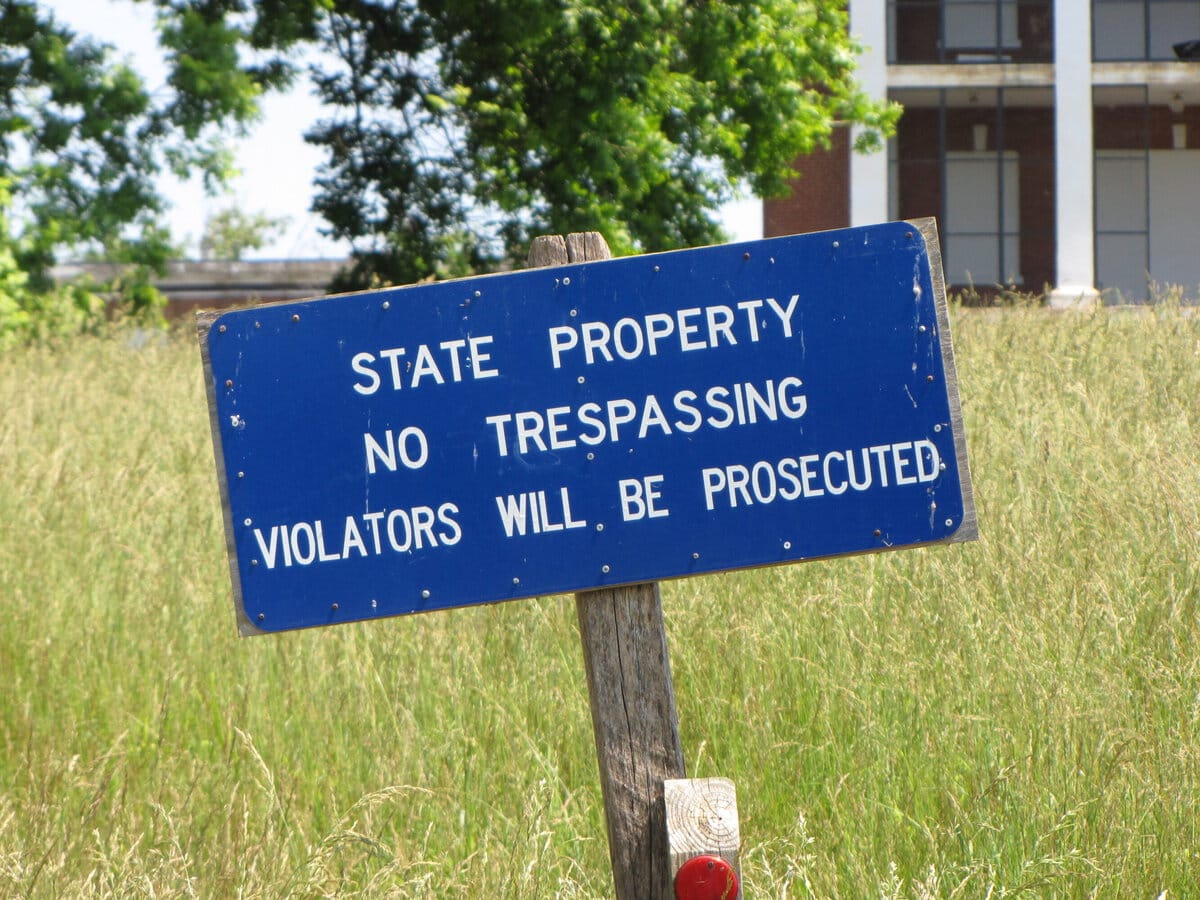
By 2024 the grounds had been cleared for prospective business partners, and trustees were pushing to secure the property with no-trespassing signs.
In 2025 the discussion turned toward something compatible with the museum, and some of those ideas still meant tearing the old buildings down.
Signs, brush, and people trying to get in
For years the hilltop has pulled in urban explorers and trespassers, drawn by its size and visibility.
In early 2025 the foundation cleared the brush around the lot to make it more visible from the main road and posted large no-trespassing signs on the old building.
The work answered a real problem: people trying to get inside, and others camping in the overgrowth overnight.
Public board materials from 2025 show the property still in motion.
In May, the Foundation said it was meeting with potential buyers.
In September, it extended a DeJarnette-property contract through December and noted another interested developer.
In October, the Foundation president said he was working with several potential development companies.
Those records did not announce a completed sale, demolition date, construction start, or final plan.
Up the road, the child psychiatric work DeJarnette took on in 1975 still goes on, in a different building under a different name.
The Commonwealth Center for Children and Adolescents runs out of the 1996 facility, with four 12-bed living units on a single-story floor plan, education and recreation space, and an acute mission for children admitted in crisis after a community services board prescreening.
The old complex on the hill, the one that started as a hospital for paying adults and spent two decades as a children's center, sits at 1290 Richmond Avenue, boarded and posted, waiting on a decision no one has managed to make.
Independent Publisher Notice
BestAttractions is an independent editorial publisher. We are not affiliated with, endorsed by, or acting on behalf of any location, business, property owner, manager, government agency, or organization described in this article.
Comments posted on this page are not forwarded to, reviewed by, or acted upon by any entity mentioned in the article.
For official inquiries, complaints, applications, bookings, or other requests, please contact the relevant entity directly through its official website or other verified channels.
In the late fifties, I remember that Dejarnettes was where the wealthy prominent people of the area went to dry out
Also do you have information on what we called “the poor house” located on Rockfish Rd in Staunton?
Thank you for sharing your memories of the DeJarnette Sanitarium and its role in the 1950s. As for the "poor house" on Rockfish Rd, I regret that I don't currently have enough information to compose an article about it.
When I was in school in the 90s they sent the trouble maker students here. They would flip out if they had to go back a second time
Thank you for sharing your experience! It's fascinating to learn how the DeJarnette Sanitarium was utilized during that time. It must have been quite an effective deterrent for misbehaving students.
😊
Remember that “none’ is a singular word. Always a teacher.
I'll try to argue against it. In the sentence "Though various plans for its demolition and redevelopment have been proposed, none have come to fruition," the auxiliary verb "to have" is appropriate.
The sentence's subject, "various plans," is plural in nature, signifying multiple instances of proposed demolition and redevelopment schemes. Therefore, the subject-verb agreement requires using "have" when referring to a plural subject. Conversely, "has" would be employed if the subject were singular.
#Facts
I was a patient there in 1986 for a month. I hated it... however I found that the staff all were nice enough. they did keep a lot of the patients medicated so they were out of it a lot. It was a difficult time in my life at 16...wouldn't wish it on anyone. Glad mental health practices have changed!
Thank you for sharing your personal experience as a patient at DeJarnette Sanitarium in 1986. I'm glad the staff were kind during your stay, as compassionate care is essential in mental health settings. Your reply adds a valuable layer to the overall narrative about the sanitarium.
My Mother was incarcerated there from 1949 to 1960. She was sterilized. I don't know what her analysis was, but when she came home she was irreversibly screwed up
I'm so sorry your family went through that. The sterilization program left deep scars on thousands of people, and its effects still echo through families like yours. Thank you for sharing this truth.
Have you considered turning it into a no rent homeless shelter where residents would pay their own share of the electric,heat,a/c and water?
A no-rent shelter could give the building a humane purpose, but shared utility payments would cover only part of what such a conversion would require. The abandoned structure would still need extensive work before it could legally and safely house residents.