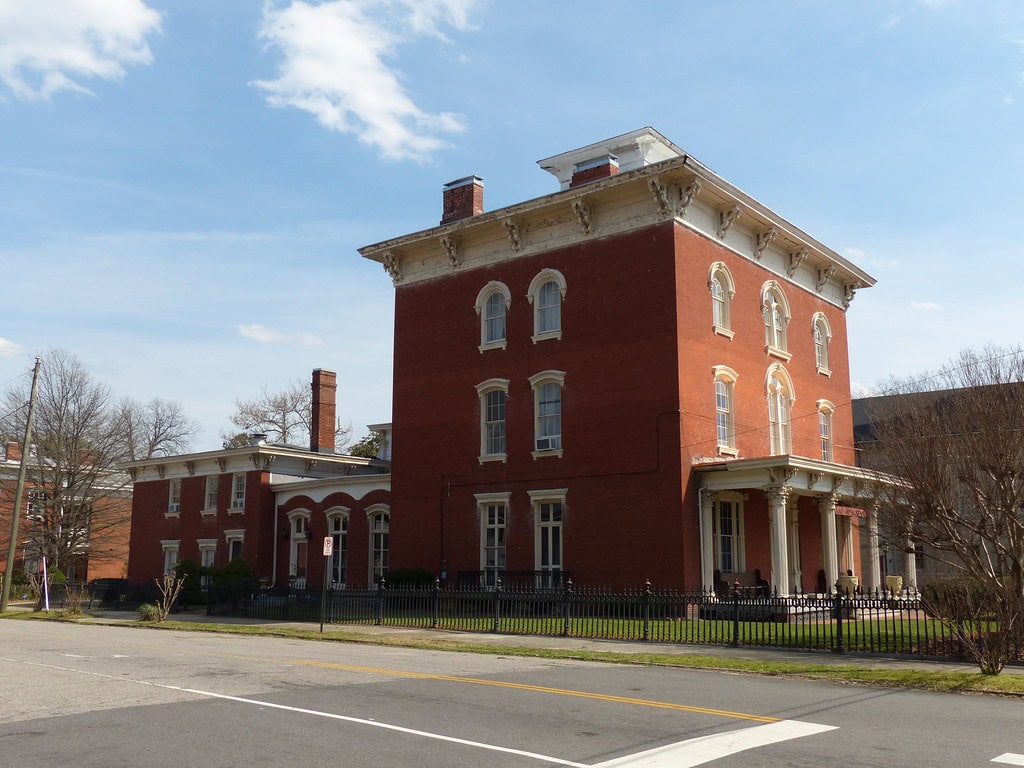
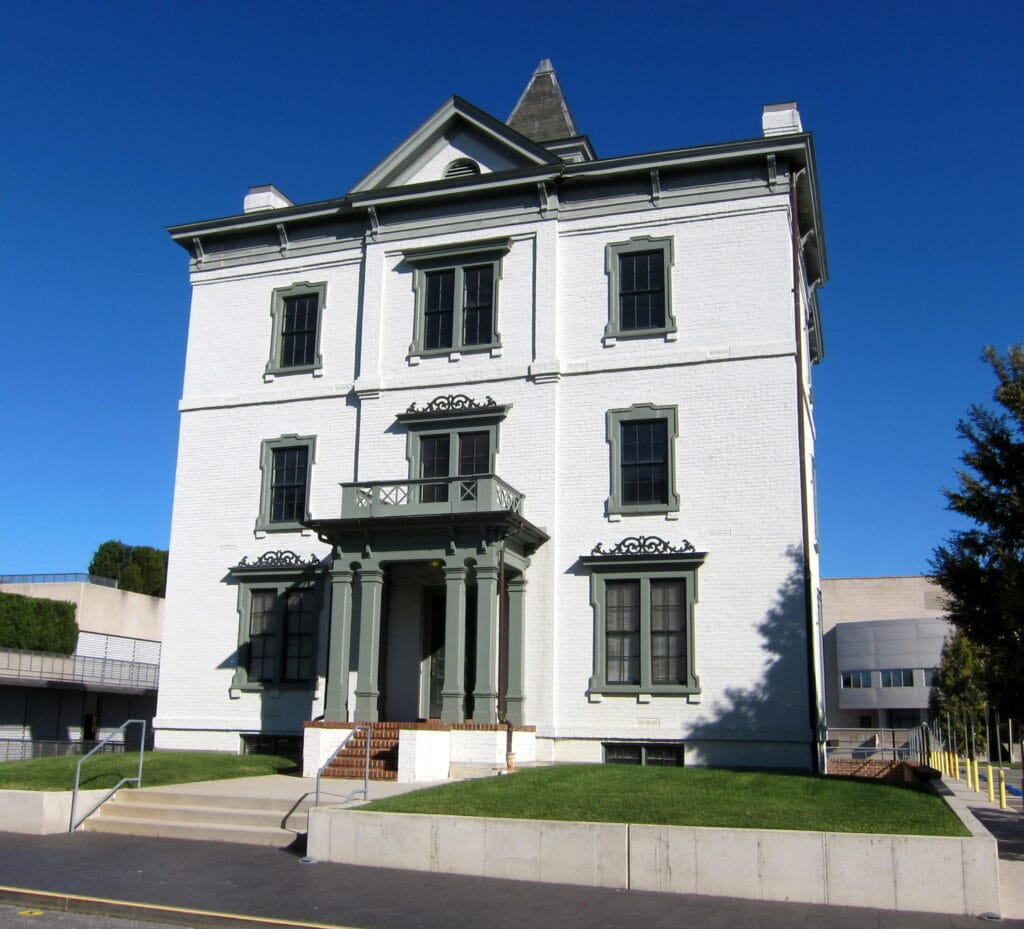
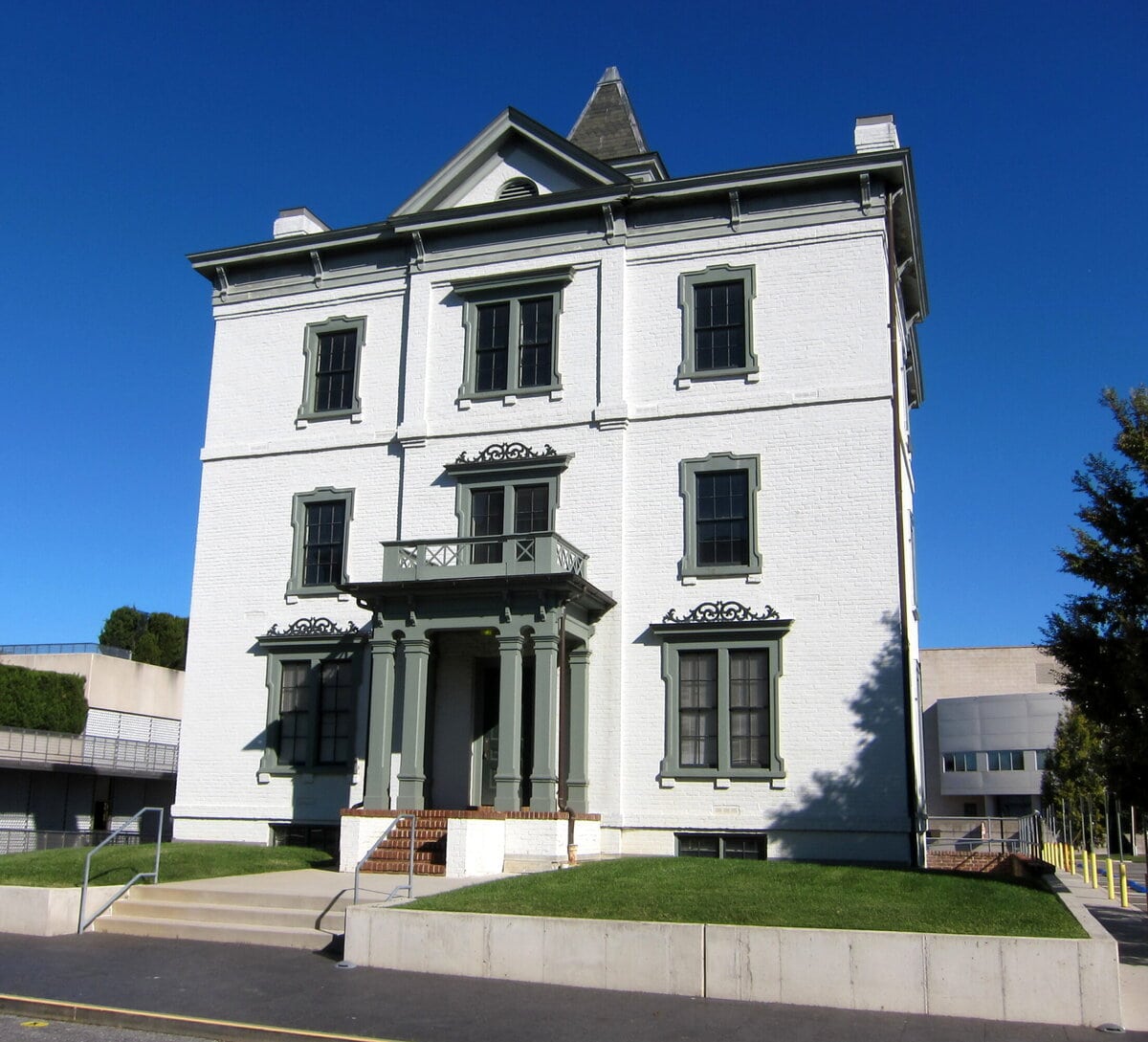
There is a brick building at 200 North Arthur Ashe Boulevard that most people driving past probably mistake for a side entrance to the museum.
Three stories, Italianate trim, a peculiar little belvedere poking up from the roofline - it looks important in the way that old Richmond, Virginia buildings often do, serious without quite explaining why.
The Robinson House is a good deal stranger than it appears. In the span of its nearly two-century life, it has been a summer house and a full-time mansion.
It has also been the front office of a Confederate veterans' campus that housed thousands of old soldiers, a Cold War laboratory, an art studio annex, and a storage room.
Finally - after a major renovation finished in 2019 - it became a free public history museum and tourism center.
That is a lot of lives for one building to accumulate, and the remarkable thing is that physical evidence of most of them is still in the walls.
It takes its name from Anthony Robinson Jr., the Richmond banker who first put it up in the late 1820s. His family lived here until 1884.
The Confederate veterans who moved in renamed it Fleming Hall, after the architect who added the third floor and funded the work himself.
Then the Commonwealth called it the Robinson House again, and the name stuck. The building now sits on the Virginia Museum of Fine Arts campus and has been on the National Register of Historic Places since 2013.
It is one of the oldest structures in this part of Richmond, and one of the most layered.
A Banker Builds His Country Estate: The Grove
Anthony Robinson Jr. was born in 1792 and worked as an officer at the Bank of Virginia. Over about twenty years, he bought land northwest of downtown Richmond until he had put together an estate of 160 acres.
He named the estate The Grove because old trees shaded the property. The name stayed in use, and it still appears today in Grove Avenue and Robinson Street.
Around 1828, he built the first house there. It was a one-story summer cottage, meant as a place for the family to get away from the city's heat during the warm months, not as a permanent home.
But the family kept growing and eventually had eleven children. During the 1850s, he and his wife, Rebecca Webb Couch Robinson, enlarged the house into a full two-story Italian Villa.
At that point, they chose to sell their townhouse in Richmond and live at The Grove all year.
The move was finished by 1860. The estate presented an image of wealth and success.
The Italian Villa style had become popular in the 1840s and 1850s through the work of architectural writer Andrew J. Downing, and it matched what a prosperous Virginia family of that time was expected to want.
But maintaining 160 acres took a great deal of labor, and that labor came from enslaved people. People lived in cabins on the property.
They worked in the fields and in the house, and some tried to escape. The formal entrance to the estate stood roughly where the VMFA loading docks are today.
The grove of trees around it is gone.
War Comes to The Grove, Then the Silence After
Anthony Robinson Jr. died on June 28, 1861, two months into the Civil War, at 69. He left Rebecca 48 acres and the house.
Their sons, Samuel, Starkey, and Edward, joined the Confederate army. A fourth son, Channing, had an arm that was not formed correctly, which kept him from fighting.
He spent the war working as a clerk for the War Department and taking care of his mother.
Rebecca Robinson was not easy to categorize. She came from a Philadelphia-connected Quaker family that had freed their own enslaved people - yet she had kept enslaved workers at The Grove for close to four decades.
When the war finally ended in April 1865, she invited Union officers into the house to deter soldiers camped nearby from looting the place.
It was a practical decision, and it probably worked.
The war had left the family nearly broke. Rebecca died on July 4, 1879, leaving The Grove to Channing.
He married in 1883 and the following year sold the remaining 36 acres and the house to the R. E. Lee Camp, No. 1, a Confederate veterans' organization in Richmond, for $14,000. Sixty years of Robinson ownership ended with that transaction.
Whatever The Grove had once meant to that family, whether it was a farm, a safe place, something passed down, or a heavy responsibility during the war, it was not any of those things anymore.
A Veterans' Campus Grows Up Around the Old House
When the directors of the R. E. Lee Camp bought The Grove, they had a clear purpose.
They wanted to create a home for Confederate veterans who were poor or disabled and had no family able to care for them.
Donations for the project also came from Northern chapters of the Grand Army of the Republic. This was a small sign of national reconciliation, but it did not resolve the deeper divisions it covered over.
The Confederate Soldiers' Home opened on January 16, 1885, with a few residents.
Within a few years, it had grown into a campus with more than 30 buildings, including cottages, a chapel, a mess hall, and a hospital.
Much of the campus was designed by Marion J. Dimmock, an architect who had served in the Confederate army.
At its largest, the campus housed 300 men at one time. Over 56 years of operation, about 3,000 veterans from 33 states lived there at some point.
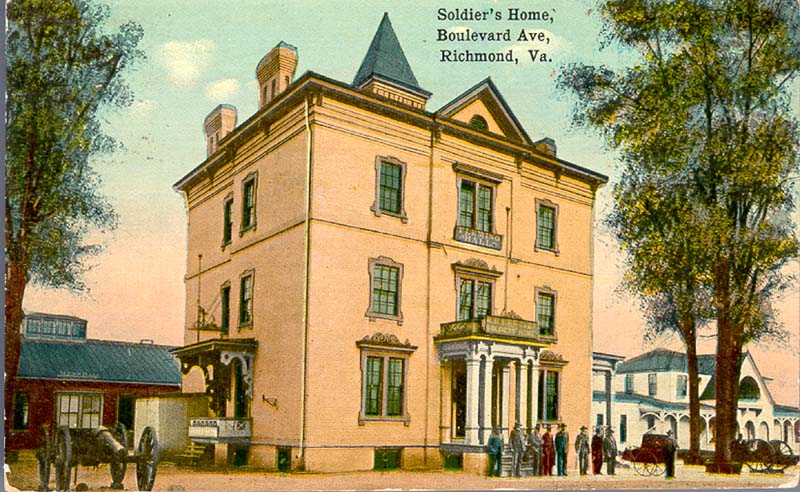
The Robinson house itself was significantly enlarged in 1886. Architect Robert I. Fleming paid for the work himself, added a third floor, and placed a pyramidal belvedere on top.
The building was then renamed Fleming Hall and became the administrative center of the campus.
It held offices, a library, a war museum, and, when necessary, an infirmary. It was the right place for former Confederates to live out their remaining years.
At its busiest, the campus operated much like a small city with its own facilities.
Stonewall Jackson's Horse and the Museum Years
Fleming Hall's war museum contained an exhibit that attracted a great deal of attention: the preserved remains of Little Sorrell, the horse Stonewall Jackson rode through most of his military campaigns.
Little Sorrell died in 1886, the same year Robert I. Fleming's renovation was finished.
After that, the mounted horse was placed on display in the building, where it remained for decades alongside veterans who had served and fought with Jackson's army.
Virginia began providing financial support to the Soldiers' Home in 1886. In 1934, the state officially named the property Confederate Memorial Park.
By that time, the campus had grown into something beyond a shelter for elderly veterans.
It had become less a place to live and more a memorial site. People visited to see and physically connect with surviving objects tied to the Confederacy.
The last resident, John "Jack" Blizzard, died on January 29, 1941, and the home then closed.
Fleming Hall stayed open for a few more years as the R. E. Lee Camp Museum, until the collection was broken up in 1948.
The United Daughters of the Confederacy received most of the items, and Little Sorrell was sent to the Virginia Military Institute, where the mounted horse is still on display today.
The 56-year Confederate period left visible changes in the building itself: the third floor, the belvedere, and the name Fleming Hall.
All of those remain if you know where to find them. The house Anthony Robinson had built was now much taller than when he left it.

Nobody Knew Quite What to Do With It
After 1941, the Virginia state government took over the building. For the next fifty years, it passed from one tenant to another.
From 1949 to 1963, the Virginia Institute for Scientific Research used it for Cold War-era laboratories in rooms where veterans had once slept and recovered.
After the institute moved out, the Virginia Museum of Fine Arts - which took formal control of the building in 1993 - used it for offices, studios, galleries, and art classes.
Between 1995 and 1996, the building was briefly used by the Virginia Association of Museums. After that, it stopped changing hands.
In 2001, state funding paid for a new roof, new windows, and basic maintenance. But no major interior renovation followed.
For nearly twenty years, the building remained in a kind of in-between state while the VMFA campus changed around it.
It was the oldest structure on the grounds and the one most often overlooked.
The 2019 Reopening Gives the Building New Meaning
The Virginia Museum of Fine Arts brought in Glavé & Holmes Architecture to lead the rehabilitation, which ran from 2017 to 2019.
Principal architect Steven Blashfield mapped the interior carefully to identify what had survived intact - most of the original first-floor fabric was still there, including the mantelpieces and the historic staircase, both of which were kept in place.
The mechanical systems were replaced with care taken to limit the impact on the historic interior.
A 3,200-square-foot addition went up at the back of the building, containing an elevator, a stairway, and three floors of glass-enclosed porches that step down off the rear of the structure and reconnect to the original house.
The addition also solved a problem left by a 2010 VMFA expansion that had lowered the surrounding grade and left the building sitting awkwardly high.
The Robinson House reopened on February 15, 2019. The first floor now holds the Richmond Region Tourism Center.
A permanent 600-square-foot exhibition called "Across Time: Robinson House, Its Land and People" covers the building's full history - native peoples, the Robinson family and their enslaved workers, the Confederate veterans, the Cold War scientists, and the present.
Walk in on any day of the week, and you will find it open, no admission charged, the old brick exterior still giving nothing away to passing traffic on the boulevard outside.