Richmond is easiest to enjoy when you do not treat it as a checklist of museums. A strong first visit mixes three things the city does especially well: a major cultural attraction, time along the James River, and a historic site that puts Virginia's capital in context.
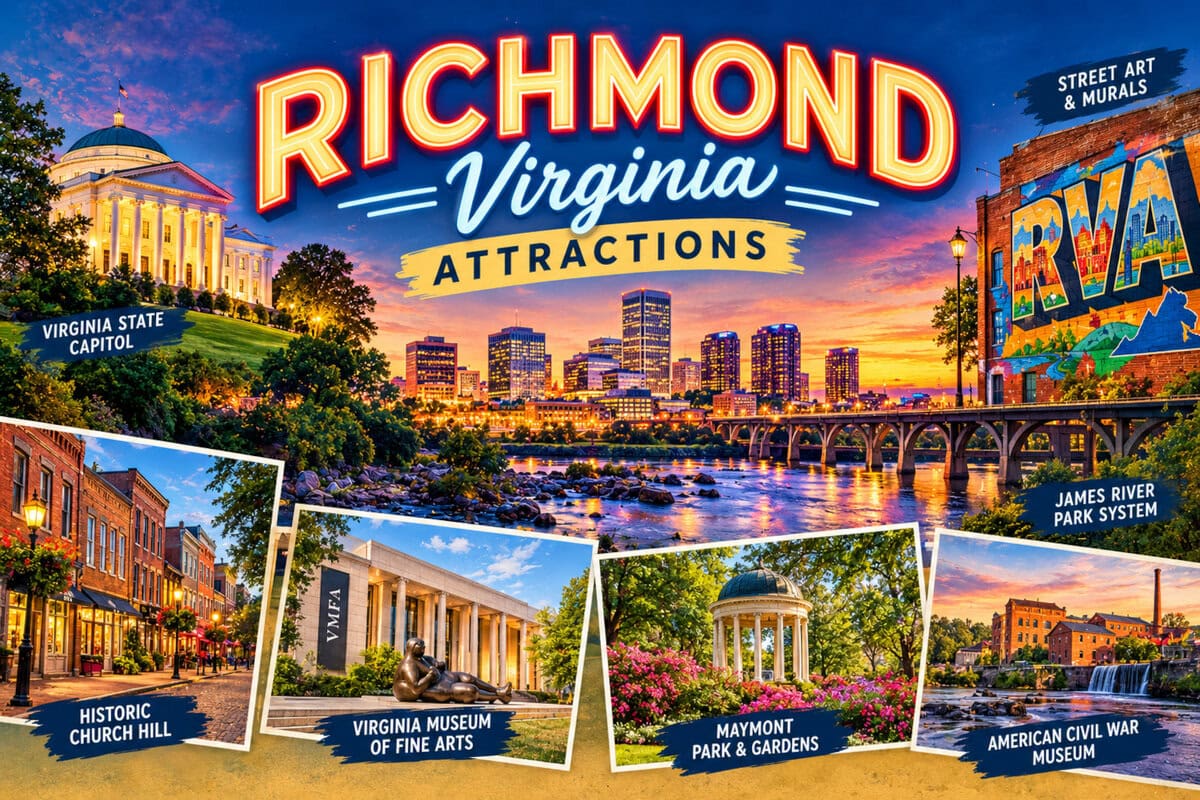
For most visitors, the best starting points are the Virginia Museum of Fine Arts, Maymont, the James River riverfront, the Virginia State Capitol, and Lewis Ginter Botanical Garden.
Families should also look hard at the Science Museum of Virginia, while history-focused travelers can spend much of a day around Historic Tredegar, the Capitol, Shockoe, and the Poe Museum.
This guide is current for August 2026. One detail matters right now: Brown's Island is closed for construction, so part of the downtown riverfront works differently than older guides and maps may suggest.
Richmond attractions at a glance
| Attraction | Best for | Cost pattern | Good visit length |
|---|---|---|---|
| Virginia Museum of Fine Arts | Art, rainy days, first visits | Free general admission; some exhibitions cost extra | 2-4 hours |
| Maymont | Gardens, families, history, easy outdoor time | Grounds are free; some indoor experiences are ticketed | 2-4 hours |
| James River Park System and Belle Isle | Walking, views, active travelers | Free | 1-3 hours |
| Virginia State Capitol | Architecture, government, Virginia history | Free | 1-2 hours |
| Lewis Ginter Botanical Garden | Gardens, photography, families | Paid admission | 2-3 hours |
| American Civil War Museum at Historic Tredegar | Civil War and Reconstruction history | Paid admission | 1.5-3 hours |
| Science Museum of Virginia | Families, STEM, rainy days | Paid admission | 2-4 hours |
| Poe Museum | Literature, unusual small museums | Paid admission | 1-2 hours |
| Hollywood Cemetery | History, architecture, walking | Free | 1-2 hours |
| Virginia Museum of History & Culture | Broad Virginia history | Paid admission | 1.5-3 hours |
| Riverfront Canal Walk | Downtown history and a short walk | Free | 45-90 minutes |
| Carytown | Shops, food, an easy evening | Free to explore | 1-3 hours |
The visit-length estimates are planning ranges, not official time limits.
1. Virginia Museum of Fine Arts
The Virginia Museum of Fine Arts is the safest all-around recommendation for a first visit to Richmond.
General admission is free, the museum is open every day, and its permanent collection is broad enough that you can make the visit as short or as long as your schedule allows.
The museum is especially useful on hot, rainy, or cold days because it can carry a large part of an itinerary by itself.
If you only have an hour, focus on two or three galleries rather than trying to cover the building.
If you have half a day, add the sculpture garden and a meal break.
As of August 2026, VMFA is open 10 a.m.-5 p.m. daily, with hours extended to 9 p.m. Wednesday through Friday.
Special exhibitions can require paid tickets even though general admission is free.
Choose VMFA if: you want one high-quality attraction with almost no planning risk, especially if weather is uncertain.
2. Maymont
Maymont works because it is several attractions in one 100-acre estate: formal gardens, walking paths, a Gilded Age mansion, farm animals, native wildlife, and the Robins Nature Center.
The grounds are the key advantage. You can visit without committing to a museum ticket, then decide whether to add an indoor experience.
The estate is also more physically demanding than a typical museum visit because the property is hilly and spread out.
Trying to see the mansion, Japanese Garden, farm, wildlife areas, and nature center in one quick loop usually turns into more walking than expected.
Maymont is particularly worth reconsidering if you visited Richmond a few years ago.
The mansion reopened in spring 2026 after a major preservation project, and the Virginia Wildlife Trail also reopened with updated paths and habitats.
The grounds are open daily. Current posted hours are 10 a.m.-7 p.m. from April through October and 10 a.m.-5 p.m. from November through March.
The grounds are free; mansion and nature-center schedules and tickets are separate.
Choose Maymont if: your group has mixed interests and you want outdoor time without giving up history or family activities.
3. James River Park System and Belle Isle
The James River is not background scenery in Richmond.
The city has a 600-acre river park system with more than 20 miles of trails, and Belle Isle gives visitors one of the easiest ways to get close to the river near downtown.
For a casual visit, think of Belle Isle as a walking and river-view stop rather than a swimming destination.
The rocks can look inviting in warm weather, but the river is moving water and conditions change.
Richmond's park guidance says people using watercraft should wear or carry a personal flotation device when the river reaches 5 feet, and only expert paddlers should use the river at 9 feet or above.
The park system is open from sunrise to sunset. If you want a low-effort outing, walk part of Belle Isle and return.
If you want a more active half day, combine Belle Isle with the North Bank or Buttermilk trails.
Choose the James River if: you want the attraction that feels most different from a standard state-capital sightseeing day.
A 2026 riverfront note: Brown's Island is closed
Brown's Island is normally one of the main connectors between downtown attractions and the river.
It is temporarily closed during a major improvement project.
As of August 2026, the closure is still in effect.
Venture Richmond says the island is planned to reopen temporarily for the Richmond Folk Festival on October 9-11, 2026, with full project completion anticipated in early 2027.
The Canal Walk remains usable, but the Brown's Island section has a detour along Tredegar Street to the Haxall Point Bridge.
The T. Tyler Potterfield Memorial Bridge generally remains open and is reached from Tredegar Street during construction.
This is worth checking before you leave your hotel because many older walking routes assume you can cross Brown's Island normally.
4. Virginia State Capitol and Capitol Square
The Virginia State Capitol gives you a large return for a relatively short stop.
The building is still an active seat of government, but visitors can take free guided or self-guided tours.
Free guided tours generally run Monday through Saturday, with the last tour starting at 4 p.m. Sunday tours begin at 1 p.m., also with the last tour at 4 p.m. Visitors enter through the Capitol's Bank Street entrance and pass through security.
A guided tour is worth the hour if you care about architecture or political history.
If you mainly want to see the building and grounds, a self-guided visit can fit more easily between other downtown stops.
Capitol Square also puts you close to other historic areas, so it pairs well with Shockoe, the Canal Walk, or the Poe Museum.
Choose the Capitol if: you want a free history stop that is distinct from Richmond's Civil War museums.
5. Lewis Ginter Botanical Garden
Lewis Ginter Botanical Garden is the stronger choice than Maymont when plants, conservatory exhibits, and a more concentrated garden visit are the main reason you are going.
A major 2026 expansion opened in May.
It added new garden areas, more than seven acres of meadows planted mostly with native species, Wick Lake, an expanded conservatory, and a permanent year-round butterfly exhibit.
That last point changes the usual seasonal calculation. Visitors no longer have to time a trip around a short butterfly season.
Regular daytime hours are 9 a.m.-5 p.m., with select late Thursdays in spring through fall.
Current regular admission is $24 for adults, $20 for seniors 65+ and several eligible groups, and $14 for ages 4-17; children 3 and under are free.
Special events can have separate prices.
Choose Lewis Ginter if: gardens are a main event for your trip rather than an add-on.
Maymont or Lewis Ginter?
If you only have time for one, choose based on the experience you want.
Pick Maymont for variety: historic house, gardens, animals, walking, and a free outdoor base.
Pick Lewis Ginter for a more focused botanical visit, a conservatory, the year-round butterfly exhibit, and less need to decide among several separate attractions on one property.
Families can enjoy either.
Maymont gives children more changes of pace; Lewis Ginter is easier if the group is happy spending most of the visit around plants, gardens, and the conservatory.
6. American Civil War Museum at Historic Tredegar
Historic Tredegar is the most useful Civil War stop for visitors who want a museum rather than only monuments or preserved ground.
The museum sits at the Tredegar Iron Works site on the riverfront and covers the war through multiple perspectives, including the causes, military course, emancipation, and aftermath.
That makes it a better starting point than trying to piece the story together from scattered markers around downtown.
The Richmond Historic Tredegar site is open daily from 10 a.m.-5 p.m. Current single-site tickets range from $10 to $19 depending on visitor category.
Because it sits near the riverfront, this museum pairs naturally with the Canal Walk.
During the Brown's Island construction period, follow posted detours rather than relying on an old walking map.
Choose Historic Tredegar if: Civil War history is important to your trip and you want context before visiting other Richmond sites.
7. Science Museum of Virginia
For families, the Science Museum of Virginia is one of Richmond's most dependable indoor anchors.
Exhibits cover subjects such as space, health, electricity, and Earth science, and the Dome adds large-format science films and astronomy programming.
The museum is open 9:30 a.m.-5 p.m. daily and stays open until 8 p.m. on Fridays.
Current general admission is $19 for adults ages 13-59, $16 for seniors 60+ and children 6-12, $11 for ages 3-5, and free for children 2 and younger.
Booking online in advance currently saves $1 per ticket.
A Dome feature costs extra, so families should check the day's schedule before buying tickets rather than treating it as an automatic add-on.
Choose the Science Museum if: you need a weather-proof half day with children or teenagers.
8. Poe Museum
The Poe Museum is smaller than Richmond's major museums, which is part of its appeal.
It works well as a focused 60- to 90-minute stop for readers, literature fans, or anyone who prefers a distinctive small museum to another large institution.
The museum uses historic buildings and its Enchanted Garden to tell the story of Edgar Allan Poe's life and work. It is closed Mondays.
Current admission is $12 for adults, $10 for seniors 65+ and military visitors, $6 for ages 7-17, and free for younger children and eligible EBT/SNAP visitors.
It fits especially well with a Shockoe or downtown history day because you do not need to reserve half a day for it.
Choose the Poe Museum if: you want Richmond's most specific literary attraction.
9. Hollywood Cemetery
Hollywood Cemetery is both a working cemetery and a large historic garden cemetery overlooking the James River.
It is free to visit and can be explored on foot or by car.
The appeal is broader than famous graves.
The hills, mature trees, ironwork, monuments, and river views make it one of Richmond's better quiet outdoor stops.
If you are interested in specific people or monuments, use the cemetery map instead of wandering at random; the property covers 135 acres.
Public visiting hours are 8 a.m.-5 p.m. daily, extended to 6 p.m. during Daylight Saving Time.
Guided options are offered seasonally, while self-guided visits are available during public hours.
Remember that this is still an active cemetery. Sightseeing should remain secondary to funerals and people visiting graves.
Choose Hollywood Cemetery if: you want history outdoors without another museum ticket.
10. Virginia Museum of History & Culture
The Virginia Museum of History & Culture is a better fit than Historic Tredegar when your interest is Virginia as a whole rather than the Civil War specifically.
Its galleries cover a long sweep of the state's history, and current exhibitions add focused stories beyond the permanent material.
The museum is open daily from 10 a.m.-5 p.m. Current admission is $15 for adults, $13 for seniors, educators, students, active military, and veterans, $10 for ages 6-17, and free for children 5 and under.
The practical advantage is location.
It sits on Arthur Ashe Boulevard close to VMFA, so museum-focused visitors can pair the two without crossing the city.
Choose VMHC if: you want broader state history and already plan to spend time in the Museum District.
Which Richmond history museum should you choose?
Richmond has enough history museums that choosing matters more than collecting them all.
- Virginia State Capitol: best for government, architecture, and a free guided experience.
- American Civil War Museum at Historic Tredegar: best for the Civil War, emancipation, and Reconstruction.
- Virginia Museum of History & Culture: best for the broad story of Virginia across many periods.
- Poe Museum: best for literature and a short, highly specific visit.
- Hollywood Cemetery: best for history mixed with walking and outdoor scenery.
A first-time visitor who is not a history specialist rarely needs all five on the same trip.
Pick one major history stop and one smaller one, then leave room for the river, art, or gardens.
11. Riverfront Canal Walk and Canal Cruises
The Canal Walk is a 1.25-mile downtown path along the James River and the Kanawha and Haxall canals.
It is useful when you want history without committing to another indoor attraction.
Markers, public art, canal structures, and river views turn it into a self-guided downtown introduction.
In 2026, remember the Brown's Island detour described above.
If walking is not enough, Riverfront Canal Cruises run 40-minute narrated tours seasonally.
For 2026, regular service runs seven days a week from May through October, with more limited schedules in April and November.
Current fares are $15 for adults, $8 for children 5-12 and seniors 65+, and free for children 4 and under.
The cruise is a good choice for visitors with limited walking stamina or anyone who wants a compact history overview before exploring on foot.
12. Carytown
Carytown is not a single ticketed attraction. It is a walkable commercial district with shops, restaurants, cafes, and the Byrd Theatre area.
That makes it useful at the end of a sightseeing day.
You do not need to arrive at a specific time, read museum labels, or commit to a fixed visit length.
It also gives a trip some everyday Richmond texture after a day heavy on state history.
Carytown pairs especially well with VMFA because the two are close enough to combine without turning the day into a long cross-city drive.
Choose Carytown if: you want food, browsing, and an easy evening rather than one more formal attraction.
Best free attractions in Richmond
Richmond is unusually easy to enjoy on a low-cost itinerary. The strongest free choices are:
- Virginia Museum of Fine Arts general admission
- Maymont grounds
- Virginia State Capitol tours
- James River Park System and Belle Isle
- Hollywood Cemetery
- Riverfront Canal Walk
- Carytown browsing
A solid free day could combine VMFA in the morning, Maymont in the afternoon, and a James River walk before dinner.
The main cost would be transportation, parking where applicable, and food.
Best Richmond attractions for families
For younger children, start with Maymont or the Science Museum.
Maymont gives families animals, gardens, walking, and several changes of setting; the Science Museum gives you a predictable indoor plan.
Lewis Ginter is another strong family choice, especially in warm weather and for children who enjoy the conservatory and butterfly exhibit.
VMFA can work well with school-age children if you keep the visit focused.
Rather than covering gallery after gallery, pick a few sections and use the sculpture garden as a break.
Best rainy-day attractions
Richmond has enough indoor attractions that rain does not need to ruin the day.
The best rainy-day anchors are VMFA, the Science Museum, the Virginia Museum of History & Culture, the American Civil War Museum, and the Poe Museum.
The State Capitol is also useful, but you still have a short outdoor approach and security process.
Save Maymont, Lewis Ginter, Hollywood Cemetery, Belle Isle, and long Canal Walk plans for better weather unless light rain does not bother you.
A strong one-day Richmond itinerary
A one-day plan should not try to cover every major attraction.
Morning: Start at VMFA when it opens. Give it about two hours.
Lunch: Eat in the Museum District or head toward Carytown.
Afternoon: Choose one outdoor anchor:
- Maymont for gardens, animals, and estate history; or
- Belle Isle and the James River for walking and river views.
Late afternoon: If you still have energy, add the Virginia State Capitol or a short section of the Canal Walk.
Evening: Finish in Carytown or another dining district rather than squeezing in another museum.
This plan works because each stop feels different.
You get art, outdoor time, and either civic history or the riverfront without spending the day moving between similar galleries.
A two-day Richmond itinerary
With two days, split the city by experience rather than trying to drive back and forth.
Day 1: Art, gardens, and the west side
Start at VMFA, then choose Maymont or Lewis Ginter for the afternoon. Finish with dinner and browsing in Carytown.
If gardens are a major reason for the trip, use Lewis Ginter as the afternoon anchor.
If you want a broader mix of animals, history, and gardens, use Maymont.
Day 2: Downtown history and the James River
Tour the Virginia State Capitol in the morning. Then choose either Historic Tredegar or the Poe Museum, depending on your history interests.
In the afternoon, walk part of the Canal Walk and continue toward the James River. Check the current Brown's Island detour before setting out.
If you prefer a seated experience, take a canal cruise instead of doing the full walk.
This leaves enough time to stop, read exhibits, and enjoy the river instead of treating downtown as a race between landmarks.
What to skip when time is short
The easiest way to improve a Richmond trip is to stop adding attractions once the day is full.
If you have one day, do not try to visit VMFA, Maymont, Lewis Ginter, the Capitol, Tredegar, and the Science Museum.
The city is not difficult to drive around, but parking, walking, security, meals, and the size of Maymont all add time.
For a first visit, choose:
- one major museum,
- one outdoor stop,
- one history stop,
- one neighborhood or meal area.
That is enough to understand Richmond without spending the whole day checking the clock.
Sources and further reading
- Maymont visitor information - Richmond Region Tourism.
- Virginia Museum of Fine Arts visitor and exhibition tickets - VMFA.
- Lewis Ginter Botanical Garden hours and admission - Lewis Ginter Botanical Garden.
- Lewis Ginter gardens and 2026 expansion - Lewis Ginter Botanical Garden.
- James River Park System - City of Richmond.
- Brown's Island Improvement Plan - Venture Richmond.
- Riverfront Canal Cruises - Venture Richmond.
- Virginia General Assembly visitor information - Virginia General Assembly.
- American Civil War Museum visitor information - American Civil War Museum.
- Science Museum of Virginia tickets and admission - Science Museum of Virginia.
Independent Publisher Notice
BestAttractions is an independent editorial publisher. We are not affiliated with, endorsed by, or acting on behalf of any location, business, property owner, manager, government agency, or organization described in this article. Comments posted on this page are not forwarded to, reviewed by, or acted upon by any entity mentioned in the article. For official inquiries, complaints, applications, bookings, or other requests, please contact the relevant entity directly through its official website or other verified channels.