
Standing at the south end of State Line Avenue in Texarkana, Arkansas, sits a brick railroad terminal that crosses into Texas. The Amtrak address is 100 East Front Street.
Four railroads built it. The Missouri Pacific, Texas and Pacific, Cotton Belt, and Kansas City Southern opened the station on April 17, 1930. It replaced an 1888 depot on the same ground.
The last private passenger train left in 1971, and the central waiting room went out of use. Amtrak arrived in 1974 and took a small room at the baggage end.
The Texas Eagle still stops here. The waiting room and ticket office are closed, and the building is privately owned.
Where two railroads were set to meet in 1873
The first lot in Texarkana sold on December 8, 1873, on the Arkansas-Texas boundary, where the Texas and Pacific Railway and the Cairo and Fulton Railroad were expected to meet.
The Cairo and Fulton arrived on January 15, 1874.
Two more lines came in during the 1880s and grew into the Cotton Belt and the Kansas City Southern.
Missouri Pacific and Texas and Pacific built the first Union Station here in 1888.
By 1920 the depot had become inadequate for the traffic moving through it.
Replacing it took most of the decade, because four competing railroads had to agree on one building first.
In December 1927 the Missouri Pacific, Texas and Pacific, Cotton Belt, and Kansas City Southern signed an indenture creating the Texarkana Union Station Trust, a shared company to finance, own, and run the terminal.
Texarkana Union Station opened in April 1930
Ground broke on May 17, 1928.
E. M. Tucker, an architect for the Missouri Pacific system, drew a formal city terminal, and Stewart-McGehee Construction Company of Little Rock spent the next two years building it.
The bill came to $1.7 million, with the Cotton Belt carrying 21 percent.
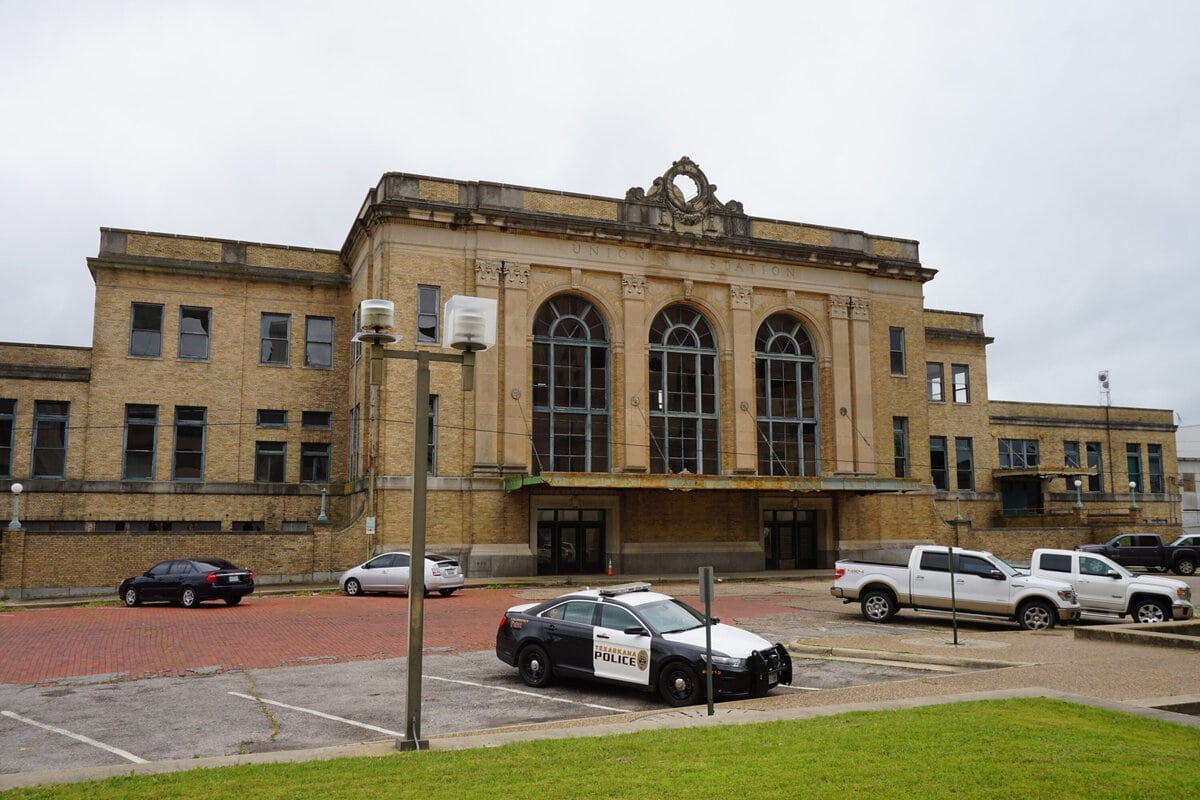
Three stories of buff brick, the center section pushed forward and the wings stepped back.
Three tall Roman-arched windows fill the middle, with a clock set in the parapet above them.
Inside: terrazzo floors, marble in the waiting room and restrooms, bronze chandeliers over the main hall and smaller chandeliers along the mezzanine corridor.
The building came to 67,000 square feet, arranged around the central waiting room.
Trains started using it on April 17, 1930, and the city held its dedication on May 12 with a railroad banquet at the Grim Hotel.
The terminal was planned and financed in the boom of the 1920s. It opened in the first year of the Depression.
The Texas Eagle years, 1948 to 1971
For 40 years the station did the job it was built for.
Trains from all four owner railroads called there, and the building moved baggage, express, and mail alongside people.
From Texarkana you could change for St. Louis, Little Rock, Dallas, or Kansas City.
The Texas Eagle entered service in 1948.
Then highways and airline competition cut into long-distance rail travel across the country, and Texarkana followed.
Trains kept calling, fewer each year, into a hall sized for 1920s crowds.
In 1971 the last Missouri Pacific passenger train left, and the central waiting room stopped being used.
Amtrak came to the baggage end
Amtrak took over most intercity passenger service in the United States on May 1, 1971, and skipped Texarkana for three years.
Trains came back in 1974 with the Inter-American, running St. Louis to Laredo.
The hall stayed shut.
It was too big for the traffic left and had no suitable access for passengers with disabilities, so Amtrak converted space at the east baggage end into a small waiting and ticket room.
The building went on the National Register of Historic Places on October 19, 1978. The listing supplied no money to fix it.
The Inter-American became the Eagle in 1981 and the Texas Eagle in 1988, running Chicago to San Antonio.
When a full train stands at the platform, it reaches across the state line into Texas.
The license pulled on opening day
The western end of the complex ended up beside the Bowie County Correctional Center at 105 West Front Street.
In January 1995 an applicant asked the city for a license to run an adult cabaret at Union Station's Texas-side address, 101 West Front.
The planning administrator found no church or school within 1,000 feet, and the license was issued on February 2.
The operators remodeled and spent close to $100,000.
The police chief revoked the license on May 8, the planned opening day, counting the correctional center's worship area as a church.
The city later argued that its GED program counted as a school.
A federal judge granted a preliminary injunction on May 30, finding that neither fit the ordinance's definitions.
A $20,000 facelift, then the mold
A private buyer took the building in 2003.
That left Amtrak leasing one room, Union Pacific owning the track and platform, and a private owner holding the historic terminal around both.
In spring 2023 a Leadership Texarkana team finished an 18-month project with $20,000 in donated money and services: power washing, restriped parking, string lighting, landscaping, paint on the Amtrak end, and a mural facing the platform.
On April 17, 2023, the Texarkana, Arkansas board of directors approved $200,000 toward buying and redeveloping the station.
In 2024 mold and deterioration pushed Amtrak out of its leased indoor space and into a temporary structure outside. The trains kept stopping.
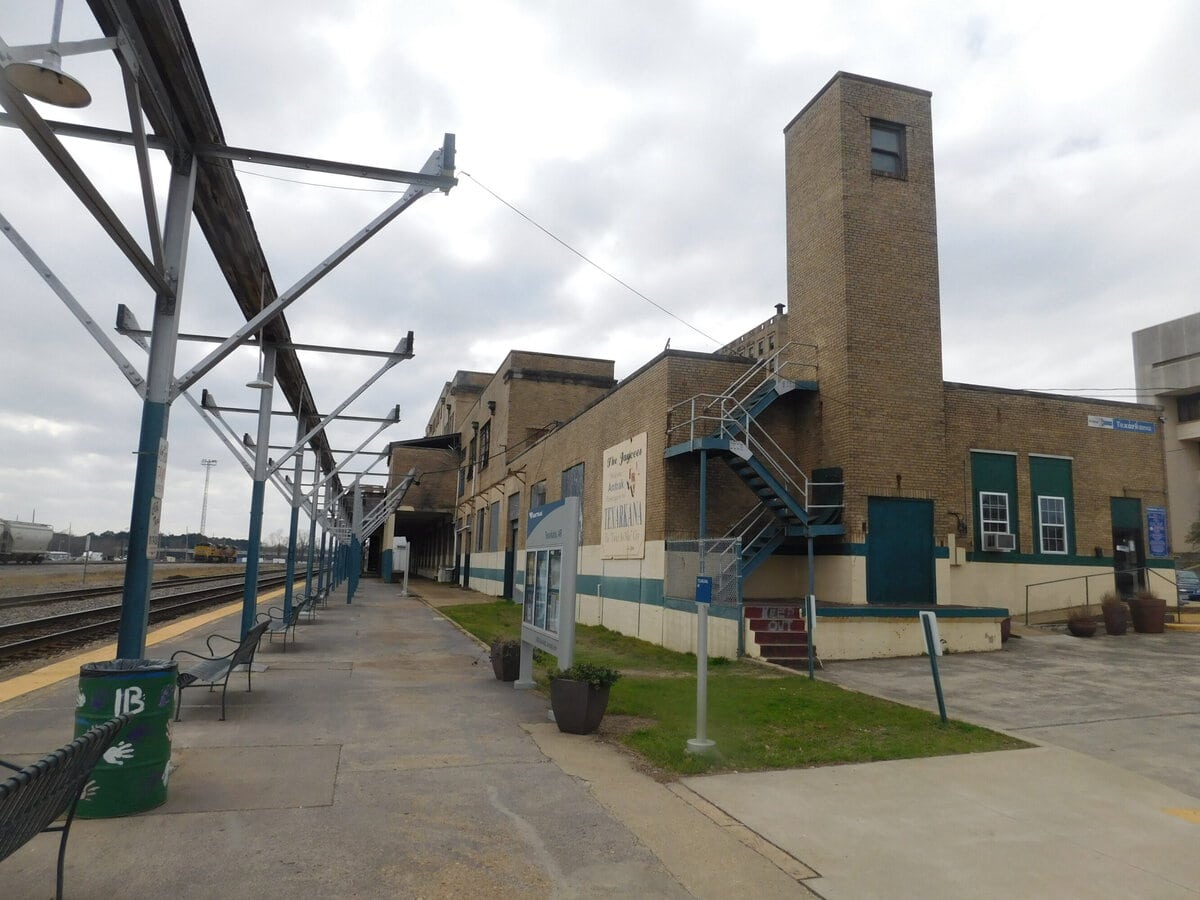
Texarkana Union Station in 2026
In July 2024 the two city governments agreed to act together, $200,000 from each side of the line, and Texarkana, Texas went after a federal rail grant.
The money has mostly sat. The joint Union Station Fund closed fiscal 2025 with $433,500 and nothing spent on the project that year.
A draft budget dated August 10, 2026 projects $461,500 in the fund by the end of the year ahead, still for acquisition and redevelopment.
Amtrak has described a modern passenger facility near the old depot, with no construction date announced.
In fiscal 2025, 7,000 passengers boarded or got off at Texarkana, at the Arkansas end of a terminal whose waiting room is listed closed and which has no ticket office.
Independent Publisher Notice
BestAttractions is an independent editorial publisher. We are not affiliated with, endorsed by, or acting on behalf of any location, business, property owner, manager, government agency, or organization described in this article. Comments posted on this page are not forwarded to, reviewed by, or acted upon by any entity mentioned in the article. For official inquiries, complaints, applications, bookings, or other requests, please contact the relevant entity directly through its official website or other verified channels.
The terminal is such a beautiful historic building. Its glitz and glamor represent a bygone era; but surely there are funds available for developers and contractors to design and execute concepts for a multiuse building containing shops, medical offices, commercial offices, train depot, apartments, and restaurants. Money was found for the Grim Hotel renovation which it never approached the grandeur of Union Station
.
The Hotel Grim shows that a large historic rescue can be financed, but its $26 million package combined housing and historic tax credits, EPA money, debt, and local contributions. Union Station has drawn city pledges and a federal grant effort, yet I could not confirm that enough money has been secured for the full redevelopment.