On September 10, 1979, the Canyon Drive-In showed its final movie. The theater stood off Highway 6 and 24 in west Glenwood Springs, Colorado.
It had been operating since September 1950. For twenty-nine years, cars came into the lot on summer evenings, the projector light crossed the dark sky, and on warm nights, many of its 325 spaces filled with local people.
A few years later, bulldozers cleared the drive-in site. They removed more than just the screen and snack bar. The Canyon had been a familiar place where people came back year after year because the setting felt easy and the people around them were part of the local crowd.
A covered shopping mall took its place. It went up along a commercial stretch that was growing quickly as western Colorado expanded in the early 1980s.
The property at 51027 Highway 6 and 24 changed from a lot where people watched movies outside under the night sky into a parking lot in front of glass entrance doors and a brightly lit indoor mall.
How Glenwood Springs Mall Came to Life
In January 1979, plans were already underway for a 230,000-square-foot mall at the site, with construction set to start that spring and a grand opening scheduled for spring 1980.
Kmart was named as one of the anchor tenants, with a 55,550-square-foot store planned.
The schedule slipped. Garfield County had approved the property's development before the area became part of Glenwood Springs.
The city annexed West Glenwood in the early 1980s, in part to bring the then newly built mall onto its sales-tax rolls.
In 1984, Glenwood Springs signed an agreement with Mitchell-Cooper Ditch and Pipeline Co. over water service in the area.
By 1984, JCPenney was advertising its Glenwood Springs Mall catalog department in local papers. By 1985, Alpine Bank had a branch at the mall.
The exact opening date was not identified in the available sources, but the mall was clearly operating as a retail center by the mid-1980s.
More Than 35 Stores and a Mall Used by the Community
By February 1986, more than 35 stores were open inside the mall. Kmart stood at one end. JCPenney served as the department store.
Giant Foods had been bringing in grocery shoppers since 1985, then closed on February 15, 1987.
These were the mall's anchor stores. The mall also served as a gathering place for local events.
Strawberry Days activities took place there in 1985 and 1987, including a beet-strawberry cook, a carnival, and an amateur video contest co-sponsored with local media.
In 1986, an MG car rally took place in the parking lot. These were regular community events tied to a place many people treated as an important part of town life.
A satellite office for the Division of Vocational Rehabilitation operated in the mall in 2006. Garfield County Public Health used the mall as a flu clinic site in 2012.
By that time, stores were leaving, but the mall's address still appeared on county service lists.
People still came to the building for reasons beyond shopping.
The Mall Theater and Its Brief Return
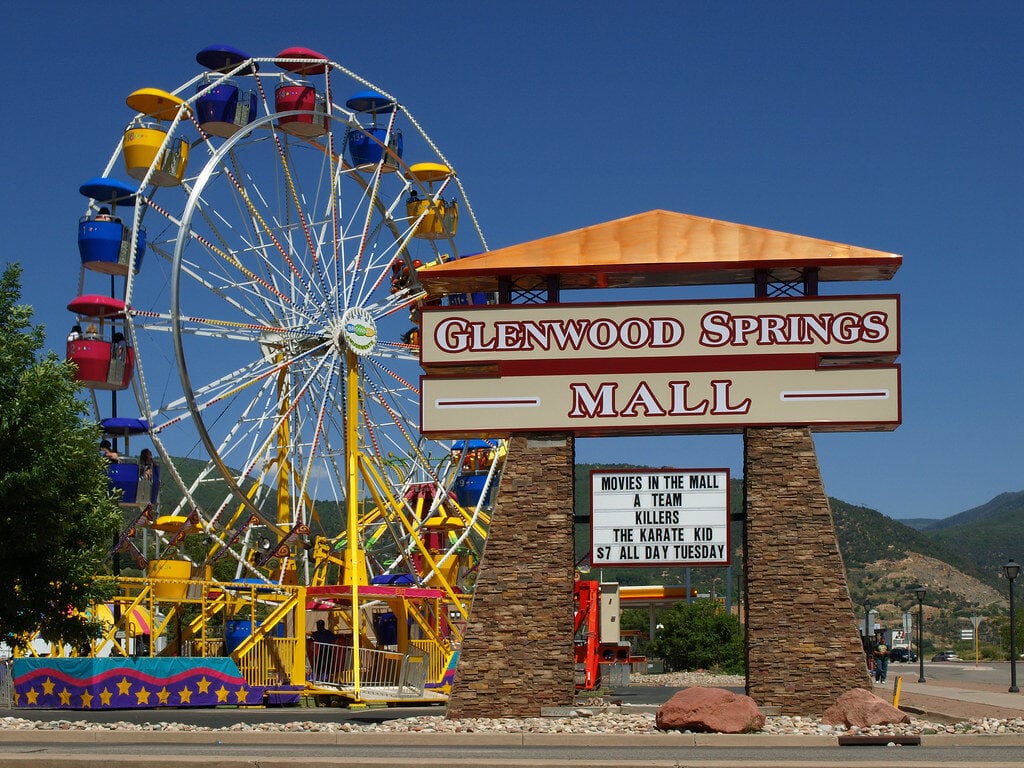
By the late 1980s, the mall's three-screen theater was a regular part of the property. Carmike operated it for many years.
In May 2008, Carmike closed the theater. Red Mountain Books closed that same month. The two businesses were very different, but both left during the same period.
The theater space was renovated and reopened on November 13, 2009, under the name "Movies in the Mall."
The reopening brought a closed three-screen theater back into use inside the mall along Colorado Highway 6.
The theater stayed open until October 2013, when it closed permanently. Its empty space became another vacancy in the mall.
All Three Anchors Were Gone Within a Few Years
When Ross Dress for Less signed a lease in 2011, the mall still had three major anchors alongside it: Kmart, JCPenney, and Staples.
All three were gone within a few years.
Kmart left in the early 2010s, caught in the wave of Sears Holdings closures that moved through Colorado around 2011 and 2012.
JCPenney lasted longer - the chain announced in March 2017 that it would close its Glenwood Springs Mall store, one of dozens of locations it closed that year.
Staples also closed during the same period.
By 2020, the mall was predominantly vacant. The Colorado DMV occupied space in the building, and a Tractor Supply operated there as well, but neither generates the kind of foot traffic that keeps a covered mall alive.
Ross remained a significant retail anchor, and its lease, structured with provisions that gave the chain unusual control over property management, was about to become a formal obstacle when the city moved to redevelop the site.
Ten of Eleven Blight Factors Were Present
In August 2018, the city council approved a deal for the mall's owner to advance up to $25,000 to pay for a study on whether an urban-renewal authority could be formed for the property.
The 2018 West Glenwood Springs Urban Renewal Plan reported that 10 of the 11 possible statutory blight factors were present at "significantly adverse" levels.
The factors included deteriorating structures, defective street layout, unsafe conditions, deteriorating site improvements, inadequate public improvements or utilities, title problems, life-or-property-endangering conditions, unsafe buildings, environmental contamination, and substantial underutilization or vacancy.
Only one of the eleven was absent.
The urban-renewal area covered about 20 acres, including adjacent rights-of-way, across two legal parcels - a 15.76-acre main parcel and a 3.39-acre secondary parcel at 51027 Highway 6 and 24.
The 2011 comprehensive plan had already called for a mixed-use neighborhood on the site, with medium- to high-density housing, internal sidewalks, and shared community spaces.
Moving from that vision to an actual project would take far longer than the blight survey suggested.
A Lawsuit Settled, But the Site Still Waits
Ross Dress for Less had $1.8 million invested in its 23,700-square-foot store and a lease that gave the chain more control over how the property was managed than usual.
The city's plan to redevelop the area moved forward, which could have forced Ross out. Ross took the city to court.
On January 16, 2020, both sides agreed to settle: Ross ended its lawsuits, the city stopped trying to get its legal costs paid, and the city no longer had the power to take over the property.
CenterPointe Development already had an agreement to buy the mall. By 2021, R2 Partners also had a deal to buy it from the owner. But neither agreement changed who owned the property.
Since August 2024, eleven spaces at 51027 Highway 6 and 24 have been advertised for rent, with about 313,800 square feet of empty retail space.
That year, the city's parks department paid $53,000 to use some of the building as temporary office space.
On October 16, 2025, the Glenwood Springs City Council voted for a new zoning category called M1 - Mixed-Use Corridor for the property.
The old mall zoning was removed, so now homes and more types of businesses could be allowed there. No building plans were approved with this decision.
Glenwood Springs Mall feels like a place that is still open, but only just.
The building is still there, some areas are still used, and stores like Ross keep it from feeling completely empty, but as a mall, it looks run-down, not busy, and far from its best days.
A place with so much empty space, so few options, and so much doubt about its future does not seem healthy or steady.
It seems like a partly working property that is waiting for a new reason to exist, not a shopping center that is doing well.