
A 1955 strip center with Woolworth and Walgreens as early tenants had no business becoming Tennessee's only Nordstrom address. The Mall at Green Hills did exactly that, outlasting four ownership changes and the closures that gutted its rivals.
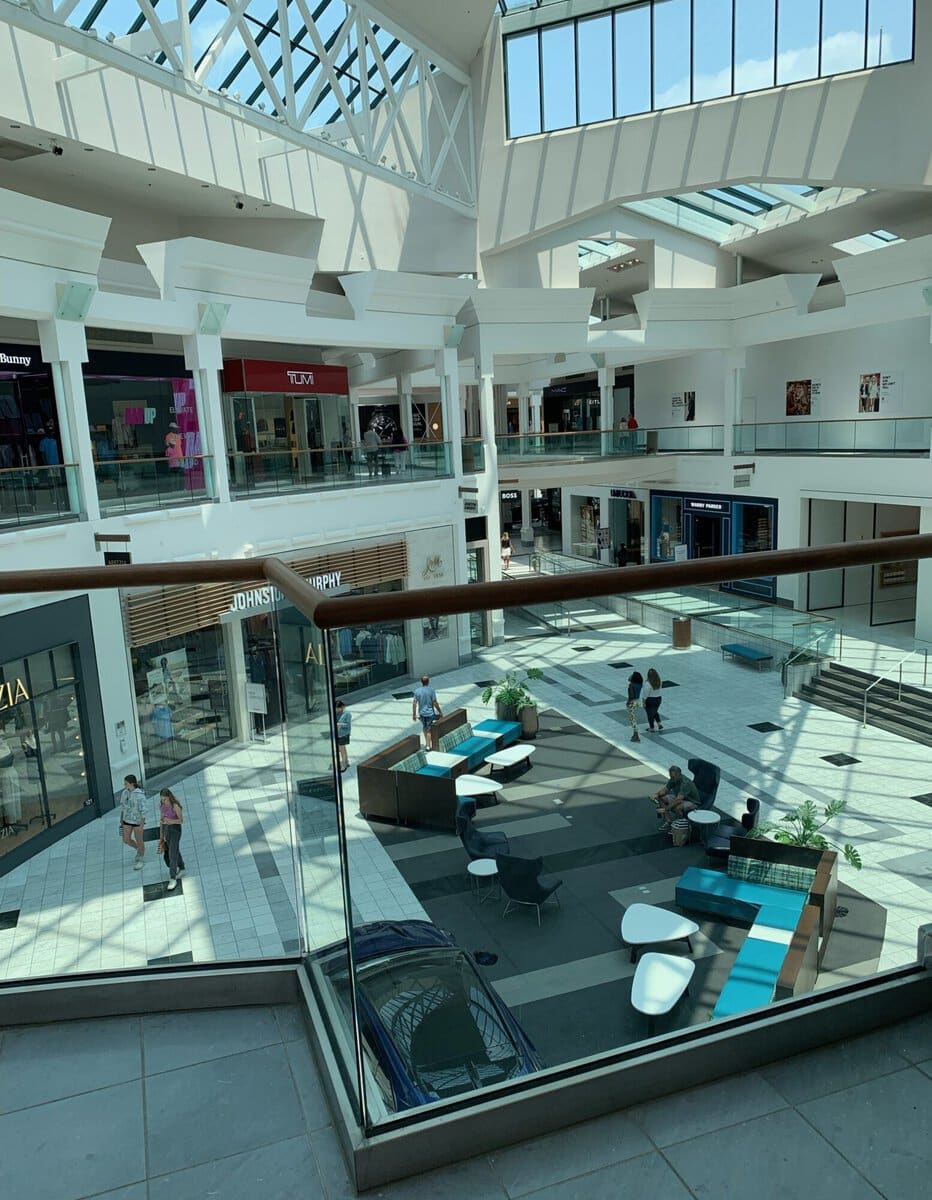
It now runs at 93.1 percent occupancy across 1,057,500 square feet, with Nordstrom, Dillard's, and Macy's as anchors and Chanel, Louis Vuitton, and Gucci on the tenant roster.
The property sits at 2126 Abbott Martin Road in Davidson County's Green Hills neighborhood, where Abbott Martin Road meets Hillsboro Pike, and is the only enclosed regional mall for miles.
Shoppers come in from Nashville, Belle Meade, Forest Hills, Oak Hill, Brentwood, and Franklin, making it the high-end retail hub for southwest Nashville and the wealthy suburbs around it.
Green Hills Village: Nashville's Suburban Wager That Paid Off
In 1953, two Nashville real estate developers looked at a stretch of land near Hillsboro Pike and Abbott Martin Road and saw something most people in the city hadn't.
William C. Weaver Jr. and W. H. Criswell proposed a 25-store shopping center less than five miles south of downtown.
Nashville families were moving south and west, and they wanted to shop where they lived.
Population data from 1940 to 1950 showed strong growth along the Hillsboro Pike corridor.
That growth justified an investment most downtown retailers weren't ready to make: a purpose-built suburban commercial center designed to pull shoppers away from the department-store districts downtown Nashville had long depended on.
Two years after the proposal, Green Hills Village opened. The original layout came in at about 112,400 square feet.
It was open-air, surface-parked, designed entirely around the automobile, a format so new that the word "mall" wasn't commonly attached to it yet.
Woolworth and Walgreens were among the first tenants. Castner Knott and Gus Mayer were positioned as the center's anchors. The architect was Hart, Freeland, and Roberts.
The 1950 Census put Nashville's total metropolitan population at around 321,000.
Green Hills Village opened at the center of a city actively spreading outward and sat exactly in the path of that expansion.
A Strip Center Becomes a Mall: Green Hills Through the 1980s
The open-air design that defined Green Hills Village in 1955 did not last.
In the 1960s and 1970s, many malls were enclosed because developers saw that indoor, climate-controlled malls with hallways attracted more visitors.
Green Hills adapted by slowly connecting its separate stores into one indoor hallway with big department stores at each end.
Cain-Sloan anchored the west end through most of this period. Between 1987 and 1988, Dillard's acquired the Cain-Sloan chain, and the Green Hills store became a Dillard's.
On the other side, Castner Knott, a Nashville chain operating since 1898, held the anchor position that would eventually become the Macy's wing.
Castner Knott was part of Mercantile Stores in its later years.
These transitions reflected the broader national department-store consolidation that changed anchor lineups at many major American shopping centers over the following decades.
Green Hills wasn't losing anchors. It was absorbing them into larger national chains and holding its position as the dominant enclosed mall in southwest Nashville.
By the early 1990s, the open-air strip center proposed in 1953 was gone in all but the street address.
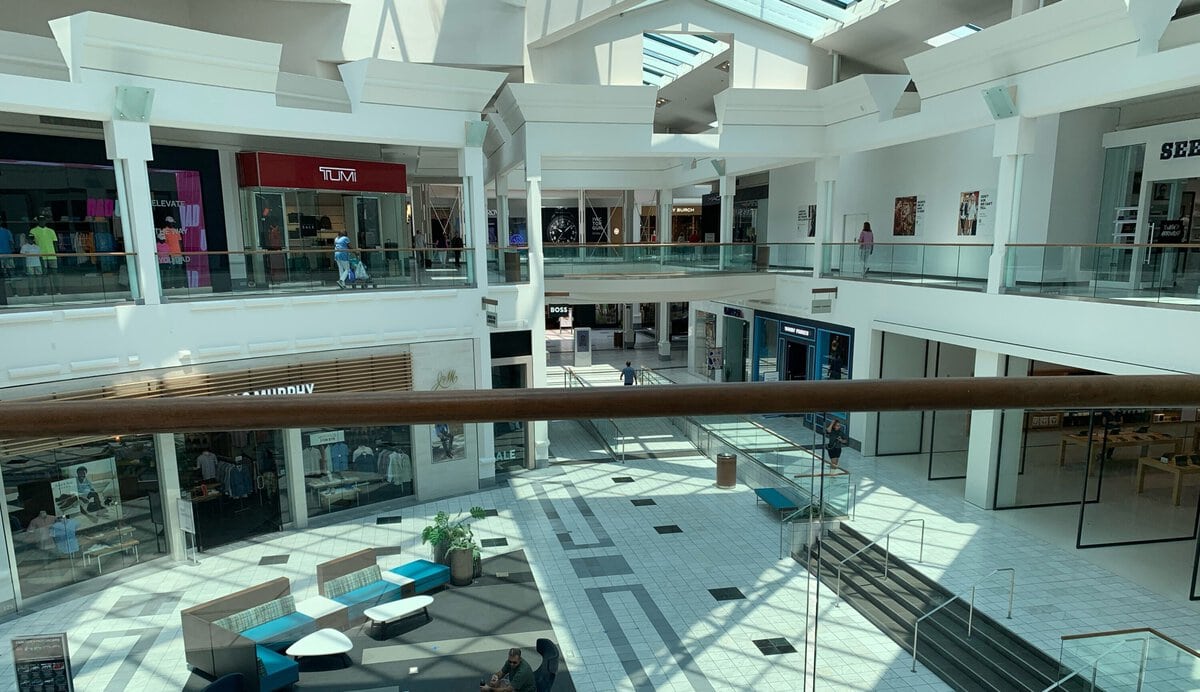
The Mall at Green Hills operated as a multi-level enclosed property with two major department-store anchors.
Hillsboro Pike and Abbott Martin Road had grown considerably busier, and parking was already a planning concern.
When Department Stores Changed Names, and Green Hills Kept Moving
Dillard's acquisition of Cain-Sloan between 1987 and 1988 locked in one anchor. The other anchor's history across the 1990s and 2000s moved through four names in roughly fifteen years.
After Dillard's acquired Mercantile Stores in 1998, it sold selected overlapping mall locations to Proffitt's rather than operating two Dillard's stores in the same market.
The Green Hills Castner Knott location went to Proffitt's. May Company purchased those stores in 2001 and brought in the Hecht's name.
Three years later, a new Hecht's was built at Green Hills, a full physical rebuild rather than just a sign swap.
The May Company-Federated Department Stores merger in 2006 converted Hecht's to Macy's.
A Regal Cinemas 16-screen megaplex had been operating next to the mall since 1998.
Regal also launched an indoor amusement concept called FunScape alongside the theater. FunScape closed in 2000 when Regal ended the concept nationally.
Davis Street Properties and its affiliate, Davis Street Land Company, held the ownership and management position throughout all of this.
Barge Design Solutions took on design and engineering work at the property beginning in 1997, covering Macy's expansion, a new parking garage, Dillard's relocation, and later Nordstrom and RH additions.
The property-management fee base increased 15 percent in 2005.
Castner Knott, Proffitt's, Hecht's: three names had occupied the same anchor position before a brand-new Hecht's store opened in 2004.
Macy's took over that store two years later.
Tennessee's First Nordstrom Lands at The Mall at Green Hills
On April 24, 2008, Nordstrom signed a letter of intent with Davis Street Land Company for a store at The Mall at Green Hills.
The deal took three years to reach opening day.
On September 16, 2011, Nordstrom opened a three-level, 149,000-square-foot store at the Abbott Martin Road entrance.
It was Tennessee's first Nordstrom. Luxury and fashion retailers that had passed on Nashville began taking the market more seriously.
Ninety-six days later, Taubman Realty Group completed the acquisition of the mall from Davis Street affiliates.
The December 21, 2011, transaction was part of a $560 million multi-property deal that also included The Gardens on El Paseo and El Paseo Village in Palm Desert, California.
The structure carried about $206 million in assumed debt and about $281.5 million in installment notes at a 3.125 percent rate, paid in full by February 2012.
The purchase price broke down to about $74.2 million for land, about $468.9 million for buildings and improvements, and about $29.8 million for in-place leases.
At closing, the mall had about 868,000 square feet of total gross leasable area. Dillard's and Macy's were already in place. Nordstrom had been open for just over three months.
The Decade That Rebuilt Green Hills From the Ground Up
A 2013 expansion plan called for a new, larger Dillard's and roughly 125,000 square feet of additional retail space.
February 2015: a new four-level covered parking structure facing Cleghorn Avenue was completed, replacing an uncovered surface lot with about 700 spaces.
June 2015: demolition of the former parking garage west of Dillard's was finished.
July 2015: construction began on the new two-level Dillard's and underground parking, adding about 570 spaces.
The new Dillard's opened in March 2017. The old Dillard's building was demolished afterward.
In August 2016, Nordstrom expanded its SPACE concept to the Green Hills store.
A 132,000-square-foot two-level wing opened in June 2019. For more than two years during Dillard's construction, the direct interior connection between the mall and both levels of Dillard's had been disrupted.
The new wing restored that connection. Since 2015, more than 1,500 parking spaces had been added, pushing the total above 4,300.
The 2019 wing brought RH Nashville (The Gallery at Green Hills) and the RH Café, Crate & Barrel, Gucci, North Italia, Cava, Chopt, and a relocated Apple store.
By early 2020, Zara, Arhaus, Evereve, and Ulta Beauty were expected or opening.
How Simon Property Group Took Full Control of Green Hills
Simon Property Group acquired an 80 percent interest in Taubman Realty Group on December 29, 2020, at $43 per Taubman share.
The Mall at Green Hills was among the properties that came with it.
Simon completed the full buyout of the remaining Taubman interests in November 2025, gaining full ownership, management, and leasing control.
Simon's 2025 property figures put the mall at 1,057,500 square feet and 93.1 percent occupancy.
Other older enclosed malls spent the past decade losing anchors and converting space to non-retail uses.
The Green Hills tenant mix at the time of Simon's full acquisition included Chanel, Christian Louboutin, Gucci, Louis Vuitton, Saint Laurent, Tiffany & Co., Omega, Burberry, David Yurman, Dolce & Gabbana, BOSS, and Breitling alongside Nordstrom, Dillard's, and Macy's.
The mall's three department-store anchors (Nordstrom, Dillard's, and Macy's) had been continuously active since 2011. More than 55 of its stores had no other Nashville location.
Green Hills Traffic: A Dense District With Nowhere Left to Grow
The Mall at Green Hills sits inside one of Nashville's most traffic-constrained commercial corridors.
Hillsboro Pike, Abbott Martin Road, Cleghorn Avenue, and connecting streets carry mall, neighborhood, and office district traffic simultaneously.
The roads are hard to widen, so planners have focused on managing access, improving connections, and making targeted road upgrades instead of widening the entire corridor.
Metro Nashville imposed design and access controls on the district starting in 2002, when the Green Hills Urban Design Overlay was adopted.
It was amended in 2003 and 2007. The Green Hills-Midtown Community Plan was updated in August 2017 as part of NashvilleNext. The plan area holds more Urban Design Overlays than any other Nashville community plan area.
Adding structured decks rather than expanding surface lots let the mall increase capacity without consuming land it didn't have.
The Emerald deck beneath Dillard's holds more than 870 spaces. The Gold deck holds more than 700. The Ruby deck between Macy's and Nordstrom holds more than 1,810.
Between 2015 and 2019, the program added over 1,500 spaces without changing the mall's street-level footprint.
Hill Center Green Hills added walkable retail and restaurant space nearby.
The combination of the enclosed mall, Hill Center, adjacent commercial strips, and Hillsboro Village, a short drive north, has made Green Hills one of the densest retail concentrations in Tennessee.
The Green Hills Urban Design Overlay covers a district where nearly every available parcel is already built.
Simon's $250 Million Push to Remake Green Hills as a Luxury Mall
On February 4, 2026, Simon placed The Mall at Green Hills into a redevelopment program exceeding $250 million alongside Cherry Creek Shopping Center in Denver and International Plaza in Tampa.
Construction at Green Hills was expected to begin in 2026.
Earlier phases rebuilt Dillard's, added parking decks, opened a new wing, and brought in luxury tenants.
The 2026 program targets the exterior: a complete revitalization, two-story flagship entrances, new luxury boutique spaces, updated landscaping, improved arrival areas, and façade changes.
Cherry Creek is one of Denver's most exclusive retail destinations. International Plaza holds a comparable position in Tampa.
Simon grouped all three properties together, treating Green Hills as the same category of asset.
The tenant list at Green Hills includes Chanel, Christian Louboutin, Gucci, Louis Vuitton, Saint Laurent, Tiffany & Co., Omega, Burberry, David Yurman, Dolce & Gabbana, BOSS, and Breitling.
The mall currently holds more than 130 stores and restaurants, and once the exterior overhaul is complete, the 1955 strip center will look nothing like its origins.
However, it will still be sitting on the same corner of Hillsboro Pike and Abbott Martin Road where Weaver and Criswell first sketched it out.


Independent Publisher Notice
BestAttractions is an independent editorial publisher. We are not affiliated with, endorsed by, or acting on behalf of any location, business, property owner, manager, government agency, or organization described in this article.
Comments posted on this page are not forwarded to, reviewed by, or acted upon by any entity mentioned in the article.
For official inquiries, complaints, applications, bookings, or other requests, please contact the relevant entity directly through its official website or other verified channels.