
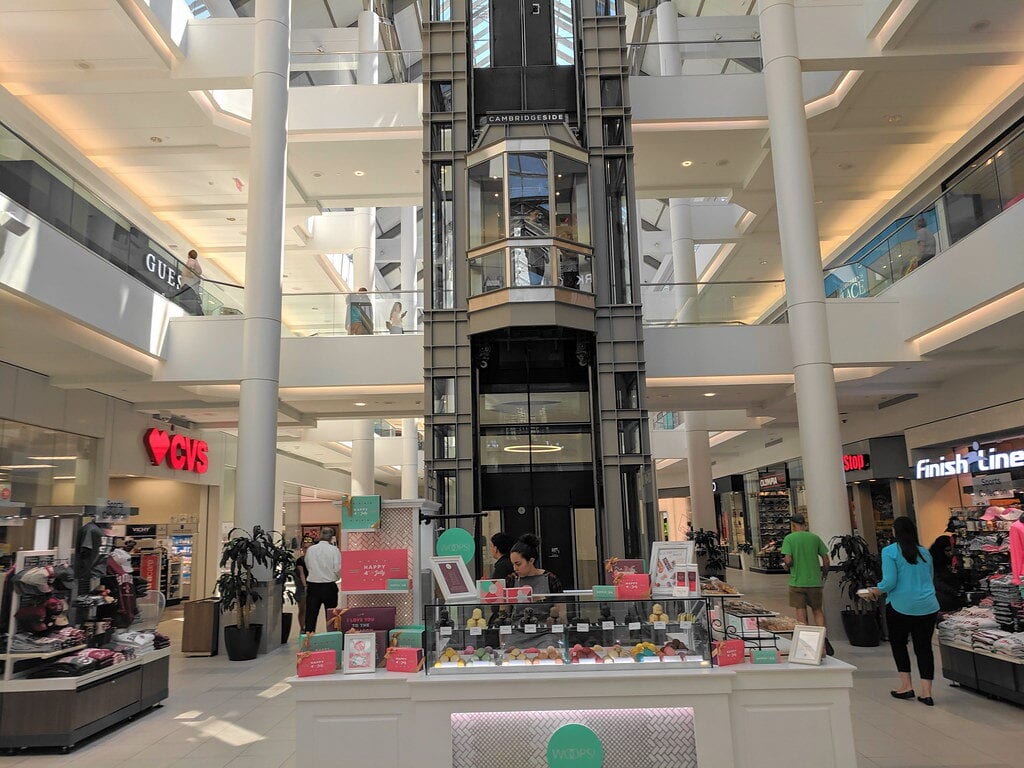
CambridgeSide is a waterfront shopping complex on the Lechmere Canal in East Cambridge, Massachusetts. It opened in 1990 as CambridgeSide Galleria, a three-level enclosed mall.
Filene's, Lechmere, and Sears anchored it. Lechmere closed in 1997. The Filene's name vanished in 2006. Sears went dark in 2018, Macy's followed in 2020, and Best Buy in 2022.
The building kept going. A $30 million renovation in 2017, more than 7 million visitors a year at the time, then an at-least-$800 million redevelopment plan that put lab and office space where Sears and Macy's had been, plus 140,000 square feet of lab and office space on the mall's own third floor.
The anchors were supposed to be the permanent part. Here's how the building outlasted all five of them.
Dinosaurs and a Sistine Chapel inside the CambridgeSide mall
Through September 7, more than 50 full-scale animatronic dinosaurs are standing inside a shopping mall in East Cambridge.
Through June 14, the same building also holds life-size reproductions of all 34 Sistine Chapel ceiling and altar frescoes, printed from licensed high-resolution imagery.
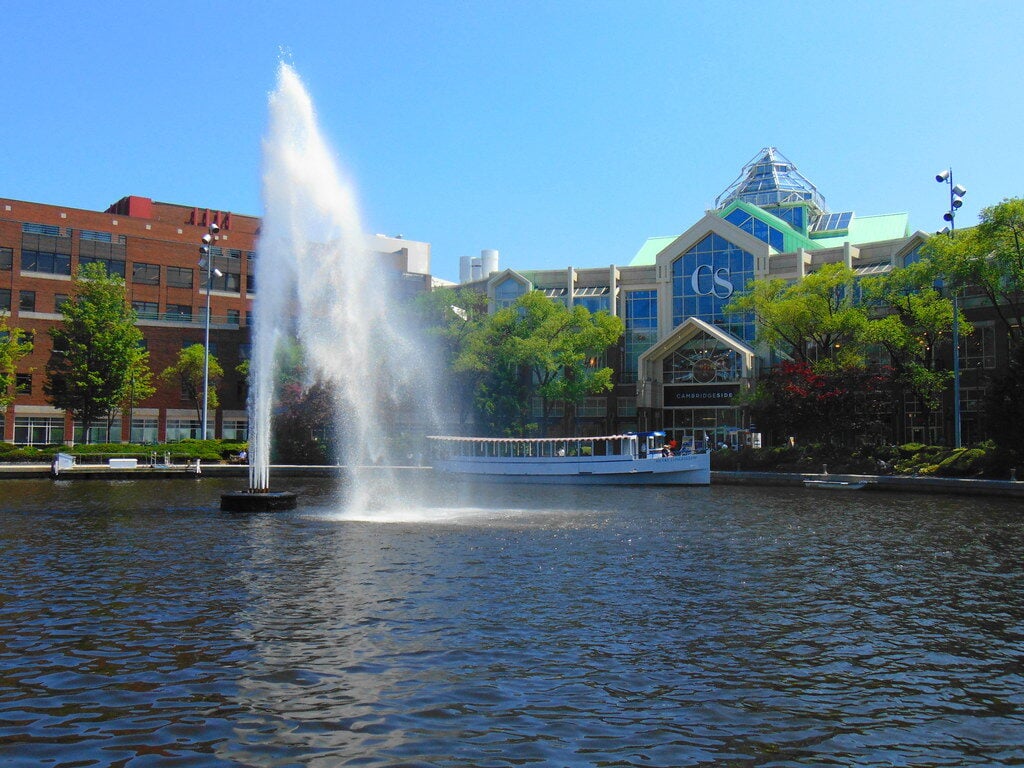
The building is CambridgeSide, a waterfront shopping and dining complex at 100 CambridgeSide Place in East Cambridge, Massachusetts, on the Lechmere Canal next to the Museum of Science.
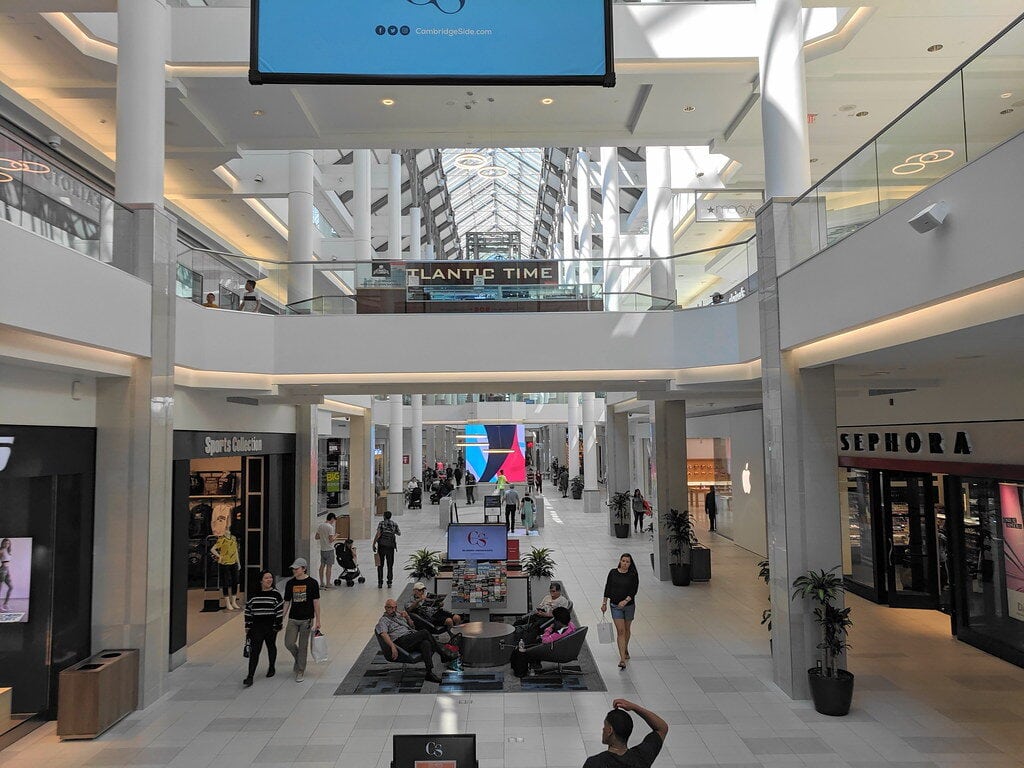
It opened on September 13, 1990, as CambridgeSide Galleria, a three-level enclosed mall under a long gabled skylight. The "Galleria" came off the name in 2017. The third floor is now lab and office space.
A mall that fills its big rooms with dinosaurs and Renaissance frescoes while its top level turns into lab and office space has been through a few eras.
The first one starts with a canal that used to be the back of an industrial district.
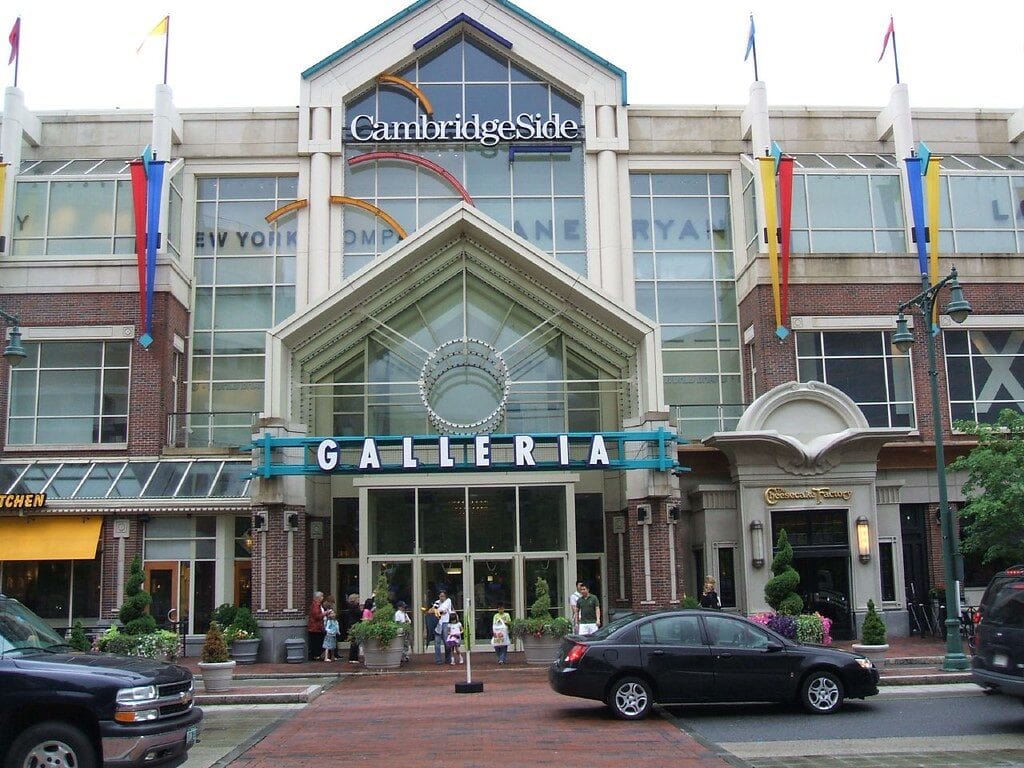
CambridgeSide replaced an industrial stretch of the Lechmere Canal
By the pre-renewal years, the blocks around the Lechmere Canal held warehouses, service buildings, a liquor store, and a casket company.
Lechmere Sales, the local appliance retailer, had its original store in the area. After World War II, the district slid, and by the 1970s much of it sat deteriorated or underused.
Cambridge's 1978 East Cambridge Riverfront Plan turned the canal from an edge into a centerpiece.
It called for a major open-space system and a restored canal surrounded by retail, housing, offices, and recreation.
The Planning Board approved the mall's planned-unit development in 1987.
New England Development built it, and Arrowstreet drew the master plan: a 782,000-square-foot enclosed center with parks at both ends, canal-facing dining, and attached covered parking.
It opened into a weak Boston real estate economy, a visible test of whether a big enclosed mall could work in a dense city neighborhood without copying the old downtown department-store pattern.
For a long stretch, it could.
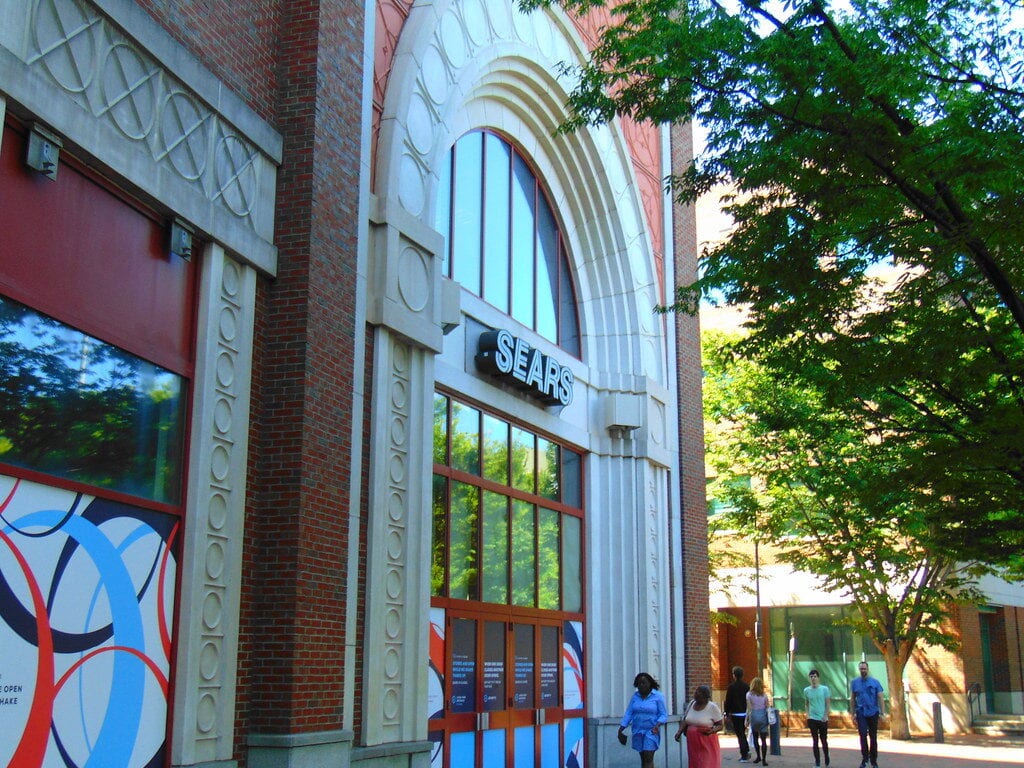
Opening day 1990: Filene's, Lechmere, Sears, and a glass roof
CambridgeSide Galleria opened on September 13, 1990, with Filene's and Lechmere in place and Sears set to follow in mid-October.
Around 80 stores filled the three levels, along with three restaurants, the New England Sports Museum, a car wash, ATMs, and an express driver's license renewal counter.
The food court opened toward the canal, facing the fountain at the circular end of Canal Park.
The first floor was built to read like a street, with pavement-style flooring and pushcarts. The first Bath & Body Works store anywhere opened here in September 1990.
The pitch filled a gap in Greater Boston shopping. Copley Place was expensive, Downtown Crossing was a hassle for routine errands, and the suburban malls required a drive.
CambridgeSide had department stores, the Green Line nearby, a garage, and water out the window. By 1992, it was a finalist for an Urban Land Institute Award for Excellence.
All three anchor names would be gone within 30 years.
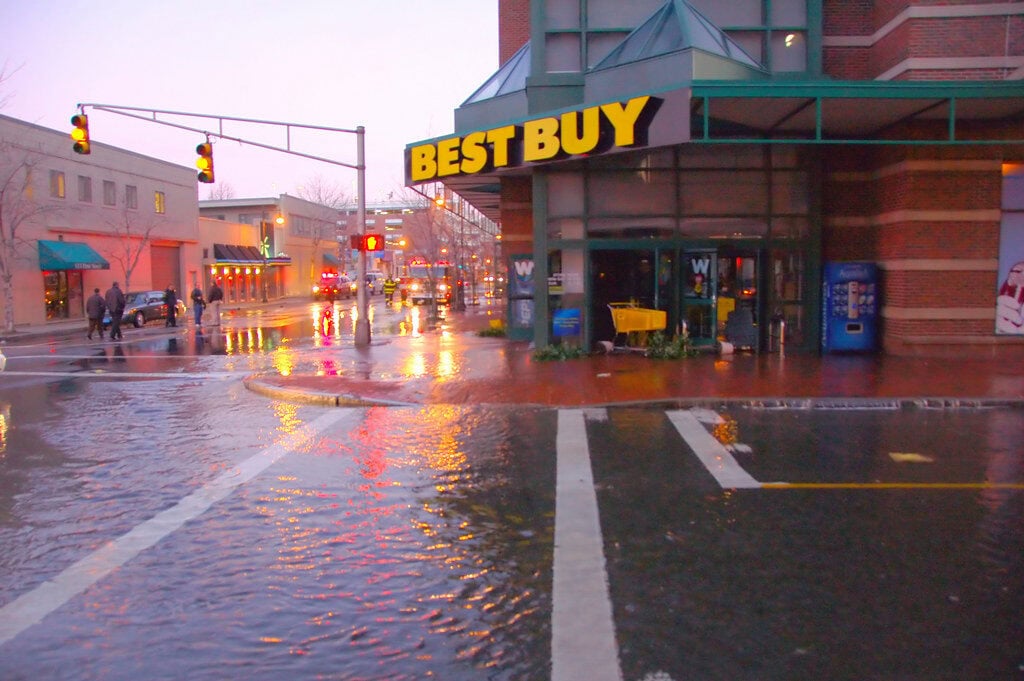
The anchors closed one by one, over 25 years
Lechmere went first. The chain collapsed, and the store closed in 1997, seven years into the mall's life and a short walk from where the original Lechmere Sales had stood.
The space was divided up: Best Buy took part of it, Borders another, and Macy's later ran home and children's departments there.
The Filene's name disappeared in 2006, when the Boston-market stores were rebranded as Macy's.
Sears held out until store-closing signs went up in October 2018. By December, the store was dark, leaving a huge empty box along First Street.
Macy's Home & Kids closed in mid-2019. The full-line Macy's followed on December 27, 2020. Best Buy closed in June 2022, which left T.J.Maxx as the biggest conventional box in the building.
Five big-format names gone in 25 years. Through most of that stretch, the mall's overall numbers stayed strong, which is the strange part.
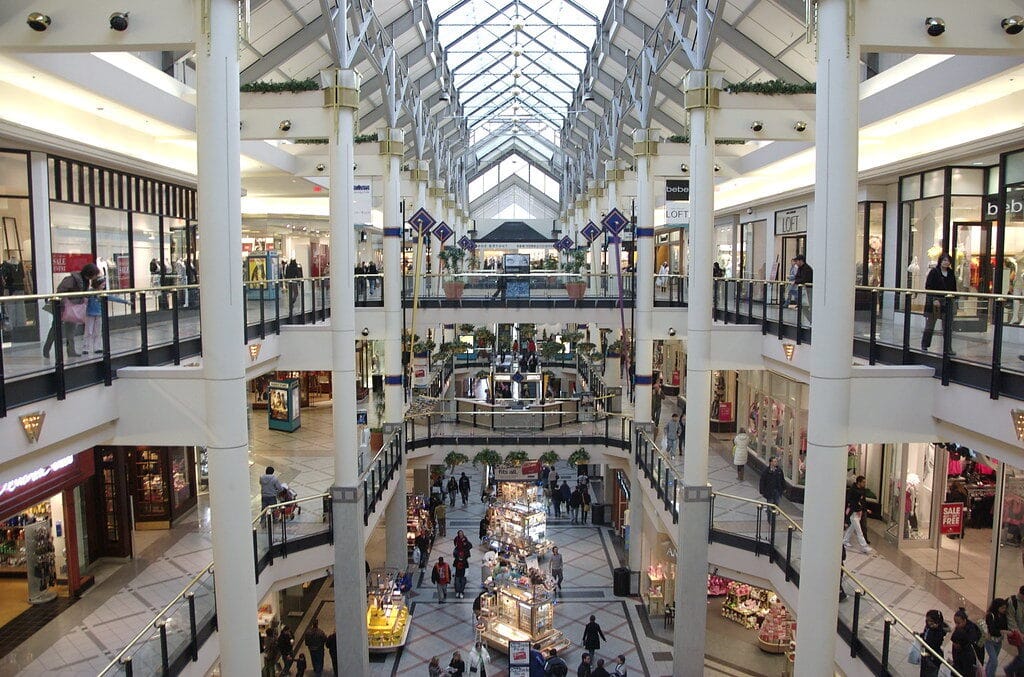
Seven million visitors a year and a third floor going quiet
In 2017, New England Development put $30 million into the building: new flooring, new escalators (replacement parts for the originals had become hard to find), energy-efficient lighting, new signage, and a shorter name.
The beige-and-brass 1990 interior went too.
The center was drawing more than 7 million visitors a year. Occupancy sat in the mid-to-high 90 percent range. Sales ran $485 per square foot. The Apple Store was rebuilt at nearly double its old size.
The third level was the weak spot.
Upper-floor retail had become hard to lease, third-floor stores were struggling for foot traffic, and department stores and big boxes were fading nationally, as the First Street side would prove within 18 months.
Next door, meanwhile, Kendall Square had grown into one of the strongest life-science markets in the country. Cambridge had an obvious use for a quiet third floor. Getting permission took a fight.
Cambridge traded lab space for a housing requirement
In 2019, the owner asked the city for 600,000 square feet of new development, mostly office and laboratory space, enough to more than double the scale of the mall area.
Planning officials and neighbors pushed back, asking for housing and more public benefits. The first proposal expired without action after a May 2019 Planning Board hearing.
The version that passed that December allowed up to 575,000 square feet of net new development and required at least 30 percent of it to be residential, with a large share reserved for affordable and middle-income households.
The construction estimate was more than $800 million.
The deal carried a $6.9 million transportation package plus commitments to East End House, tree replacement, and open space, including new pocket parks and a mid-block connector from First Street toward the canal-side food court.
A separate approval converted the mall's third floor from retail to office use, later amended to allow labs.
The Planning Board granted the project's special permit on December 22, 2020. Macy's locked its doors for good five days later.
Two new buildings finished, two stripped to the second floor
The former Sears went first. 60 First Street was completed by 2023, with 175,000 square feet of lab and R&D space and 35,000 square feet of retail.
The former Macy's building became 20 CambridgeSide Place, 360,000 square feet of lab, office, and retail, and reached certificate-of-occupancy review by 2025.
By April 2026, permits covered the third-floor conversion, 84,000 square feet of lab space and 56,000 square feet of office space, along with 315,000 square feet of retained retail and 1,695 parking spaces for the whole project.
The last two buildings are slower.
80 First Street (455,000 square feet of office, R&D, and retail) and 150 CambridgeSide Place (185,000 square feet, including 170 housing units and 10,000 square feet of shops) were down to interior demolition by February 2026; their structures were kept up to the second-floor slab.
Leasing and financing conditions stalled new construction, and the owner asked to push the relevant deadline to March 8, 2028.
The housing stays in the approved plan. The open question is when, and while that question sits, the open floors have found new reasons for people to come.
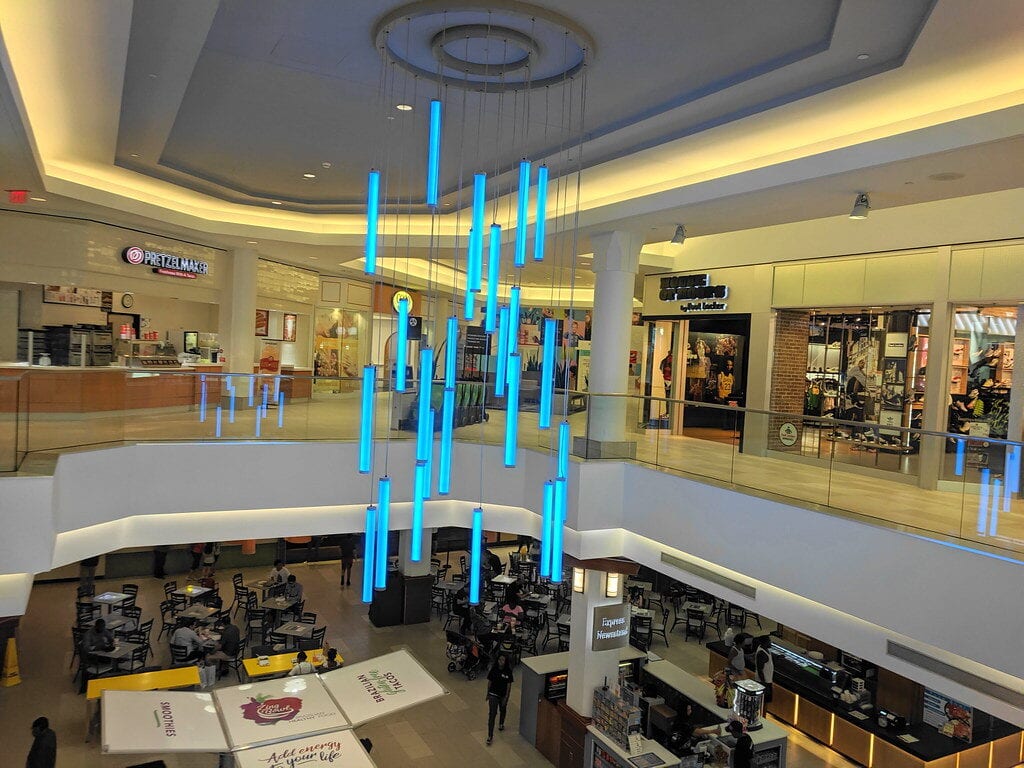
What's at CambridgeSide in 2026: ramen, tacos, and lab permits
The old food court is gone.
CanalSide Food + Drink opened in its place on October 25, 2024, with 13 vendors, many of them local, around a central bar: Sapporo Ramen, Lala's Neapolitan-ish Pizza, Anoush'ella, Chilacates, DalMoros Fresh Pasta to Go, and Far Out Ice Cream among them.
Gato Exotico, a Mexican restaurant from the team behind Wusong Road, opened on December 2, 2025, with tacos, enchiladas, carne asada, and a cocktail list; lunch service started two weeks later.
The shopping side runs on Apple, Sephora, T.J.Maxx, Mango, lululemon, Victoria's Secret, The Cheesecake Factory, and a two-level Zara.
A Harry Potter exhibition filled the former Best Buy space into 2025 before the frescoes and the dinosaurs took their turns.
The full plan calls for six connected buildings and 2 million square feet of stores, labs, offices, hotel rooms, and apartments.
What's actually there on a June afternoon is people eating ramen and tacos beside a canal that spent the first half of the last century as the back of a warehouse district.
The 1978 plan asked for roughly that. It took 48 years and five big-format departures to get it.
Independent Publisher Notice
BestAttractions is an independent editorial publisher. We are not affiliated with, endorsed by, or acting on behalf of any location, business, property owner, manager, government agency, or organization described in this article.
Comments posted on this page are not forwarded to, reviewed by, or acted upon by any entity mentioned in the article.
For official inquiries, complaints, applications, bookings, or other requests, please contact the relevant entity directly through its official website or other verified channels.