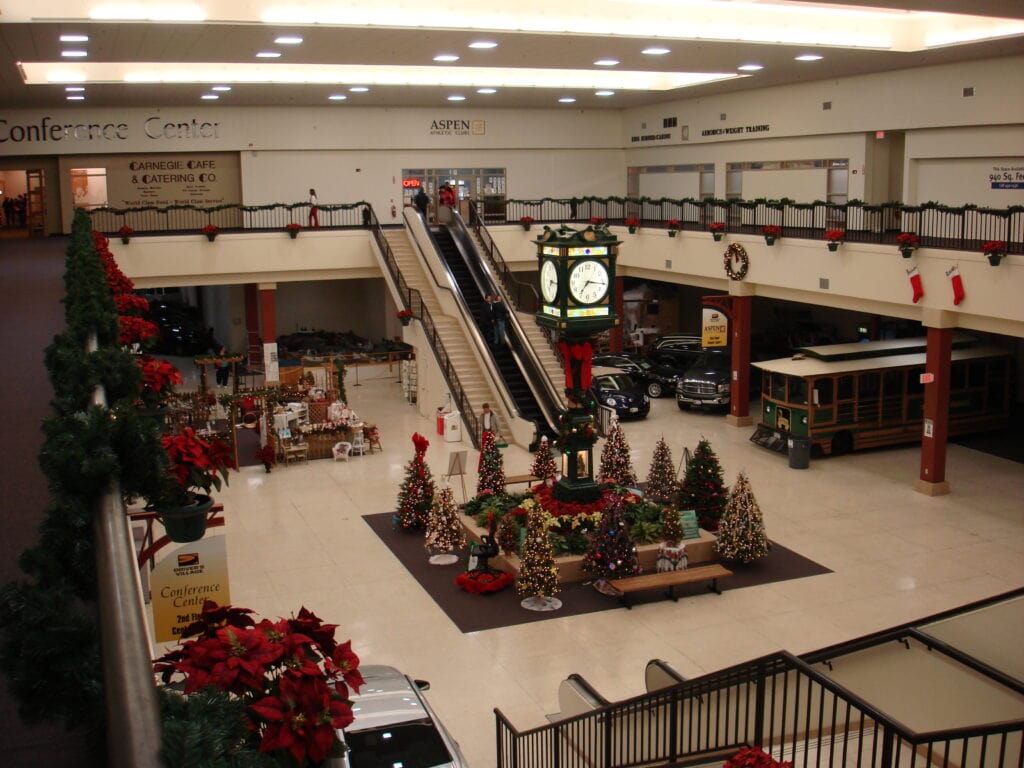
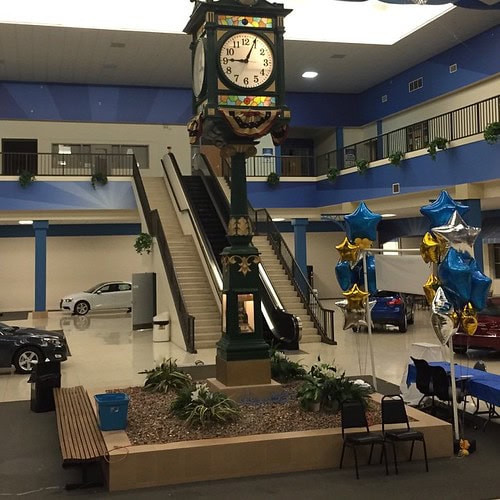
The antique street clock stood tall in the center court, and from the moment Penn-Can Mall opened on March 25, 1976, it became the place people aimed for first.
Friends met under it. Parents used it as a rally point. Teenagers drifted toward it before splitting off to wherever the day went next. The clock did what good landmarks always do - it made the building feel easy to navigate.
The grand opening had the feel of a local holiday in Cicero, New York, just north of Syracuse.
Onondaga County Executive John Mulroy and Sheriff Patrick Corbett gave speeches while the Cicero High School Band and Color Guard performed and presented the flags of the United States and Canada.
The mall rolled right into a full week of live entertainment at Central Court near the clock, with appearances by Johnny Latone and the Schnickelfritz Band, the Magic Toy Shop, and Rick Gary and Ron Bee.
Penn-Can opened with Sears as its anchor and space built for 86 regular stores, including early tenants like Gerber Music, Hoppe Office Supplies, Lerner Shoes, Marjax, and Pants 'N Stuff Shed House.
A smaller upper level added a three-screen movie theater, a restaurant, an arcade, several small stores, and the mall offices.
From 1967 plans to a 1976 opening day
Penn-Can took the long way to opening. Plans for a Penn-Can Mall were announced in 1967. By 1973, a new center was under way.
In 1975, two major retail stores were lined up to open outlets in the future mall, and the project kept moving.
After that, nearly two years of construction ran the clock down to the opening in 1976.
The developers were the Winmar Company of Seattle, Washington, and Eagan Real Estate.
The project became the first enclosed shopping mall built on Syracuse's north side and one of the metropolitan area's earliest major malls.
It was built for crowds and for weather that does not cooperate. The corridors were climate-controlled. The structure ran about 1,000 feet end to end, and there were about 3,000 parking spaces outside.
Inside, the layout was built around the anchors, with a long line of smaller stores running off them. The anchor spaces used modular construction, and the smaller storefronts filled in along the walkways.
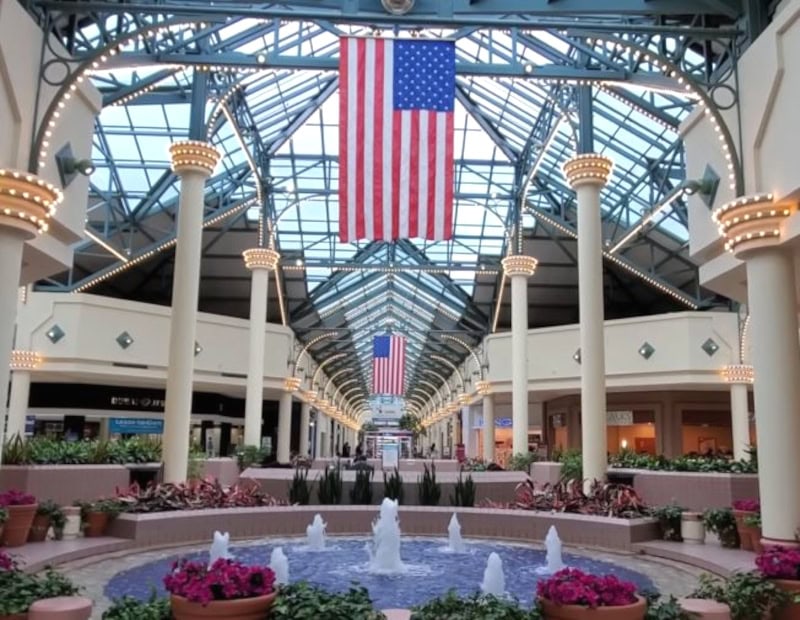
Live plants were placed throughout the interior to soften the corridors and give them a park-like feeling instead of a bare hallway.
Between the stores and the work needed to keep the place running, Penn-Can was expected to employ more than 1,000 people.
The name "Penn-Can" came from its location between Canada and Pennsylvania, and it matched the idea of a mall meant to serve a wide stretch of Central New York.
Shows, contests, and the mall as a stage
Penn-Can was as much a place for community events as it was for shopping. A February 1976 newsletter announced the opening, and a March 1976 "Penn Can Progress" newsletter highlighted what was new inside.
Ads and events continued all year, including an August 4, 1976, back-to-school event that made the mall feel like the starting point for fall.
The holidays made the mall even more popular. On December 16, 1976, a contest with a huge 16-foot King Kong display brought families to the center court.
In 1977, the mall held a Cookie Monster coloring contest. In 1978, it focused on themed nights like "Wednesday Night Fever" and brought in Sesame Street guests Susan and Gordon.
Special events and guest visits continued through 1979 and 1980.
On December 18, 1980, an International Show brought excitement to the Christmas season in the center court.
On August 19, 1981, the mall hosted a fashion event to keep clothing and style in focus.
Penn-Can even had its own theme songs, all using the line "It's happenin' now at Penn Can Mall."
The clock was always at the center of everything. It was built in Boston in 1876, then stood in Tacoma, Washington, before becoming the mall's main feature.
Its electronic bells played seasonal songs, local favorites, and "Big Ben" chimes that rang through the hallways.
Hills arrives, and Penn-Can Mall grows to a T
Penn-Can's first big expansion step came in the early 1980s. On October 24, 1983, Hills opened on the north side as the second anchor store, giving the mall a stronger pull at the far end.
Retail nearby was growing too. On October 31, 1984, Marketplace Mall opened across Hogan Drive South. It was smaller and worked more like an outlet-style center, and it did not hit Penn-Can hard at first.
Penn-Can kept building anyway. On September 18, 1986, Syracuse-based Chappell's opened as the anchor store on a new wing on the east side, with an opening day schedule of events built to feel like a fresh start.
On November 12, 1986, that new wing opened, extending the food court and adding many smaller stores.
With those additions, the layout shifted into a "T" shape. Store count reached 121 in 1986.
Alongside the anchors, Penn-Can also had junior-anchor spaces for Addis & Company and Dey Brothers, plus the small upper level with its three-screen movie theater and other uses.
New rivals, new owners, and shifting anchors
By the late 1980s, Penn-Can was drawing attention for the familiar problems that can follow teen hangouts in an enclosed mall, including theft, fights, and drugs.
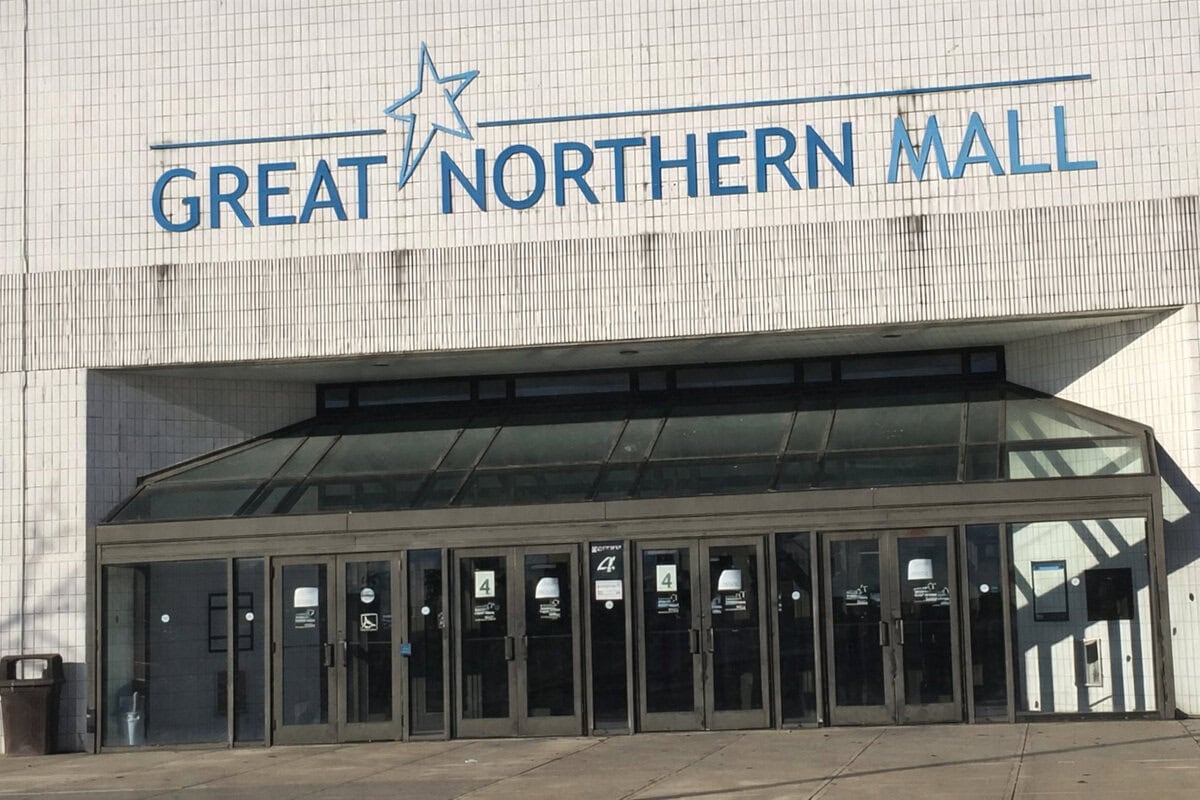
Then the regional mall map changed. Great Northern Mall opened in October 1988, and Penn-Can saw a slight drop in shoppers after that.
In 1989, Wilmorite Company partnered with the Eagan family and gained control of Penn-Can.
The mall was still there, but things were changing as new shopping centers tried to attract the same customers and weekend shoppers.
Anchor space changes followed over time. Sears left the original anchor role. The former Sears space was later held by a Steinbach store. The Chappell's space later became a Caldor.
As those big boxes turned over, smaller stores faced the same pressure, and the mall's earlier identity as the north-side indoor shopping place started to blur.
Carousel Mall opens, and the 1990s unravel fast
Penn-Can started the 1990s with problems coming from all sides. In January 1990, New York banned smoking inside indoor malls, and Penn-Can saw a smaller drop in shoppers after that change.
On July 19, 1990, it ran a "Holy Guacamole!" promotion built from ads across 19 stores, and it booked a meet-and-greet with the Teenage Mutant Ninja Turtles.
The bigger hit came when Carousel Mall opened in October 1990. Traffic dropped hard, and regular store departures followed.
The mall still staged moments meant to look like a comeback, including a November 2, 1990, grand opening for Steinbach in the former Sears spot.
By 1992, the mall tried to give itself a new look with an "old movie" theme, putting up posters to change how the hallways felt.
That same year, things got tougher, including a store taking the mall owner to court.
A planned "American Folk Art Theme" renovation aimed for summer 1993 but was never finished.
In 1994, plans were floated to demolish the mall and replace it with a power-center style project while keeping major boxes. The plan did not happen.
By 1996, Penn-Can closed. Bryant & Stratton stayed just long enough to finish its semester, while other parts of the mall were blocked off.
People could only use one entrance to get to the school upstairs without passing empty hallways.
Regal Cinemas opened Cicero Cinema 13 in September 1996, as the anchor of its FunScape complex on the north side of Penn-Can Mall.
It was the Syracuse area's first stadium-seating theater, which gave it a cult following, but the back-of-mall location in a failing Penn-Can hurt business.
Regal sold the complex to Hoyts in February 1998, stayed on to run FunScape for a time, and it ultimately closed during the 2000 bankruptcy.
Driver's Village keeps the clock alive
After the closure, Penn-Can lingered in pieces. The Sears wing became Burlington Coat Factory and Office Max, and both stayed open for several years.
Hills stayed open for several years, then became an Ames after Ames purchased Hills in 1998. Ames stayed until its 2002 closure.
Caldor closed in 1997 as part of Central New York store closings.
As the property emptied out, it went unguarded for about four years, and break-ins and vandalism followed.
Control churned before the site settled. In summer 1998, Equitable Companies assumed control and sold the property to Land Lease Real Estate of Atlanta.
LaSalle Partners managed the mall with plans for month-to-month leasing that never took hold.
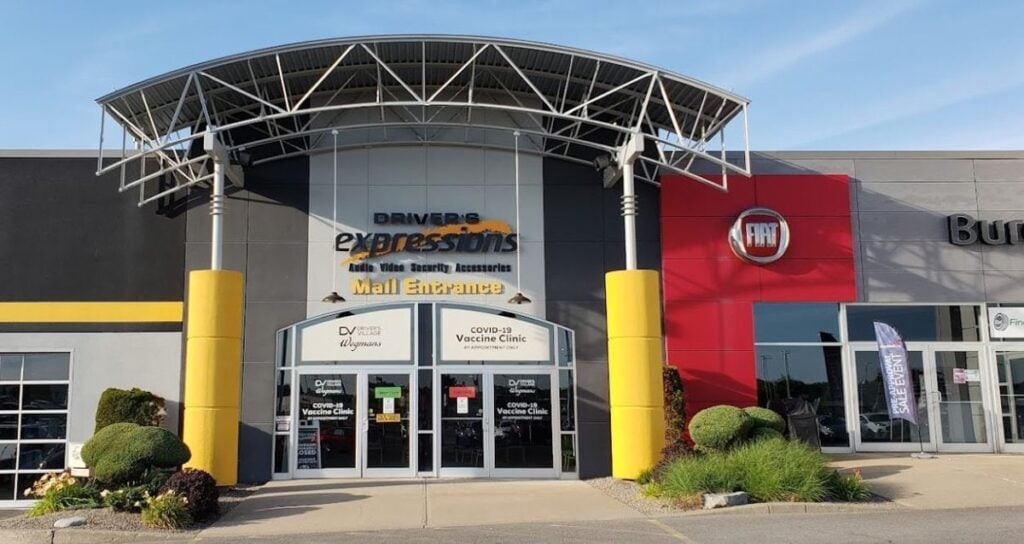
In late 2000, local auto dealer Roger Burdick bought the property and began converting it into an auto mall called Driver's Village.
Robertson Strong Apgar Architects handled the design. The newer east wing from 1986 and the center connection area stayed, while the two side wings were torn down, including the old Sears and Ames wings.
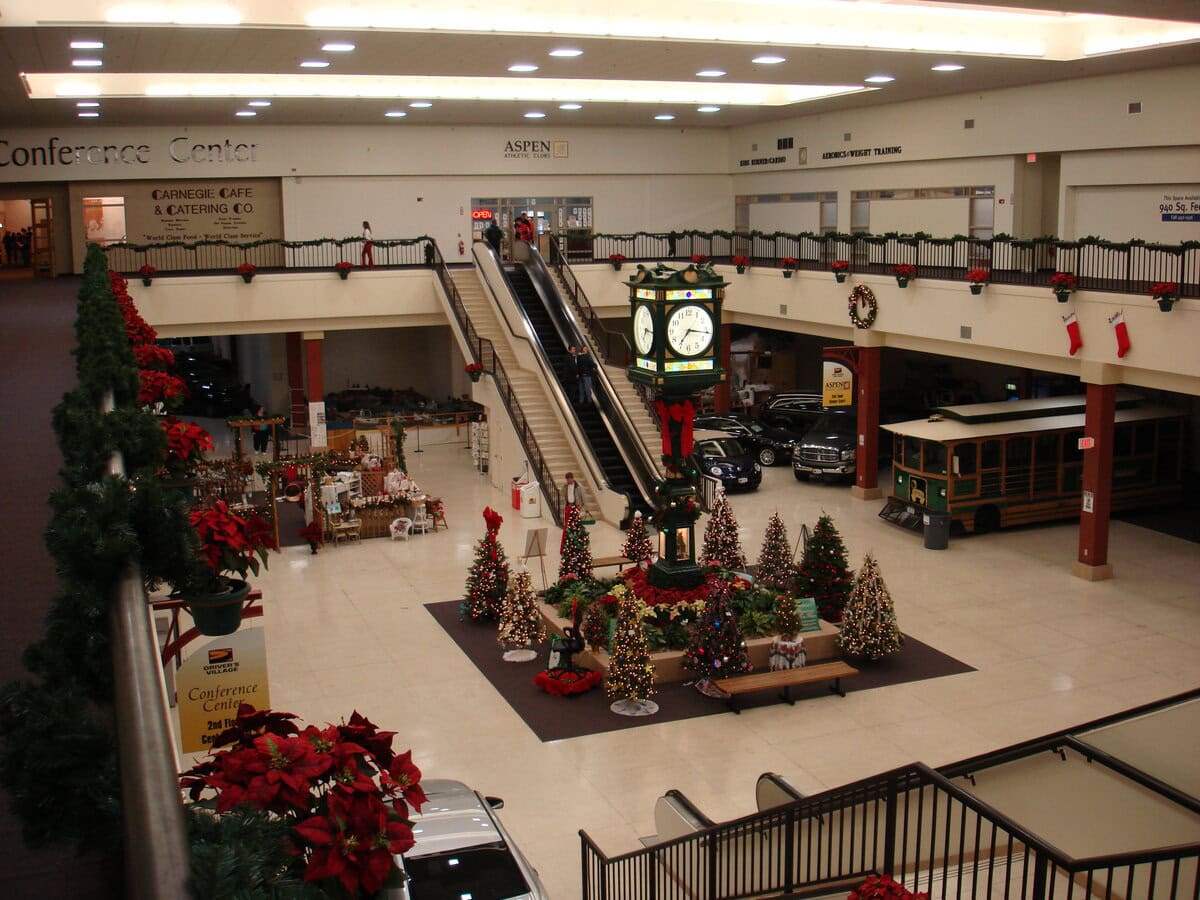
Burdick brought back the center clock, cleaned and reconditioned it, and reinstalled it in 2003.
Driver's Village operates at 5885 East Circle Drive in Cicero, NY.
The main building carries Audi, Buick, Chevrolet, Chrysler, Dodge, Fiat, GMC, Jeep, Kia, Lincoln, Mazda, Mitsubishi, Nissan, Porsche, Ram, and Volkswagen, with BMW, Hyundai, Lexus, and Toyota in separate buildings.
Inside, it also includes a cafe, a catering company, a children's party location, offices for real estate, insurance, financial, tax, and other services, the Aspen Athletic Club, and the Greater Syracuse Sports Hall of Fame.