Biltmore Estate and Its Impossible Existence
Frederick Law Olmsted designed the Approach Road in the 1890s to control how visitors arrive. He wanted the drive to last long enough that you would forget you were headed to a destination.
The road runs about three miles on winding pavement through forest, with trees close on both sides. The canopy mostly blocks distant views, so the Blue Ridge Mountains don't show up until you're much closer to the house.
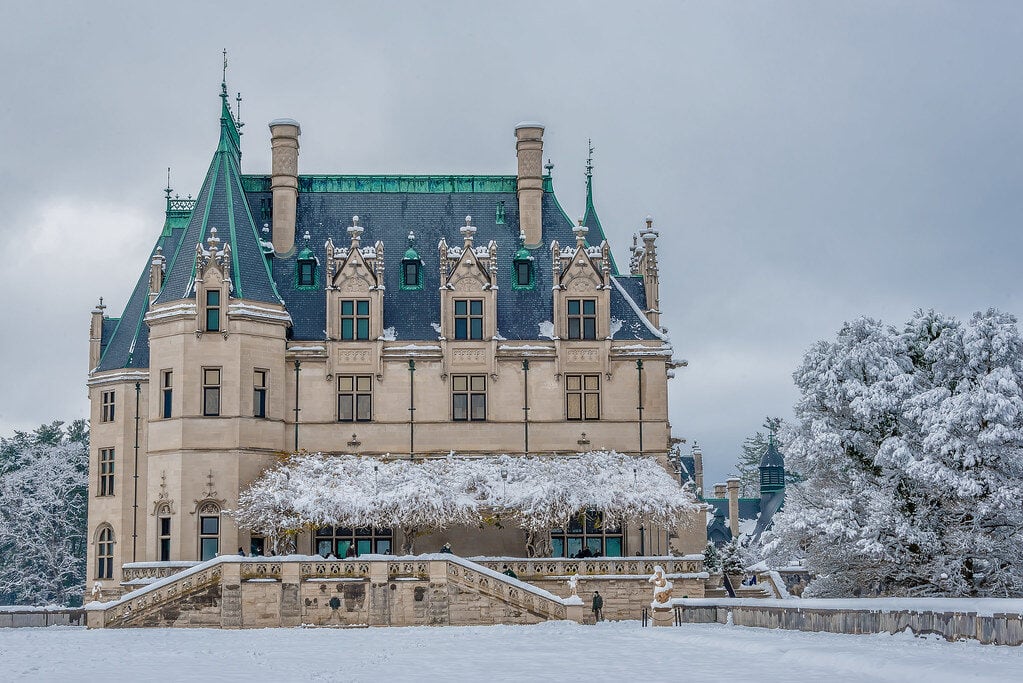
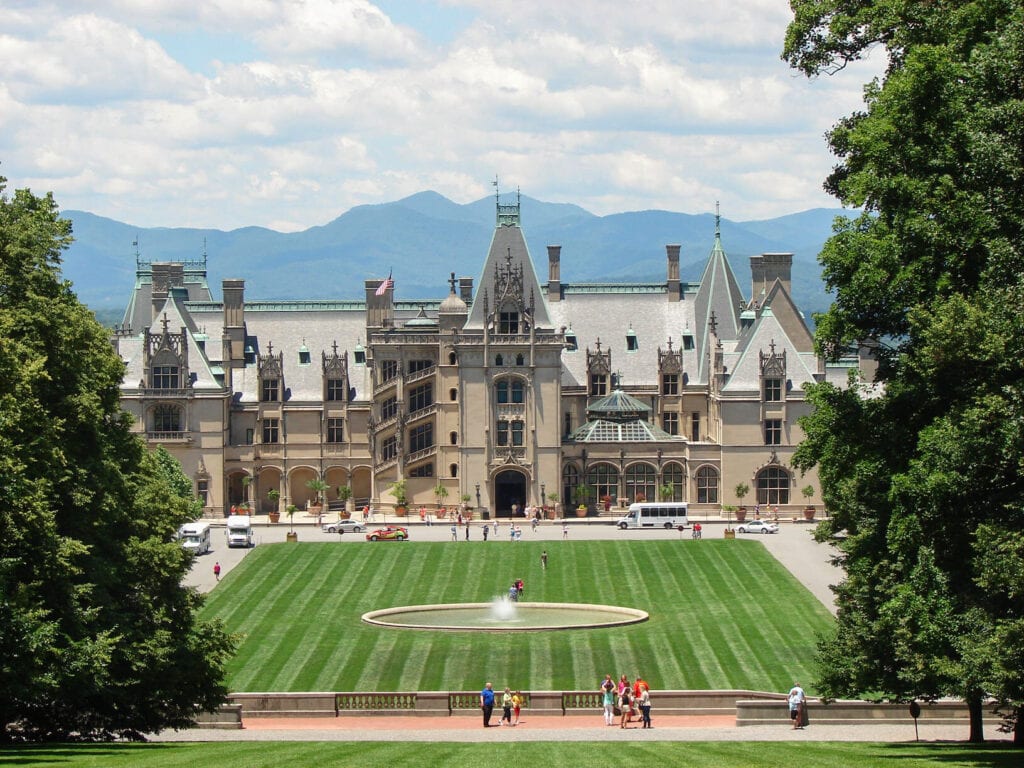
Then, at the top of a rise, the house appears suddenly: a 375-foot-long facade of Indiana limestone. The building is a French chateau set in western North Carolina.
George Washington Vanderbilt began the Biltmore Estate in 1889, even though he had no experience building an estate of this scale and was twenty-six years old.
He called it a "little mountain escape."
Biltmore remains the largest privately owned home in the United States. The estate has shrunk over time as land was sold off, but the Biltmore House itself has remained in the family.
Vanderbilt's descendants still run it through The Biltmore Company. The operation does not receive public funding, and it does not rely on it.
About 1.4 million people buy tickets each year, and they arrive the way Olmsted intended, driving the same road through the trees before the limestone house comes into view.
This Land Was Already Old When He Arrived
This land had a long human history before George Vanderbilt arrived with his architects and land agents.
The point where the French Broad and Swannanoa Rivers meet had been a place where people lived for close to 10,000 years.
Archaeologists have documented continuous occupation across that entire span.
During the Middle Woodland period, roughly 200 to 600 CE, people built an earthen mound at the river confluence, and wooden council structures once stood on top of it.
By the late 1700s, the area was Cherokee territory, and it had been for a long time.
Then the treaties followed. The Treaty of Holston in the 1790s and the Treaty of New Echota in 1835 came during sustained government pressure that forced the Cherokee out.
The removals of 1838 and 1839, known as the Trail of Tears, pushed most Cherokee people west of the Mississippi.
By 1888, other residents lived on the land. One community, Shiloh, an African-American settlement, sat north and east of where the main house would later rise.
About 28 landowners and more than 100 residents lived there. The tract where Biltmore House now stands belonged to Boston A. Jenkins, a reverend and a trustee of the local A.M.E. Zion Church.
Vanderbilt's agents bought the Shiloh parcels for around $37 per acre, which was above the going rate.
The church and cemetery were moved to a nearby site that residents called New Shiloh. The estate's archives note the people who lived there, but most of their individual stories are gone.
The One Vanderbilt Who Didn't Care About Money
Born in 1862 on Staten Island, George was the youngest of William Henry Vanderbilt's eight children and, by any reading of the record, the strange one. He read constantly.
He learned eight languages. He cared about philosophy, art, and architecture in the way that, in another family, might have been encouraged more and funded less.
His grandfather, the Commodore, had built one of the great American fortunes in shipping and railroads. George's idea of a good use of time was browsing European markets for 15th-century tapestries.
He was twenty-six when he traveled to Asheville with his mother in 1888 and decided these mountains were where he wanted to build what he called "a little mountain escape."
He hired Richard Morris Hunt to design the house - Hunt had done the Statue of Liberty pedestal, among other things - and Frederick Law Olmsted for the grounds, the man behind Central Park.
Then all three spent months planning before any stone moved.
Olmsted pushed hard for managed timberland, farm operations along the river bottoms, and an approach road long and winding enough to establish the right feeling before anyone saw the house.
The stated ambition was self-sufficiency, not grandeur - a working estate that, in practice, became both.
Six Years, One Thousand Workers, One House
Construction started in 1889, and the logistics alone give some sense of what Vanderbilt was attempting. A brick kiln went up on site to produce 32,000 bricks a day.
A woodworking shop was built for millwork. A three-mile railroad spur was laid entirely to bring materials in.
Indiana limestone was shipped from out of state. About 1,000 laborers and 60 stonemasons worked for six years, and while all of this was happening, Vanderbilt and Hunt were in Europe, buying.
They came back with tapestries, carpets, prints, and decorative objects, with items from the 15th century next to items from the 19th.
The total cost came to about $5 million, which is somewhere around $194 million in today's money.
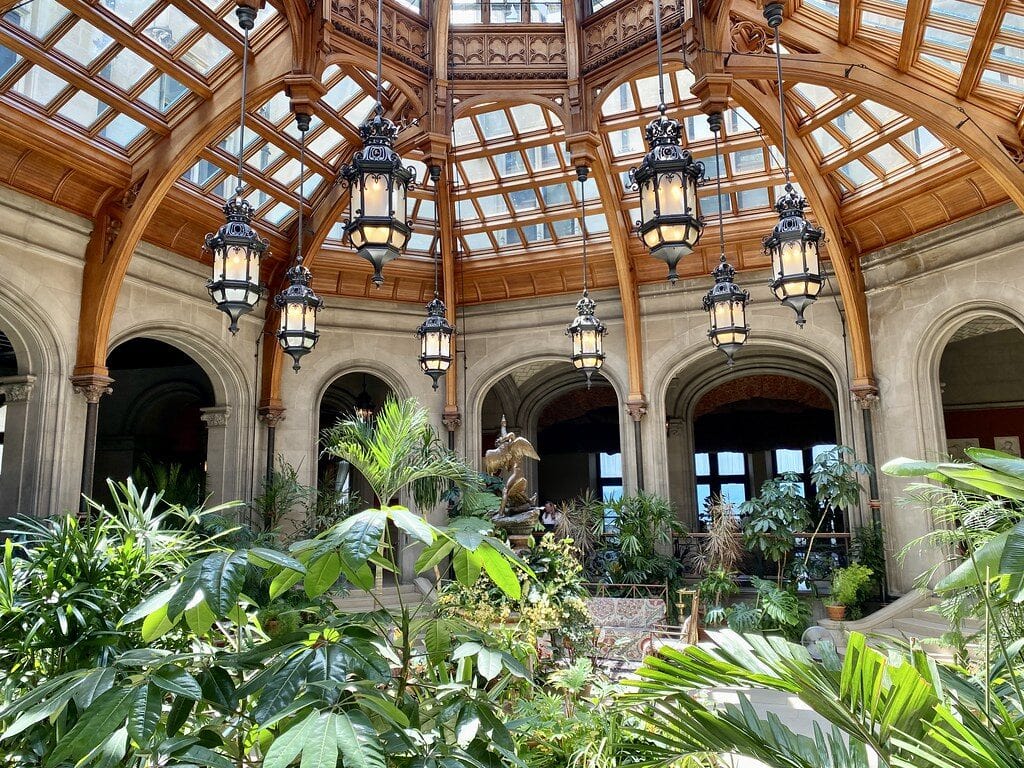
The finished house had 250 rooms, 35 bedrooms, 43 bathrooms, and 65 fireplaces. The Banquet Hall ran 72 by 42 feet under a 70-foot ceiling, with Flemish tapestries on the walls.
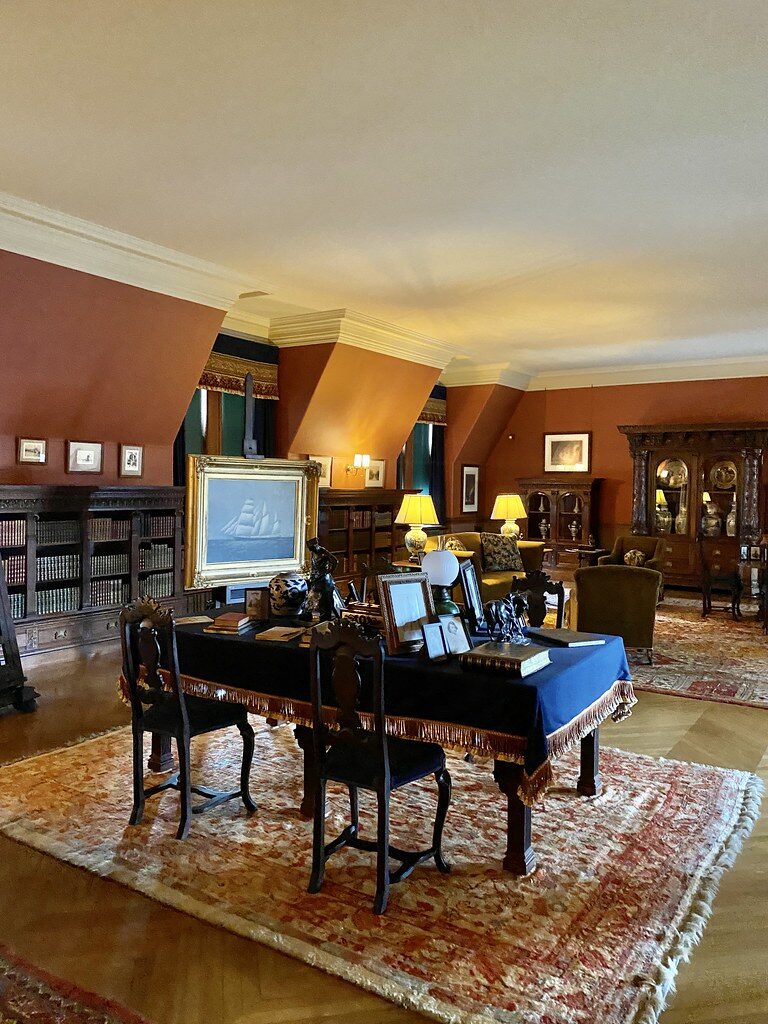
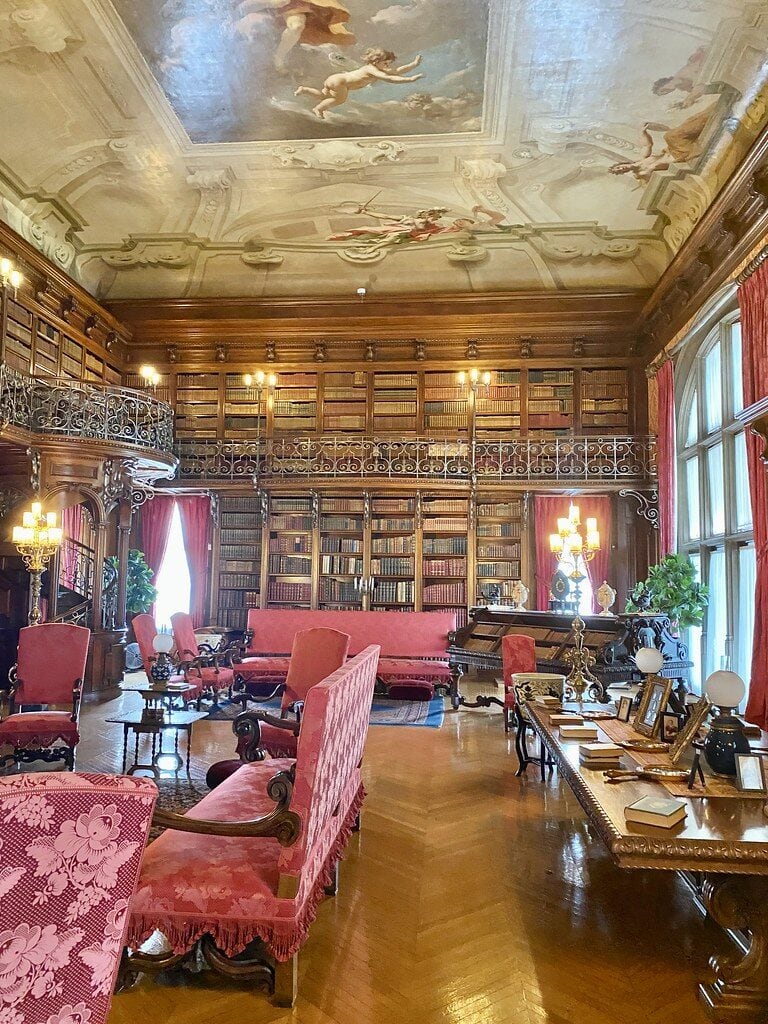
The Library held more than 10,000 books in eight languages, and a cantilevered staircase climbed 107 steps beneath a chandelier with 72 bulbs.
Somewhere in the basement: a 70,000-gallon swimming pool, a bowling alley, a gymnasium.
From the first day of operation, the house had electricity, forced-air heating, Otis elevators, fire alarms, and telephones in 1895.
Vanderbilt opened the doors on Christmas Eve to family and close friends, and every employee's child received a gift that night.


Marriage, Children, and a Death Too Soon
George Vanderbilt married Edith Stuyvesant Dresser in Paris on June 1, 1898. They held a civil ceremony that day, followed the next morning by a church service at the American Church of the Holy Trinity.
They honeymooned in Italy, then returned to Asheville. When they arrived, estate employees had laid out the words "Welcome Home" in goldenrod flowers along the Approach Road.
They also made a horseshoe-shaped display of blooms large enough that it took planning.
Their daughter, Cornelia Stuyvesant Vanderbilt, was born in the Louis XV Room on August 22, 1900. The society pages covered the birth as major news.
George built the estate to be as self-sufficient as possible. Gifford Pinchot managed the forests using scientific forestry methods.
Carl A. Schenck took over after him and, in 1898, founded the Biltmore Forest School on the property, the first professional forestry school in the country.
Farms on the lower land raised dairy cattle, poultry, and hogs.
In 1901, Eleanor Vance and Charlotte Yale began teaching craft skills (starting with woodworking) to local youth in Biltmore Village.
By 1905 the program had expanded to include weaving, and in 1906 it was incorporated as Biltmore Estate Industries.
George died in March 1914. He was 51 and had entered the hospital for an appendectomy. Cornelia was 13 at the time.
He left the estate in trust to her. Edith then sold about 87,000 acres to the U.S. Forest Service for under $5 an acre. That land became the core of what is now Pisgah National Forest.
Depression, War, and 80 Works of Art
Cornelia married John Francis Amherst Cecil, a British diplomat, on April 29, 1924, at All Souls Church in Biltmore Village.
They had two sons, George Henry Vanderbilt Cecil and William Amherst Vanderbilt Cecil. Both were born in the Louis XV Room, the same room where their mother had been born, in 1925 and 1928.
The estate continued to run, but by the late 1920s, it was earning much less.
In March 1930, the Cecils opened the house to paying visitors because the city of Asheville asked them to.
The Depression was squeezing the local economy. Civic leaders wanted tourism, and admission fees would help the estate cover its costs.
This was a business decision. It permanently changed what Biltmore became.
During World War II, the house was used for a second purpose. In 1942, the National Gallery of Art in Washington packed up 62 paintings and 17 sculptures and shipped them to Asheville.
The group included Gilbert Stuart's portrait of George Washington. The East Coast felt exposed, so the works were stored at Biltmore in the Music Room. They stayed there until 1944.
Cornelia and John divorced in 1934. She moved overseas, while he stayed in the Bachelors' Wing until his death in 1954. Many years later, their younger son William, came back with a clear vision for the estate.


How William Cecil Saved What His Family Built
William Amherst Vanderbilt Cecil came back to Biltmore in 1960 after years in New York banking. He was not sentimental about what he found.
The estate needed to pay its own way, or the accumulated cost of maintaining it would eventually win. He intended to prevent that.
His biggest move turned out to be wine. He planted the first grapevines in 1971.
This was not an obvious bet - western North Carolina was not known for viticulture. The old dairy barn became a winery by 1983 and opened to the public in 1985.
The Biltmore Winery is now among the most visited in the country. People who hear that for the first time usually look skeptical, then look it up.
A 210-room inn opened in 2001, realizing plans George Vanderbilt had drawn around 1900 and never built.
Cottages for overnight stays began in 2005. Antler Hill Village - shops, dining, a working farmyard - opened in 2010. The Village Hotel followed in 2015.
William's son Bill Cecil Jr. became President and CEO in 1995, the centennial year. William died in 2017 at 89. His daughter, Diana Cecil Pickering, took over as Chair of the Board.
The company now employs more than 2,000 people, pays its own property taxes, and funds all preservation work without outside money.
Still Standing After a Hard Few Years
The estate is always being repaired and cared for following national rules for historic places.
The Smoking Room and Gun Room now look just like they did in 1895. Anders Zorn's painting "The Waltz" was carefully restored in 2024.
The Stable Courtyard was rebuilt one brick at a time using materials that match the original. In 2022, workers rebuilt an island in the Bass Pond using Olmsted's original design notes.
Tropical Storm Helene hit western North Carolina in September 2024. Fields at the estate that are lower down flooded, and the group sales office was damaged.
The house, the greenhouse, and the winery were not badly hurt. Biltmore Estate reopened on November 2, 2024, just in time for Christmas, and promised $2 million to help the area recover.
Today, the property covers about 8,000 acres divided by the French Broad River.
Nearly 1.4 million people visit each year, exploring over 60 restored rooms, walking through 75 acres of beautiful gardens, tasting wine made on the estate, and sometimes staying in rooms where Vanderbilt's guests once stayed.
George Vanderbilt built this place and called it a little mountain escape. For 130 years, through loss, tough times, breakups, and storms, the people who followed him have kept it going and made it even better.