Penn Square Mall breaks ground and rises
Plans for a major northwest Oklahoma City shopping complex were first envisioned in 1952. Ground broke on November 5, 1958, on a 55-acre site at the corner of the NW Urban Bypass and N Pennsylvania Avenue.
Developer Ben C. Wileman formed a joint venture with Anderson-Rooney Operating Company, and Sorey, Hill & Sorey designed the center to avoid the uniform storefront look that dominated early malls at the time.
Penn Square was planned as seven separate buildings with different brick types and colors, and storefront styles that ranged from Old English to rustic to modern.
Six buildings wrapped a central park-like courtyard with raised planters, seating, and a stage for live performances.
The seventh building, Ward's Auto Service, stood alone on the southeast corner of the property.
The finished center measured 582,000 sq ft and came with a 35-acre parking lot for up to 4,500 cars.
1960 opening day and the first lineup
A mall-wide grand opening was held in March 1960.
Mrs. James H. Norick was presented with a Key to Penn Square, and a 30-minute concert included the "Penn Square Song."
At the west and south entrances, hexagonal canopies - described as inverted umbrellas - shaded the walkways as shoppers entered an open-air center that housed forty-six stores and services.
Two-level anchors framed the site: John A. Brown, 128,000 square feet on the southwest, and Montgomery Ward, 206,000 square feet on the southeast.
Charter stores and services included Lerner Shops, Peyton-Marcus, Campbell's Hobby House, Sir's London Shop, Valgene Restaurant, the British Import Shoppe, and Paris Shoe Repair.
Other charter tenants included a two-level Rothschild's at 30,800 square feet, a two-level S.S. Kresge 5 & 10 at 37,800 square feet, and a Humpty Dumpty supermarket at 31,300 square feet.
It was an early mix of department-store gravity and small daily conveniences, built for people who wanted everything in one stop.
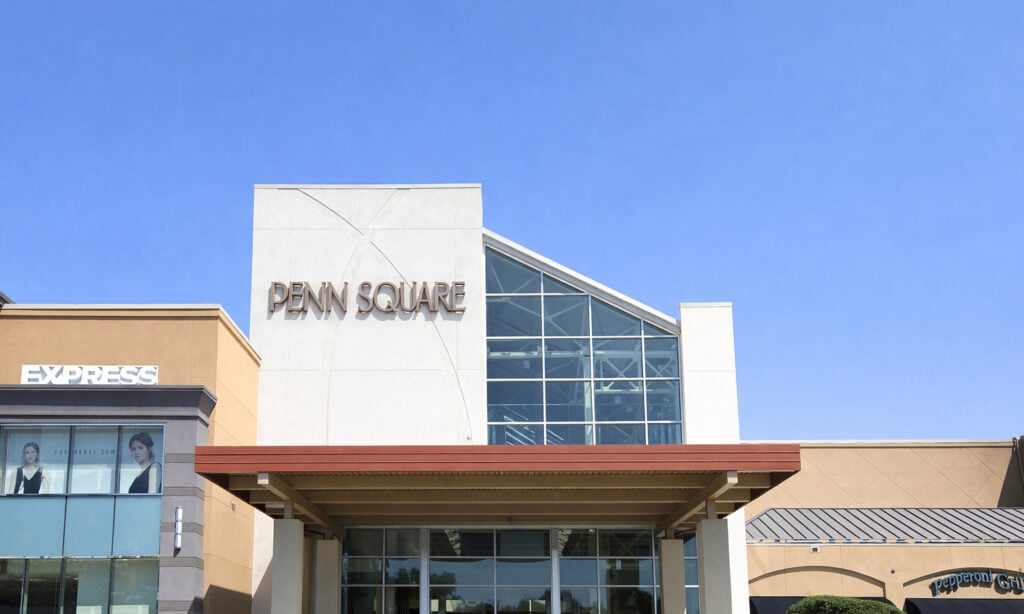
Landscaping, events, and the first rivalry
Penn Square treated its outdoor space like part of the attraction. Courts and concourses were planted with 10,000 trees and other plants.
In spring and summer, tropical plants were installed. Central Square held a reflecting pool and fountain and a 26-foot-high abstract sculpture by Oklahoma City artist J.B. Thompson.
The courtyard stage quickly became a community platform. The center hosted a First Christian Church choir concert in the 1960s, an arts festival in 1973, and a National Record Breaking Day contest in 1976.
The mall was growing in tenant square footage as well: Rothschild's expanded in 1966 and 1967.
Aerial photos from the late 1960s and 1970s tracked the mall's growth, and one local account noted that the parking lot held nearly as many out-of-state cars as local ones by the late 1960s.
In February 1974, Crossroads Mall opened in Oklahoma City as an enclosed competitor.
It was described as one of the ten largest malls in the country, with air-conditioning built into the appeal. Planning to enclose Penn Square began after Crossroads opened.
Penn Square Bank grows, then collapses in 1982
Penn Square Bank opened inside the mall in 1960 with a drive-up window that let customers handle transactions without leaving their cars.
In 1975, William Paul "Bill" Jennings bought the bank and moved it into oil exploration and drilling finance.
The bank made loans, then sold shares in those loans to other banks. It charged a fee to split incoming payments among the participating banks based on their share.
Assets rose from $30 million in 1977 to more than $435 million by 1982 as the bank expanded its high-risk energy lending.
It originated more than $2 billion in participation investments, pushing exposure far beyond Oklahoma.
Penn Square Bank failed on July 5, 1982, during the oil glut. Customers formed long lines to recover deposits.
Over the Fourth of July weekend, the closure was set up, and a new bank was formed so the Federal Deposit Insurance Corporation could pay the $207 million due to insured depositors.
The failure spread through the banking system nationally and fed into Oklahoma's economic bust.
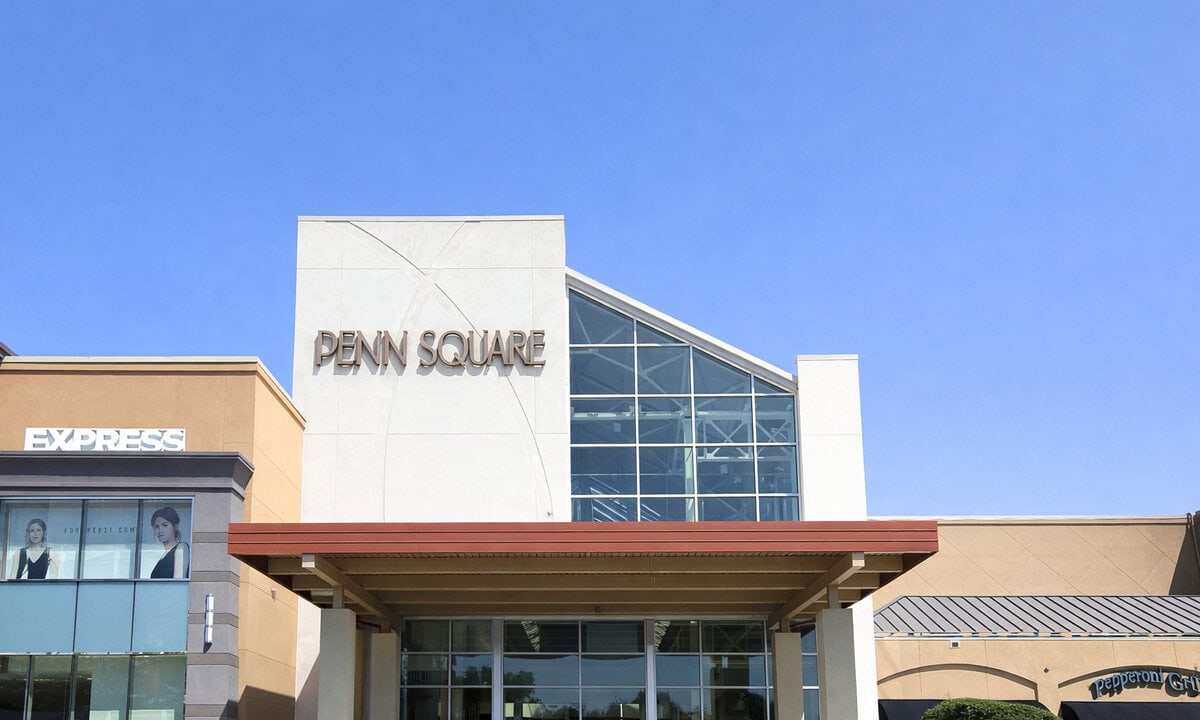
Enclosure, renaming, and 1984 rebranding
Quail Springs Mall opened on October 23, 1980, and Penn Square's open-air format no longer fit the new competition.
In 1980 and 1981, a $3 million renovation enclosed Penn Square, increased its size to 637,000 square feet, and renamed it Penn Square Mall.
New early enclosed-era tenants included Gordon's Jewelers, Harzfelds, Catherine's Stout Shop, Extension 1, and Naturalizer Shoes.
The center moved from outdoor sidewalks and courtyards into interior corridors, and the shopping trip stopped depending on the weather.
Al Rosenthal's, a high-end Park Avenue junior department store, opened a branch at the mall in 1960.
The two-store chain was rebranded as Gus Mayer in 1969. In 1974, the branch converted to Harzfeld's. The store closed in 1984, ending a tenant line.
The anchor identity changed as well. In September 1984, John A. Brown was rebranded as Dillard's, replacing a local department store name with a national chain flag.
The newly enclosed mall moved toward its next expansion cycle.
1986-88 renovation adds a second level and food court
In September 1985, Penn Square Mall was sold to JMB/Federated Realty. They laid out an expansion plan that would take the property from 588,000 square feet to about 950,000 square feet by fall 1987.
The project took longer than expected, lasting from 1986 to 1988.
The expansion changed the building in obvious ways. It added a second level, created a food court, and brought in a third anchor.
In March 1988, the rebuilt mall was re-dedicated at 1,122,000 square feet with 160 stores, committed to the two-story enclosed format rather than the earlier, smaller version.
Construction did not stop the usual public activities at the mall. Lionel Hampton performed at Penn Square in 1986.
This period also had its own look on the floor. In the 1980s, fashion favored shoulder-padded styles inspired by "Dallas" and "Dynasty," and Penn Square sold a lot of these clothes while the mall was getting bigger.
1988 stores, food court, Foley's, and cinema opens
The 1988 expansion brought a new wave of tenants into Penn Square Mall.
New stores included Victoria's Secret, The Limited, Camp Beverly Hills, Units, The Oak Tree, Bacharach, The Sharper Image, The Bombay Company, and B. Dalton Bookseller.
The food court lineup included Chick-fil-A, Taco Bell, Cozzoli's Pizza, Hot Dogs & More, Gyros & Pida, and Chao Prayua.
Foley's opened as a 161,000-square-foot anchor in the expanded mall and added another major department store draw.
General Cinema Corporation's Penn Square Mall 8 opened in May 1988, showing its first features near the end of the expansion program.
The theater added a steady evening crowd alongside the daytime traffic.
1992-2018 anchors, upgrades, and outparcels
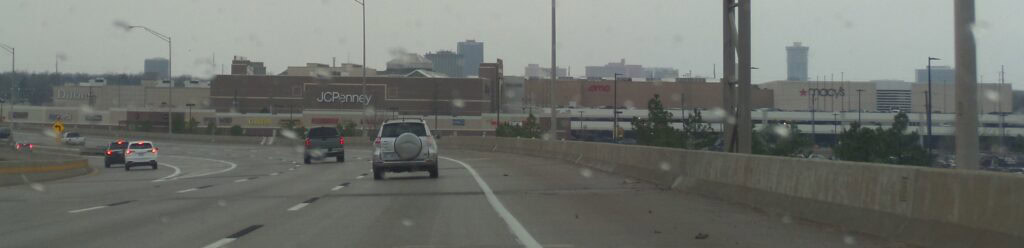
In 1992, Rothschild's was acquired by Dillard's and closed, and Dillard's expanded to 234,000 square feet. In 1995, JCPenney opened as a fourth anchor at 124,700 square feet.
The cinema expanded to a 10-plex in 1998. In 2000, Penn Square spent $10 million on a facelift that brought new flooring, lighting, and seating.
Belle Isle Station opened next door in 2000 with retailers including Walmart Supercenter, Old Navy, Linens 'n Things, Babies R Us, Shoe Carnival, and Ross Dress for Less.
Montgomery Ward closed in March 2001. Simon Property Group acquired Penn Square in February 2002 and owns 94.5%.
Dillard's East opened May 30, 2002, in the former Ward space at 132,500 square feet, and Dillard's West was dedicated August 14, 2002, at 170,600.
Foley's was rebranded as Macy's on September 9, 2006, and The Cheesecake Factory opened outside the mall on September 19, 2006.
Six entrances were rebuilt in 2007 and 2008. In 2012 and 2013, the food court and restrooms were refurbished, and the cinema reopened as AMC Penn Square 10 on May 1, 2013, with stadium seating.
Linens 'n Things went bankrupt in the late 2000s, and Nordstrom Rack opened in its place on September 12, 2013.
The Container Store opened in the parking lot on September 15, 2018.
In March 2018, it was announced that Babies R Us would close permanently after the Toys R Us bankruptcy, and the space was replaced the next year by REI and Five Below.
2025 refresh and 65th anniversary changes
Simon acquired Penn Square in 2002, when sales were about $400 per square foot. By 2018, sales topped $700 per square foot.
In 2025, Penn Square celebrated its 65th year with updates inside, such as new white paint on the upper level and a new skylight in the atrium.
Several new stores opened, including OFFLINE by Aerie, Johnston & Murphy, Garage Clothing, Alo Yoga, and Burger King in the food court.
American Eagle reopened in late August, and Foot Locker was expected to open later in 2025. Spunkie's Soul Food closed its food court spot on December 28, 2025.
Penn Square Mall operates at 1901 NW Expressway as a two-story mall with 1,084,000 square feet. The mall lists more than 150 stores.
The anchors are AMC Theatres (37,600 square feet), Dillard's East (132,500), Dillard's West (170,600), JCPenney (about 125,000), and Macy's (about 160,000).
Penn Square Mall feels like a busy, popular place that still works well most days, with enough big stores and smaller shops to keep it lively.
The inside looks cared for instead of fancy, and the crowds can make it feel more crowded than it really is, especially near the food court.
A few empty stores and times when the escalator is not working make it look less perfect, and parking can be a hassle when it is busy. Overall, it is a solid mall, in good condition, and usually worth visiting.