
Scranton is easiest to misread when the housing price comes first.
U.S. Census Bureau estimates for 2020-2024 put the median value of owner-occupied housing at $158,100 and median gross rent at $1,048, both well below comparable citywide figures for Philadelphia, Newark, and New York City.
But cheap housing is not the lifestyle. Scranton is a smaller Northeast city with a different job market, entertainment scale, historic character, and daily routine.
Scranton works best for people who actively want that smaller scale. It is much less convincing for someone hoping to keep a big-city life while merely lowering the housing bill.
The affordability is real, but it comes with a different economic scale
The housing gap is large enough to matter.
For 2020-2024, the Census Bureau reported median owner-occupied home values of $243,100 in Philadelphia, $373,700 in Newark, and $777,600 in New York City.
Scranton's $158,100 figure was $85,000 below Philadelphia's, $215,600 below Newark's, and $619,500 below New York City's.
Those are citywide Census measures, not current listings or matched-home comparisons.
They show the scale of the housing difference, not what a specific buyer will save.
Scranton's median household income was $50,739 in 2020-2024.
At the wider Scranton-Wilkes-Barre metropolitan level, the Bureau of Labor Statistics reported a mean hourly wage of $27.31 in May 2025, versus $33.54 nationally.
Lower housing costs therefore do not automatically mean unusually easy finances for someone who will depend on the local labor market.
The bargain looks different for a remote worker bringing outside income than for someone changing both city and employer.
Remote workers can get more from Scranton than local-job seekers
Scranton is especially logical for a remote worker whose career does not depend on finding the next job nearby.
Census data show that 84.1% of Scranton households had a broadband internet subscription in 2020-2024, but that does not guarantee service quality at a particular address.
Remote workers should verify the exact provider, speed, upload performance, and backup options.
The local career market has its own shape.
In May 2025, transportation and material-moving jobs accounted for 15.4% of employment in the Scranton metro, while production accounted for 8.2%, office and administrative support 11.3%, healthcare practitioners and technical occupations 7.1%, and healthcare support 6.1%.
Some white-collar categories were less concentrated than they are nationally.
Computer and mathematical occupations made up 1.5% of local employment versus 3.4% nationwide; business and financial operations were 4.3% locally versus 6.8% nationally.
Career fit is therefore field-specific. A remote software employee and a warehouse supervisor are evaluating different versions of the same place.
People who like old Northeast cities have something real to work with
Scranton's historic character is not just a nickname or tourism theme.
The National Park Service preserves Steamtown National Historic Site in the former Delaware, Lackawanna and Western Railroad yard in downtown Scranton.
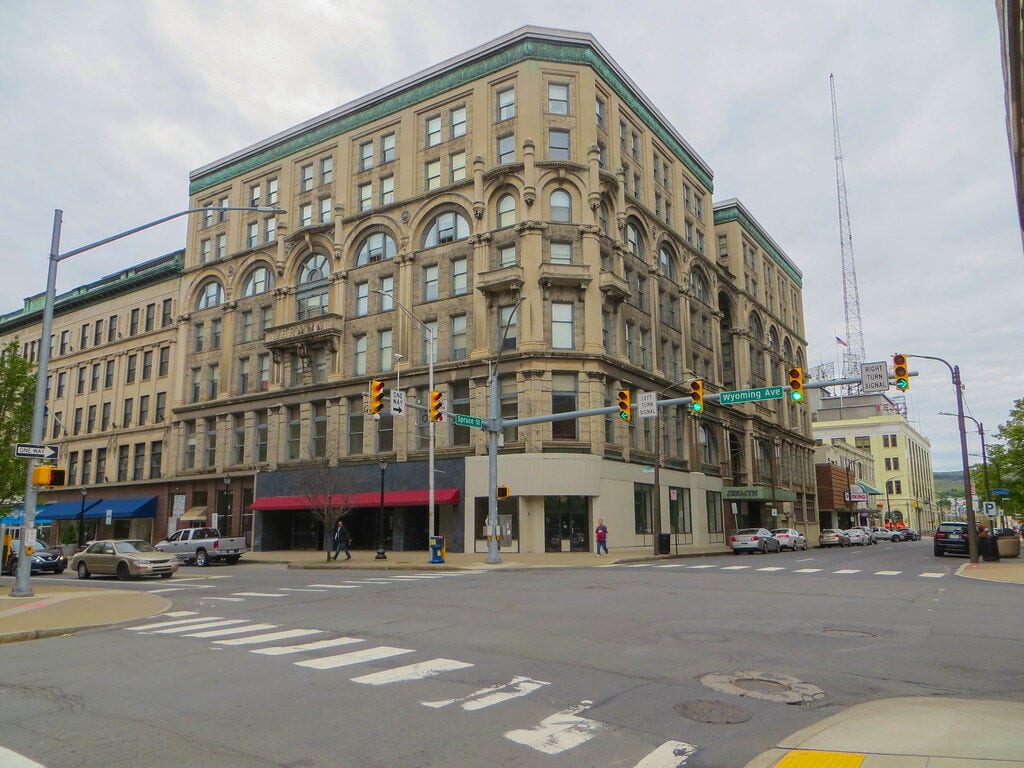
NPS records also document downtown buildings such as the Romanesque Dime Bank Building from 1890-1891, the Gothic municipal building from 1888, and the later Gothic Revival Masonic Temple and Scottish Rite Cathedral.
That matters if you want older masonry, established street grids, civic buildings, industrial remnants, and homes outside the new-subdivision pattern.
If an older house is part of the attraction, inspect the actual structure and its major systems carefully.
Purchase price, renovation appetite, and maintenance tolerance belong in the same decision.
Scranton is a better fit for someone who enjoys living around visible history than for someone who wants everything new, uniform, and low-maintenance.
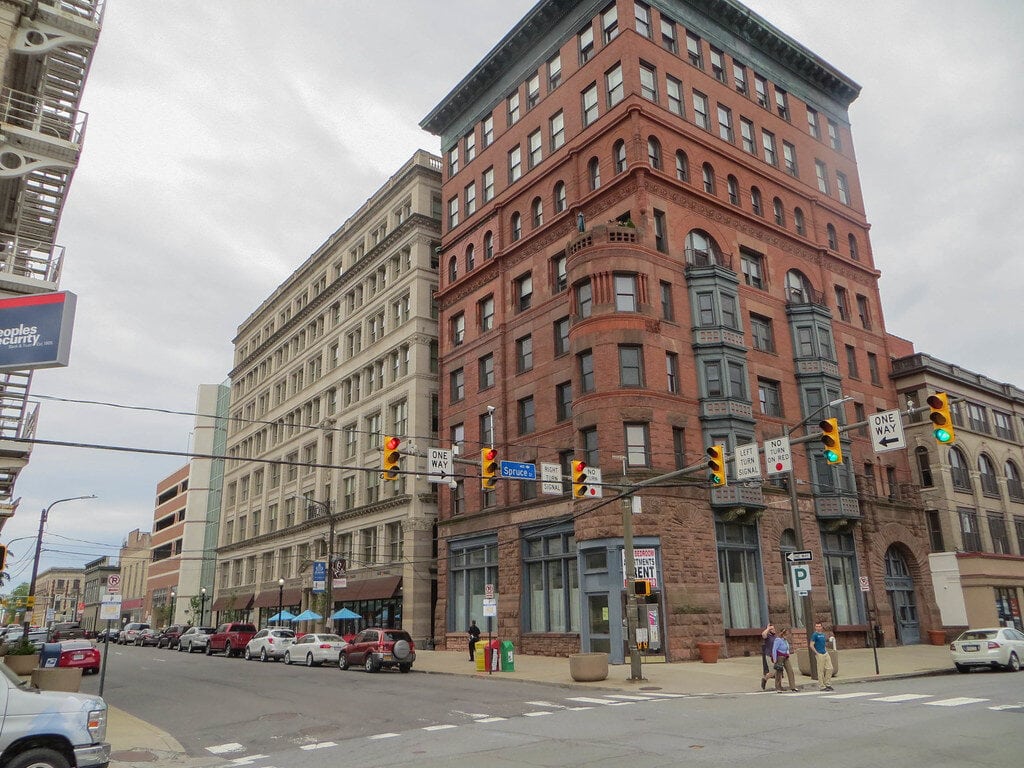
Neighborhood life matters more here because the city is not a giant entertainment market
Scranton's 2025 population estimate was 75,514. Philadelphia was above 1.5 million, and New York City was above 8 million.
That scale difference should shape expectations before moving.
A smaller city can support restaurants, bars, colleges, local events, and familiar neighborhood places without producing the constant churn of choices found in a much larger metro.
This is where Scranton either feels comfortable or limiting.
If your ideal Friday is dinner at a familiar place, drinks with friends, or a local event, smaller scale can feel personal rather than dull.
If you want multiple nightlife districts and a packed calendar, low housing costs will not replace that routine.
Do not ask whether Scranton has "things to do." Ask how many different things you need within a normal month.
Car-free living needs an address-level test
Scranton can look compact on a regional map, but the city has 25.31 square miles of land.
The mean commute for workers age 16 and older was 19.3 minutes in 2020-2024.
Neither figure tells you whether your particular life works without a car.
A downtown apartment near work and groceries can create a very different one-car routine from a house where daily destinations point in separate directions.
Before moving without two cars, test the exact week.
Try the commute, grocery run, pharmacy trip, evening outing, and bad-weather backup from the address you are considering.
Do not substitute a citywide "walkable" label for those routes.
A remote worker may find a one-car household much easier because one daily commute disappears.
Someone with an off-site job and frequent regional trips may reach the opposite conclusion.
New York and North Jersey newcomers should not confuse map distance with lifestyle continuity
Scranton is connected to the broader Northeast road network, and National Park Service directions from points east route travelers through I-80 or I-84, I-380, and I-81.
That regional access is useful. It does not make Scranton an outer neighborhood of the New York metro.
A newcomer who expects regular New York or North Jersey trips should count them before treating Scranton's housing gap as savings.
The question is whether you want that travel to remain part of ordinary life.
Occasional big-city weekends fit the Scranton model much better than trying to recreate a metropolitan routine from a cheaper home base.
Who is most likely to love Scranton?
Scranton is strongest for someone who wants a smaller historic city on purpose: a remote worker who values housing flexibility, a household comfortable building social life around familiar local places, someone attracted to older urban architecture, or a person whose career fits the region's healthcare, logistics, production, office-support, or related employment base.
It is a weaker fit for someone who needs a deep local market for specialized white-collar jobs, expects a car-free routine without choosing the address carefully, or measures quality of life by the number of new restaurants, late-night options, and major-city events available every week.
The final test is simple. Imagine Scranton with the housing price hidden.
Would you still want the smaller city, the historic fabric, the local-scale social life, and the need to plan bigger-city trips rather than live inside them?
If the answer is yes, the lower housing cost is a meaningful bonus.
If the answer is no, affordability may stop feeling like an advantage surprisingly fast.


Sources and further reading
- U.S. Census Bureau QuickFacts: Scranton city, Pennsylvania
- U.S. Bureau of Labor Statistics: Occupational Employment and Wages in Scranton-Wilkes-Barre, May 2025
- National Park Service: Steamtown National Historic Site history and culture
- National Park Service: Dime Bank Building National Register record
- National Park Service: Scranton Municipal Building National Register record
- National Park Service: Masonic Temple and Scottish Rite Cathedral National Register record
- National Park Service: Directions to Steamtown National Historic Site
- U.S. Census Bureau QuickFacts: Philadelphia city, Pennsylvania
- U.S. Census Bureau QuickFacts: Newark city, New Jersey
- U.S. Census Bureau QuickFacts: New York city, New York
Independent Publisher Notice
BestAttractions is an independent editorial publisher. We are not affiliated with, endorsed by, or acting on behalf of any location, business, property owner, manager, government agency, or organization described in this article.
Comments posted on this page are not forwarded to, reviewed by, or acted upon by any entity mentioned in the article.
For official inquiries, complaints, applications, bookings, or other requests, please contact the relevant entity directly through its official website or other verified channels.