
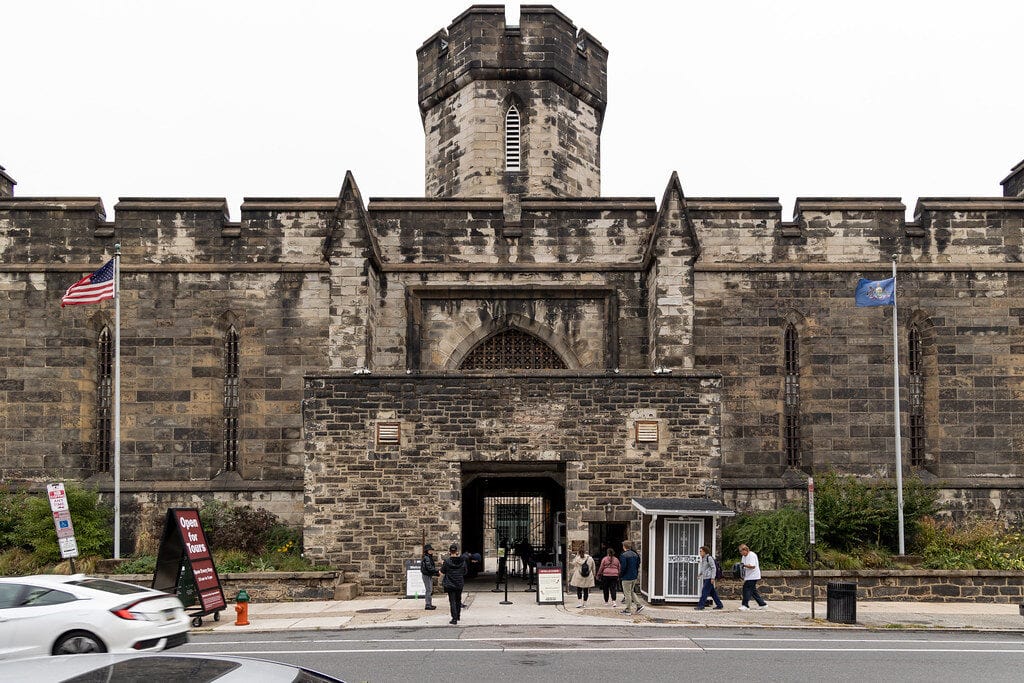
The State Penitentiary for the Eastern District of Pennsylvania took its first prisoner in October 1829, on a walled site northwest of central Philadelphia, Pennsylvania.
Stone walls 30 feet high enclosed seven cellblocks running out from a central observation room. The design was meant to keep prisoners from seeing each other. Prisoners talked through holes beside the hot-water pipes.
Pennsylvania abandoned that system in 1913, and the population climbed to 1,700 by the mid-1920s. Pennsylvania closed Eastern State in 1970 over repair costs. The city took title in 1980 and looked for a buyer. Mayor Wilson Goode stopped the sale in 1988.
Now it's Eastern State Penitentiary Historic Site, open daily. Much of it is left as a ruin, and a $2.7 million welcome center campaign reached 90 percent of its goal in March 2026.
What Eastern State was built to do
Benjamin Rush wanted Pennsylvania to stop whipping people in public.
In 1787 he and Benjamin Franklin helped found a society to relieve the miseries of public prisons, arguing that a man locked up alone would think his way to reform.
Pennsylvania tried that at the Walnut Street Jail in 1790, and crowding wrecked it within a decade.
The reformers petitioned for a purpose-built prison in 1801 and waited 20 years for the money.
A commission picked John Haviland's design on May 24, 1822.
The cornerstone went down the following May on farmland called Cherry Hill, now 2027 Fairmount Avenue.
Haviland put an observation room at the center and ran seven cellblocks out from it, so one guard could look down every corridor without walking it.
Outside was a fortress: stone walls 30 feet high and a gate with an iron portcullis.
The State Penitentiary for the Eastern District of Pennsylvania cost $772,600, one of the most expensive public buildings in the young United States.
23 hours a day, alone in one cell
The first prisoner walked in on October 25, 1829, with construction still going on.
His cell was 12 feet long and 8 feet wide, with a skylight, heat, running water, a toilet, and a private yard.
Food and work came through an opening in the wall.
For most of the 1800s, a man spent about 23 hours a day in that room.
Prisoners made shoes, wove cloth, and caned chairs, work meant to teach a trade and cover the bills.
It never paid like New York's Auburn system, where prisoners worked together by day. Running dozens of one-man workshops cost more.
Guards hooded prisoners when they moved them, so nobody learned the layout or recognized a face.
That lasted until 1903. Separation never fully held. Men tapped through the walls and passed notes through the plumbing.
The iron gag and what Dickens saw
In 1833 officers punished Mathias Maccumsey for speaking by locking an iron gag on his tongue with his arms bound behind his back.
He died. Officials were cleared, and the attempt to hide what happened did the lasting damage.
Supporters called isolation humane next to the whip and the corrupting mix of a congregate prison.
Critics tied it to mental illness, and the prison's own physicians recorded cases of insanity, though their readings rested on racial prejudice and medical assumptions nobody accepts now.
Charles Dickens came through in 1842 and called the regime "rigid, strict and hopeless solitary confinement."
Officials from abroad kept visiting anyway, and Haviland's plan was copied by prison builders in the United States and Europe.
Crowding broke the separate system
Pressure showed up before the complex was finished, so later wings went up two levels and a plan for 250 prisoners became room for 400.
Cells were shared long before policy caught up, and Pennsylvania gave up the separate system in 1913.
By the mid-1920s, 1,700 people were inside. The prison ran like any other after that.
New construction filled the gaps between Haviland's wings until there were 15 cellblocks, the last started in 1956.
Women were held here from the early 1830s until 1923, roughly a thousand of them.
Nearly 85,000 people passed through in 142 years, Black prisoners overrepresented from the early decades on.
Two names stuck. Al Capone spent part of 1929 here, and staff still test the story of his comfortable cell against the physical evidence.
Willie Sutton got further. In April 1945, he came up out of a 97-foot tunnel under the wall and was back in custody the same day.
Repair crews had already found other tunnels, unfinished, under the yards.
The first synagogue in an American prison
A building designed to stop people gathering began letting them gather.
Jewish prisoners were allowed to hold ceremonies in the emergency hospital in 1913.
A prisoner-led Passover Seder was documented in 1917. By 1922, they were using a former weaving shop and a piece of yard.
The Philadelphia philanthropist Alfred W. Fleisher pushed to make it permanent.
Prison rabbi Isaac Feinberg worked with local design firms on a formal plan in 1928, and incarcerated craftsmen, among them Jacob Forbes and David Goldman, did the work.
Fleisher did not live to see it finished. The completed room took his name, and it was the first dedicated synagogue in an American prison.
Trees grew inside the empty cellblocks
Eastern State was named a National Historic Landmark on June 23, 1965, while people were still serving sentences in it.
Pennsylvania shut the prison down in 1970 over deterioration and repair costs.
City prisoners were held here briefly in 1971 after trouble at Holmesburg. Then the place emptied out.
Philadelphia took title in 1980 and went looking for a buyer. Developers pitched condominiums and a shopping center. Nothing got built.
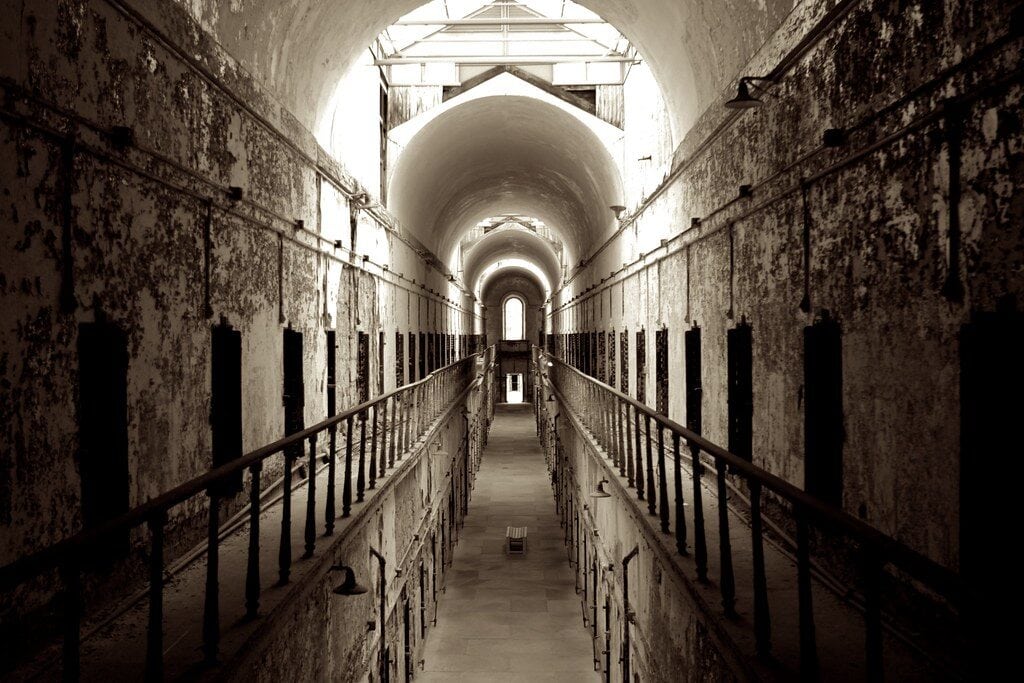
Roofs leaked and vegetation spread through the yards until photographers were shooting a forest growing inside a prison.
Preservationists organized as the Eastern State Penitentiary Task Force, and Mayor Wilson Goode stopped the sale in 1988.
Stabilization began in 1991. Daily hard-hat tours opened in 1994 and drew more than 10,000 visitors that first year.
Eastern State today, a museum in a ruin
Eastern State Penitentiary Historic Site keeps most of the buildings stable, with a few spaces restored to specific historical dates.
Peeling paint and the wreckage of the abandoned years stay visible, and the 10-acre site is kept as a semi-ruin, sharp masonry and all.
Water is still the problem. Cellblock 1 went behind scaffolding in 2024, when a change in its roofline turned out to be loose coping stones.
What the place talks about changed too.
The Big Graph, a 16-foot steel chart of incarceration rates by decade and by country, stands in the yard, and a Preservation Trades Center pays people to learn masonry and carpentry inside the walls.
A prison that opened in 1829 with toilets and running water ran for decades as a museum with no permanent public restrooms.
The $2.7 million welcome center campaign reached 90 percent of its goal in March 2026 after an $807,500 grant.
The synagogue is open again, with "Freedom Through Faith" installed in and beside it since July 2, 2026, and three residencies for justice-impacted artists run through spring 2028.
Independent Publisher Notice
BestAttractions is an independent editorial publisher. We are not affiliated with, endorsed by, or acting on behalf of any location, business, property owner, manager, government agency, or organization described in this article. Comments posted on this page are not forwarded to, reviewed by, or acted upon by any entity mentioned in the article. For official inquiries, complaints, applications, bookings, or other requests, please contact the relevant entity directly through its official website or other verified channels.