
Standing on the south bank of the Lehigh River in Bethlehem, Pennsylvania, sits a 9.5-acre public campus laid out in front of five blast furnaces.
The furnaces belonged to Bethlehem Steel, and the works under them started making iron in 1863. Seven furnaces ran at the peak. Two came down in the 1960s.
Iron and steel production ended on November 18, 1995. Most of the campus land was donated in October 2009 for the SteelStacks project, and the first SteelStacks buildings opened in 2011.
More than a million people visit each year now. A public walkway runs along the furnace row. An 1860s machine shop on the campus is being renovated as an event hall for 2027.
The first furnace was blown in on January 4, 1863
On January 4, 1863, the first blast furnace of the Bethlehem Iron Company was blown in on the south bank of the Lehigh River.
The company was chartered in 1857 as the Saucona Iron Company and renamed Bethlehem Iron in 1861.
John Fritz, hired in 1860, designed much of the works.
Beside the furnace stood the Stock House, a stone building 47 feet 6 inches wide and 260 feet long, its walls rubble quartzite, some of it cut from South Mountain across the river.
Ore, limestone, and fuel sat inside.
Men shoveled it into wheelbarrows, then pushed them into hydraulic-elevator cages that lifted them to the furnace tops.
Bethlehem rolled its first steel rails in 1873. A Spiegel furnace followed in 1874. By 1877, the Stock House had been extended to roughly 750 feet.
The trestle that replaced the stock house
Frank Kryder Hoover and Arthur J. Mason worked out a faster way to feed the furnaces, built in stages between 1900 and 1917.
Wide-gauge trolleys ran along an elevated trestle above the stockyard, carrying ore, limestone, and coke over the bins, and skip cars hauled the charge up the stacks.
That ended the Stock House's old job, and most of it came down.
About 190 feet survived, and a 1936 expansion of Furnace A cut that to roughly 159 feet.
The furnaces were rebuilt and enlarged repeatedly: A in 1910 and 1950, C in 1942-43, D in 1953, B in 1954. Seven ran at the peak.
Two later came down, leaving the row of five that stands now, 1,100 feet end to end and more than 230 feet high at the two largest.
Furnace A is the oldest standing blast furnace in the country.
November 18, 1995: the last iron
Furnaces C and D were the last two operable when iron production ended on November 18, 1995. At its peak the plant had employed about 30,000 people.
Bethlehem Steel controlled roughly 1,800 acres in the city, a fifth of Bethlehem's taxable land, along nearly six miles of the river.
It went quiet in pieces.
The combination mill closed in 1997 and the coke ovens ran until March 28, 1998, which is why sources give three closing years.
Reuse meant cleanup first: by 1999 regulators had approved remediation of the 160-acre core tract.
Bethlehem Steel filed for bankruptcy in 2001. People argued about the rust: pull it down, or leave it standing.
In 2004 the National Trust for Historic Preservation listed the plant among America's 11 Most Endangered Historic Places.
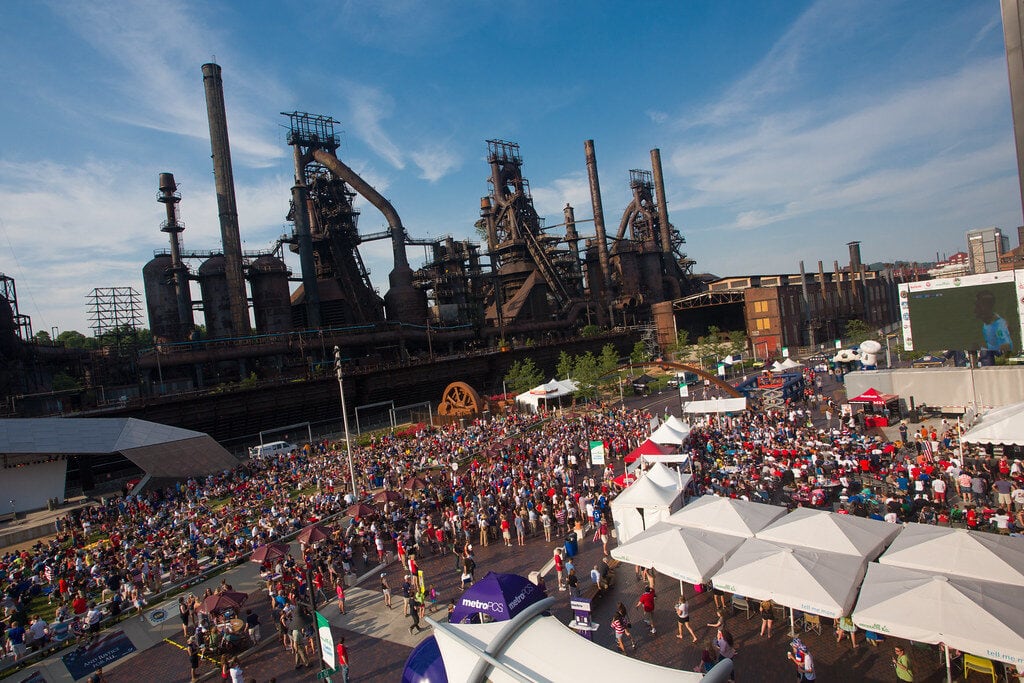
The casino deal that kept the furnaces standing
Pennsylvania legalized slot machines in 2004, and that changed what could be paid for on the site.
Las Vegas Sands won the state gaming license in 2006 and opened its casino in 2009.
The city tied its support to preserving the blast furnaces and other industrial structures and creating a cultural campus beside them.
The result is the split you can still walk across: casino resort at the east end, arts campus at the west.
ArtsQuest founder Jeff Parks and Mayor John Callahan had both visited German industrial sites reopened for public use.
Public money came through a tax increment district approved in 2000, which routed new tax revenue into roads, plazas, and public buildings.
In October 2009 most of the 9.5-acre campus was donated to the city and its Redevelopment Authority. The furnaces stayed with the private owner.
SteelStacks opened in pieces through 2011
SteelStacks is a 9.5-acre arts and public-space campus on the south bank of the Lehigh in Bethlehem's SouthSide, with the ArtsQuest Center at 101 Founders Way.
Construction started in January 2010 on a Spillman Farmer design: 67,200 square feet over four levels, exposed steel painted International Orange, and a north wall of glass aimed at the furnaces.
More than 500 guests came to the April 14, 2011 dedication. The public got in the next day.
PBS39 moved into its own 29,000-square-foot building that June.
Levitt Pavilion opened July 2 with a free Marcia Ball concert.
East First Street was swung south around the lawn so the furnaces would stand behind the stage, with room for 2,500 people.
The first season ran 44 concerts and drew more than 24,000.
By December 31, the campus had counted more than 500,000 visits.
A 1,650-foot walkway on top of the ore line
The Stock House was close to collapse when restoration began at the end of 2009.
Windows and doors were rebuilt from 1909 Bethlehem Steel drawings and glazed with historic recycled glass.
Hydraulic lime mortar replaced Portland cement, which would have damaged the old masonry.
The building was dedicated as the Bethlehem Visitor Center on June 14, 2013, for 16,000 square feet at $6.5 million.
The Hoover-Mason Trestle followed in June 2015. Roughly 1,650 feet of it, a third of a mile, opened as an elevated walkway along the furnace row.
Metal grating was laid over the original tracks so visitors can see the old bins below.
The job cost $16 million, new lighting for the furnaces included.
Annual visits passed 800,000 by 2016.
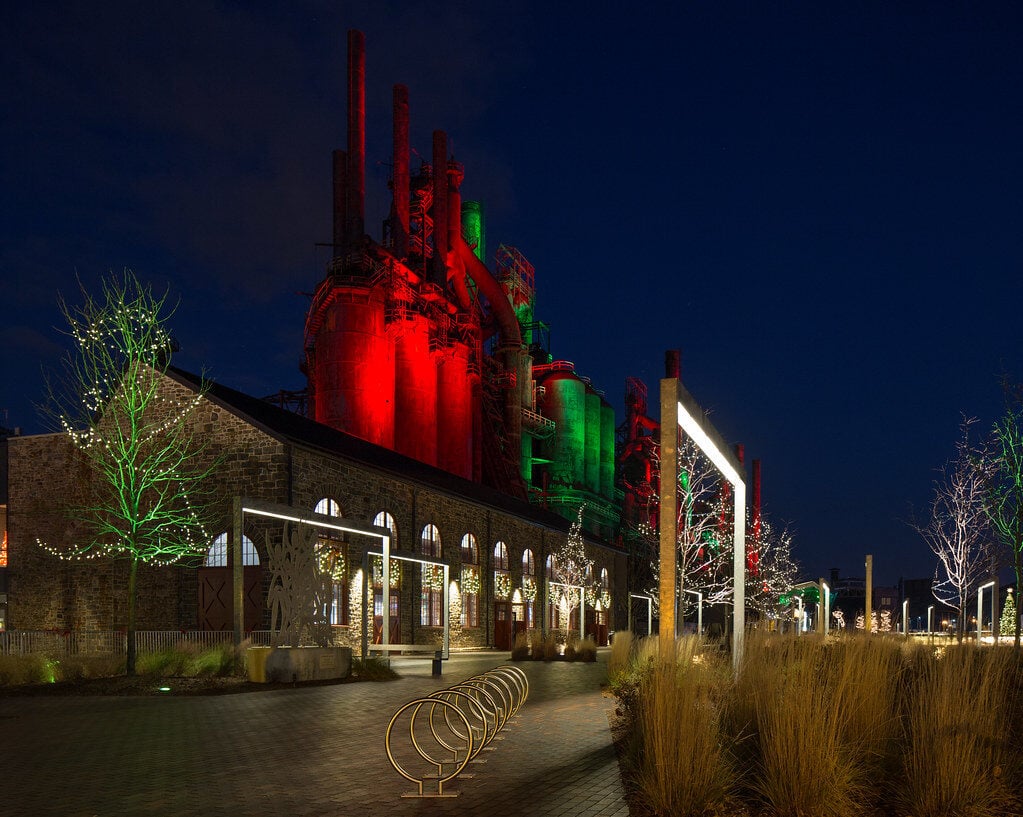
SteelStacks in 2026: the Turn & Grind finally gets its turn
The Turn & Grind Shop spent years as festival storage.
It's an 1860s-era machine shop of 26,000 to 27,000 square feet where Bethlehem Steel ground heavy components to close tolerances.
ArtsQuest is turning it into an indoor event hall for festivals and touring exhibitions, a conversion first promised for 2016.
A $1 million state grant arrived in April 2025, and ArtsQuest held a ceremonial brick-breaking inside the cleared-out shell on May 21, 2026.
Boyle Construction is due to finish in 2027.
People come anyway, more than a million visits a year.
Levitt runs more than 50 free concerts and films a summer, on a sound system installed this April.
From June 11 to July 19, SoccerFest put all 104 World Cup matches on outdoor screens and drew more than 38,600 visits.
A regular movie ticket at the Frank Banko Alehouse Cinemas costs $13.50, and parking is free unless it's Musikfest.
Independent Publisher Notice
BestAttractions is an independent editorial publisher. We are not affiliated with, endorsed by, or acting on behalf of any location, business, property owner, manager, government agency, or organization described in this article. Comments posted on this page are not forwarded to, reviewed by, or acted upon by any entity mentioned in the article. For official inquiries, complaints, applications, bookings, or other requests, please contact the relevant entity directly through its official website or other verified channels.