
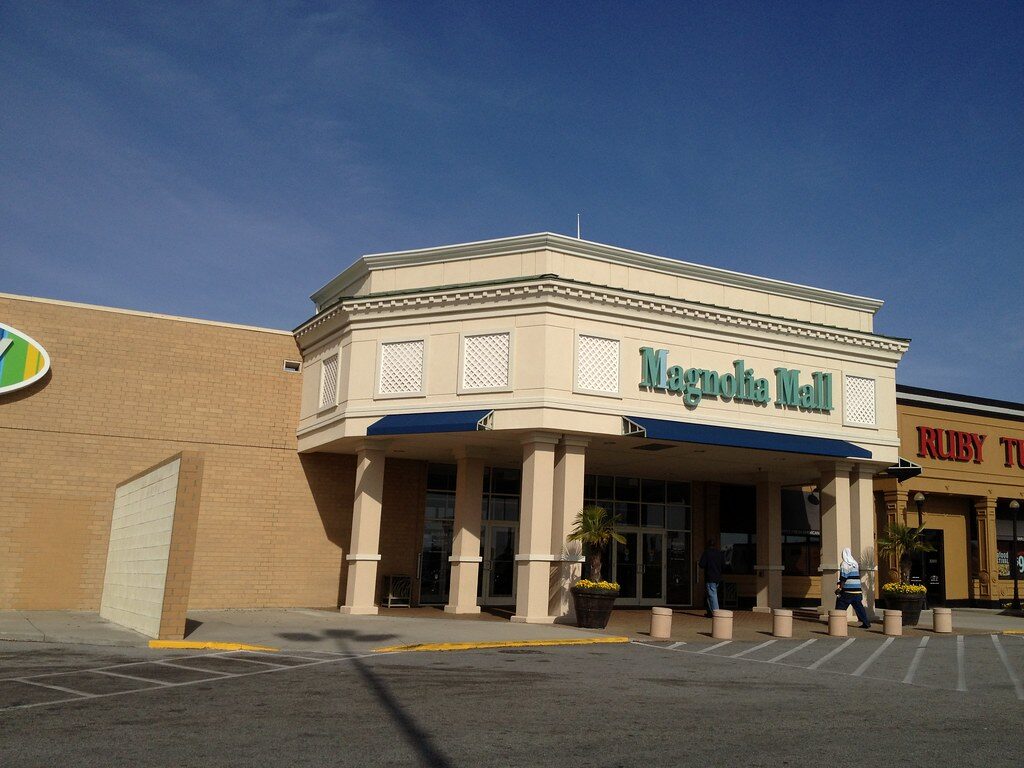
Magnolia Mall is an enclosed regional shopping mall in Florence, South Carolina, open since 1979.
For a long stretch it ran on four department stores: Belk, JCPenney, Sears, and Roses. Roses went first, in 2002. Sears closed in 2017. JCPenney liquidated in 2020. Belk is still there.
Every empty box got refilled. Best Buy and a food court took the Roses space. Burlington, HomeGoods, and Five Below split Sears. An arcade with bumper cars took JCPenney.
The mall's owner filed for bankruptcy twice along the way, and Magnolia kept going. The through-line is simple: this building keeps its tenants by never staying one kind of building for long.
Magnolia Mall opened in 1979 off I-95
Magnolia Mall opened in 1979 at 2701 David H. McLeod Boulevard, on the west side of Florence, South Carolina, close to where I-95 and I-20 feed the city.
Enclosed corridors, department stores at the ends, a ring road wrapped in surface parking.
That was the standard shape for a regional mall that decade, and Magnolia got the full version of it.
Florence was the right town for it.
The city was the retail center of the Pee Dee, and by the late 2000s, more than half of all retail sales in the seven-county region were still ringing up in Florence County.
By the 1990s, the lineup that would define the place was set: Belk, JCPenney, Sears, and Roses, with smaller shops strung along the concourses.
In December 1980, a three-screen movie theater opened at the mall.
The cinema closed and Roses became a Best Buy
PREIT bought Magnolia in 1997, picking it up inside its purchase of The Rubin Organization.
The mall ran 570,000 square feet then, with a 1992 renovation behind it and the same four department stores it had carried for years.
Then Roses gave up its box, and PREIT bought the empty space.
The 2002 rebuild cut one department store into three things: a Best Buy, a new food court, and a row of smaller store spaces.
The four-anchor pattern was finished, and PREIT had found the move it would use again when Sears left.
The three-screen theater closed that November, in the same stretch of work. It had run 22 years, under Plitt, then Cineplex Odeon, then Carmike.
The 2006 project that added two big boxes
In the second quarter of 2006, PREIT started a $16.8 million job on the building.
Barnes & Noble took 28,000 square feet in an inline spot next to Belk.
Dick's Sporting Goods took 45,000 square feet in the stretch between JCPenney and Sears.
The mall also got new entrances, a rebuilt food-court cafe, and new skylights, with completion set for the middle of 2007.
The target was 630,000 square feet of leasable space, up from 571,700 as the work got underway. It never got there.
Across David H. McLeod Boulevard, PREIT was building at the same time.
The Plaza at Magnolia, planned at 252,000 square feet, opened Home Depot, LongHorn Steakhouse, and Olive Garden in the third quarter of 2006, with Kohl's to follow.
Hotels collected around it, and by 2017 there were nearly a dozen within sight of the mall, 1,000 rooms between them.
When Sears left, three big tenants took its box
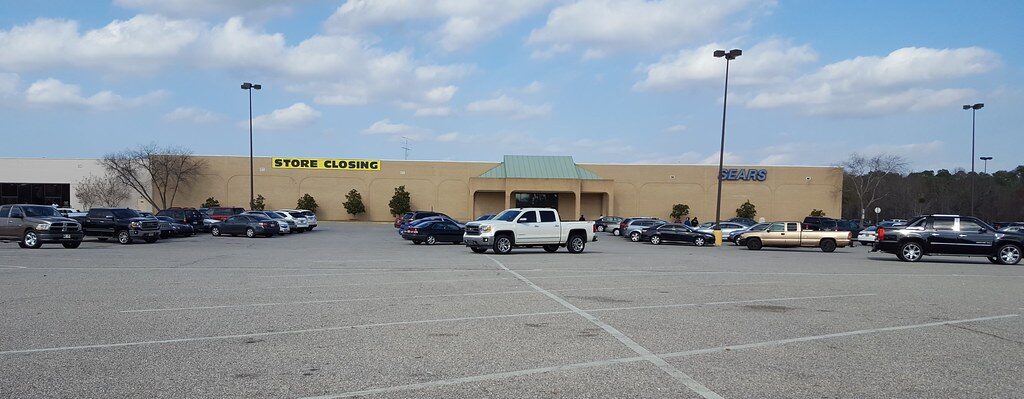
Sears closed in February 2017. By March, crews were pulling the inside out of the box, leaving a major hole at one end of the mall.
It filled fast. Burlington opened 46,000 square feet on September 22, 2017, and the rest of the old Sears was leased in under nine months.
HomeGoods took 20,000 square feet and opened on May 6, 2018. Five Below took 8,500.
H&M added another 20,000 square feet elsewhere in the mall that year.
Sales were climbing before any of those doors opened. Sales ran $388 per square foot at the end of 2015 and $429 by the middle of 2017.
A children's play area opened near the food court in March 2017, and a Tesla Supercharger went in outside the food court the same year.
Florence rewrote the mall's development plan more than once in that stretch, moving driveways, relocating the freestanding sign, and clearing room for a full Chick-fil-A.
COVID closed the doors, JCPenney reopened only to liquidate
Magnolia's common areas shut in the first phase of the pandemic and reopened on April 25, 2020 under rules that stripped the building down.
Seating was removed. The food court and the play area stayed closed, hours were cut, and shoppers came in through one controlled entrance.
Floor markings went down, and teenagers needed an escort.
JCPenney filed for Chapter 11 in May and put the Florence store in the first group it planned to close.
That store liquidated after decades at the mall.
What it left behind was a box of 100,000 square feet, twice the space Burlington had absorbed three years earlier.
Bumper cars in the old department store
Tilt Studio cut the ribbon on October 27, 2021.
The former JCPenney came back as laser tag, mini bowling, two black-light miniature-golf courses, bumper cars, a racing simulator, and a large arcade.
The cinema had gone dark 19 years earlier, and this one was far larger.
At the end of 2024, Tilt held 104,107 square feet on a lease running through 2031, which made it the second-largest tenant in the building.
Only Belk, at 115,793 square feet, was bigger.
Belk is the last name left from the old department-store group. Every square foot the other three held belongs to somebody else now.
The owner went bankrupt twice, the mall stayed open
PREIT nearly sold Magnolia in 2020. The deal covered five shopping centers, and the company terminated it on September 2 of that year.
Two months later, PREIT filed a prepackaged Chapter 11 case with most of its voting lenders behind it, got the plan confirmed on November 30, and came out in December with new financing.
Cash still had to come from somewhere. In August 2022, PREIT sold a Magnolia outparcel for $0.9 million and put the money toward its debt.
The debt caught up anyway.
PREIT filed a second Chapter 11 on December 10, 2023, closed it on April 1, 2024, cut $835 million of debt, cancelled its public shares, and went private.
A decade apart, occupancy was almost unchanged: 99.3 percent at the end of 2012, 98.6 percent at the end of 2022.
Net operating income came in at $6.0 million for 2024, against $5.1 million the year before.
What Magnolia Mall runs on in 2026
The mall covers 582,300 square feet, 330,300 of it in inline stores.
Comparable sales at the end of 2024 were $474 per square foot, up from $441 a year earlier.
Seven large-format tenants hold the corners: Belk, Tilt Studio, Burlington, Dick's Sporting Goods, Best Buy, Barnes & Noble, and HomeGoods.
Between them sit H&M, Old Navy, Five Below, American Eagle Outfitters, Foot Locker, and Pandora.
The spending is smaller than it used to be. Restroom work cost $300,000 in 2024, and PREIT sold the Panda Express parcel for $1.2 million.
One rule now shapes the evenings. Since November 1, 2024, anyone under 18 has to be with a parent or guardian at least 21 years old after 5 p.m. Monday through Saturday and after 3 p.m. on Sunday.
Florence still shows up.
There are 119,000 people within 10 miles of the building, and at the end of 2024 the mall had 8,103 square feet standing empty.
Independent Publisher Notice
BestAttractions is an independent editorial publisher. We are not affiliated with, endorsed by, or acting on behalf of any location, business, property owner, manager, government agency, or organization described in this article.
Comments posted on this page are not forwarded to, reviewed by, or acted upon by any entity mentioned in the article.
For official inquiries, complaints, applications, bookings, or other requests, please contact the relevant entity directly through its official website or other verified channels.