
Malls that lose all their anchors often go quiet, and many never come back as malls.
Hickory Ridge Mall, at 6075 Winchester Road in southeast Memphis, Tennessee, took a different route.
It's still open. Locals still walk in.
It opened in 1981, and the old retail version had a cinema, a food court called Picnic Square, and a Venetian carousel.
By the mid-2000s, the Winchester corridor around it had 700,000 square feet of empty big-box space, and Dillard's pulled out in 2005.
The 2008 tornado finished the retail version.
A church bought the storm-damaged building, reopened it in 2010, renamed it Hickory Ridge Towne Centre, and started filling it with whatever fit.
What fits now, and what has fit along the way: a court clerk, a vegan restaurant, an event space, and a storage company in the old Sears.
A driver-license office has operated there too.
The carousel made it through.
A $2.3 million land deal in southeast Memphis
Before there was a mall, there were 70 acres.
Boyle Investment Company owned the land in the Hickory Hill area, now southeast Memphis, and out-of-town developers paid $2.3 million for it.
The plan was the standard one for the late 1970s and early 1980s: build an enclosed regional mall, put department stores at the ends, fill the middle with specialty shops, and let the anchors pull shoppers from a wide trade area.
Memphis retail was already moving this direction.
Downtown had been losing ground to suburban malls for years.
Hickory Ridge pushed that pattern farther out, into a part of town where new subdivisions were spreading, and stores were chasing the rooftops.
What opened in 1981
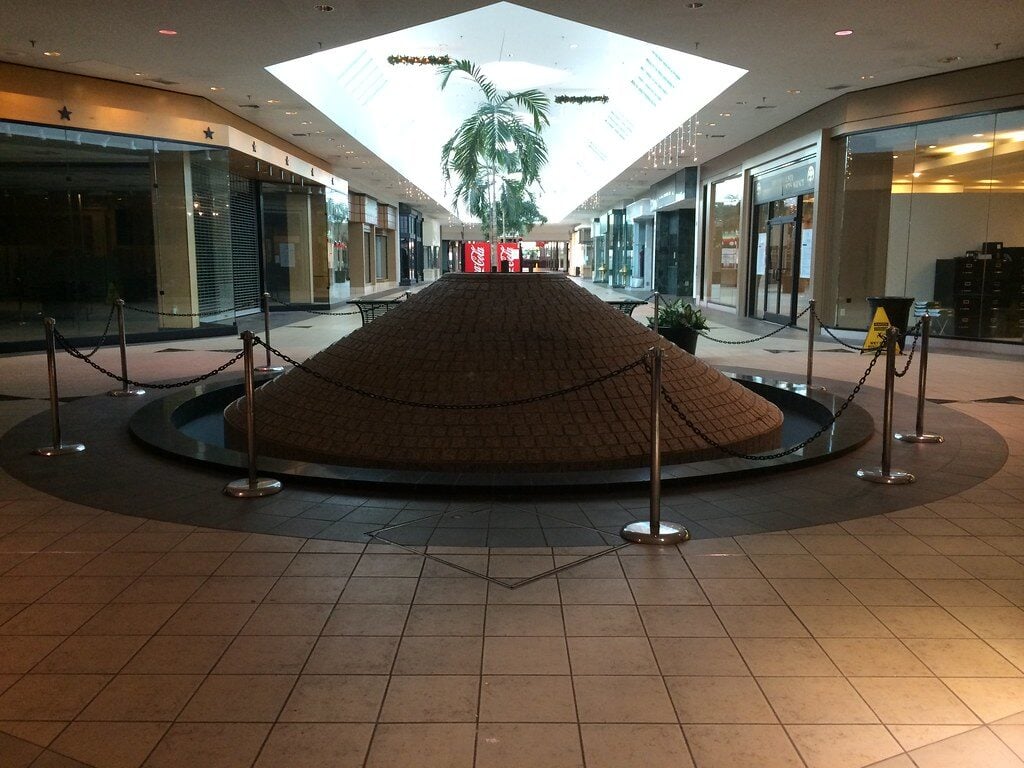
Hickory Ridge Mall opened at 6075 Winchester Road in 1981 with Goldsmith's and Sears as its main department-store anchors, plus a cinema, a food court, and a center court that gave people reasons to linger.
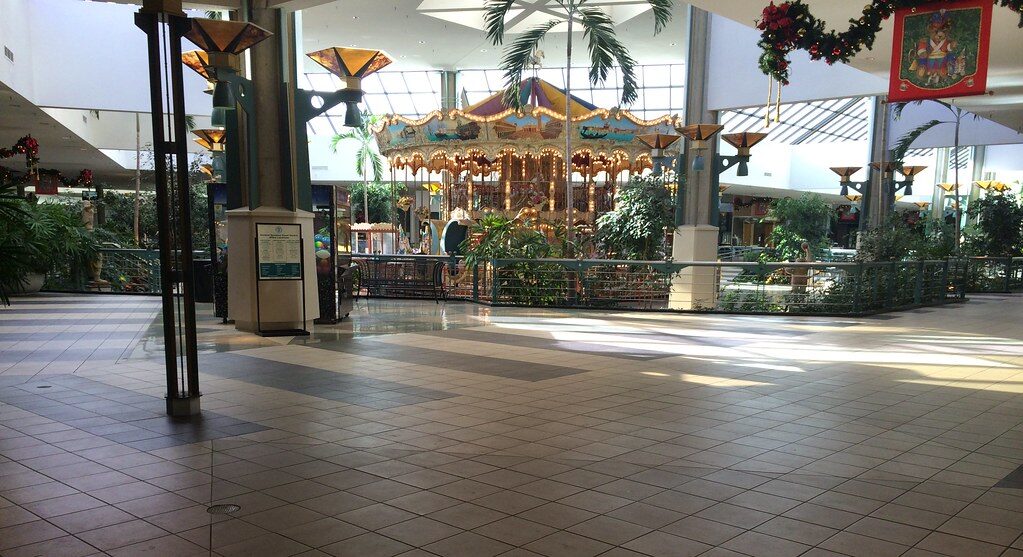
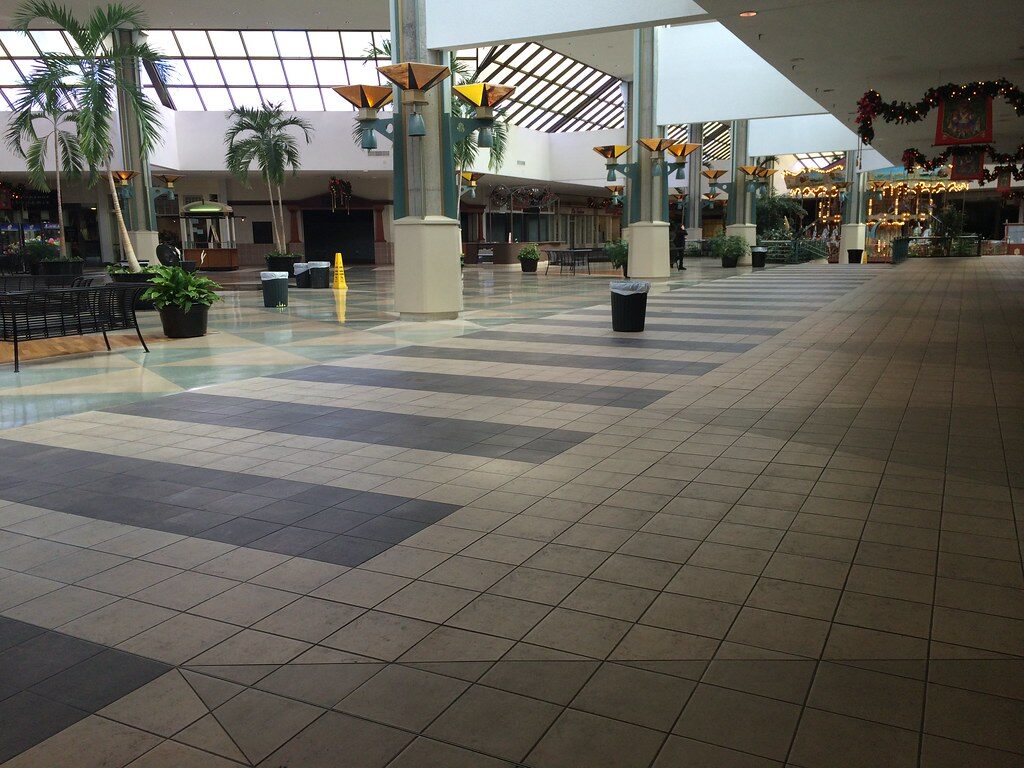
That court had fountains, a running stream, a sunken amphitheater, and a double-decker Venetian carousel.
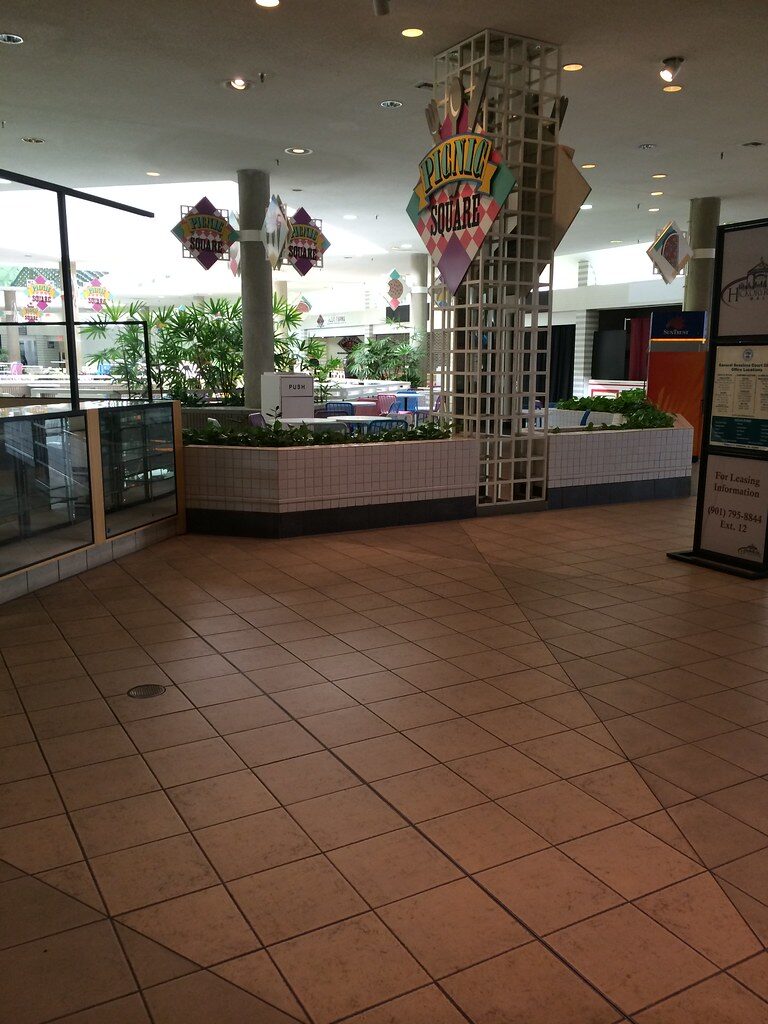
The food court had a name, Picnic Square.
The General Cinema theater opened in August 1981, tucked near the food court and arcade.
Over the years, the shops were the ones every mall of that era carried.
Foot Locker. Victoria's Secret. Express. After Hours Formalwear. Arby's and a Subway for the quick stop.
A mix of national chains and small local stores filled the concourses.
It was a complete machine for a Saturday afternoon: park, shop the anchors, eat at Picnic Square, catch a movie, ride the carousel on the way out.
Five years in, a third anchor arrives
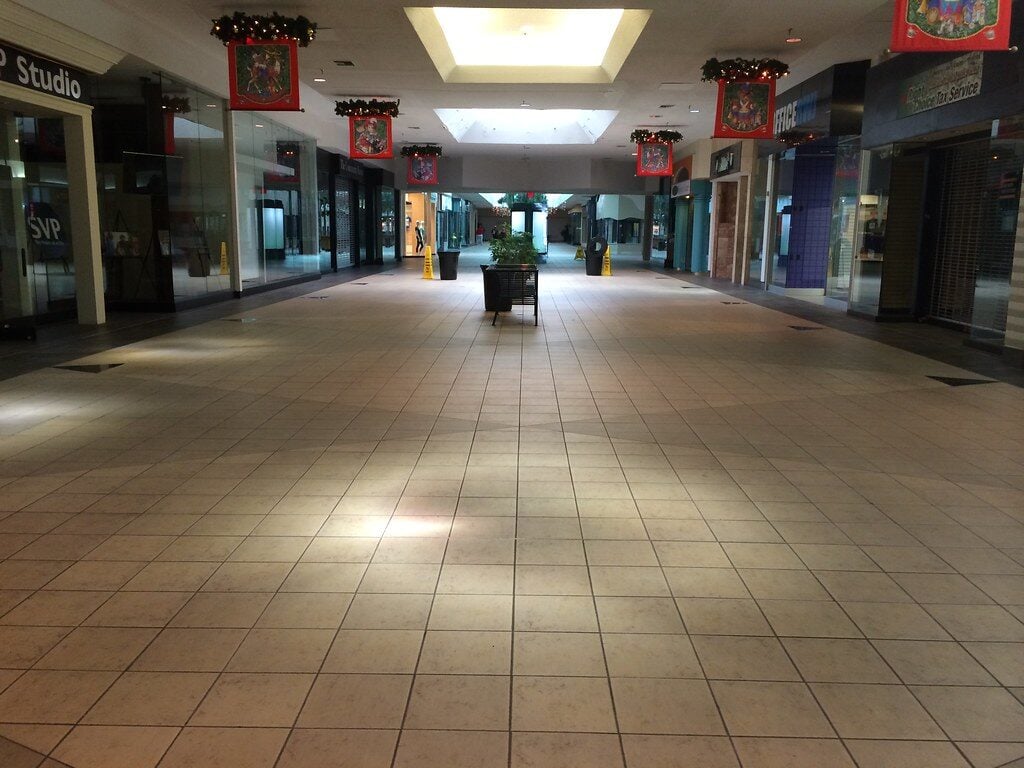
The mall expanded in 1986, and the addition brought Dillard's.
By 1987 the Dillard's store was open, and Hickory Ridge had its three-anchor lineup.
Three department stores were the mark of a serious regional mall, the kind that could hold its own.
For a stretch, Hickory Ridge did.
The trouble came later, when new competition started pulling the market outward.
Newer centers were going up in Collierville and Southaven, and national chains kept drifting toward newer buildings on roads with easier access.
A 1997 renovation against a rising tide
By 1997, Hickory Ridge needed to make a statement that it still belonged in the conversation.
It got a renovation that year.
The timing was rough.
Wolfchase Galleria opened in 1997 on the northeast side of the metro, brand new and built for the way people drove now.
Hickory Ridge sat on the Winchester corridor with no interstate frontage, an arterial-road mall in a metro that was reorganizing itself around highways.
The mall was big: 843,000 square feet by the early 2000s.
Another source later put it around 855,000 square feet.
That kind of square footage needs constant traffic to make sense, and the traffic was starting to find other places to go.
The carousel still turned. The department-store wings still ran their full length.
But the renovation was a conventional mall doubling down on being a conventional mall, right as that model was getting harder to hold up in this part of town.
The corridor empties out
By 2003, the retail strip around Hickory Ridge had 700,000 square feet of empty big-box space.
Big boxes and strip centers along Winchester sat dark or half-used.
The pattern kept going. Target moved east. So did Best Buy and Kroger, following the 385 corridor toward newer ground.
Drivers could now skip the older Winchester strip entirely, and a lot of them did.
The mall's location advantage, built on being where the people were, weakened as the people gained easier ways to shop somewhere else.
Inside the mall, the non-anchor space held up better than the corridor outside it.
In 2003, that interior space ran 340,000 square feet and was 80% leased.
The building still worked. The retail corridor around it was the part coming apart.
A new owner sees a mismatch
In 2003, Carlyle Rock Ridge LLC bought Hickory Ridge for $13.5 million from a subsidiary of Wells Fargo Bank of San Francisco.
The price came in around half of the debt the previous owner had taken on.
The new owner looked at the mall and the neighborhood and saw two things that no longer matched.
The mall still carried national tenants pitched at suburban shoppers.
The new owner put the key household-income range at $37,000 to $40,000.
The merchandise and the wallets had drifted apart, and the plan was to close that gap by aiming the mall squarely at the local customer.
Hickory Hill itself had changed in a way that complicated the picture.
The area joined Memphis through a December 31, 1998 annexation settlement, which came with promises of schools, parks, fire stations, a police precinct, and a community center.
By the early 2000s, it was big, young, and family-heavy, with people under 18 making up one-third of Hickory Hill's population.
The customers were real and close by. They just weren't the customers some national chains had signed up to serve.
Dillard's calls it
In August 2005, Dillard's confirmed it would close the Hickory Ridge store, with the doors expected to shut that October.
The chain was putting its money into newer stores in Collierville and Southaven instead.
One of the three anchors was on its way out, and the timing said something about where the smart retail money thought southeast Memphis was headed.
The empty Dillard's bay, 324,000 square feet of it, now sat at one end of the mall waiting for an answer nobody had yet.
February 5, 2008
On February 5, 2008, a tornado tore through Hickory Ridge Mall and badly damaged it.
That one storm decided the mall's future more than any lease or sale had.
The building that reopened would not be the building that took the hit.
Sears patched up and reopened soon after the storm while other parts of the mall stayed dark.
Macy's, the former Goldsmith's by then under the Macy's name, did the math on repairs and reopening and decided in March 2008 not to come back.
The cost was too high. The mall had lost one of its two original anchors, this time to weather.
Then the question became whether anyone would take on a storm-damaged regional mall at all.
For a while, the answer looked like it might be the city itself.
The city does the math and walks
After the storm, the City of Memphis looked hard at buying Hickory Ridge for public use: emergency dispatch, a backup for its information-technology systems, municipal offices.
The purchase price was low. The buildout was not.
The city estimated around $60 million over four years to make the building do what it wanted.
That number ended the conversation. Memphis passed.
The mall sat storm-damaged, with Sears left as the only anchor, too expensive for the city and no longer wanted by the big retail names.
What it needed was a buyer with a completely different idea of what a mall could be for.
A church buys the mall
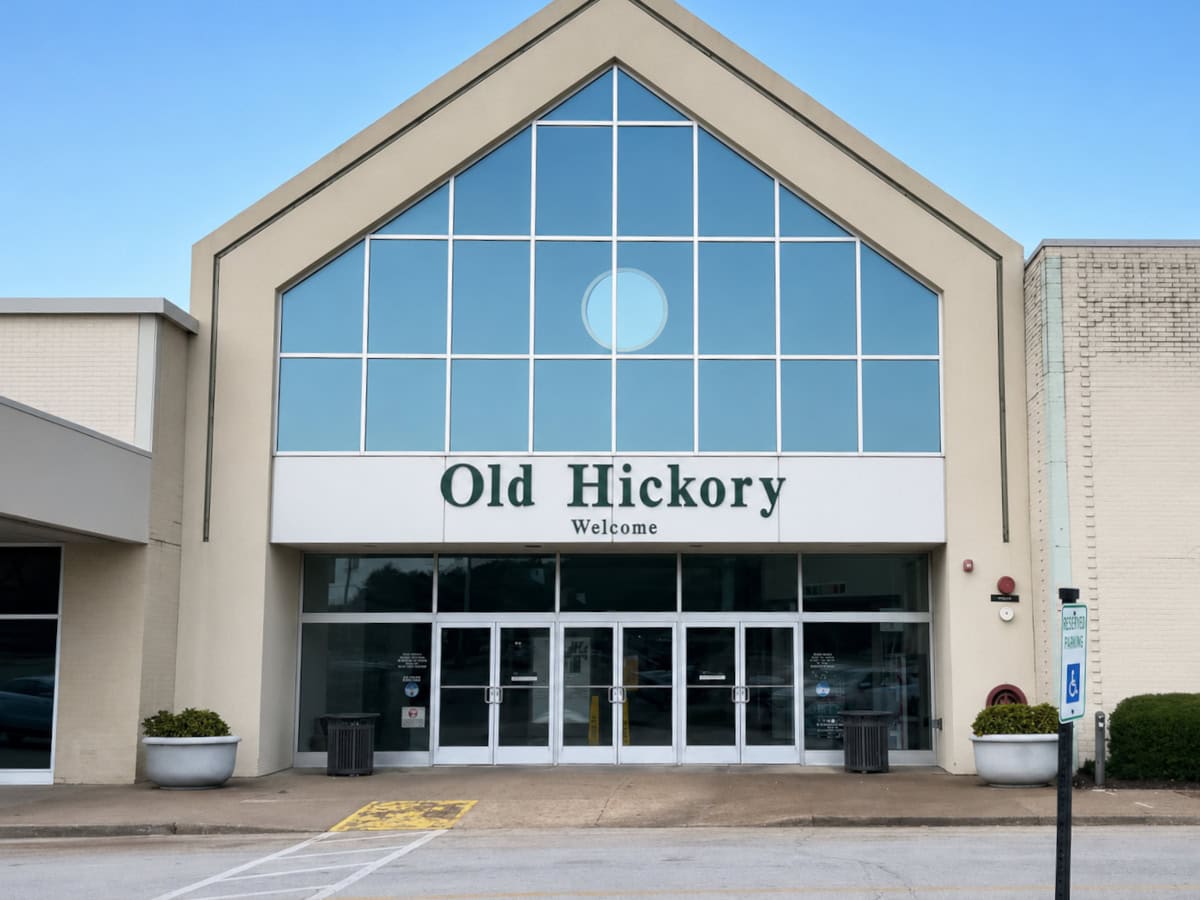
In October 2008, World Overcomers Outreach Ministries Church bought the main mall property from Carlyle Rock Ridge LLC.
The deal covered the building, 43.7 acres, and an outparcel restaurant site, all for $1.4 million.
Five years earlier, Carlyle had bought Hickory Ridge for $13.5 million.
The anchor buildings weren't part of that first purchase.
The church bought the former Macy's property in March 2009 and later picked up the old Dillard's, pulling the big empty boxes into its plan.
By February 2010, the church had put in about $5 million and 16 months of work, and held letters of intent for many of the open spaces.
The plan was never to rebuild the old mall.
It was to take a giant building and refill it with stores, public services, medical uses, community programs, and events.
In February 2010, ownership moved into a redevelopment structure: Hickory Hill Community Redevelopment Corporation took the property, with Hickory Ridge Mall CD Corporation listed on the deed.
The mall was becoming a charitable redevelopment project, literally.
A pizza-and-bowling palace opens where Macy's stood
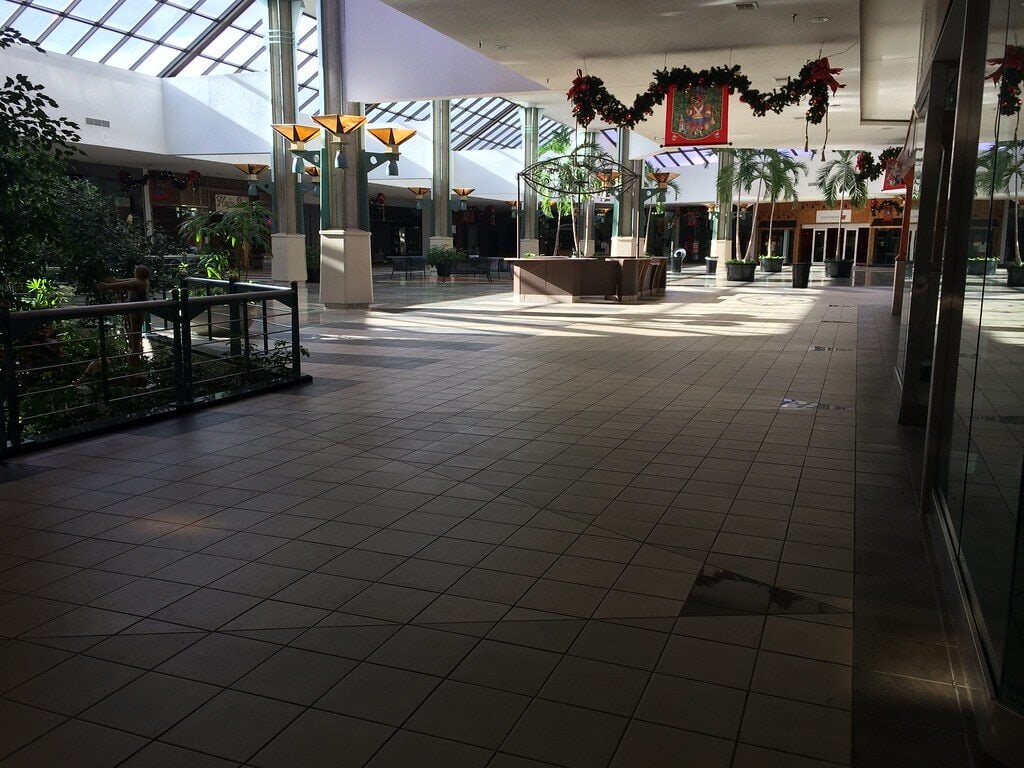
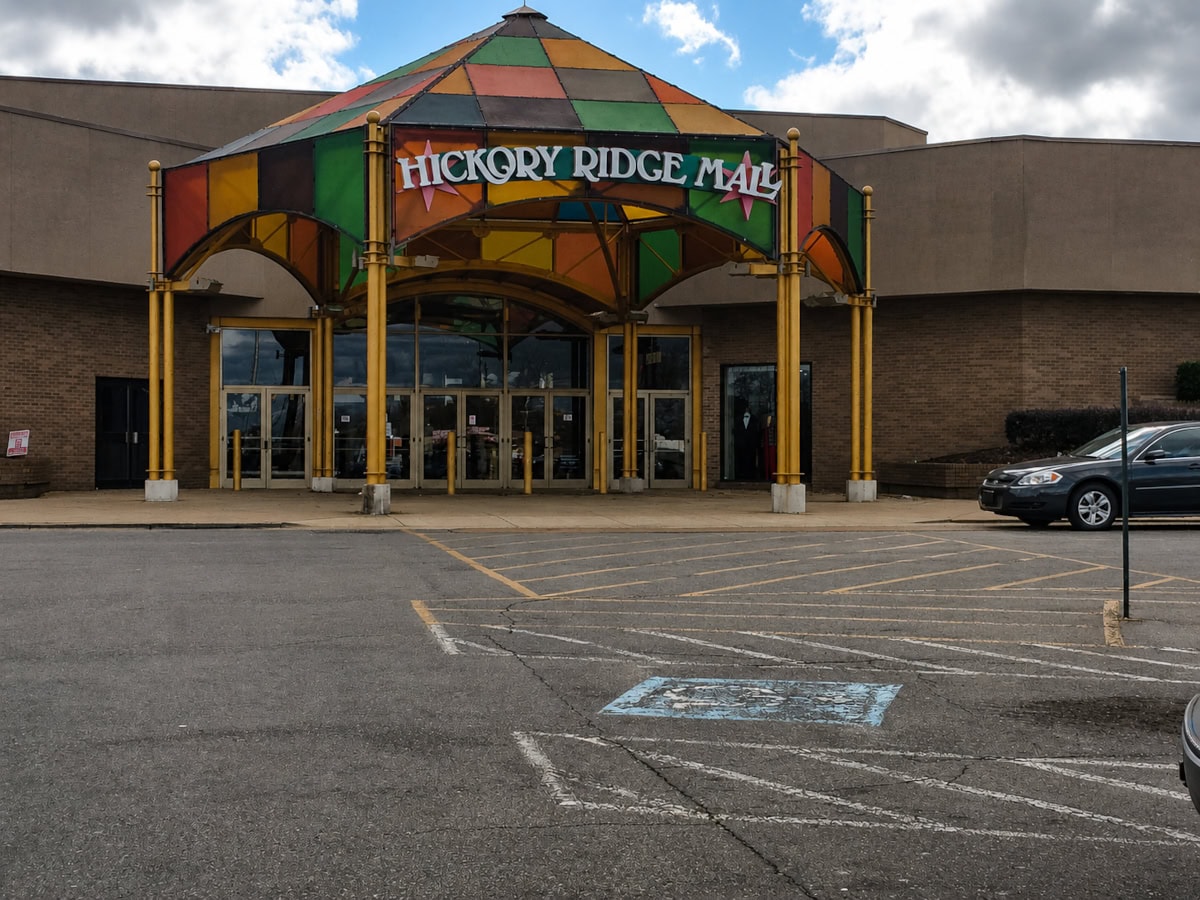
In April 2010, the property reopened. Soon, it would be Hickory Ridge Towne Centre.
The first phase brought back around 40 stores and commitments, 32 occupied retail spaces, eight food-court vendors, two training or education centers, the movie-theater area, and the carousel still standing in the middle of it all.
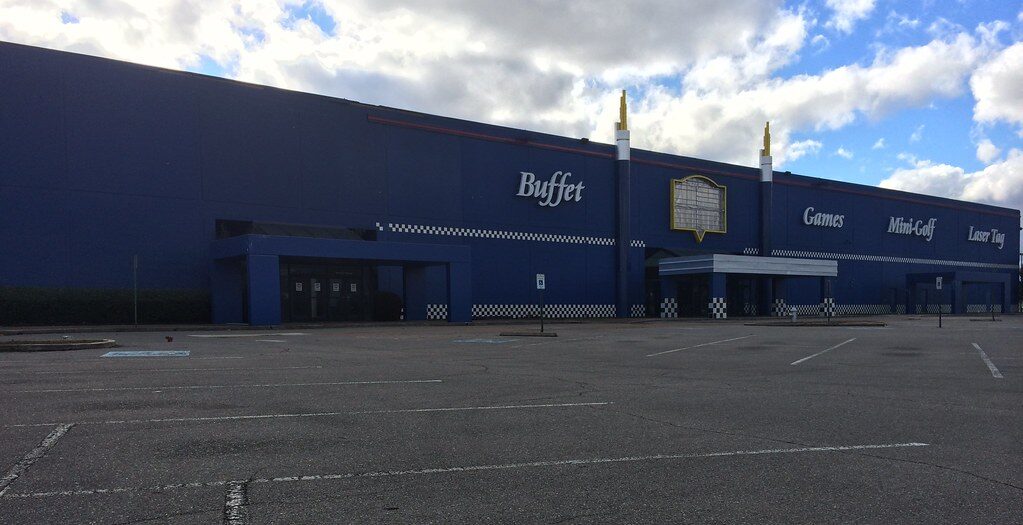
Then, in October 2010, the old Macy's reopened as something a department store would never recognize.
America's Incredible Pizza Company moved in with buffet tables, mini-bowling lanes, mini-golf, bumper cars, and more than 100 video games.
The opening brought about 100 jobs, in a space that had started life in 1981 as Goldsmith's.
The full plan was bigger and pricier: a $52.5 million, five-phase program.
Plans called for a 70,000-square-foot medical wing, a 72,000-square-foot banquet and conference space, a 110,000-square-foot youth area with a roller rink, recording studios, and a computer lab, and senior independent-living housing down the line.
By June 2011, the Towne Centre was about 50% leased, supported around 300 jobs, and held 45 shops and small restaurants alongside Shelby County and State of Tennessee offices.
The tenant list now read like nothing the 1981 mall could have produced: the County Clerk, General Sessions Court, a Tennessee driver-license center on the way, Sears still hanging on, and the pizza arcade in the old Macy's.
Some familiar local names came back too, including Milano's Classic Men's Wear, Rose's Nails, and Q Photography Studio.
The leasing rules changed under the nonprofit: prospective tenants had to show three-year projections, and rates ran $10 to $15 per square foot, built to fill the place with businesses that could actually last.
The big plan meets reality
Not all of the five phases happened.
The senior housing, the full medical buildout, the big youth complex at the scale drawn up in 2010 and 2011 didn't materialize.
America's Incredible Pizza Company closed in October 2012, and an education-and-entertainment concept was announced to replace it.
The money story underneath stayed bumpy.
On Shelby County's May 15, 2019 delinquent-tax list, Hickory Ridge Mall C D Corporation was listed as owing $640,138, with a payment plan marked 'Yes.'
In December 2021, a federal insurance case was filed involving World Overcomers and mall-related entities, with contract and insurance disputes that carried into 2022.
The building kept finding new ways to be used.
By 2021, the old Sears was being turned into indoor self-storage, a first phase planned at 450 units inside what became a 128,000-square-foot facility.
A department store had become a place to park your boxes.
Even recent years carried friction.
By early 2025, ABC24/LocalMemphis reported that Heal the Hood Foundation's long-running presence at Hickory Ridge Mall was in doubt because of a dispute involving water damage, the condition of the space, and two mall leases.
The report also included Hickory Ridge Towne Centre's position that management had investigated the complaints and completed repair work.
What's open at 6075 Winchester now
In 2026, Hickory Ridge is still open, just not as the mall anyone drove to in 1985.
Walk in today, and the old cinema mall is gone, replaced by a working mix of services, faith, events, food, and small businesses.
Shelby County once had court and clerk offices inside the building, part of the shift away from pure retail.
World Overcomers operates its World Impact Center here, with family support, clothing help, senior services, and youth work spread through the old retail spaces.
Tennessee opened a reinstatement-only driver-license center here in 2013, then closed it the next year.
Sun of a Vegan was serving food inside the mall by 2023, and took part in Memphis Black Restaurant Week at the Winchester address.
The Gathering Place hosts community events, including formal programs in 2025.
In October 2025, the Power of the Pump Women's Entrepreneur Expo was scheduled here, with vendors, speakers, food trucks, and awards.
Out on the edges, McDonald's and a Firestone Complete Auto Care still operate, and Extra Space Storage rents climate-controlled units, sized from 3 by 5 feet up to 20 by 25, out of the building where Sears used to sell refrigerators.
Independent Publisher Notice
BestAttractions is an independent editorial publisher. We are not affiliated with, endorsed by, or acting on behalf of any location, business, property owner, manager, government agency, or organization described in this article. Comments posted on this page are not forwarded to, reviewed by, or acted upon by any entity mentioned in the article. For official inquiries, complaints, applications, bookings, or other requests, please contact the relevant entity directly through its official website or other verified channels.