
As of spring 2026, you can still park in the Oak Court lot, walk into Dillard's, use the Pinnacle branch, and go to work in the office building.
But the mall is closed. These are not the same thing.
Oak Court Mall, the enclosed shopping center that opened on Poplar Avenue in 1988, closed its interior to the public on April 20, 2026, after nearly 38 years.
The most striking thing about Oak Court's financial failure is that the mall was almost completely full when the loan went into default.
Occupancy was 98 percent in 2020. The loan payment had already been missed.
Redevelopment plans exist. Demolition has begun on one end of the site.
What will happen to the 31 acres is still being decided, and so is what parts of the past will be kept.
The Fountain and the Bronze Children Inside Oak Court
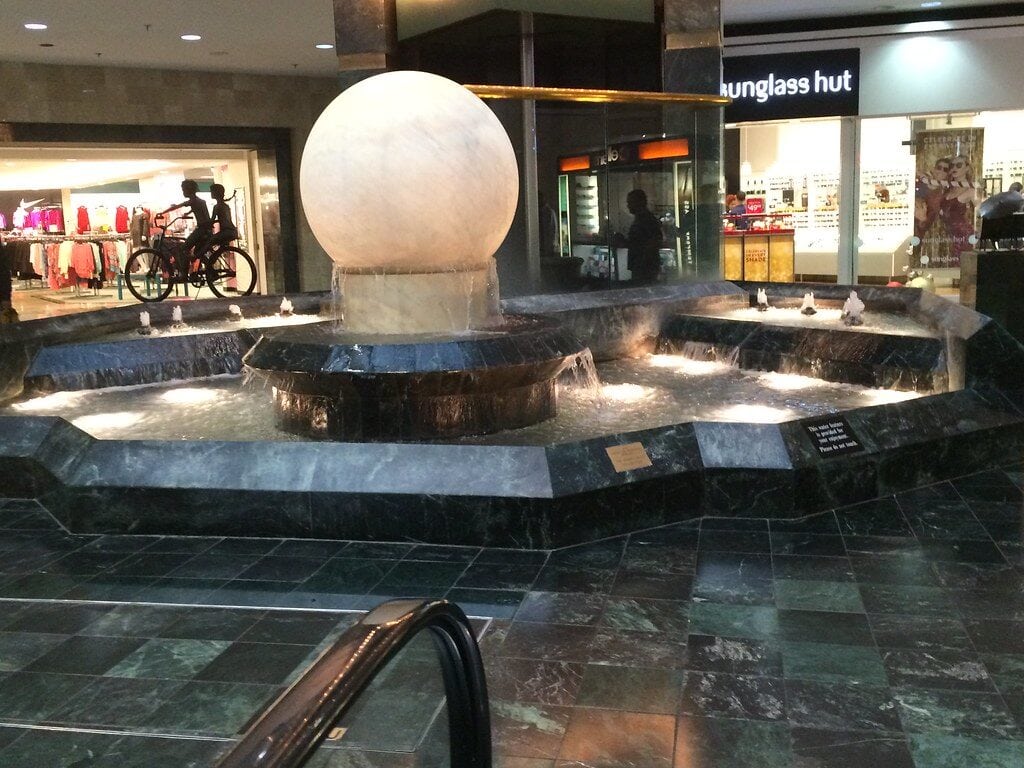
A heavy marble sphere turned on a layer of pressurized water at the center of the mall.
It floated without visible support, driven from below.
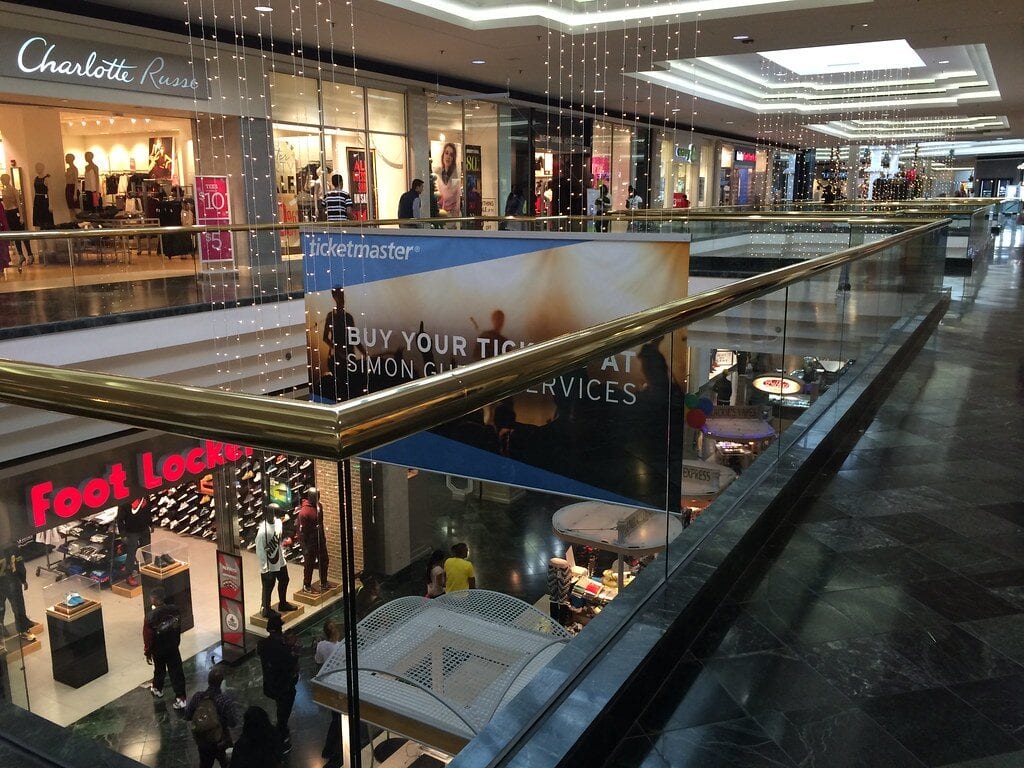
Around it: green Italian marble floors, brass fittings, skylights pressing light down from the ceiling, and seven bronze sculptures of children at play, cast by Romanian-born artist Prince Monyo.
When the mall interior closed on April 20, 2026, the future of neither the fountain nor the sculptures had been decided.
The ownership group had not announced a decision on whether to preserve them, relocate them, or remove them.
That unfinished question, more than any lease or balance sheet, shaped the public conversation about what Oak Court had been.
Oak Court Before the Mall: Goldsmith's Moves East in 1961
Goldsmith's, a department store founded in Memphis in 1870, had been part of Federated Department Stores since 1959 and was tracking the shift of shoppers away from downtown and toward the suburbs, spreading along Poplar Avenue.
In 1961, it opened its first suburban location at Poplar and Perkins Extended and named it Oak Court.
It was a three-story freestanding department store placed where East Memphis was still building out.
That store became one of the major early retail investments on the corridor.
In the early 1970s, Goldsmith's added a three-story structure immediately west of the original, using the two upper levels for parking and the lower level as additional retail connected to the first floor.
In the late 1970s, the store expanded north again: two more retail levels above ground, an expanded basement, and additional underground parking.
Later accounts placed the full store at roughly 400,000 square feet.
By the time a developer started thinking about an enclosed mall, the site already held one of the largest department stores in East Memphis, and its name had been Oak Court for more than two decades.
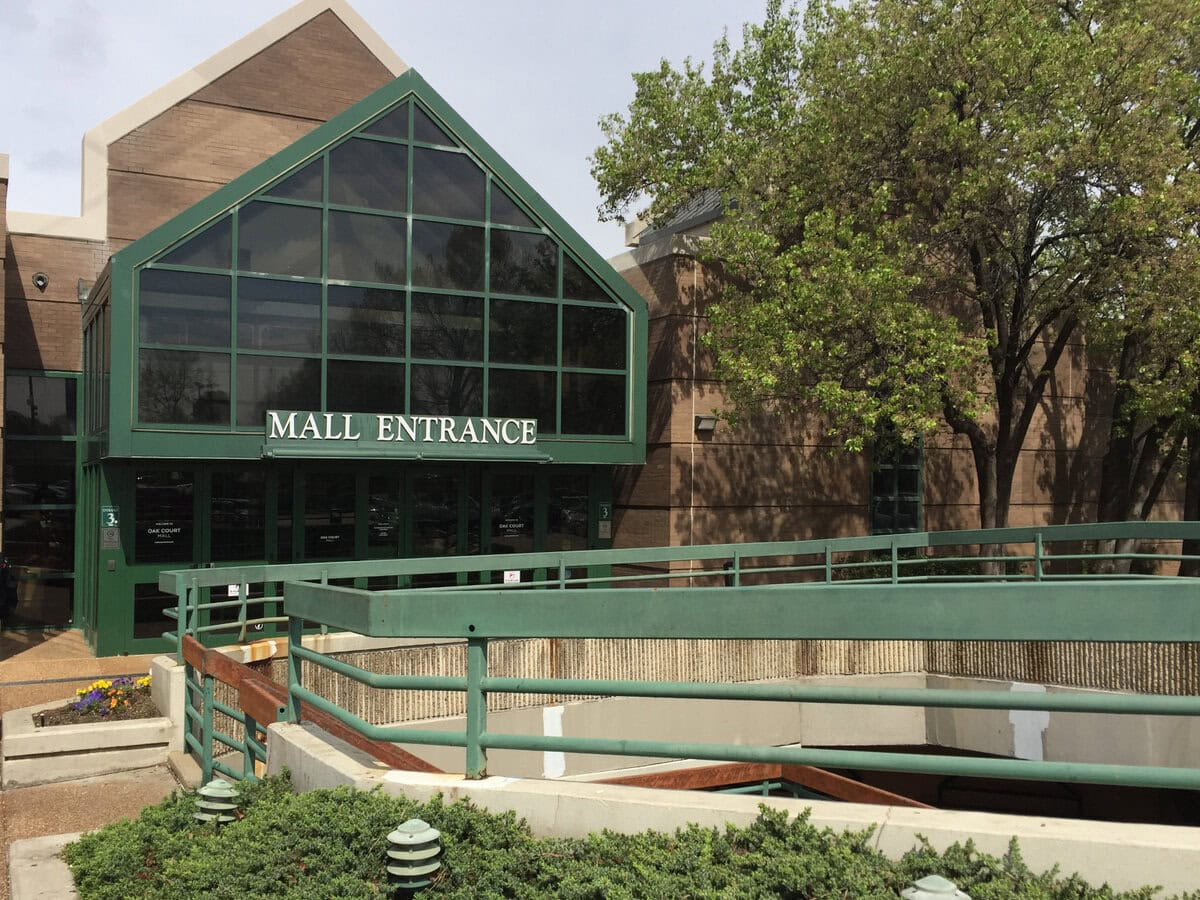
Oak Court Mall Takes Shape: Belz Enterprises Develops the Mall, Opening in 1988
Belz Enterprises developed the enclosed mall, attaching it to the west side of the existing Goldsmith's complex.
Construction began in 1986, and the mall opened on September 16, 1988.
Jack Belz, Henry Turley, and Meredith McCullar were also development partners on the project.
The mall was sold to the O'Connor Group in 1989; the ownership chain through the early 1990s is not fully documented.
Lord & Taylor was the second anchor, joining the existing Goldsmith's store.
The enclosed mall was designed to stand apart from standard suburban retail.
Its interior used green Italian marble, brass and bronze detailing, skylights, and interior landscaping.
The Kugel fountain occupied a central position.
The bronze sculptures by Prince Monyo stood nearby.
Because the new mall attached to an existing multi-level building on a sloping site, its first level sat partly below grade while its second level met grade in other portions.
Oak Court Mall was also inducted into Memphis's Most Beautiful Businesses Hall of Fame for its interior and exterior landscaping.
Lord & Taylor Leaves, Dillard's Moves In
Lord & Taylor lasted four years. It closed in 1992, leaving the west anchor space empty.
Dillard's, which had been operating at Poplar Plaza nearby, relocated into the former Lord & Taylor space that same year and gave the mall a second department store with a larger regional presence.
In 1995, Dillard's leased a center-court space for a separate men's and children's store while the original anchor building continued serving women's departments.
That expansion changed how people moved through the interior, interrupting some direct connections between the enclosed mall, the parking garages, and the office building.
The property was also renovated in 1995, the same period as the Dillard's expansion.
By 2001, Simon Property Group held the mall.
Oak Court closed briefly after September 11 of that year, along with other Memphis malls.
When Goldsmith's Became Macy's: The 2005 Rebrand
In 2005, Goldsmith's locations across Memphis became Macy's stores as part of a national consolidation of department-store names under Federated.
Goldsmith's had been part of Federated since 1959, but the name had survived on the buildings for more than four decades.
Its removal from Oak Court Mall erased a brand that had been at Poplar and Perkins Extended since 1961, before the mall itself existed.
The Macy's that replaced it occupied the same roughly 400,000 square feet and was frequently described as the largest Macy's in the region.
The mall also carried a smaller piece of Tennessee retail history.
The first Starbucks in the state opened inside Oak Court.
That store closed in 2013 and was replaced by a location connected to the Macy's side of the property.
Starbucks had spread across Memphis by then; Oak Court was where it started in Tennessee.
The tenant mix during these years reflected standard national mall retail: H&M, Aeropostale, Bath & Body Works, Foot Locker, Finish Line, Champs Sports, Claire's, and Zales, among others.
The food court ran China Master, Charley's Grilled Subs, American Wing Company, and Fresh Gulf Shrimp.
The corridor around the mall stayed active, with Pottery Barn, Williams-Sonoma, Nordstrom Rack, and Sprouts within a short drive.
A $33 Million Loan, a Pandemic, and Foreclosure
The mall's securitized loan had been appraised at $61 million when it was placed in 2014.
Washington Prime Group had taken the property into its portfolio after its 2014 spinoff from Simon.
In March 2020, the mall temporarily closed during the pandemic.
More than 40 tenants received rent relief.
The $33 million loan was transferred to special servicing in May 2020 for imminent monetary default, and the appraised value had fallen to $15 million.
Occupancy in 2019 and 2020 was reported at 96 and 98 percent, meaning the financial pressure arrived before a serious vacancy.
By the first nine months of 2021, occupancy had fallen to 76 percent.
Washington Prime filed for Chapter 11 bankruptcy in June 2021, carrying more than 100 properties.
The appraisal partially recovered to $26.1 million in 2022 before settling at $22.2 million in 2023.
Wilmington Trust National Association bought the mall in foreclosure on February 22, 2023, and the property became real-estate-owned in March of that year.
When the CMBS loan resolved in December 2023, it produced $13.1 million in proceeds against $21.9 million in losses across the two loan pieces.
A property appraised at $61 million nine years earlier had cost its lenders far more than it returned.
New Owners, a $7 Million Purchase, and Macy's Exit
A local investment group acquired the mall through Oak Court Partners LLC in December 2023.
The transaction price was put at $14.3 million in one record and above $18 million in others.
The East Memphis site moved from institutional servicing into local hands with an explicit plan to redevelop.
In 2024, the same group bought the Macy's anchor building separately for $7 million and leased it back to Macy's while the retailer continued operating.
On January 9, 2025, Macy's Inc. confirmed a 66-store closure list that included Oak Court as part of a broader program to close about 150 underperforming stores over three years.
The Oak Court Macy's closed on March 23, 2025.
Its closure ended a continuous Goldsmith's-to-Macy's department-store presence at that anchor stretching back to 1961.
Demolition of the former Macy's building began in 2025.
Planning approvals moved through the Memphis Land Use Control Board and City Council through summer 2025.
The city approved an amendment to the older planned development framework, establishing new conditions for mixed-use residential and commercial use.
Concept plans described a possible buildout with 300,000 square feet of retail, 200,000 square feet of office space, a 150-room hotel, more than 1,700 apartments, and 100 townhomes; those figures had not received final construction approval.
Dillard's Stays Open as Oak Court's Interior Comes Down
Remaining interior tenants began receiving closure notices in January 2026 without a confirmed final date.
Some stores were already packed.
Closing signs appeared in several spaces, and portions of the interior had gone quiet before the official announcement came.
On April 20, 2026, the mall confirmed that public access to the enclosed spaces had ended.
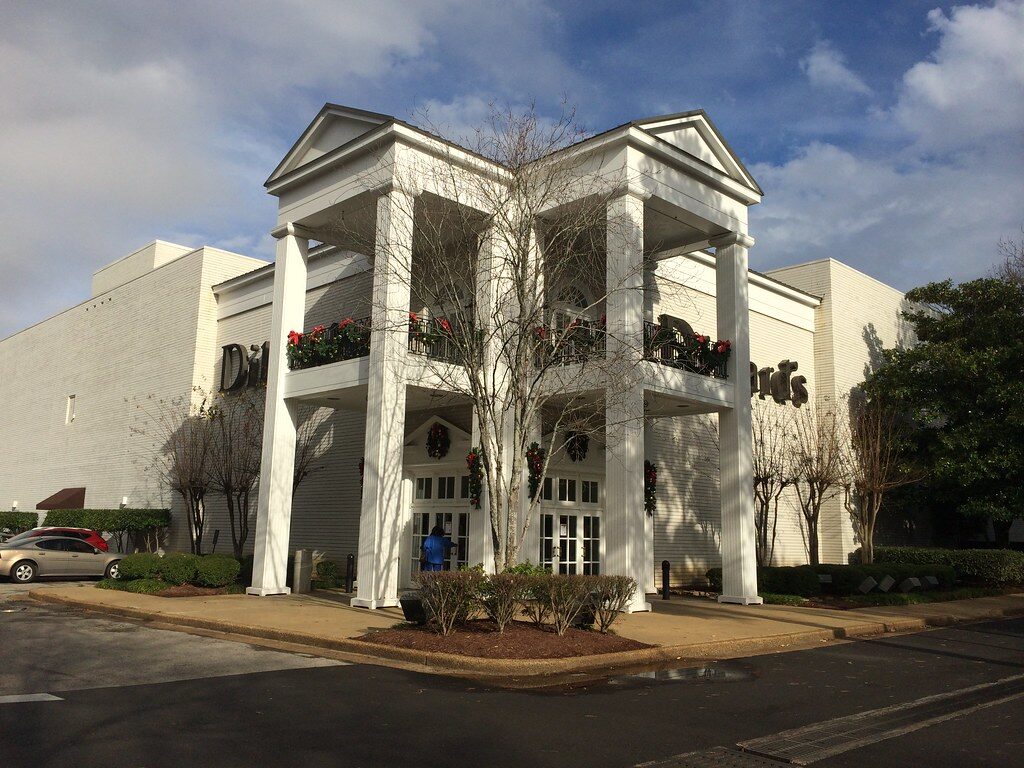
Dillard's, Pinnacle Bank, and the office building remained open after the closure, operating independently on the same 31 acres.
The seven bronze children and the floating marble sphere were still inside the shuttered interior as of May 2026.
No decision on their fate had been announced.
The building around them was closed.
The 1961 Goldsmith's store, the 1988 mall, the Italian marble, the fountain, and the first Starbucks in Tennessee all belong to the same address.
What replaces them is still being drawn.
Independent Publisher Notice
BestAttractions is an independent editorial publisher. We are not affiliated with, endorsed by, or acting on behalf of any location, business, property owner, manager, government agency, or organization described in this article. Comments posted on this page are not forwarded to, reviewed by, or acted upon by any entity mentioned in the article. For official inquiries, complaints, applications, bookings, or other requests, please contact the relevant entity directly through its official website or other verified channels.