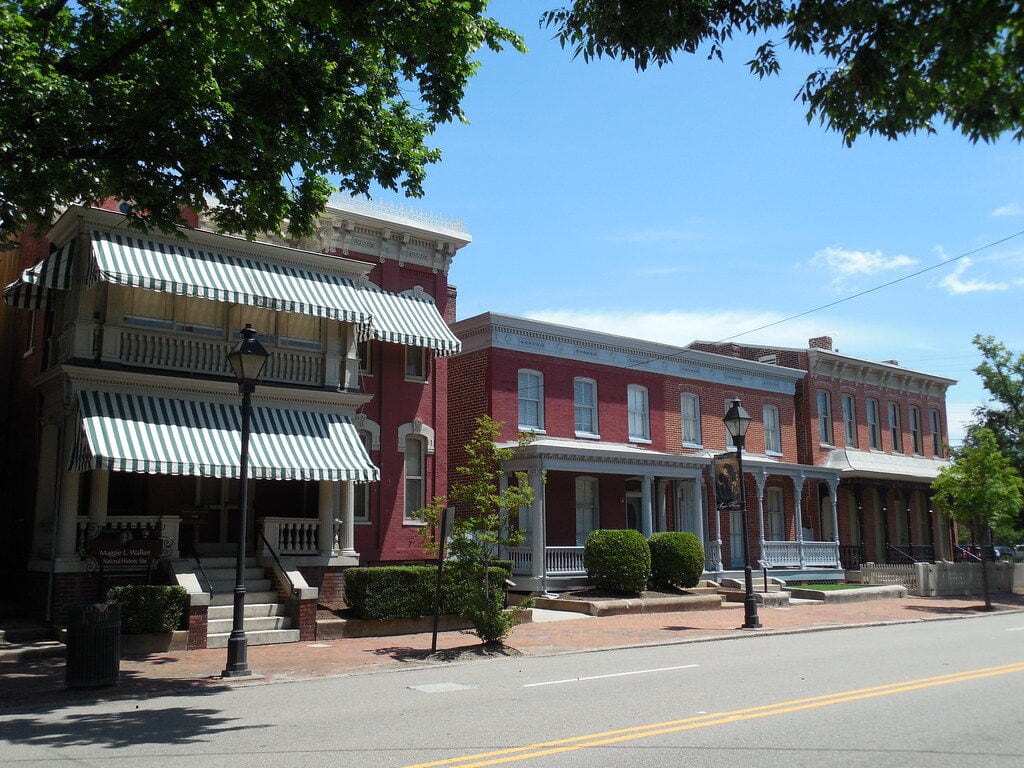
Sometime in the early 1900s, if you turned off 2nd Street onto East Leigh in Richmond's Jackson Ward, you would have left the bustle of the neighborhood's Black Wall Street and entered the quieter residential block known as Quality Row.
A block or so in, sat a two-story brick rowhouse with a front porch and bay windows. A woman lived there who had grown up the daughter of a laundress. Later, she founded the first bank in the United States ever chartered by a woman.
She then spent three decades remaking the house around her expanding life, adding electricity, central heating, a library, and new rooms by enlarging the house.
Near the end, when her diabetes had progressed so far that she needed a wheelchair, she added an elevator so she could keep moving through the home she had no intention of leaving.
Maggie Lena Walker died inside that house on December 15, 1934. When the National Park Service took the deed in 1979, most of the original furnishings were still there.
The house at 110 1/2 East Leigh Street had grown from 9 rooms to 28 and carried four decades of Walker's decisions in its walls, ceilings, and floors. Very little like it exists anywhere in the country.
The Maggie Walker House Before She Moved In
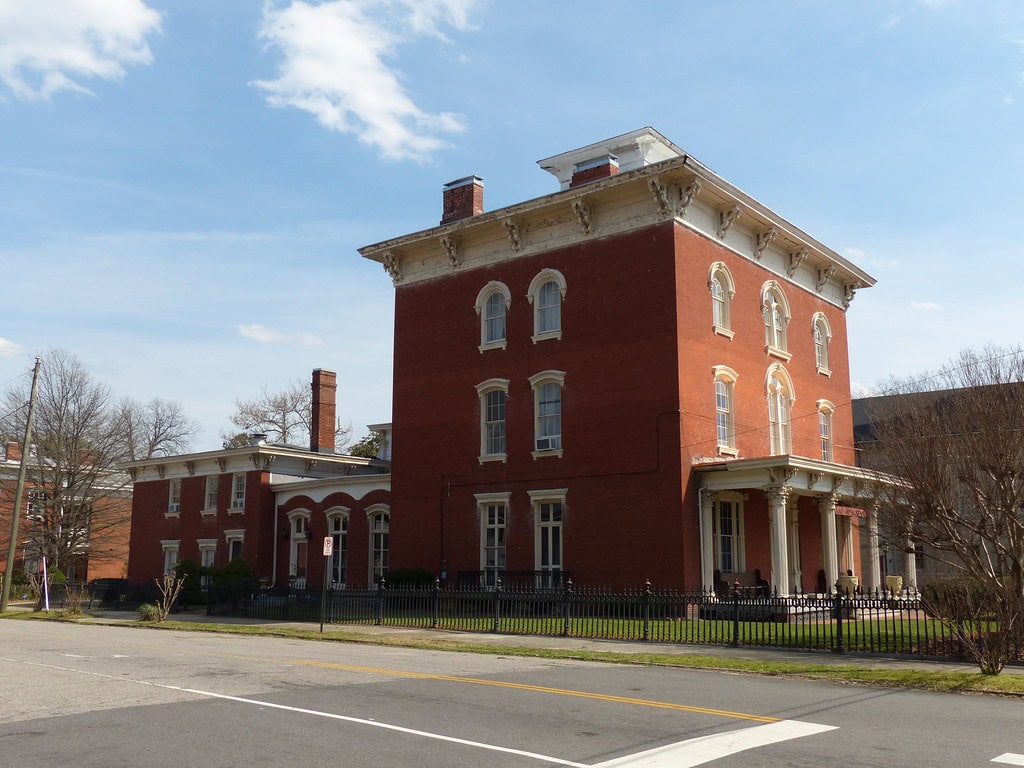
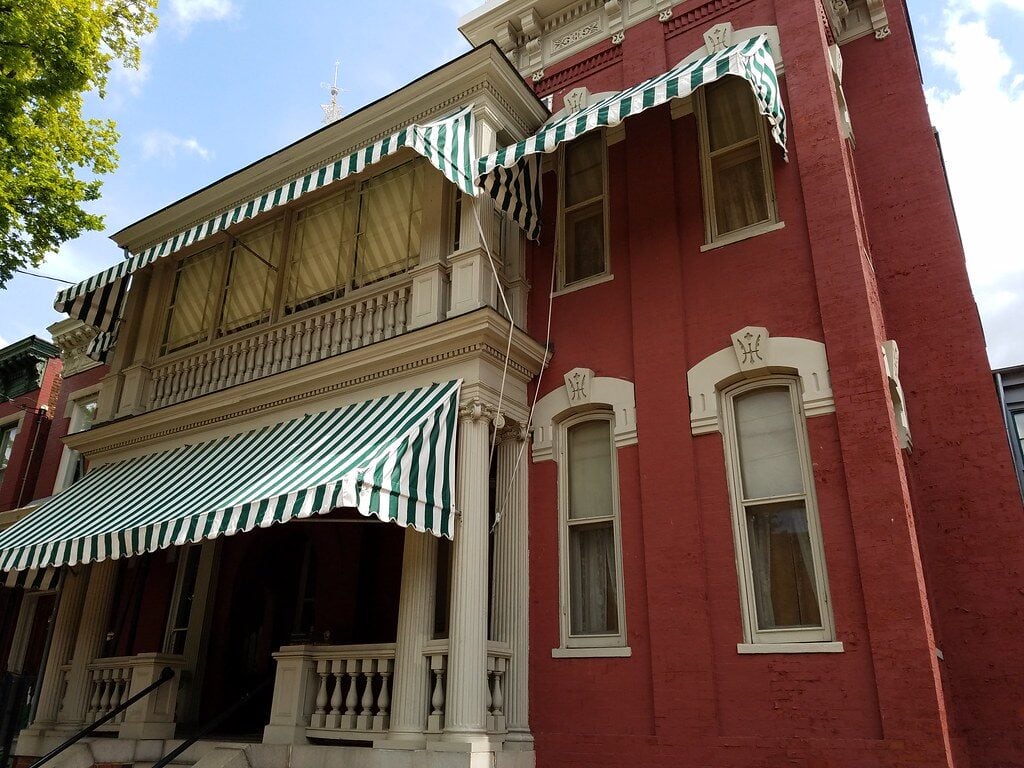
In 1882, George W. Boyd, an African American builder, started work on a two-story brick Italianate rowhouse on East Leigh Street.
A Richmond newspaper noted the project at the time and called it a "handsome brick house" with 9 or 10 rooms.
It was being built for Dr. John C. Ferguson, a Black physician. The rear carriage house was built at about the same time. This was in 1883.
The property later passed to Dr. Robert Emmett Jones. In 1892, he added a two-story brick bay and a wing for his medical office.
Around 1896, he added a one-story porch in the Eastlake style. By the time Walker bought the property in 1904, the house had already gone through more than twenty years of additions and changes.
She did not buy an untouched original structure. She bought a city townhouse that had already been altered over time.
It included a former doctor's office, a rear carriage house, and upper floors that had housed different tenants.
Walker was 40 years old. She had opened the St. Luke Penny Savings Bank the year before and moved into the house with her husband, Armstead, her mother, Elizabeth Draper, and her sons.
What Maggie Walker Changed at 110½ East Leigh Street
Walker made major changes soon after she moved in. Gas lights were replaced with electricity. Central heating was installed. The former Jones medical office was turned into a library.
These were substantial improvements made by someone who planned to live there for the long term and had the money to do the work properly.
The largest change came in 1922. That year, Walker hired Charles Thaddeus Russell, the first African American to maintain an architectural practice in Richmond and probably in Virginia.
Russell had already designed the St. Luke Penny Savings Bank building in 1910.
At the house, he added a Colonial Revival porch, enclosed and enlarged other porches, raised sections that had been one story to two stories, and remodeled the sitting room and dining room.
Rooms in the new addition were given to Walker's adopted daughter and caregiver, Polly Anderson Payne, and Polly's husband, Maurice.
Later, the bedroom in that addition was used as a playroom for Walker's grandchildren.
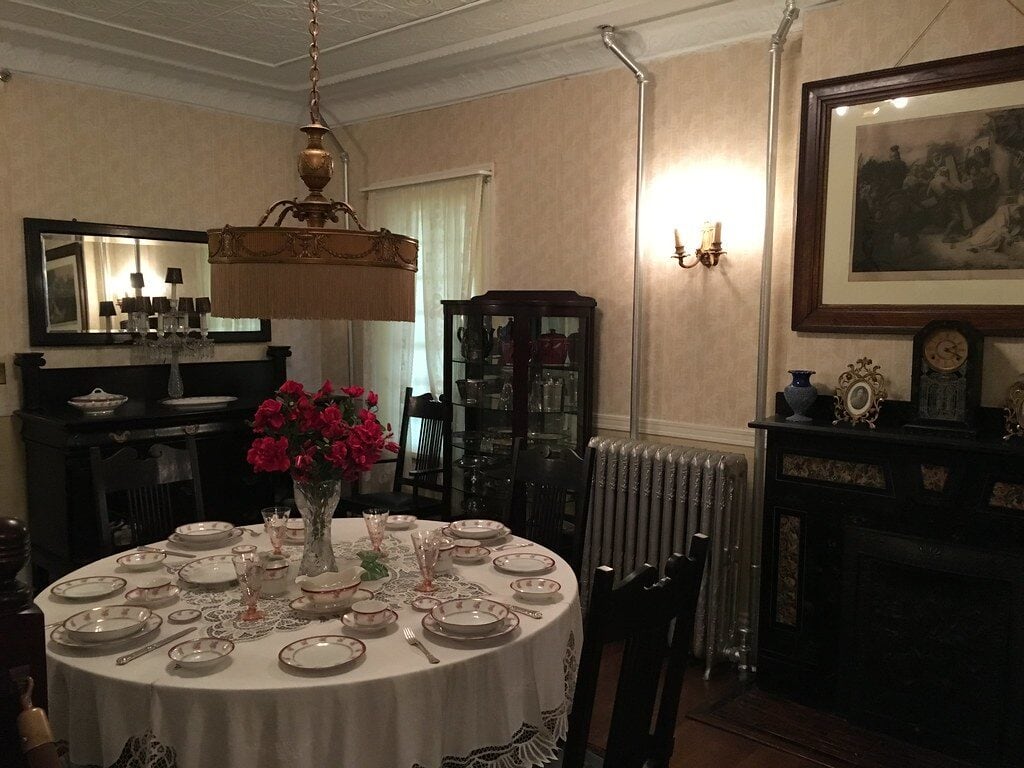
The dining room still has its pressed-tin tray ceiling. The kitchen kept its iron stove.
A door from Walker's bedroom opened straight onto a sunporch. That detail shows how the house was arranged around her daily life and care.
An Elevator Shaft and a Widened Hallway
Diabetes had begun taking its toll years before the end. By 1928, Walker was using a wheelchair.
That year, workers installed an elevator and widened a hallway to make the house navigable for her. Both changes survive in the building today.
Walker did not leave. She stayed in that house - conducting business, receiving visitors, continuing her work with the Independent Order of St. Luke - until she died there on December 15, 1934, at 70.
Her son Melvin inherited the property and died about a year later. His sister-in-law, Hattie N. F. Walker, then took ownership of the house and changed almost nothing.
She made a few minor cosmetic updates in the 1940s and kept the arrangement of the rooms close to what it had been during Maggie Walker's lifetime.
Hattie wanted it to become a museum. The last family member to live in the house did so until 1966. The family kept ownership for another thirteen years after that, not transferring the deed until 1979.
The Activists Who Worked to Save It
People trying to preserve Black history had already seen the St. Luke Penny Savings Bank building disappear.
In December 1974, Mozelle Sallee Baxter called the first meeting of the group that later became the Maggie L. Walker Historical Foundation.
The foundation was formally organized in 1975. Its plans went far beyond simply keeping the house from being altered or lost.
The group wanted to create a monument and museum of Black history and culture, a library devoted to banking and finance, and a community space in the carriage house.
Virginia acted quickly. The house was placed on the Virginia Landmarks Register on April 15, 1975.
It was added to the National Register of Historic Places on May 12. Three days later, on May 15, it received National Historic Landmark designation.
That was three separate designations in a single month.
Federal action followed in 1978. Public Law 95-625, signed by President Jimmy Carter on November 10, authorized the creation of Maggie L. Walker National Historic Site.
It also authorized appropriations of up to $795,000 for land acquisition and $500,000 for the development of essential facilities.
Jackson Ward had been split in two in the 1950s by the construction of the Richmond-Petersburg Turnpike, now I-95 and I-64.
The Maggie L. Walker National Historic Site later became part of broader efforts to preserve Jackson Ward as a historic neighborhood and to revitalize the surrounding community.
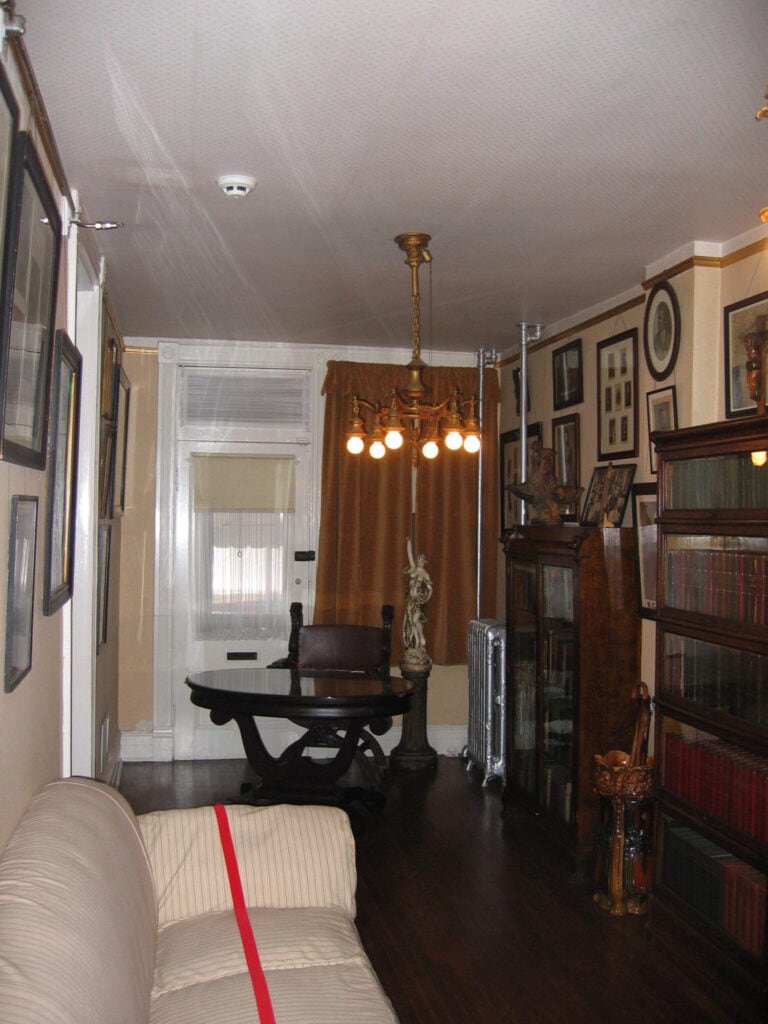
What the Maggie Walker House Contains Today
The National Park Service deed ceremony took place in 1979. It ended with Maggie Laura Walker Lewis, Walker's granddaughter, handing the deed to Deputy Director of the NPS Ira Hutchinson.
A month later, in August 1979, someone broke into the house. The thief took chairs, a tea cart, a table, a lamp, vases, figurines, and pottery. The estimated loss was $4,060. Only the lamp was recovered.
Restoration work continued for six years. The house museum opened in July 1985.
About half a million dollars had been spent on the building, and Lewis cut the ribbon. The visitor center at 600 North 2nd Street opened on April 4, 1997.
A Historic Furnishings Report, completed in 2004, used photographs, oral histories, and material analysis to determine how the house should be presented. A permanent exhibit opened in 2005.
In 2020, the Stallings family donated 40 linear feet of archival material, including Maggie Walker's personal and professional correspondence as well as records of the Independent Order of St. Luke.
The gift included letters to and from W. E. B. Du Bois, Nannie Helen Burroughs, and Mary McLeod Bethune.
Maggie L. Walker National Historic Site now holds more than 80 linear feet of archival material in two collections.
Guided tours run on Fridays and Saturdays from the visitor center. Group visits by reservation take place Tuesday through Thursday.