
A monkey cage and a bird aviary greeted families inside Ford City Center when it opened in 1965, set down in a building that two decades earlier had turned out engines for the B-29 bombers of World War II.
The mall did not replace the old factory so much as move into it. Shoppers parked on fields that had once held wartime production buildings and later rode down to a basement concourse threaded through the tunnels of a vanished defense plant.
For six decades, this was one of the largest enclosed shopping centers in Chicago and the anchor of retail life on the Southwest Side.
As of late May 2026, a court order requires the main mall to close to the public at noon on June 22, and JCPenney, the only anchor that lasted from the first day, will end a liquidation sale and shut one day before.
Ford City Mall's War Years: The Dodge Chicago Plant
Construction began in June 1942, when the federal government and Chrysler's Dodge Division built the Dodge Chicago Plant to produce Wright R-3350 Cyclone engines for the B-29.
The industrial architect Albert Kahn, whose office specialized in vast automobile and war-production factories, designed the complex.
It grew to 19 buildings and 6 million square feet of factory floor, with a main manufacturing building covering 82 acres, one of the largest industrial structures of its kind.
More than 16,000 workers raised it, and more than 30,000 people worked there at the height of production, among thousands of machine tools, underground piping, and rail spurs.
By the end of the war, it had produced more than 18,000 engines.
The factory fell empty after 1945.
Tucker Corporation moved in to build the Tucker 48 automobile, one of the best-known short-lived car projects of the postwar years, but completed only 51 cars before the effort collapsed.
Ford Motor Company acquired and retooled the plant in 1950, ran aircraft-engine work through the Korean War period, and ended operations in 1959.
The mall took its name from this Ford era, not from the Dodge builders or the wartime engines that had made the place known.
How Ford City Mall Rose From an Empty Factory
The federal government sold the property in 1961 to the developer Harry F. Chaddick and a group of Chicago investors.
Chaddick, experienced in city zoning and real estate, pursued a specific aim: to keep department-store spending inside Chicago while enclosed malls multiplied in the suburbs.
Turning a factory into a shopping center meant tearing down or walling off large parts of the old complex.
Crews cleared buildings to open parking fields and reworked the southern portion of Building No. 4 into the core of an enclosed mall.
Ford City Center was dedicated on August 12, 1965, with Mayor Richard J. Daley taking part. The enclosed section, called the Grand Mall, held 834,000 square feet and opened with 82 stores.
JCPenney anchored the east end in a single-level store of 178,000 square feet, dedicated August 1; Wieboldt's anchored the west in 219,300 square feet.
The first tenants ran to the mid-1960s formula of apparel, shoes, variety, food, and service, among them Flagg Brothers Shoes, Bond Clothes, Lerner Shops, National Food Stores, and F.W. Woolworth.
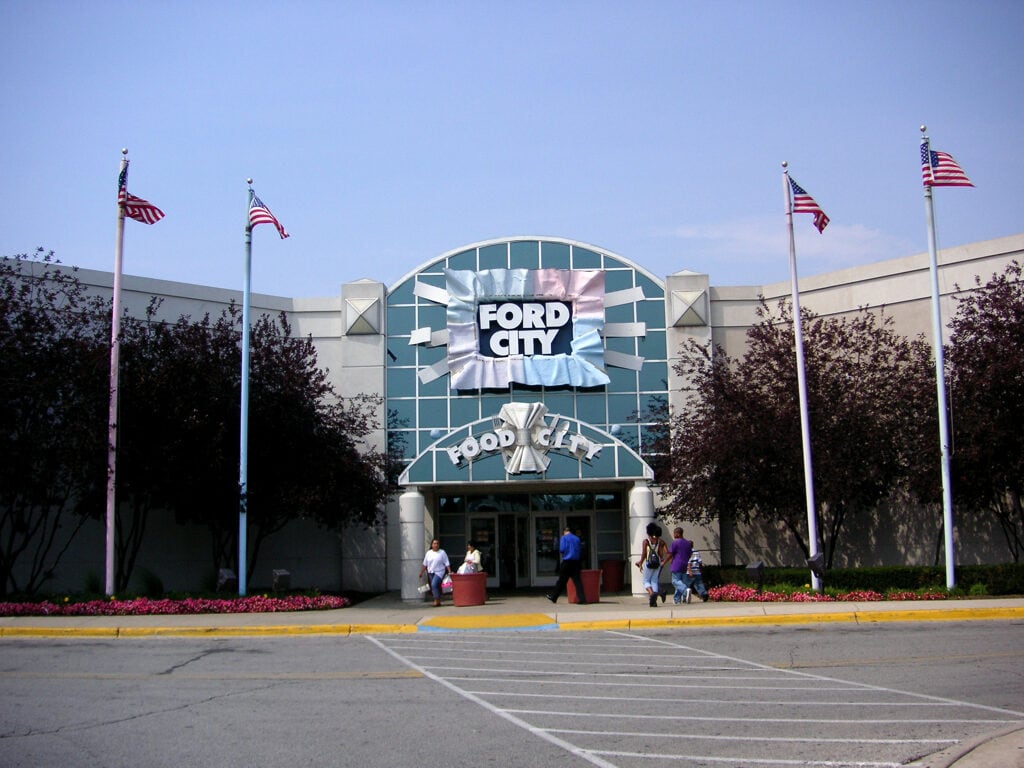
Peacock Alley: The Basement Mall Beneath Ford City
The North Mall opened in May 1966, a strip-style section rather than an enclosed wing, with 352,000 square feet that held the Ford City Bowling Center, a 110,000-square-foot Turn-Style Family Center, and the General Cinema Ford City Cinema I & II.
The strangest space came in September 1970, when a basement concourse called Peacock Alley opened in lower-level space left from the factory and connected the Grand Mall to the North Mall.
Climate-controlled and lined with small shops and food counters, it held tenants such as Nickleodeon Pizza, Tricks-N-Toys, and Gingiss Formalwear.
Most regional malls of the period were drawn up from scratch on a clean one- or two-level plan.
Ford City instead inherited factory bones: adapted shop floors, long internal corridors, and parking laid over demolished buildings.
The same inheritance that gave the mall its underground concourse later turned against it.
Water infiltration, basement flooding, exposed wiring, and questions about the ground beneath would sit at the center of the city's case against the property.
Montgomery Ward and the 1970s Growth of the Mall
A two-level Montgomery Ward of 211,000 square feet was dedicated on October 16, 1975, giving the complex a third major department store and pulling it closer to the suburban malls it competed with.
The original twin cinema had grown to three screens in 1973, and in July 1981, a separate theater, Ford City East, opened east of the mall.
Turn-Style, the discount family center in the North Mall, became Venture in September 1978 amid consolidation in the discount business.
By the close of the decade, Ford City carried JCPenney, Wieboldt's, and Montgomery Ward, along with a large discount anchor on the north side.
The $52 Million Facelift and the Food Court Era
Wieboldt's went out of business in July 1987, leaving a major vacancy on the west side, and the property changed hands the same year to an ownership group associated with Equity Properties and Development.
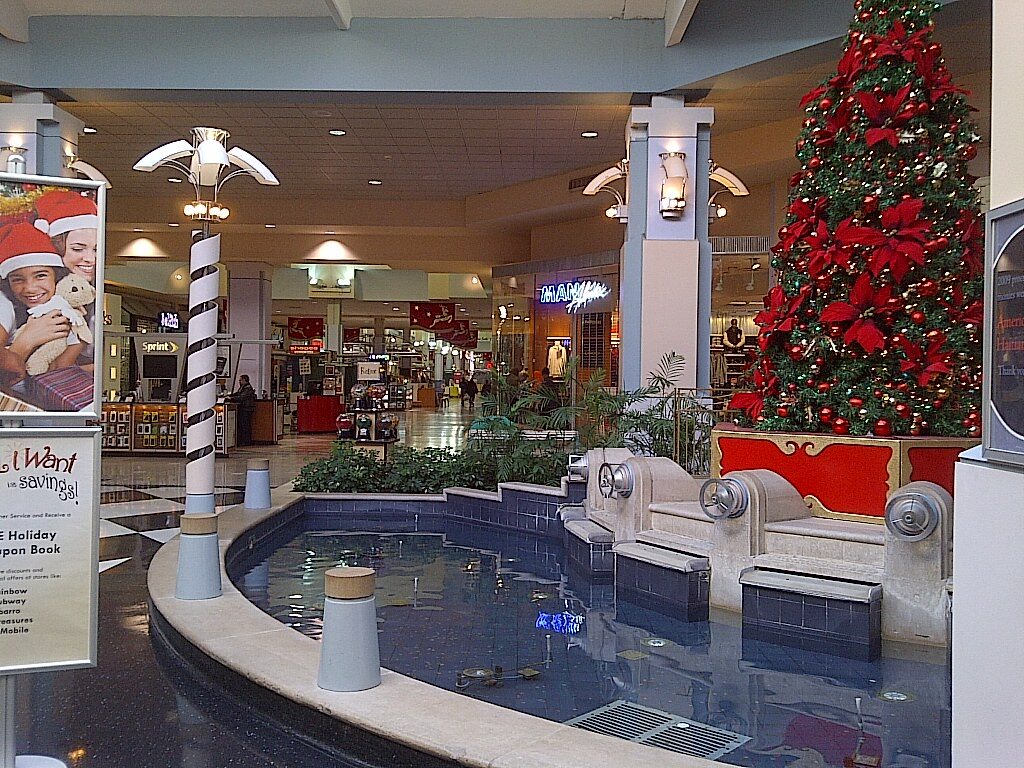
In January 1988, a renovation valued at $52 million began. The work brought a new interior, reconfigured stores, fresh signage, water features, flooring, skylights, and a 10-bay food court built into existing mall space.
Peacock Alley was rebuilt and renamed The Connection. The old Wieboldt's box was carved into smaller spaces, and Carson Pirie Scott opened in part of it on August 5, 1989.
Sears opened in the former Venture space on April 5, 1989, in 94,000 square feet.
By October, the work was substantially finished, and the center counted 1.39 million square feet of leasable space and more than 170 retail spaces.
A larger plan went unbuilt: a proposed southwest wing anchored by Marshall Field's never rose.
The freestanding General Cinema Ford City 14 opened on August 10, 1990, in the southeast parking area, replacing the older theater arrangements.

Anchor Losses and a $16.6 Million Sale at Ford City
Sears closed in 2010. Carson's followed on August 29, 2018, after the liquidation of Bon-Ton Stores, leaving JCPenney as the last traditional department store in the main mall.
The former Montgomery Ward had already been demolished during redevelopment work around 2011, and part of The Connection closed around 2012 as lower-level tenants moved upstairs, draining the concourse of the role it once played.
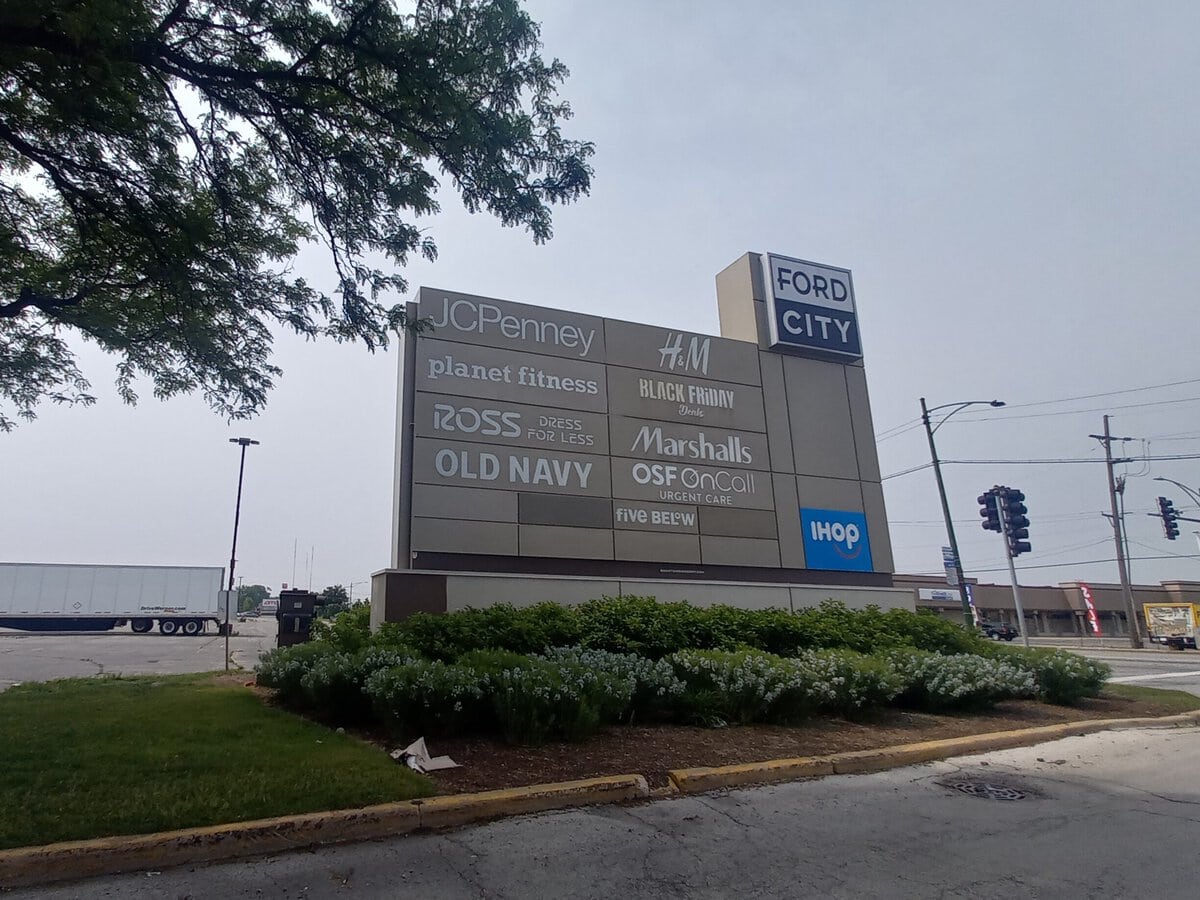
Owners kept trying to fill the gaps with a Sephora inside JCPenney, Five Below, a 23,000-square-foot H&M that opened in 2018, and outlot tenants like Chipotle and Mattress Firm.
After the 1987 sale during a wave of reinvestment, the property was relinquished to its lender, iStar Financial, in 2012, then bought by Namdar Realty Group in 2019 for $16.6 million, a low figure for a mall of 1.26 million gross leasable square feet.
In 2009, the mall set an evening curfew for visitors under 17 after concerns about loitering and disorder, and the parking lots later drew street takeovers and gun violence that hardened public perception.
A long-discussed extension of the CTA Orange Line from Midway to Ford City, studied in 2008, was shelved in July 2011 and never built, leaving the mall dependent on cars and buses.
The Court Order to Close Ford City Mall in 2026
A fire-suppression test failed on April 6, 2026.
Four days later, the City of Chicago filed an emergency motion to vacate the main mall, citing a sprinkler system that had leaked for an extended period, along with basement flooding, exposed wiring, water infiltration, possible soil instability, and the risk that leaks could undermine the ground.
The system was restored on April 17, and a hearing set for April 23 was pushed to May 15, but the city held that the building remained unsafe.
On May 15, 2026, a Cook County judge ordered the main portion of Ford City Mall to close to the public at noon on June 22.
The order spares the north mall, the outbuildings, and the theater.
JCPenney, which had renewed its lease for five years and was a profitable store, began a liquidation sale and is set to close June 21, one day ahead of the deadline.
The other plan for the site predates the court fight.
In 2025, a contract purchaser tied to Bridge Industrial, later Kurv Industrial, proposed buying 60 acres of the mall and replacing it with four industrial buildings totaling 913,000 square feet, with 923 parking spaces and 92 loading docks for warehousing and light manufacturing.
The projected investment topped $150 million, with 90 construction jobs and 400 to 500 permanent ones.
The land is zoned for community shopping and would need rezoning to light industrial use; at a September 10, 2025, public meeting at Richard J. Daley College, residents weighed truck traffic, pollution, noise, and the loss of a gathering place against the promise of jobs and reuse.
What Remains of Ford City Mall as the Doors Close
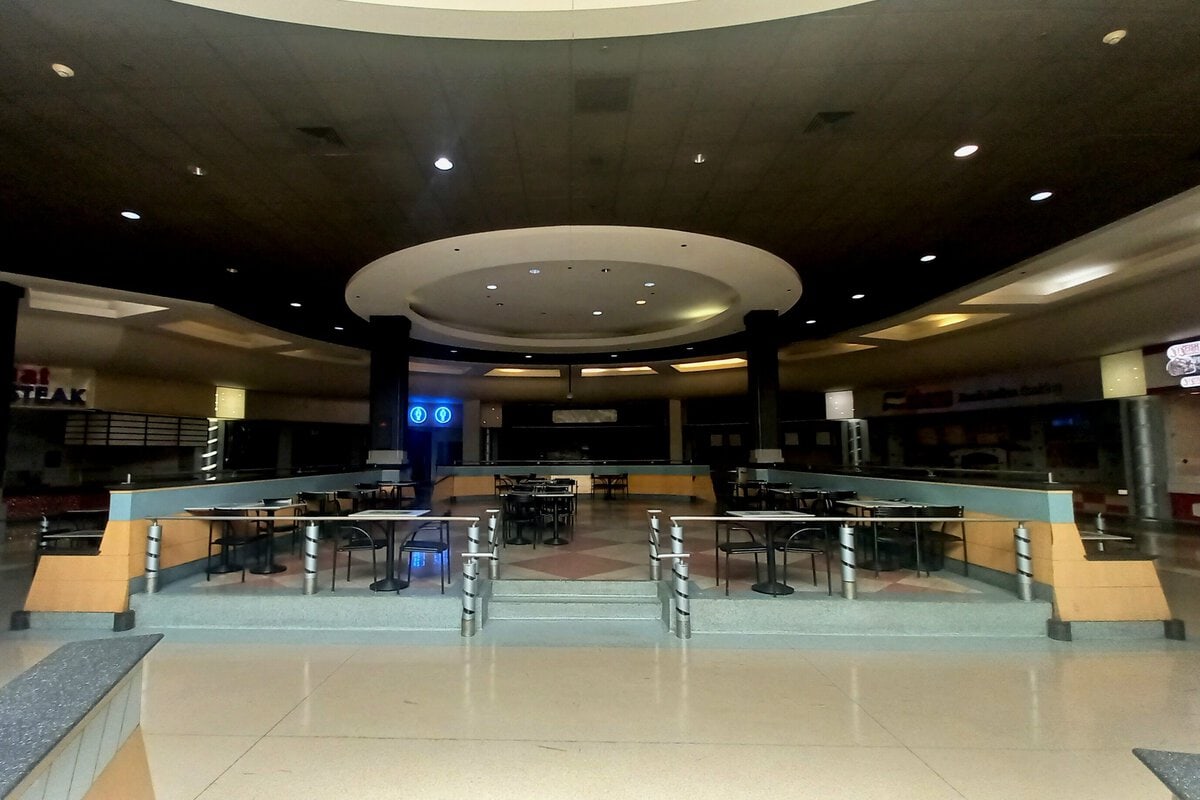
The main enclosed mall is down to its final scheduled weeks, with 16 commercial tenants left and much of the interior dark.
JCPenney runs its closing sale through June 21. The stores set to go when the doors lock at noon on June 22 include Foot Locker, Victoria's Secret, Journeys, Lids, and Auntie Anne's.
What stays open is the part of Ford City that was never a single building: the north mall, the outbuildings, and the AMC theater fall outside the order and are expected to keep operating.
What is gone is the regional mall itself, the department-store floors, the basement concourse, the aviary and monkey cage that once drew families inside.
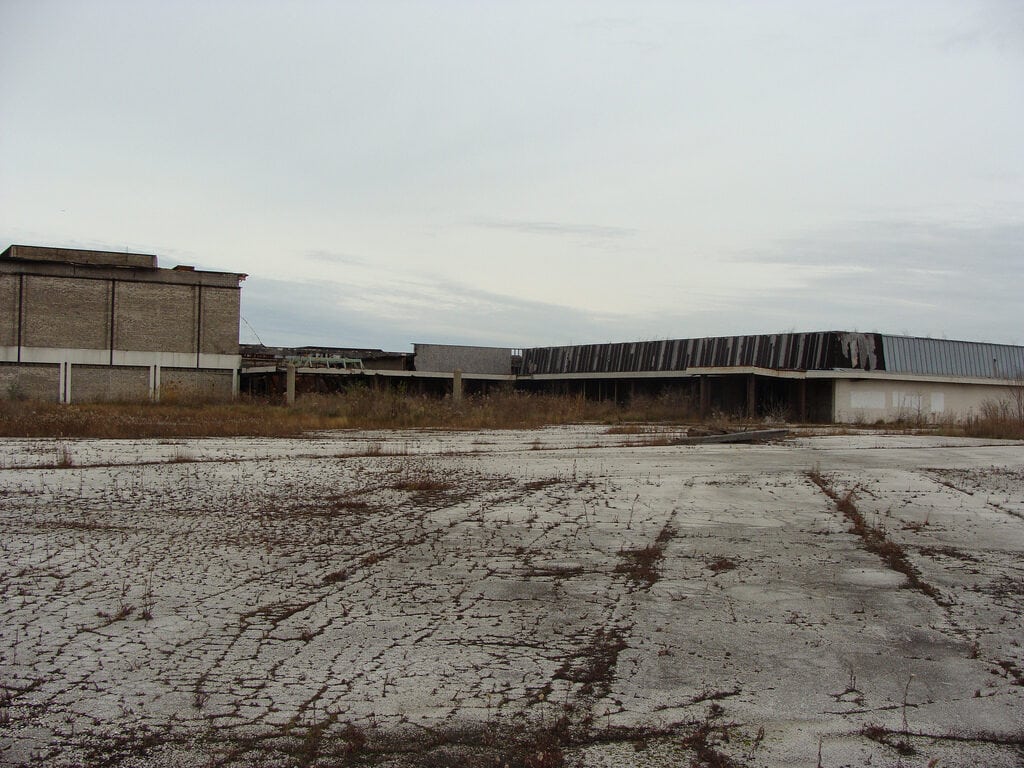
What remains is the land near Midway Airport and the industrial corridors of the Southwest Side, and a proposal to turn it into warehouses that has not yet cleared zoning, planning, or the City Council.
People still come for what stays open and for a closing sale at the one store that opened with the place in 1965.
The factory that built bomber engines became a mall, and the mall is now being measured for whatever the land becomes next.
Independent Publisher Notice
BestAttractions is an independent editorial publisher. We are not affiliated with, endorsed by, or acting on behalf of any location, business, property owner, manager, government agency, or organization described in this article. Comments posted on this page are not forwarded to, reviewed by, or acted upon by any entity mentioned in the article. For official inquiries, complaints, applications, bookings, or other requests, please contact the relevant entity directly through its official website or other verified channels.
This place is a dump now. The parking lot looks like the west side of Chicago.
It’s sad to see it in that state, but hopefully, they can improve things over time. Maybe with some investment in the area, it’ll get back to what it once was. Thanks for sharing!
I grew up on the southside. Visiting Riverside Mall in Berwyn, Illinois. To see the spike with the cars stacked on top of each other like a skewer.
Ford City Mall was a special occasion. When my parents would take me. The colors and the banner like entrance making looking like an amusement park. It's a shame how now and days. It has become a dead zone. The once giant of American like Mall. Has turned dormant and cold. I hope it finds a way to maintain its glow.
Thank you for sharing your memories! It’s great to hear how special Ford City Mall was for you. I agree, it’s sad to see it lose some of that energy, but I also hope something can bring it back to life.