
Water Tower Place is a 74-story tower and vertical shopping mall at 835 North Michigan Avenue on Chicago's Magnificent Mile, open since 1975 as the city's first enclosed downtown mall.
Ask a Chicagoan about it, and you'll hear the old story: glass elevators going up the atrium, waterfalls on the walls, Marshall Field's taking up eight floors.
Some of that is memory now, and the rest is slated to go. Lord & Taylor was gone by 2007, Macy's in 2021, and in 2022 Brookfield gave the mall to its lender with an estimated $300 million in debt hanging over the property.
Today, American Girl, LEGO, Adidas and dozens of other tenants still operate, but the owner now plans to pull retail down to the first three floors.
A more than $170 million redevelopment, with construction expected to start in 2027, will reduce retail to three floors and move floors 4 through 8 toward offices, medical offices and other commercial uses.
The mall people describe has outlasted the mall that exists. Here's how the first turned into the second.
The morning Chicago lined up to get into Water Tower Place
On a morning in October 1975, the line outside Water Tower Place started forming at 8 a.m. for a 10 a.m. opening.
Within two hours, 2,000 visitors had been handed roses, and employees of the anchor stores struggled to push through the crowd into their own building.
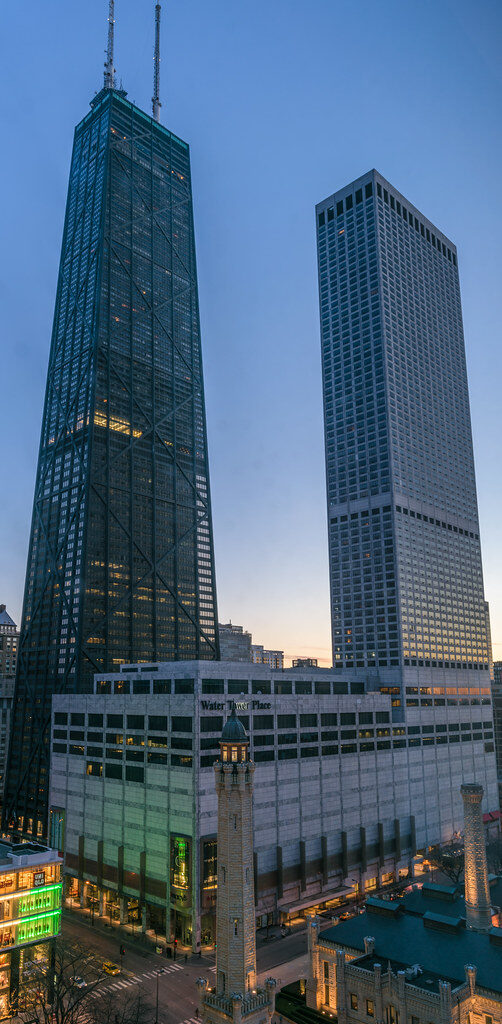
What they were waiting for was Water Tower Place: a 74-story tower at 835 North Michigan Avenue on Chicago's Magnificent Mile, with eight levels of stores stacked inside its base.
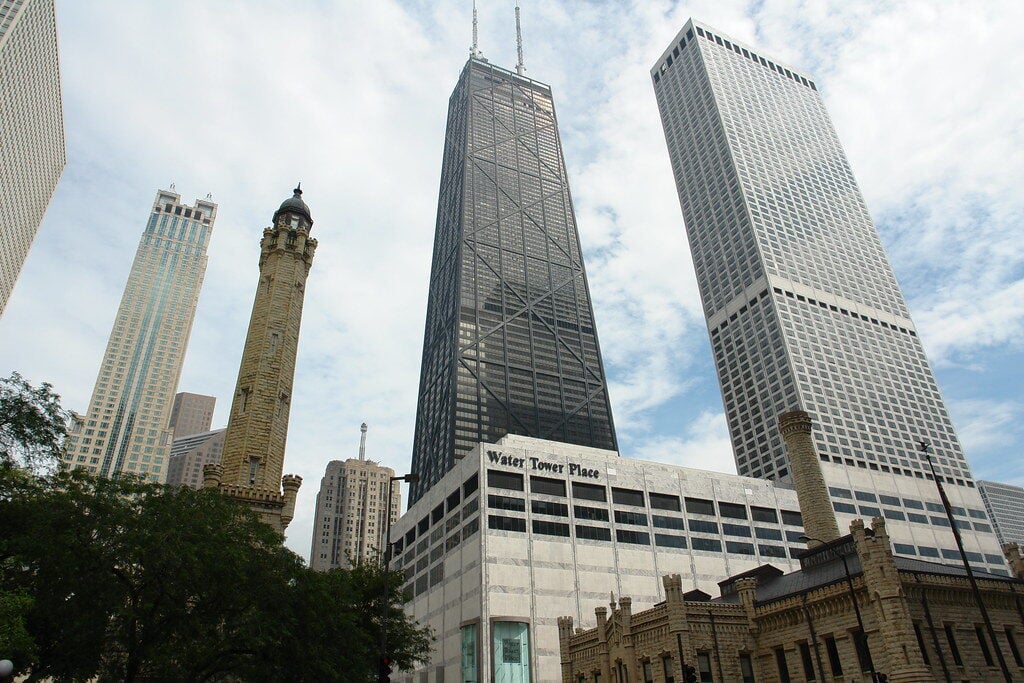
It was Chicago's first enclosed urban shopping mall, set beside the historic Chicago Water Tower and across the street from the John Hancock Center.
Above the stores sat offices, condominiums, and a luxury hotel.
A shopping mall turned on its end and dropped into downtown. The idea came from a department store watching its customers move to the suburbs.
The suburban mall idea behind Water Tower Place
In the late 1960s, Marshall Field & Co. ran a shopping-center division called the Mafco Company, and Mafco wanted to bring suburban-style shopping into downtown Chicago instead of chasing shoppers outward.
Then a 55,000-square-foot parcel on North Michigan Avenue tied to the Bronfman family came up for sale.
Philip Klutznick of Urban Investment and Development Company saw the opening, formed a joint venture with Marshall Field's, and bought it.
The partners kept buying neighboring lots until the project filled the block bounded by Michigan Avenue, Chestnut, Pearson, and Mies van der Rohe Way.
The plan stacked everything on that one block, a city within a city, because land on the avenue cost too much to spread out.
Early drawings leaned more heavily on office floors. When the office market made that harder to justify, the developers swapped much of that space for a hotel.
The tallest concrete building in the world
Construction started in 1972 and eventually cost $192 million, backed by Mafco, Marshall Field's real-estate subsidiary, and Urban Investment, a subsidiary of Aetna Life & Casualty.
Loebl Schlossman Bennett & Dart designed it. Inland-Robbins built it.
The tower topped out at 74 stories and 859 feet, the tallest reinforced-concrete building in the world at the time.
Inside went 260 condominiums, 200,000 square feet of offices, a 600,000-square-foot retail mall, hotel floors and parking below, all wrapped in gray marble.
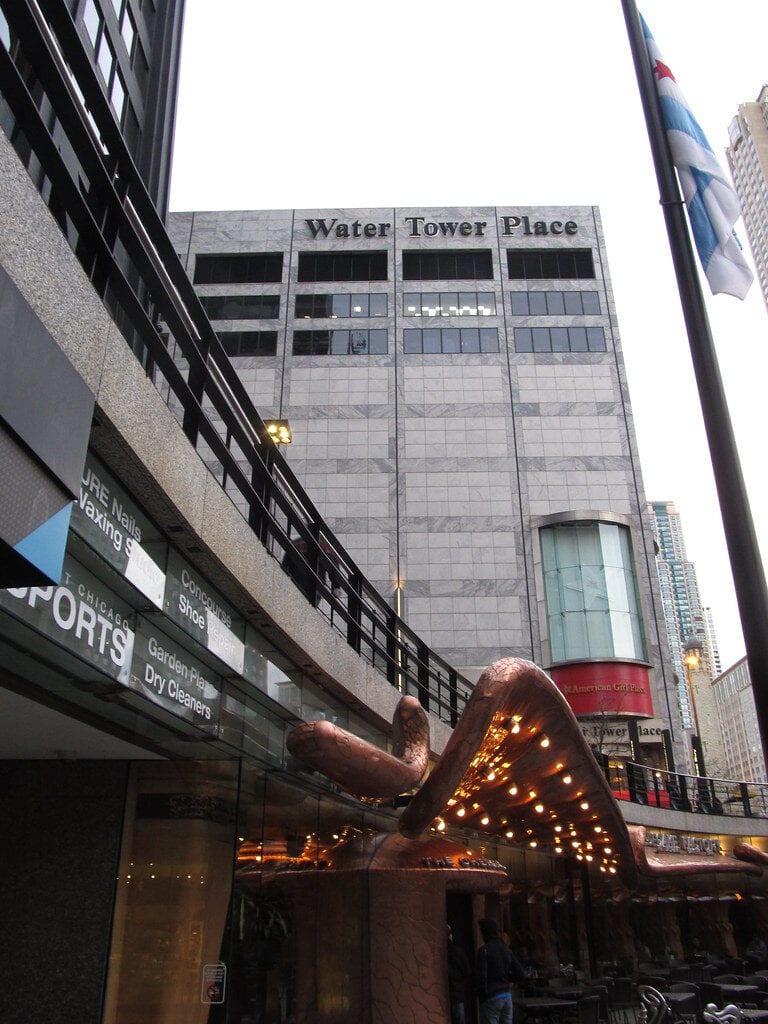
The marble was the catch. Along Michigan Avenue and Chestnut Street, the base presented almost no windows at all. Critics would have things to say about that.
Waterfalls and glass elevators inside, blank marble outside
The interior went the other direction.
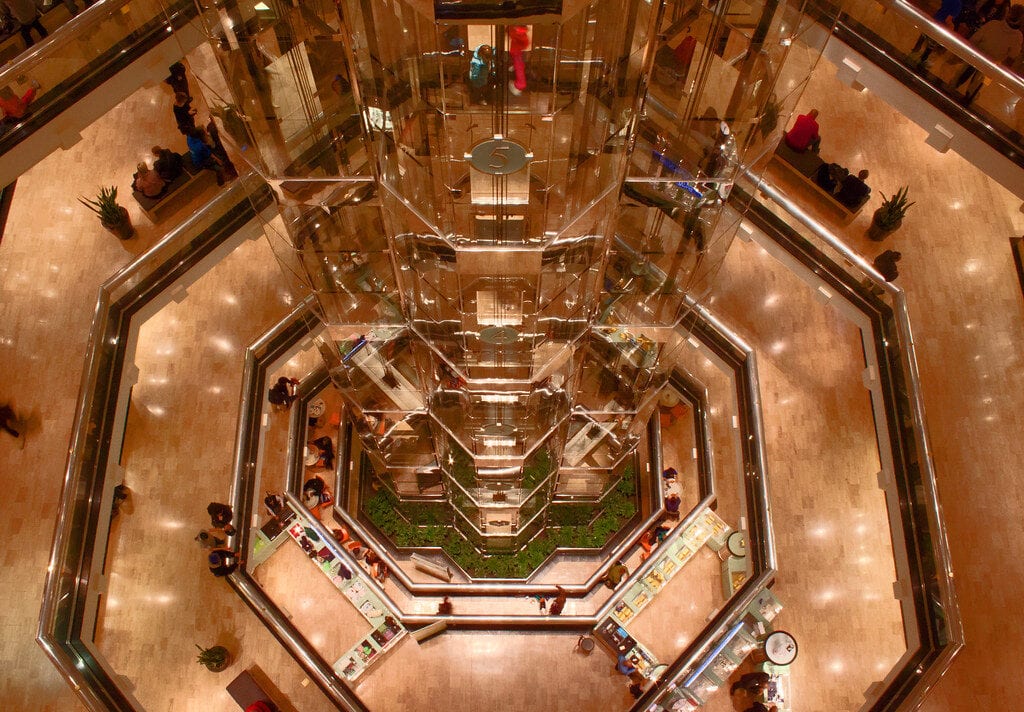
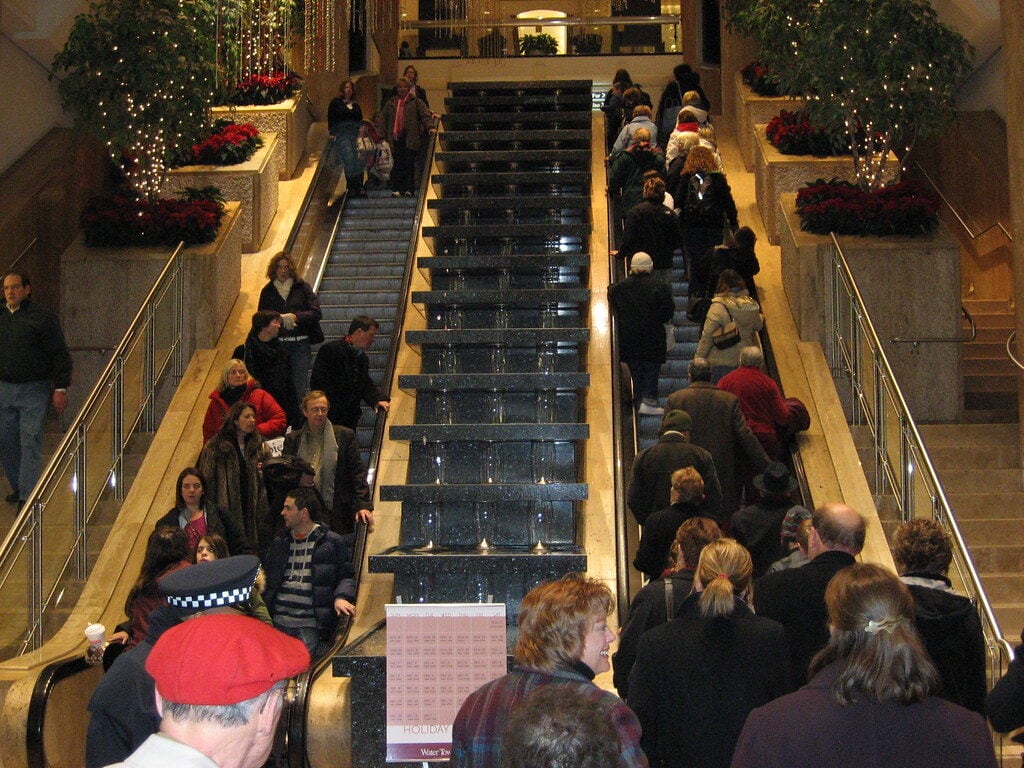
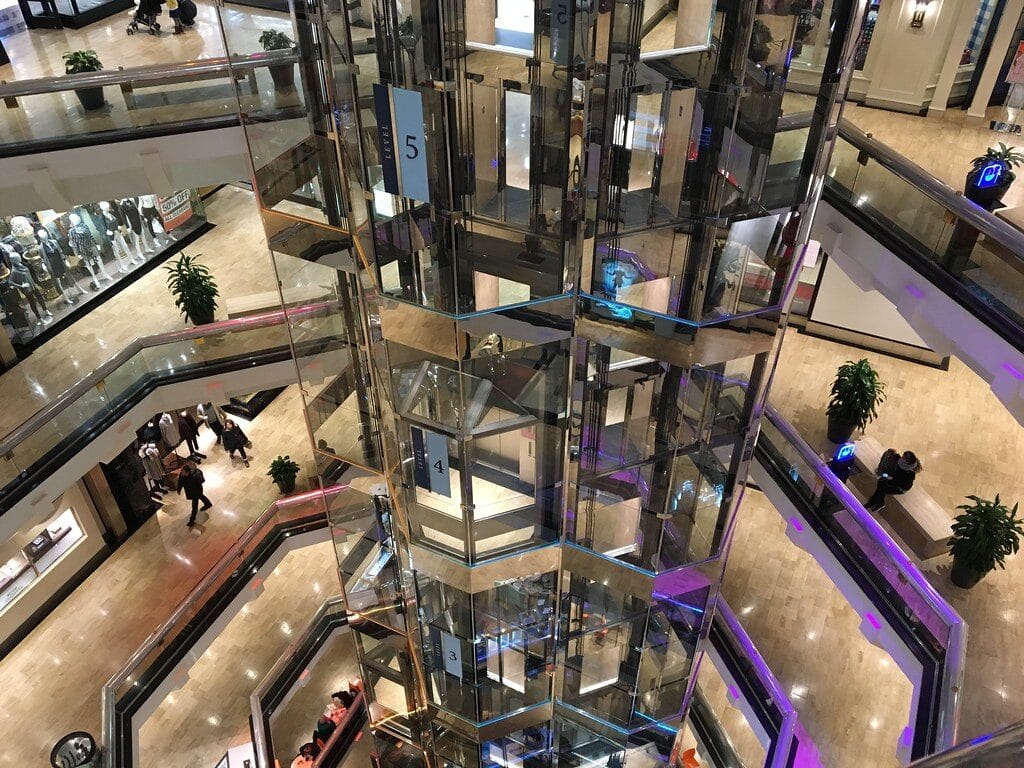
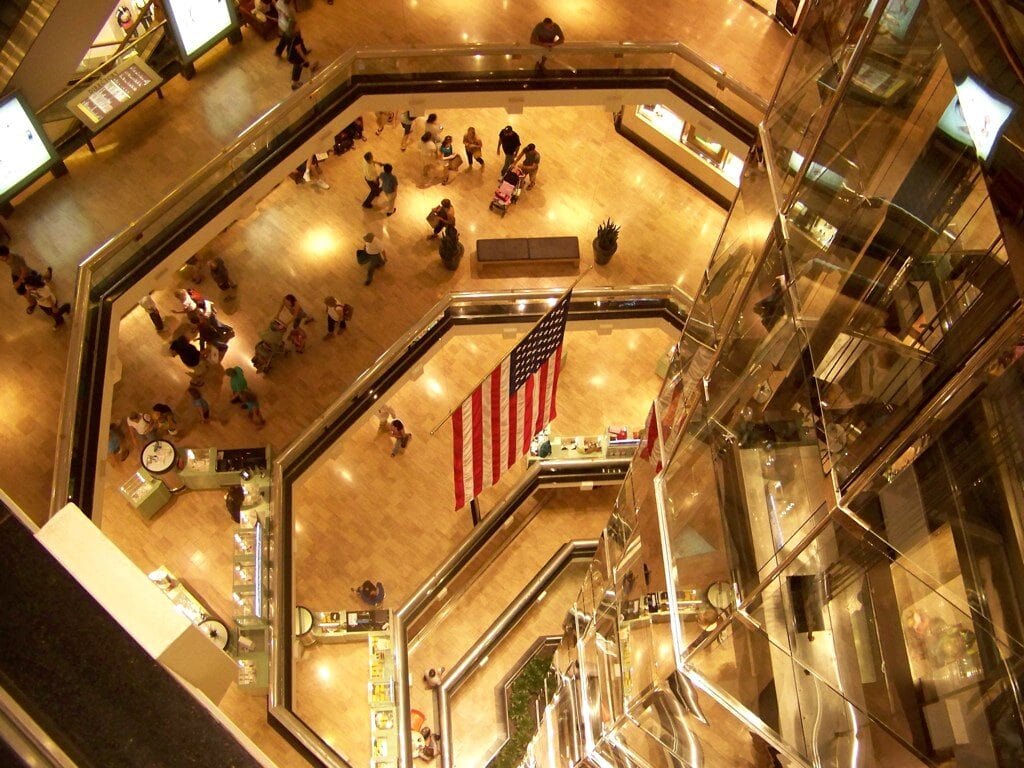
More than 100 stores wrapped around an eight-level atrium where glass-and-chrome elevators rode up the center, water cascaded beside the escalators, and those escalators zigzagged from level to level.
Polished stone, chrome, moving water: the 1970s idea of luxury.
The anchors were enormous. Marshall Field's filled eight floors. Lord & Taylor took seven and spent $9.5 million (around $56.7 million in 2025 dollars) building out its interior.
A four-screen cinema opened on the second floor on December 21, 1976, and three street-level screens followed in April 1984.
Paul Gapp, the Chicago Tribune's architecture critic, listed the building among Chicago's prominent architectural failures and compared it to a "dowdy young millionairess," expensive and blank toward the street.
Shoppers overruled him. In 1976, its first full year, the mall rang up sales of $108 per square foot, close behind the $118 posted by suburban Woodfield Mall, the kind of place it was built to answer.
The copycats that rebuilt the Magnificent Mile
Those numbers traveled.
Water Tower Place helped pull downtown Chicago retail from State Street toward North Michigan Avenue, and developers followed with vertical malls of their own: 900 North Michigan in 1988, Chicago Place in 1990, The Shops at North Bridge in 2000.
In 1986, the Urban Land Institute recognized Water Tower Place in its Awards for Excellence program for the urban mixed-use model it put on Michigan Avenue.
The hotel settled in between floors 15 and 30, managed by Four Seasons from 1977 and carrying the Ritz-Carlton name, with its lobby up on the 12th floor and elevators to reach it.
The building even answered its critics, eventually. A 2001 makeover added glass walls and display windows to the exterior.
It updated the escalators and fountains, breaking up some of the blank marble critics had singled out.
Then the pieces started coming loose, one tenant at a time.

Lord & Taylor leaves and American Girl moves in
The cinema went first. The original four screens closed in May 2000, the street-level three that November.
Village Theatres tried art and foreign films in part of the space from August 2002 to August 2003.
In May 2005, the auditoriums reopened as a live venue, Drury Lane Water Tower Theatre, renamed the Broadway Playhouse at Water Tower Place in 2010. It's still staging shows.
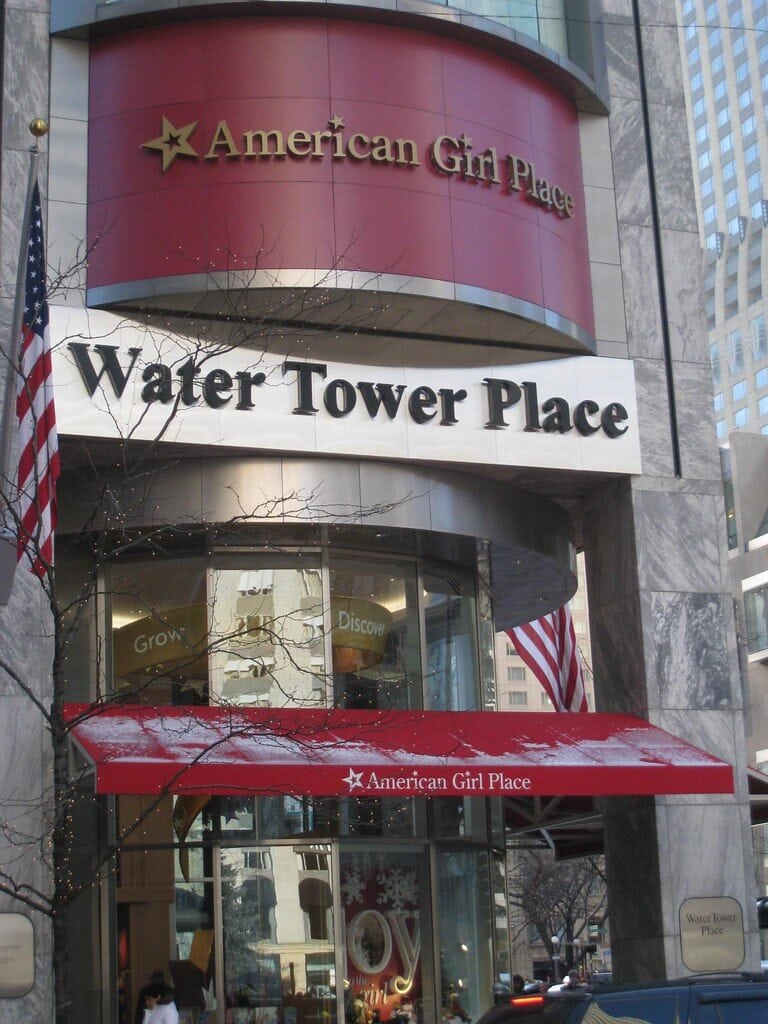
In spring 2007, Lord & Taylor closed its seven-story store after 31 years. A three-story American Girl Place opened in the space in 2008 and became one of the building's signature draws.
It still is, though now on the first two floors: seven floors of department store became two floors of dolls.
Macy's goes, then the owner hands back the keys
The other anchor took longer. Marshall Field's became Macy's in 2006 after Federated Department Stores consolidated its brands.
In January 2021, Macy's announced the store would close as part of a national pullback from malls. By that March, the doors were shut, ending 45 years of a department store inside Water Tower Place.
The mall itself had been changing hands for years: to The Rouse Company in 2002, to General Growth Properties through its 2004 Rouse deal, then to Brookfield through its 2018 GGP deal, with Brookfield buying out its remaining partner around 2020.
Brookfield had planned a major renovation in the late 2010s; money troubles and the pandemic shelved it, and the Macy's closure left it stranded.
In April 2022, Brookfield handed the mall to its lender, MetLife Investment Management, after concluding it was worth less than the $300 million owed on it.
The surrender fit the street.
By early 2023, availability in the northern stretch of North Michigan Avenue had reached 38%, security concerns colored public perception of the Mile, and the building's owner was weighing whether the upper floors should become medical offices, regular offices, apartments, or something else.
Forever 21's U.S. bankruptcy in March 2025 emptied another storefront; closing signs went up at Water Tower Place before the filing was even public.
Five quiet floors and a $170 million answer
By June 2025, MetLife had hired JLL to market floors 4 through 8, up to 500,000 square feet, for office, medical, institutional, or nonprofit use, with a dedicated entrance on Pearson Street.
The upper mall was, in effect, up for grabs.
The full plan landed in April 2026: a redevelopment expected to top $170 million, starting in 2027 and substantially finished by 2028.
Retail and dining get concentrated on the first three floors. Floors 4 through 8 split off from the shopping center entirely and convert to offices and medical space.
The Michigan Avenue entrance gets reworked with a new atrium, high ceilings, natural light, a pedestrian arcade, and clearer sightlines.
Pepper Construction is the general contractor, Neumann Smith the architect, and the work is phased so the remaining stores can stay open the whole time.
The eight-level mall, the thing the whole building was invented for, shrinks to three floors.
Who still shows up at Water Tower Place in 2026
The roster is smaller and more specific now: American Girl in the old Lord & Taylor space, plus Akira, Lego, Bath & Body Works, Express and Lacoste.
The Broadway Playhouse runs live performances where the movie screens used to be.
The Ritz-Carlton, which renovated 432 guest rooms and 50,000 square feet of public space around 2017, still fills the middle of the tower, and condominium owners still live above it.
Floors 4 through 8 are still part of the mall for now, but leasing agents are already pitching them as future offices and exam rooms.
But people still come. The ground floors still trade, the elevators still run, and the Magnificent Mile outside still carries tourists past the door.
When construction starts in 2027, the shoppers will already be inside. The plan is to rebuild the place around them, with the lights on.
Independent Publisher Notice
BestAttractions is an independent editorial publisher. We are not affiliated with, endorsed by, or acting on behalf of any location, business, property owner, manager, government agency, or organization described in this article. Comments posted on this page are not forwarded to, reviewed by, or acted upon by any entity mentioned in the article. For official inquiries, complaints, applications, bookings, or other requests, please contact the relevant entity directly through its official website or other verified channels.