
Manhattan Town Center is an enclosed regional shopping mall in downtown Manhattan, Kansas, within Riley County in the northeastern Flint Hills region of the state of Kansas.
The mall anchors the eastern terminus of Poyntz Avenue, Manhattan's central commercial corridor, sitting near the Kansas State University campus and roughly 18 miles east of Fort Riley military installation.
It serves as the main indoor shopping place for Manhattan and nearby towns, attracting shoppers from up to 50 miles away since it is the only regional mall in that area.
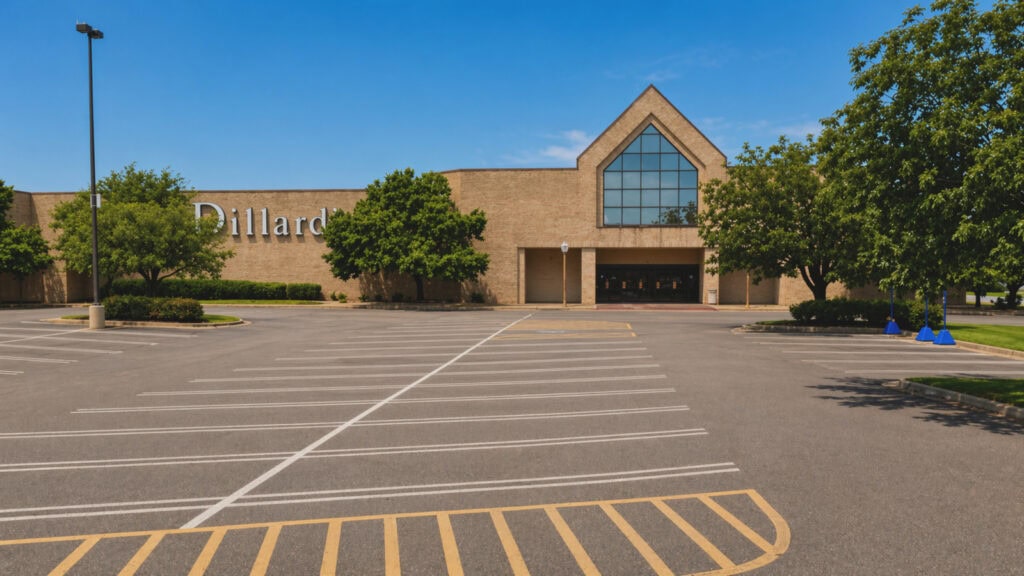
The center opened on October 26, 1987, established through a public-private partnership between the City of Manhattan and Forest City Enterprises, and anchored today by Dillard's, JCPenney, and AMC Dine-In 13 IMAX.
Cinnamon Rolls, Limestone, and Parking You Can't See from the Street
Walk into Manhattan Town Center from Poyntz Avenue, and the smell hits before anything else does - Mrs. Powell's Cinnamon Rolls, a long-running mall tenant since 1988.
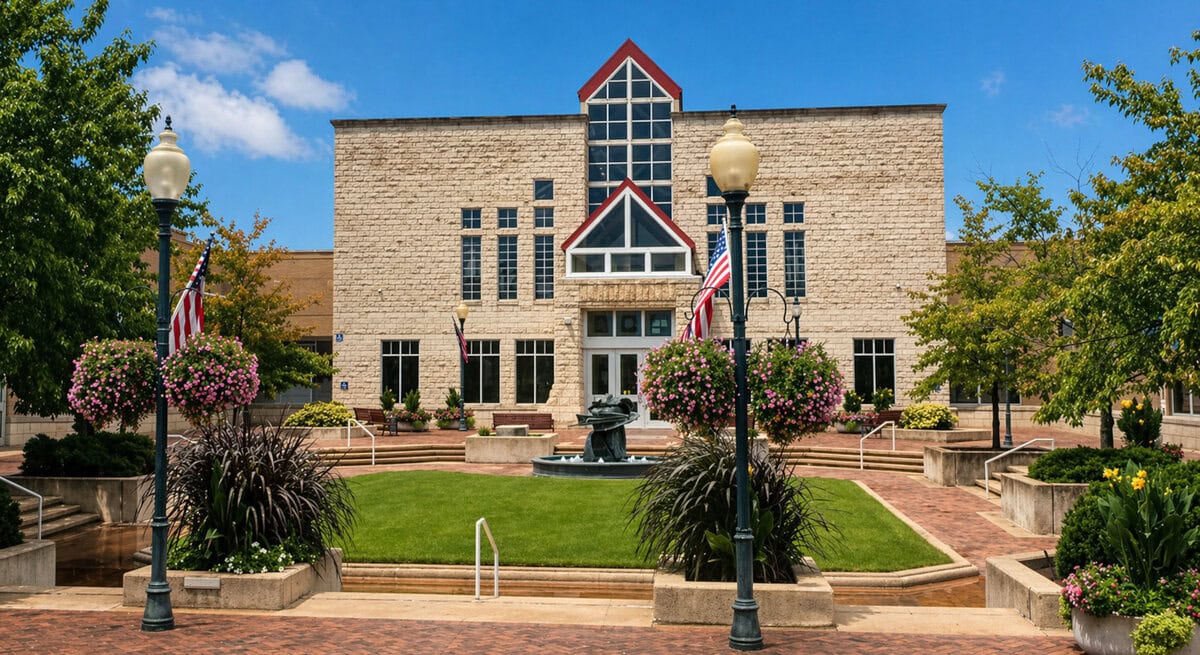
The building is made of limestone, which is also what the older commercial blocks to the west are made of.
The parking is behind the building and along the sides, not out front. The corridors inside are wide and get daylight from above.
The mall opened on October 26, 1987. Allen Raynor was the mall's first security director that day and later became general manager.
The building sits at the east end of Poyntz Avenue, the main commercial street through downtown Manhattan, Kansas, in the same city as Kansas State University.
Fort Riley is about eight miles west. The nearest competing regional mall is more than 50 miles away.
None of the physical choices - the limestone, the hidden parking, the street-level frontage - were accidental.
They came out of almost a decade of planning, a federal arts grant, an unusual public-private land deal, and a city government that had already said no to four developers before it said yes to this one.
Manhattan Town Center's Origins: The City That Rejected Four Malls
During the 1970s, retail activity in downtown Manhattan shifted west. A project called Westloop drew stores away from Poyntz Avenue.
As that happened, interest grew in building a regional mall next to the highway, with large parking lots and department store anchors.
Four different developers proposed versions of that plan. The city turned down all four.
In 1979, Manhattan issued a request for proposals for a developer willing to build in the downtown area instead. Forest City Enterprises won the bid.
RTKL joined as the architect. The city handled demolition, site preparation, and improvements along Poyntz Avenue.
Forest City and RTKL were responsible for the building itself.
Before construction began, a 1981 study funded by the National Endowment for the Arts looked at the project.
The study, titled "Poyntz Avenue: Rediscovery of Manhattan's Main Street," involved architecture students from Kansas State University.
They focused on a key question: how to place an enclosed shopping mall into an existing downtown street grid without harming street life.
The study was completed six years before the mall opened. The final design by RTKL placed the structure at the eastern end of the avenue instead of cutting it off.
The building used limestone on the exterior, kept parking away from the main street, and included wide, well-lit interior corridors designed to feel like covered streets rather than enclosed boxes.
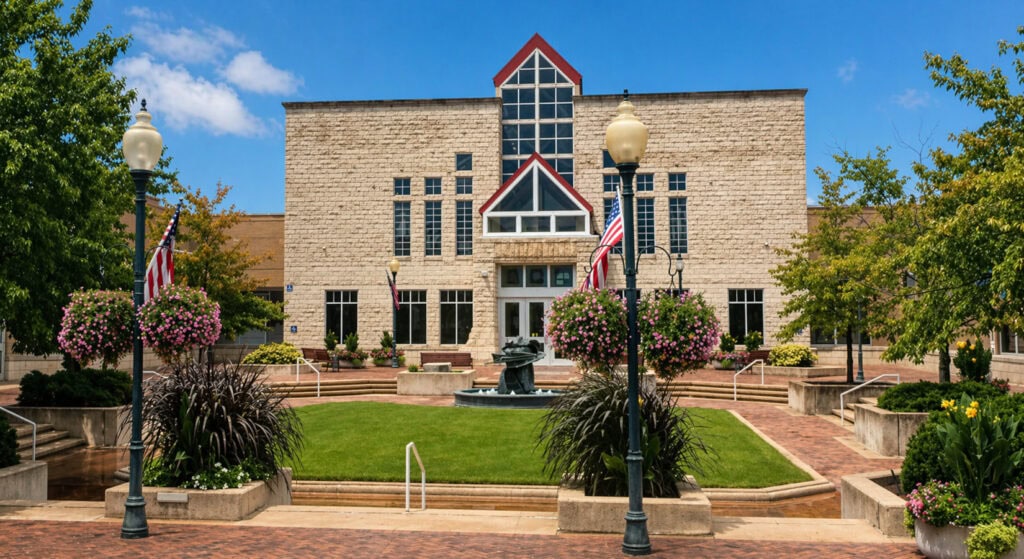
How the Design Held the Downtown Together
Manhattan Town Center appears in the Society of Architectural Historians' Archipedia project, which catalogs significant buildings across the United States.
The project highlights the mall for how well it fits into the downtown environment.
Many malls built in similar settings during that time disrupted their surroundings and weakened nearby streets. This one was designed to keep the downtown intact.
The city remained closely tied to the project after it opened. Manhattan continued to own the land beneath the building, and a nearby parking lot owned by the city stayed leased to the mall.
A later planning document for eastern Manhattan defines its corridor as starting at the mall's entrance.
Planning records from the 2020s list Manhattan Town Center, along with the university and other civic institutions, as a key stakeholder in the district.
In November 2023, RockStep Capital purchased the property and finalized a revenue-sharing agreement with the city.
Under the terms, 10 percent of revenue goes to Manhattan, and 90 percent goes to the mall and its owners. This arrangement was possible because the city never gave up ownership of the land.
That position dates back to the original deal with Forest City in the early 1980s and has remained in place ever since.
Dillard's, JCPenney, Sears, and the Years the Mall Changed Hands
Manhattan Town Center opened with two anchors: Dillard's and JCPenney. Forest City held roughly half the project through the early 2000s. The property ran an operating loss in 2003.
Forest City sold its stake in 2005, recording a $3.138 million gain on the transaction, to a group co-managed by retail executive Craig Delasin.
That group was sold to UrbanCal, LLC in February 2008. After UrbanCal, the public record gets sparse.
The mall had been listed for sale five times since 2015, with eight years of sale listings with no completed transaction until RockStep closed in November 2023.
Somewhere in those years, Sears vacated. The brand was shuttering locations across the country, and customers went to big-box stores and then to online shopping.
Sears had been an anchor at Manhattan Town Center. Its departure left a large empty box at one end of the mall.
The space sat there - vacant, while the building cycled through ownership attempts - long enough that by 2016 the Board of Zoning Appeals was involved in the paperwork to convert it into something else.
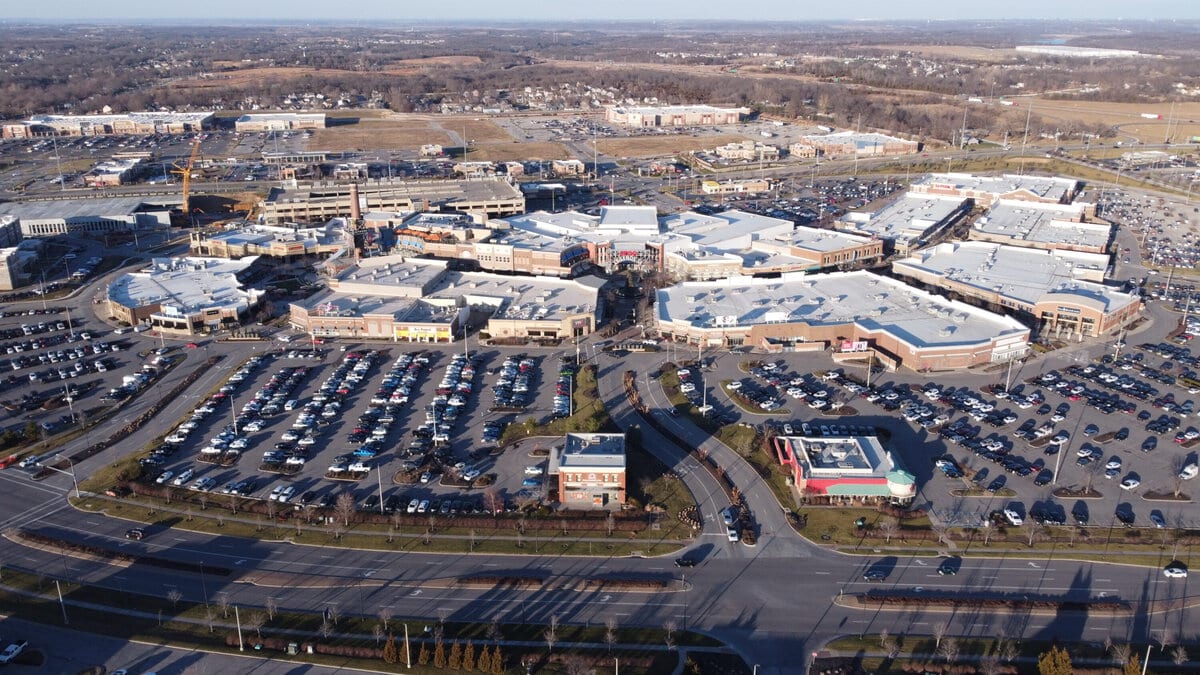
December 15, 2016: Thirteen Screens Go In Where Sears Was
The former Sears space was redeveloped after the Board of Zoning Appeals worked through a sign variance request for the Carmike Cinema and Ovation Grill facade.
Carmike Cinemas put in thirteen screens, including an IMAX, plus an Ovation Grill and bar for dine-in service. The ribbon cutting was held the night before December 15, 2016.
Carmike was still operating under its own name at the time, before AMC completed its acquisition later in December 2016.
The theater draws from across the region - Sears, in its last years, did not. A family from Junction City drives about 20 miles to Manhattan for an IMAX screen and a meal.
They weren't making that trip for a department store running liquidation sales.
H&M signed a lease in 2019. Construction ran through the summer; the store opened that fall. The chain had no Kansas locations outside Wichita and the Kansas City area before Manhattan.
Kansas State's student population and Fort Riley's residents gave the location enough of a market to make it work.
It was the chain's first Kansas location outside those two metro areas - a notable reach for a chain that size into a college town of roughly 55,000 people.
RockStep Buys In, the Sale Price Goes Unannounced
RockStep completed its purchase in November 2023.
The announcement listed the anchor tenants - Dillard's, JCPenney, and AMC Dine-In 13 IMAX - along with the size of the property at more than 367,000 square feet and a tenant count of over 50.
It did not include the sale price, and no trade reports that followed provided one. A mortgage filed in Riley County shows $9.35 million tied to the property.
The city commission approved the deal on October 17, 2023. Under that deal, 10 percent of revenue goes to the city, and 90 percent goes to Manhattan Town Center and its owners.
At the time of the sale, leasing conditions were weak. Nineteen suites were vacant.
This reflected years of uncertainty about ownership, with repeated attempts to sell the property and no long-term operator focused on filling and keeping spaces leased.
RockStep told the city it had a plan to address the vacancies. The revenue-sharing agreement, along with the city's continued ownership of the land, gave both sides a clear reason to make the effort succeed.
King's Candy Shop, Boy Scout Derby Races, and Then Claire's Closes
By March 2025, 12 of the 19 vacancies had been filled. King's Candy Shop opened.
Jock's Nitch Sports, Awana Jireh Arts, Lil Munchkins, and Build A Buddy Factory all moved in. Books-A-Million, already a tenant, expanded from 4,400 square feet to 9,300.
Tradehome Shoes went from 2,000 square feet to 3,000. Spirit Halloween came back for fall 2024 and took 11,000-plus square feet. Witch Craft A Maker's Market was set for July 2025.
Manhattan High School used the building for the prom activity. Boy Scouts ran Pinewood Derby races through the corridors. A wellness fair ran there.
So did an entrepreneurship challenge. Mrs. Powell's Cinnamon Rolls, which the ownership noted in early 2025 had been in the building for close to thirty years, kept baking.
In August 2025, Claire's announced the closure of its Manhattan location as part of a bankruptcy-related cut of more than 290 stores.
The chain sold its North American business to Ames Watson. One vacancy went back on the books.
Nine Empty Suites in April 2026
The leasing page showed nine suites ready to rent starting April 1, 2026.
Dillard's is in the building. So is JCPenney. AMC Dine-In 13 IMAX operates in the space where Sears used to be. H&M and Ulta are tenants. Mrs. Powell's Cinnamon Rolls is a tenant.
The building's look from Poyntz Avenue, limestone, hidden parking, hallways that let in natural light, was developed through downtown design work in 1981, and the final design by RTKL, six years before the first tenant arrived.
They were trying to figure out if a mall could fit into a downtown area without ruining it.
The answer has been standing at the east end of Poyntz Avenue since October 1987. Nine suites for rent. The rest occupied.
Notable Milestones
1970s - Downtown Manhattan lost retail activity to west-side development, and pressure grew for a major shopping center.
1979 - The City of Manhattan issued a request for proposals for a downtown mall developer.
1981 - An NEA-funded "Poyntz Avenue" planning study helped shape how the mall would fit into downtown.
1980s - The City of Manhattan partnered with Forest City Enterprises, and RTKL designed the project.
October 26, 1987 - Manhattan Town Center opened.
2000-2002 - Forest City records listed Dillard's, JCPenney, and Sears as the mall's anchors.
2005 - Forest City disposed of the property, and Craig Delasin and partners acquired it.
February 2008 - The property was sold to UrbanCal, LLC.
2016 - The former Sears space was redeveloped into Carmike Town Center 13 with IMAX and dine-in service.
2019 - H&M was added as a major new tenant.
October-November 2023 - Manhattan approved agreements tied to the transaction, and RockStep Capital completed its acquisition of the mall.
March 2025 - RockStep said it had cut vacancies and announced tenant additions and expansions.
2026 - The mall was still actively leasing space, with several suites listed as available.
Independent Publisher Notice
BestAttractions is an independent editorial publisher. We are not affiliated with, endorsed by, or acting on behalf of any location, business, property owner, manager, government agency, or organization described in this article. Comments posted on this page are not forwarded to, reviewed by, or acted upon by any entity mentioned in the article. For official inquiries, complaints, applications, bookings, or other requests, please contact the relevant entity directly through its official website or other verified channels.