Drive north out of Baltimore on York Road, and there's a point where the traffic bunches up without explanation.
Cars slow. Parking garage signs appear. People are crossing from all directions, dragging bags, arguing about where they parked.
The building responsible for all of it sits at the corner of Dulaney Valley Road and Joppa Road - four floors of glass and retail and poured concrete built into the side of a hill.
Towson Town Center has been standing at 825 Dulaney Valley Road since 1959 in one form or another. For most of that time, it was simply a fact of life for anyone who lived in Baltimore's northern suburbs.
Over a million square feet of retail. Parking for 4,400 cars. Macy's on one end, Nordstrom on the other, and more than 180 stores in between.
For decades, the mall was downtown Towson. Not in an official sense - there are government buildings and restaurants and offices that would argue that point - but in the way that matters: it was where people went.
It was the destination. Getting there on a Saturday afternoon in December meant sitting in traffic you didn't remember being this bad last year.
That's still mostly true. But the stores have been leaving, and the ones that left in late 2025 did so in a way that felt different.
A College's Land and Ralph DeChiaro's Plan
Goucher College owned the land, and Ralph DeChiaro secured the rights to develop it. In the spring of 1959, he started building Towson Plaza, a then-unusual two-level open-air center for the area.
Towson Plaza opened on May 13, 1959, as an open-air shopping mall with two levels - one of the earliest multi-level open-air shopping centers in the country.
DeChiaro, founder of DeChiaro Properties, looked at Towson and decided it needed a commercial center that matched its ambitions as a growing county seat just north of Baltimore City.
Hutzler's, one of Baltimore's most established department store names, signed on as the anchor. People came from well outside the area just to walk around.
Much of that original structure is still inside the mall today.
The two lower floors of Towson Town Center are built on the same bones DeChiaro poured in 1959, absorbing sixty years of renovation and expansion without being fully erased.
That's unusual for a building that has changed as much as this one has. Most malls of that era were torn down and rebuilt entirely.
Towson Plaza was layered over, floor by floor, decade by decade, until what you see now bears almost no resemblance to the original - except structurally, where it counts.
Kennedy Stopped Here Before the White House
About one year after Towson Plaza opened, John F. Kennedy added it to his presidential campaign route.
His appearance at a suburban shopping center in Maryland was enough to pull people in from across the state. For a property that had been open barely sixteen months, the attention was significant.
Members of both the DeChiaro and Rachuba families were there that day.
The connection between those two families had started through real estate and deepened through marriage - Larry Rachuba married into the DeChiaro family in 1961.
By 1964, Ralph DeChiaro had asked Rachuba to join the company formally, and he did.
Over the years that followed, the two families built extensively across the Baltimore region: houses, apartment complexes, offices, and additional shopping centers.
The operation grew large enough that it eventually took on its own identity as the DeChiaro-Rachuba Group.
Towson Plaza was always their most prominent property. The Kennedy visit had helped fix it in people's memories as a place where real things happened, not just somewhere to buy shoes.
Larry Rachuba - who would go on to lead the mall's major expansions - was there that day, at a shopping center he would spend the next several decades rebuilding from the inside out.
Enclosed, Renamed, and Filled With Stores
By the early 1970s, enclosed malls were on the rise, and many open-air centers were either being enclosed or facing tougher competition from those that were.
Lawrence Rachuba and the DeChiaro-Rachuba Group enclosed Towson Plaza that year and renamed it Towsontowne Centre.
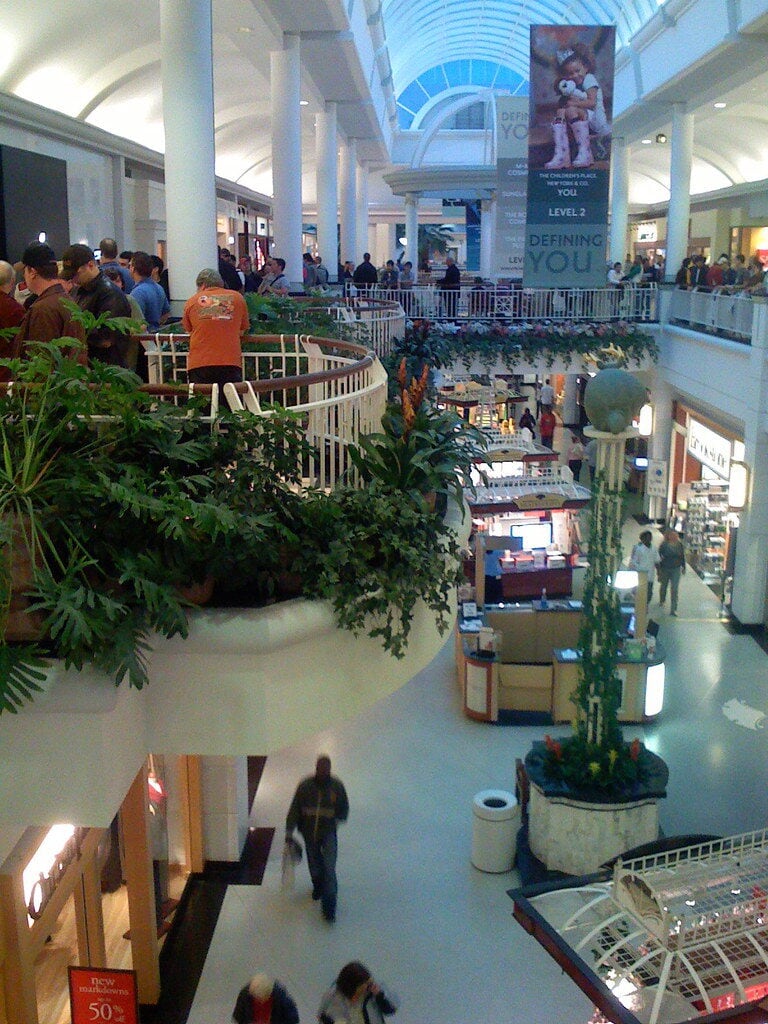
The corridors went inside. The mall expanded, and it finally began to feel like a real mall.
The 1982 renovation added Hecht's as a second major anchor, and Hutzler's remained until the chain closed in 1990.
Between those two markers, the inside was filled with shops and attractions that were popular at the time.
Gadgets was a Warner Bros.-themed restaurant and arcade that ran in the early 1980s, complete with animatronic characters performing periodic shows on a small stage.
The Level 1 center court had The Garden Cafe and a dandelion fountain near the entrance.
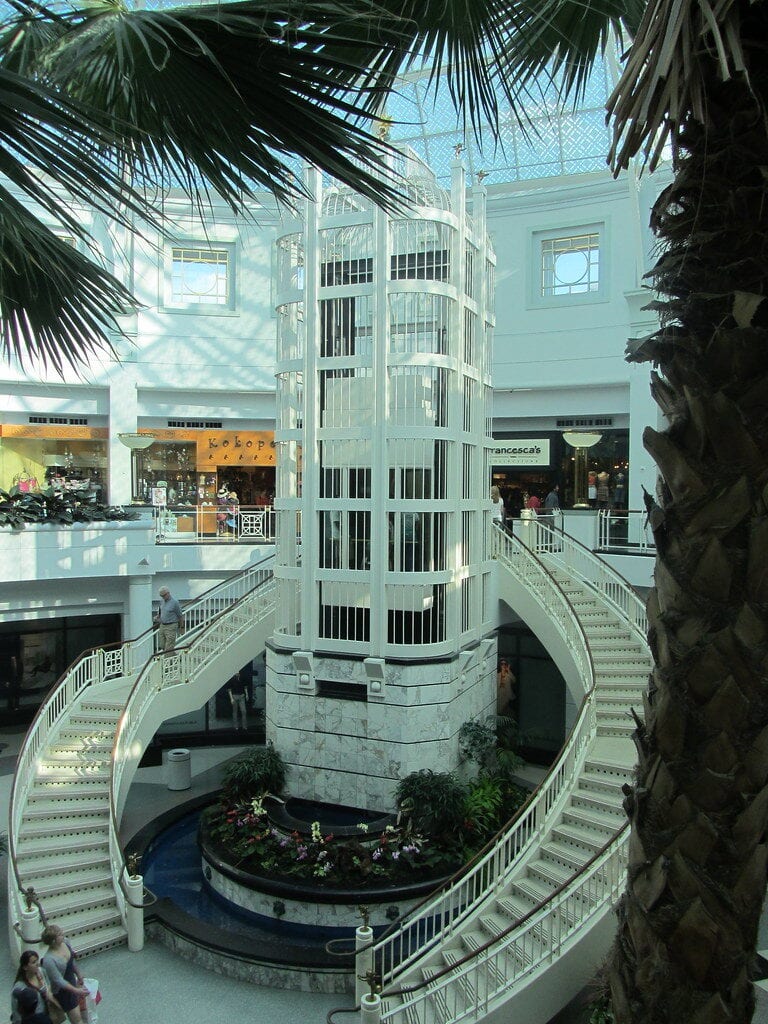
A glass elevator went in alongside the existing escalators. Hess Shoes, Loewmeyer's, and Friendly's had long runs before closing.
It was a special kind of place back then, crowded, full of different things, and a little unusual. Mall life in the area before everything started to look the same.
The $150 Million Renovation That Remade It
The 1991 renovation was not a refreshment. It was a reconstruction.
Adding two full floors to an existing shopping center built on a hillside, above a parking garage, is a logistically complicated project, and the $150 million price tag reflected that.
The DeChiaro-Rachuba Group partnered with the San Diego-based Hahn Company and California-based Santa Anita Realty to make it happen.
Baltimore's RTKL Associates - the same firm that designed both Owings Mills Mall and White Marsh Mall - handled the architecture.
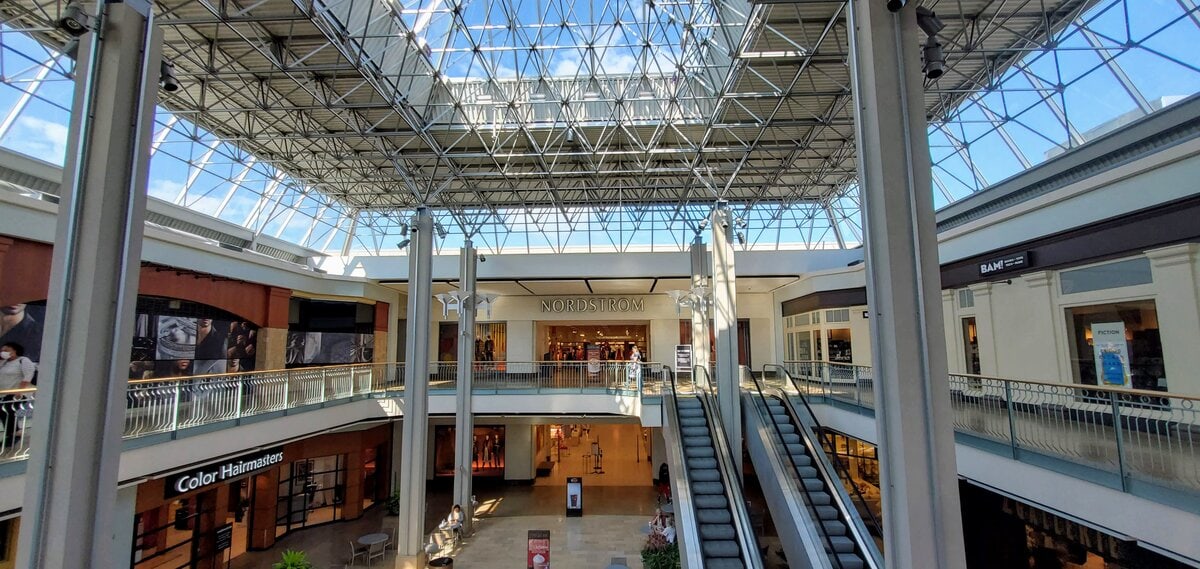
The third and fourth floors opened on October 14, 1991. Nordstrom became the new signature anchor, taking space across all four levels, with Nordstrom Rack on the ground floor.
An Arbor Terrace food court opened on the third level. New fountains went into the Nordstrom court and the upper common areas.
A second glass elevator connected floors three and four. More than 100 new stores came in with the expansion, and the mall was rechristened Towson Town Center.
The Rainforest Cafe moved in during 1999 and quickly became one of the busiest spots in the building - families drove specifically to eat there. It closed in January 2009 after ten years.
From TrizecHahn to Brookfield: Towson Town Center's Ownership
TrizecHahn Corporation, which took shape after Trizec bought Hahn's shopping-center holdings in 1980, sold Towson Town Center in 1998 to the Rouse Company, the Columbia, Maryland-based developer best known for building Columbia.
The deal was worth $1.1 billion and covered multiple mall properties.
For the DeChiaro and Rachuba families, selling the mall ended their direct link to the place they had created about forty years ago.
Neither family still owned it, but both still felt proud of what the mall had become.
Rouse held it for six years. In November 2004, Chicago-based General Growth Properties purchased the entire Rouse portfolio for $12.6 billion, one of the largest real estate deals in the country at the time.
GGP renovated Towson Town Center in 2008 and again in 2016, both times trying to keep it attractive as a high-end shopping spot in the Baltimore-Washington area.
In August 2018, New York-based Brookfield Properties acquired GGP and its full holdings, including Towson Town Center.
That way of owning the company stayed the same until 2025. In January 2026, Brookfield changed its U.S. retail company's name back to GGP.
Through all of it, Hecht's had converted to Macy's in 2006 - part of the national rebranding that followed Federated Department Stores' takeover of the May Company chain.
Round1 Bowling & Arcade became part of Towson Town Center in late 2019, when the mall converted a large first-floor space into a single entertainment venue.
Crime Became the Mall's Visible Problem
The first major warning came in 2005, when a school teacher was murdered on an upper level of one of the mall's parking garages. The killing shocked local residents.
Towson had long seemed separate from the violence seen in some parts of Baltimore City, and a murder in the parking garage of a suburban shopping mall was not something many people expected.
After that, more crimes followed in the garages, including muggings and armed robberies.
In December 2011, a man was shot and killed outside a service entrance to Nordstrom. Four men were later convicted in the gang-related killing.
In April 2012, two shoppers were robbed at gunpoint by three men in one of the parking structures. The robbers were never identified.
In 2016, the management set a curfew. On weekends after 5 pm, anyone 17 and under had to be with an adult.
This was a big change for a suburban mall like Towson Town Center, and it got a lot of attention.
In November 2025, a robbery and stabbing inside the mall resulted in the arrest of four teenagers.
Afterward, a local council member urged mall management to improve security and work more closely with others to help keep the area safe.
Four Retailers Out in a Single Month
The departure of Crate & Barrel in early 2022 was a blow, but not a panic. Large stores leave malls.
The explanation at the time was treated as part of the broader churn in big-box retail, and the Towson space - one of the most prominent in the building, visible from the street - went dark and stayed dark.
As of February 2026, it remains vacant.
What happened in December 2025 was harder to explain away. Tommy Bahama, Banana Republic, Madewell, and Wockenfuss Candies all announced they were leaving in quick succession.
Tommy Bahama cleared out first. Wockenfuss Candies announced its closure on December 29 and shut down that same day.
Banana Republic and Madewell followed in January 2026. Four departures inside one month, concentrated enough to register as something beyond the usual post-holiday turnover.
Macy's has been identified as a potential closure target for 2026. Nordstrom continues operating across all four floors. The mall itself remains open, still home to about 160 stores.
Towson Town Center seems fine these days, but it's definitely not at its best. It is still useful, busy, and a good place for a regular shopping trip, but it is not as comfortable or nice-looking as it used to be.
The place is mostly kept up, with shoppers noticing that it is bright inside and that there have been some recent updates that make it look better.
The mall is still busy enough to keep big stores and bring in a steady flow of shoppers. Still, some ongoing practical problems make the experience less enjoyable.
The parking garages are hard to figure out, there are some safety worries, and several stores have recently closed, which makes parts of the mall feel less stable than you would expect from a busy mall.
Towson Town Center
Shopping mall in Towson, Maryland
Address: 825 Dulaney Valley Rd, Towson, MD 21204
Opened: 1959
Owner: GGP
Architect: RTKL Associates
Floors: 2 (original Towson Plaza); 4 (since 1991 renovation, 3 in Macy's)
Anchor tenants: 3 (2 open, 1 vacant)
Parking: Lighted lot, 4400 spaces, and four 7-story parking garages
Renovated: 1973; 1982; 1991; 2008; 2016
Previous names: Towson Plaza (1959–1973); Towsontowne Centre (1973–1991)