
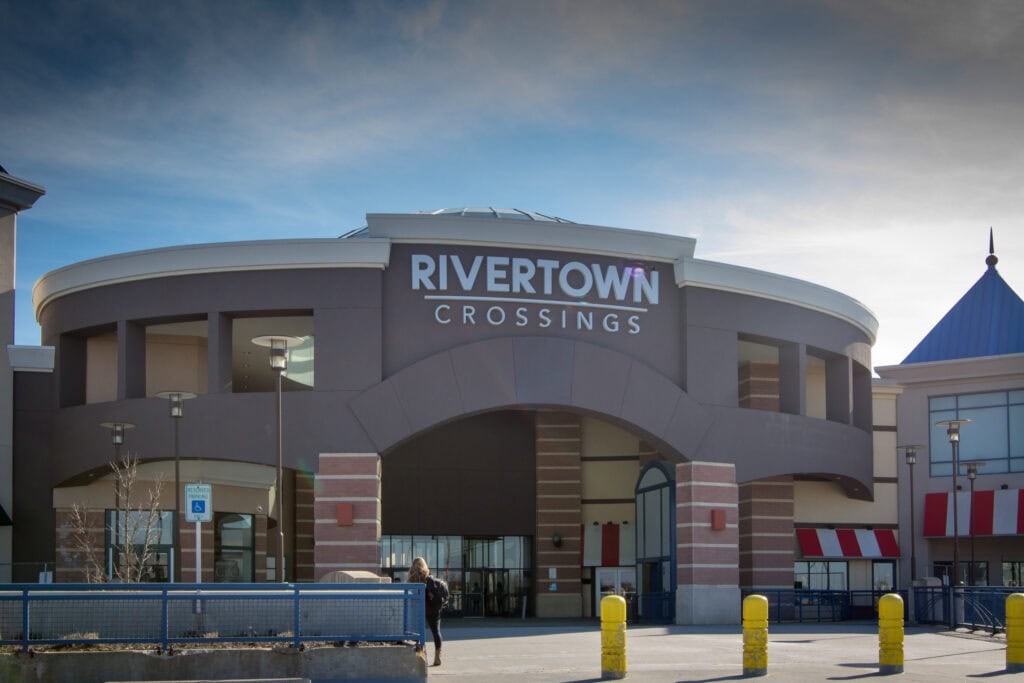
RiverTown Crossings is a two-story, fully enclosed super-regional shopping mall located at 3700 Rivertown Parkway in Grandville, Michigan, part of the Grand Rapids metro area in Kent County.
The mall sits near 44th Street and Interstate 196, about one mile east of I-196 and three miles west of US-131. This location makes it one of the easiest shopping areas to reach on the west side of Grand Rapids.
With about 1,250,000 square feet of space and around 110 stores, it acts as the main place for shopping and entertainment in Grandville, Grand Rapids, and the wider West Michigan region.
People visit from across Ottawa and Kent counties. It opened on November 3, 1999, and is still the largest enclosed mall in West Michigan and a dominant regional shopping center in the Grand Rapids area.
RiverTown Crossings' Cold Opening Day
On the morning of November 3, 1999, the weather was cold enough for wind chills in the teens. Even so, people showed up early.
Many stood outside for two hours before opening, waiting in 35-degree temperatures with light snow.
When RiverTown Crossings opened in Grandville, Michigan, 345,000 visitors came through in the first five days. That total went far beyond what General Growth Properties had expected.
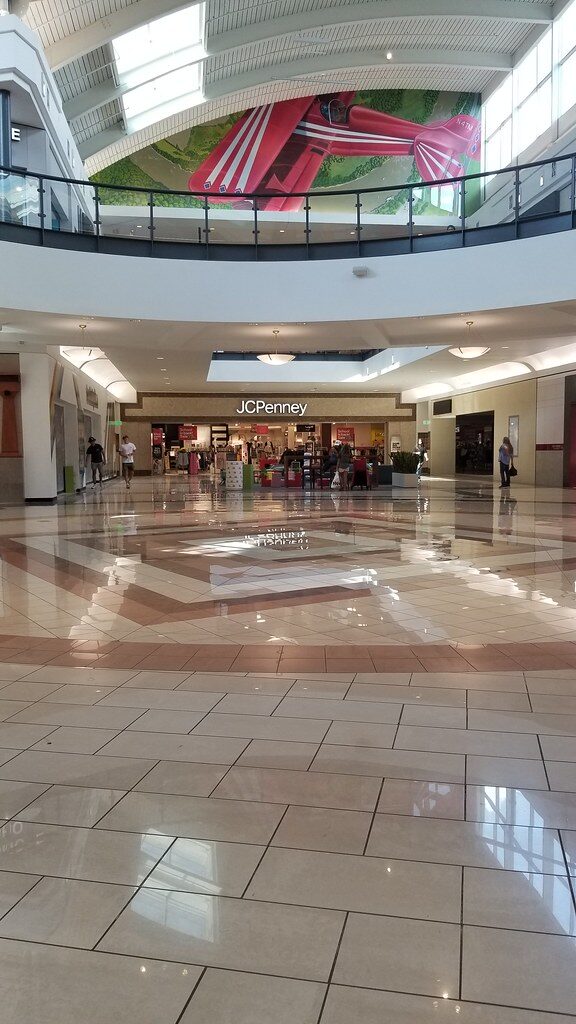
Inside the mall, a carousel that could hold 40 riders sat on the second level. Around it was a food court with seating for 1,000 people.
A 20-screen Cinemark theater was located at the south end. Murals painted by Chicago artist Thomas Melvin covered the walls.
They showed scenes from southwestern Michigan and its connection to Lake Michigan, including a reference to the long-gone town of Singapore.
Five department stores - Hudson's, Kohl's, J.C. Penney, Sears, and Younkers - served as the main anchors.
Barnes & Noble, Pottery Barn, and Restoration Hardware filled the smaller anchor spaces.
Near the center of the mall, eight jewelry stores were placed together. This was part of a plan to group similar stores so shoppers could easily compare them without walking across the entire mall.
Construction took 498 days and cost $160 million. The finished mall covered 1,250,000 square feet and included about 130 stores.
Why RiverTown Crossings Almost Never Got Built
The land under RiverTown had been contested ground for close to two decades before the first shovel broke dirt. The site was formerly Shoemaker Airfield, built in 1958.
In 1980, Grandville residents narrowly approved rezoning 100 acres near Rivertown Parkway and Wilson Avenue after a petition push.
General Growth Properties purchased 99 acres there in 1981 and waited for the economy to strengthen.
In November 1990, Homart Development Company - a Sears subsidiary - proposed its own mall on 94 acres near 44th Street and Ivanrest: a 1-million-square-foot, 120-store development requiring rezoning from industrial to commercial.
GGP pushed back, arguing it already had plans for the Rivertown Parkway site. Grandville rejected Homart's proposal in January 1991, pointing out that GGP's adjacent lot was already zoned commercial.
Homart's director, Roy Vice, left the company. The firm was put up for sale in 1994. GGP purchased it in 1995.
GGP vice president John Bergstrom came back in October 1994 with a 150-store proposal, claiming it could be completed by spring 1997.
Mayor James Buck rejected it that same month.
In January 1996, GGP proposed a 425 Agreement - a Michigan arrangement under which two adjacent cities share land development - with the neighboring city of Wyoming, offering Grandville control of permits and utilities in exchange for Wyoming contributing 80 acres.
GGP acquired more adjacent land in August 1996, bringing the proposed site to 138 acres. In October 1996, GGP and Mayor Buck reached an agreement after GGP committed to keeping the development within Grandville.
Buck called the anticipated project "the finest shopping mall in Michigan."
The $160 Million Mall Referendum and Taubman's Opposition
In 1997, a ballot initiative came before Grandville voters to rezone 16 acres needed for drainage improvements on GGP's property.
GGP put $41,500 behind the initiative - about $81,000 in 2024 dollars. Taubman Company, the then-owner of Woodland Mall in nearby Grand Rapids, spent $13,400 opposing it, around $27,600 in current value.
Opponents raised environmental concerns about building in wetlands, argued the mall would attract street gangs, and questioned whether city council member Ken Bouma was impartial following accusations that GGP had paid him.
The environmental objections were rejected in court, and voters approved the initiative. Taubman responded by spending millions renovating Woodland Mall's interior.
Construction broke ground on December 6, 1997. About 344 workers were on site daily at peak, with 1,000 total involved.
Materials consumed included 400 concrete truck loads, 7.6 million pounds of steel, 200,000 floor tiles, and 5,000 cans of paint.
Close to 10,000 plants - including 1,600 trees and 3,000 shrubs - were installed around the site.
The parking lot held roughly 7,000 spaces. The name "RiverTown Crossings" had been fixed in the revised plan approved in May 1997.
RiverTown Crossings During a High-Occupancy Era
By 2011, RiverTown Crossings carried a $154.9 million outstanding loan balance on a split mortgage originated to refinance existing debt.
The anchor lineup included Macy's, Younkers, Sears, Kohl's, J.C. Penney, Dick's Sporting Goods, and Celebration Cinemas.
The Hudson's box had become Marshall Field's in 2001 and then Macy's in 2006.
Galyan's - which opened October 6, 2000, as the sixth anchor with a 90,000-square-foot footprint and a 45-foot rock climbing wall - was absorbed by Dick's Sporting Goods in 2004.
The Cinemark theater became Celebration Cinema when it reopened on June 27, 2007.
More than 100 tenants operated in 2011 at an occupancy exceeding 95 percent of the total gross leasable area.
RiverTown was the dominant regional mall in the Grand Rapids metropolitan area. By 2014, the property measured 1,266,000 square feet at 97 percent occupancy.
Kahunaville closed in 2004 and was replaced by UBU Home Furnishings in September 2005. A Meijer opened adjacent to the mall on March 26, 2002.
A NASCAR Silicon Motor Speedway Racing Center was present at the mall shortly after opening, but it closed in 2001 after Silicon Entertainment ceased operations.
The anchor structure held, and occupancy stayed high.
The Anchor Closures That Reshaped RiverTown's Lineup
On April 18, 2018, Younkers at RiverTown Crossings was announced as a permanent closure. Younkers closed on August 29, 2018, after nearly 19 years as one of the five original anchors.
On August 28, 2018, Brookfield Property Partners completed its acquisition of GGP, folding RiverTown into Brookfield's retail holdings and ending the original ownership era.
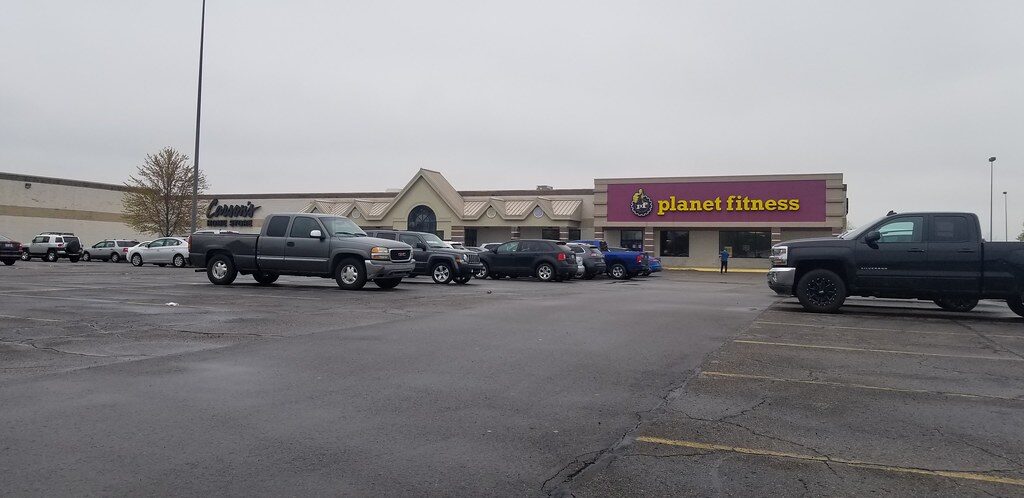
On November 9, 2020, Sears announced it would close its RiverTown location as part of a seven-store national plan, and the store closed on January 24, 2021.
Two of the five 1999 anchors were gone within three years of each other.
Department-store square footage contracted, and Brookfield put little money into the property - a combination that visitors noticed.
By late 2024, Macy's, Kohl's, JCPenney, Celebration Cinemas, and Dick's Sporting Goods were the five remaining operating anchors.
Jonathon Bryant purchased the vacant former Younkers building in 2022 for $2 million.
Poag Takes Over and Lays Out a New Direction
After six years of ownership, Brookfield Properties sold RiverTown Crossings to Poag Development Group on August 30, 2024.
The price was not disclosed. The deal also brought in Jones Lang LaSalle to oversee management and leasing, leaving Poag to focus on redevelopment work.
Josh Poag pointed to the mall's location in the Grand Rapids market and the dense surrounding population as the main draw. The first $1.3 million in upgrades focused on visible areas.
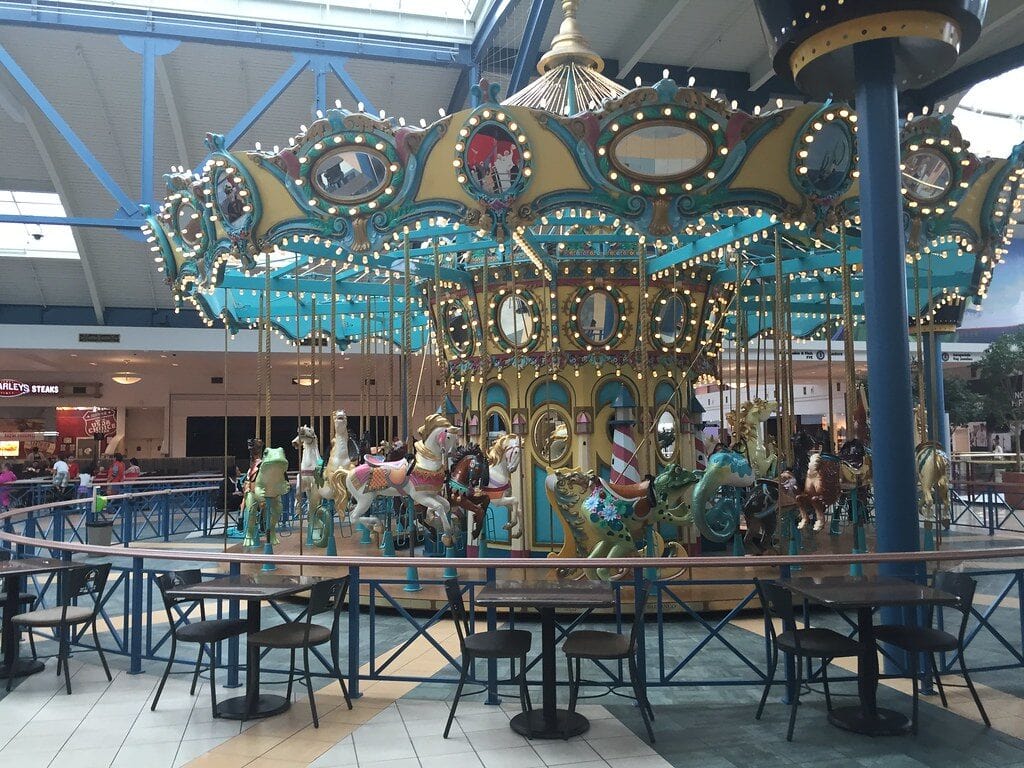
Crews handled landscaping, resurfaced the parking lot, and repaired the second-floor carousel that has been running since 1999.
Choosing to restore the 25-year-old merry-go-round instead of removing it showed how the new owner viewed its role at the mall.
In January 2025, the Grandville Planning Commission approved plans to demolish the two-story parking deck on the north side of the property.
The structure had already been closed and was in declining condition. Removing it will eliminate nearly 1,400 parking spaces and open 2.63 acres for two new development sites.
Plans Poag shared included retail, restaurants, entertainment, hotel space, and residential uses around the mall.
By October 2025, the Grandville City Planning Commission approved a proposal to replace the Sears Auto Center with a Raising Cane's.
Demolition is expected to start in February 2026, with the restaurant set to be completed by October 2026.
Soar N Bounce, Celebration Cinema, and the Entertainment Pivot
The second floor of the former Younkers store sat empty for six years. Jonathon Bryant bought the building in 2022 for $2 million. On December 14, 2024, it reopened as Soar N Bounce.
A portion of the upper level now holds trampolines, climbing areas, and other attractions, replacing a space that once sold furniture and housewares.
It is the largest trampoline park in West Michigan by square footage, inside a building that had been a mall anchor since 1999.
At the same time, Celebration Cinema was upgrading its theaters. The first phase finished in July 2025 with new 4K laser projectors, Dolby Atmos sound systems, and heated recliner seating.
The theater was already among the top three in Michigan for attendance before the work began.
The second phase brought Oscar's Restaurant & Bar, announced January 15, 2026. It is the only place in RiverTown Crossings where alcohol is served.
Oscar's combines two uses. Customers can order food to their seats during a movie by scanning a QR code, or they can visit it as a regular restaurant from the mall.
The construction wall came down on March 31, 2026, and the restaurant opened the following day. The full renovation cost $5.8 million.
In October 2025, Inspire Marketplace replaced the former Harrison's West. Over a period of less than 16 months, Soar N Bounce, Oscar's, and Inspire Marketplace all opened, and none of them were department stores.
Macy's Closes and the Biggest Box in the Mall Enters Demolition
Macy's said on January 8, 2026, that it planned to shut down 14 stores nationwide, with most closing by the end of Q1 2026.
At RiverTown Crossings, exterior work had already been finished ahead of the closure, and talks with possible replacement tenants were in progress before the lease expiration date of March 31, 2026.
The store ended operations on March 22, closing nine days early.
Interior demolition was underway by April 2026. Crews were removing all building systems, including fire protection, lighting, and mechanical components, in order to rebuild from the shell.
Plans involved two or three new uses, covered by nondisclosure agreements, and estimated that the future tenants could draw four to five times the foot traffic of the former Macy's.
The Macy's building is separately owned and managed, though it remains physically connected to the mall.
The rest of RiverTown continued operating during this period, with tenants including JCPenney, Kohl's, Dick's Sporting Goods, Old Navy, H&M, Bath & Body Works, Hot Topic, and Aerie.
The mall posted an Easter closure notice for April 5 while confirming that Celebration Cinema would stay open with regular hours.
Overall, RiverTown Crossings is about 88 percent occupied out of roughly 110 stores, even with its largest anchor space vacant and under redevelopment.
Independent Publisher Notice
BestAttractions is an independent editorial publisher. We are not affiliated with, endorsed by, or acting on behalf of any location, business, property owner, manager, government agency, or organization described in this article. Comments posted on this page are not forwarded to, reviewed by, or acted upon by any entity mentioned in the article. For official inquiries, complaints, applications, bookings, or other requests, please contact the relevant entity directly through its official website or other verified channels.