
Two public-school addresses help explain the scale of this place before the population numbers do.
One is on Dinev Road. The other is on County Route 105.
Together, they belong to a public district with only two schools - yet they sit inside a village where more than half the population is under 18, and private-school enrollment is measured in the thousands.
That mismatch is the first warning against reading this community like an ordinary Hudson Valley suburb.
The village had an estimated 47,147 residents in 2025. Its 2020 Census land area was only 1.46 square miles.
Households averaged just over five people, renting was far more common than owning, and nearly one-quarter of workers walked to work in the latest American Community Survey estimates.
These are not separate curiosities. They fit together.
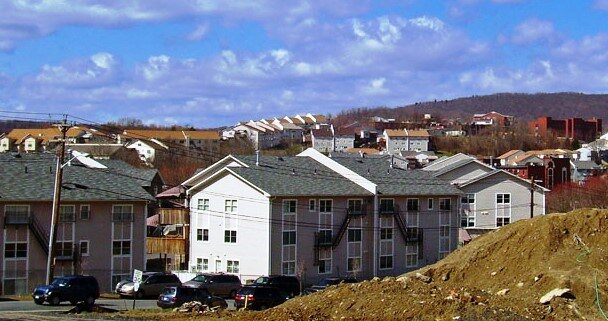
Daily life here is shaped by a young population living at urban density inside a geographically small community.
Schools, housing, work, shopping, transportation, and family routines all operate at close range.
The result can feel efficient, crowded, familiar, and difficult to enter - sometimes in the same afternoon.
Growth Has Become A Daily Condition
The village counted 20,175 residents in 2010 and 32,954 in 2020.
The Census Bureau's July 2025 estimate reached 47,147, an increase of 43.1% from the agency's 2020 population estimates base.
That growth has been packed into very little land.
At the 2020 Census, population density stood at 22,540 people per square mile.
The number is easier to understand at street level.
Thousands of new residents do not simply require additional housing units.
They require bedrooms, school places, deliveries, trash collection, medical appointments, places for vehicles to stop, and safe movement for children.
Because the average household is large, one newly occupied apartment may add five people rather than one or two.
Construction is therefore not background scenery.
It is part of the household cycle.
A young couple may need a small unit.
A few years later, the same household may need another bedroom, more storage, and a different route through the building with several children.
The pressure is not only to build more housing, but to build housing that remains usable as families change.
The compact geography also means that new development is quickly felt.
Another building can alter pedestrian traffic, school movement, parking, curb access, and delivery patterns within a small radius.
Growth here arrives close to the front door.
More Than Half The Population Is Under 18
Children account for 55.2% of residents.
Those under five alone make up 18.4%, while only 2.4% of the population is 65 or older.
That age structure changes the timetable of the entire village.
School movement is not one minor rush among many.
It is one of the main organizing events of the day.
Food purchases, clothing, household storage, pediatric care, and transportation all reflect the needs of families with several children.
The Census Bureau estimated 7,505 households during the 2020-2024 American Community Survey period, with an average of 5.08 people in each.
It also estimated that 95.3% of residents age one or older had lived in the same home one year earlier.
That suggests considerable short-term residential stability, but not necessarily comfort or permanence.
A family can remain at the same address while steadily outgrowing the rooms inside it.
In a household of five, a kitchen is not simply a place to prepare dinner.
It may also hold bulk food, school items, coats, bags, and the daily traffic of several people leaving and returning on different schedules.
One bathroom matters more. So does a narrow stairway.
The practical unit of life is not the individual resident.
It is the household moving together.

Renting Is The Main Housing Experience
Only 33.4% of occupied housing units were owner-occupied in the 2020-2024 Census estimates.
That leaves roughly two-thirds of occupied homes in the rental market.
Median gross rent was $1,604.
For owner-occupied units, the estimated median value was $758,800, while median monthly owner costs for households with a mortgage were $2,616.
The owner-value figure needs careful reading.
It is an American Community Survey estimate reported by owners over a five-year period.
It is not a current median sale price, an asking price, or the cost of every home in the village.
Even so, the pattern is striking: homeownership is relatively uncommon, while the owner-occupied portion of the market carries a high estimated value.
For renters, the headline rent is only the beginning of the decision.
A unit may be affordable but poorly suited to a large household.
Bedroom count, storage, stairs, laundry access, building circulation, and proximity to schools may matter more than a small difference in monthly price.
Availability also matters.
A household searching for an ordinary one-bedroom apartment is competing in a different market from a family that needs several bedrooms within a specific institutional network.
This is not a classic starter-home suburb.
Housing works more like a constrained local system in which space, household size, and location are tightly connected.
The School Numbers Do Not Add Up Neatly
At 1 Dinev Road, the federal school locator reports 152 students for the 2024-2025 school year.
At 655 County Route 105, it reports another 15.
The district-level NCES page, however, reports only 117 students across its two schools for that same year.
Those figures conflict.
The discrepancy may result from different submission stages, membership definitions, or corrections within the Common Core of Data.
Whatever the cause, the district total and the two school-level totals should not be combined or presented as a single settled enrollment number.
What can be said safely is that the public district is very small relative to the number of children living in the village.
Its two schools also report mostly ungraded enrollment, indicating that their role is not comparable to that of a conventional public district serving every neighborhood child through standard grade levels.
Private-school records reveal the larger educational scale.
In the 2023-2024 Private School Universe Survey, NCES listed one local institution reporting 11,070 students and another reporting 5,566.
Those figures should not be added together without confirming whether campuses, organizations, or reporting structures overlap.
They still show that the visible private-school system is vastly larger than the public one.
For a family evaluating the village, school research must begin with the specific institution, eligibility, curriculum, language, transportation, and support services.
A district rating or generic real-estate school score would explain almost nothing.
Walking Is A Major Commute Mode
The latest five-year American Community Survey commute estimates do not describe a conventional outer suburb.
About 35% of workers drove alone. Roughly 25% walked.
Around 14% worked from home, about 13% carpooled, and approximately 10% used public transportation.
The estimated mean journey to work was 18.9 minutes.
Margins of error apply, but the broad pattern is clear.
Driving alone is important without dominating the village in the way it does across many suburban communities.
A quarter of workers walking to work changes the value of proximity.
A home near schools, stores, employers, or community institutions can reduce the number of daily vehicle trips a household must coordinate.
Short distances also make carpooling and shared transportation more practical.
That does not mean every destination is easily reached on foot.
The Census commute table covers workers, not grocery trips, medical appointments, school travel, or weekend errands.
It also says nothing about sidewalk quality, crowding, weather exposure, or the experience of moving with several children.
Still, the transportation profile is one of the biggest practical differences between this village and the surrounding region.
A prospective resident who assumes that every adult will need a separate car may overestimate vehicle dependence.
Someone who assumes that density eliminates the need for a car may make the opposite mistake.
Work can be local while hospital care, specialist appointments, broader retail, and regional employment remain elsewhere.

The Economy Is Busy, But Household Budgets Are Tight
The 2022 Economic Census recorded about $801 million in retail sales within the village.
Health-care and social-assistance businesses reported approximately $250 million in revenue, while transportation and warehousing businesses reported about $38.6 million.
These figures establish substantial commercial activity.
They do not show how much spending came from residents, how many workers lived locally, or whether the economy is fully self-contained.
The household numbers tell a different part of the story.
Median household income was $50,032 during the 2020-2024 period.
Per capita income was $14,440, and 37.6% of residents were below the official poverty threshold.
Civilian labor-force participation among residents age 16 or older was 51.8%.
The female participation rate was 37.7%.
Large households make those income figures especially important.
Fifty thousand dollars supports a different standard of living when it covers five people rather than two.
Food, clothing, housing, school needs, and transportation absorb money quickly even when some services or resources are shared.
The poverty figure should not be treated as a complete biography of every household.
The federal measure does not capture every form of family help, institutional support, shared consumption, or noncash assistance.
It should not be waved away either.
The safest conclusion is direct: a substantial share of residents live with limited cash income, and household size reduces the margin available when rent, utilities, food, or medical costs rise.
A Low-Internet Household Is Not An Anomaly
Only 31.3% of households reported having a computer, and 22.6% reported a broadband internet subscription during the 2020-2024 ACS period.
Those figures measure household possession and subscription.
They do not prove that broadband infrastructure is unavailable, unreliable, or unaffordable.
Their daily meaning is nevertheless hard to miss.
Across most of the country, schools, employers, hospitals, banks, insurers, and government offices increasingly assume that every household has a private screen and continuous internet access.
Forms arrive by email. Appointments move through portals. Work schedules change through apps.
In a community where most households do not report a broadband subscription, information must often travel through other channels: telephone calls, printed notices, institutional offices, shared access, and personal networks.
That can work smoothly for residents who already know where to call and whom to ask.
A newcomer accustomed to handling every task online may find the system less transparent, even when the task itself is routine.
Language reinforces that boundary.
The Census Bureau estimated that 92.8% of residents age five or older spoke a language other than English at home.
The statistic does not identify the language and does not mean that 92.8% of residents cannot speak English.
It does show that English is not the default language inside most homes.
In daily life, that affects school communication, notices, customer service, advertising, and informal exchanges between neighbors.
Institutional familiarity can matter as much as formal language ability.
Major Services Still Reach Beyond The Village
Dense local business activity does not eliminate regional dependence.
The Centers for Medicare & Medicaid Services lists Garnet Health Medical Center at 707 East Main Street in Middletown as an acute-care hospital option in Orange County.
That record does not establish which hospital every resident uses, how emergency routing works, or whether it is the nearest provider for every medical need.
It does show why healthcare should be evaluated in layers.
Routine appointments may be available locally.
Specialist care, imaging, surgery, emergency treatment, or a particular pediatric service may require travel elsewhere.
Households should check actual providers rather than assume that a population approaching 50,000 has every major service within its borders.
Weather adds another regional constraint.
At Montgomery Orange County Airport, a nearby NOAA station, the 1991-2020 normal January high was 34.6 degrees F, with a normal low of 17.3.
In July, the normal high was 83.6, and the normal low was 60.8.
Annual precipitation averaged about 41 inches.
That is a heating-dominated climate with cold winter mornings, warm summers, and precipitation throughout the year.
For a large household in a compact building, weather becomes a storage and movement problem as much as a comfort issue.
Wet coats, boots, strollers, school bags, and groceries all compete for limited entry space.
Walking remains useful, but winter conditions make a short trip feel considerably longer.
Who Is Likely To Fit
The strongest reasons to live here are proximity and institutional access.
A household whose schools, relatives, work, shopping, and community life are already concentrated inside the village may complete much of the day within a small radius.
Walking and shared transportation are realistic parts of the commute pattern.
Dense development keeps people and services close.
The trade-offs are equally concrete.
Housing is tight, and renting is common. Large households increase the importance of layout and storage.
The public school district represents only a small and specialized part of local education.
Household broadband use is unusually low.
Major medical or regional needs may require travel beyond the village.
The fit question is therefore not whether a person likes "small-town life." This is not small-town life in the conventional sense.
A useful decision begins with five practical checks:
Can the household access the school system it intends to use?
Can it find a rental or owner-occupied home with the required number of rooms?
Does its work pattern fit the local mix of walking, shared transportation, and driving?
Can family members navigate institutions where English may not be the main household language?
How dependent are they on private broadband, regional healthcare, and services outside the village?
The answers matter more than a generic livability score.
The Place Is Kiryas Joel
The village is Kiryas Joel, New York.
Its population, household structure, schools, transportation patterns, and business activity do not resemble those of a typical Orange County suburb because they were not produced by a typical suburban lifestyle.
Kiryas Joel functions through unusually concentrated family and institutional networks.
That concentration helps explain why so many workers walk, why private schools operate at such scale, why rental housing dominates, and why daily life can remain intensely local even when major regional services lie elsewhere.
It also explains why the place can be easy to navigate for one household and opaque to another.
The useful distinction is not between an "insider" and an "outsider." It is between residents whose practical needs match the systems already operating here and those who would need the village to work differently.
Kiryas Joel rewards proximity. It demands compatibility.
The sidewalk is still the best place to understand it: crowded, purposeful, and carrying far more of daily life than the map initially suggests.

References
U.S. Census Bureau, QuickFacts: Kiryas Joel village, New York, 2025 population estimates and 2020-2024 community characteristics.
U.S. Census Bureau, S0801: Commuting Characteristics by Sex, 2020-2024 American Community Survey five-year estimates.
National Center for Education Statistics, Kiryas Joel Village Union Free School District, district directory and 2024-2025 membership data.
National Center for Education Statistics, Kiryas Joel Village School, school directory and 2024-2025 enrollment data.
National Center for Education Statistics, Kirya Joel Early Childhood Educational Center, school directory and 2024-2025 enrollment data.
National Center for Education Statistics, Private schools near ZIP code 10910, Private School Universe Survey data for 2023-2024.
Centers for Medicare & Medicaid Services, Garnet Health Medical Center, acute-care hospital provider record.
National Centers for Environmental Information, Summary of Monthly Normals for Montgomery Orange County Airport, NOAA 1991-2020 climate normals.
Independent Publisher Notice
BestAttractions is an independent editorial publisher. We are not affiliated with, endorsed by, or acting on behalf of any location, business, property owner, manager, government agency, or organization described in this article.
Comments posted on this page are not forwarded to, reviewed by, or acted upon by any entity mentioned in the article.
For official inquiries, complaints, applications, bookings, or other requests, please contact the relevant entity directly through its official website or other verified channels.