
Standing on Middle Ridge Road north of the village of Madison, Ohio, sits a brick complex that opened as a private school and now sells ghost tours.
Madison Seminary took its first students in 1847 and taught until July 1891. The Woman's Relief Corps then remodeled it as the Madison Home for Civil War Army nurses and veterans' relatives.
Ohio took the institution over in 1904 and ran it as a state home until 1962. State rehabilitation programs used the buildings until 1975, and Madison Township ran its offices there until 1993.
Then it sat empty. Lake County sold it at auction in 1998 for $28,500. Today the complex is privately owned and open to the public. A flashlight tour costs $20, and ghost hunts run until 4:00 a.m.
Madison Seminary opened in 1847
By 1845 the select school meeting in the Madison town hall had more students than the room could hold.
Neighbors passed a subscription and bought land on Middle Ridge Road.
Seminary was a broader word then. Here it meant an advanced private school, with nothing to do with training clergy.
Chartered in 1845, Madison Seminary took male and female students in Madison Township, Lake County, Ohio, and taught high-school and college-level work that no public school nearby offered.
The frame building opened for the spring term of 1847, with C. S. Hartwell teaching it.
The next year G. N. Campbell had about 100 students, at $2.50 to $4.50 a term.
The brick building of 1859
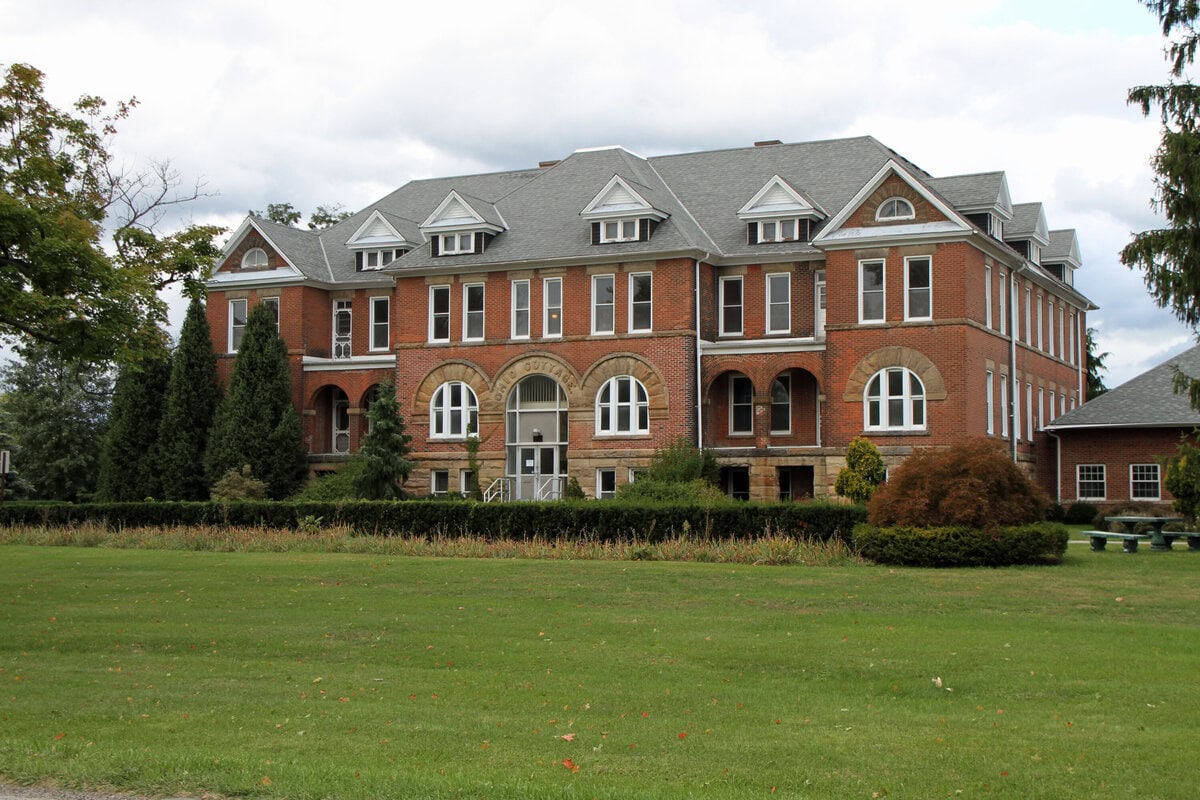
A brick seminary went up in 1859 with a chapel, recitation rooms, and sleeping rooms for the male students.
The old frame school became the boarding hall. That 1859 block is the east wing of the building standing today.
Boarding mattered because this had stopped being a Madison school. Students came from surrounding townships, which helped pay to house them.
Enrollment moved with whoever was in charge.
H. Avery took over in August 1864 and had 150 students in one term, the highest the school ever recorded, then resigned in poor health.
A few years later the count was under 10. W. N. Wight arrived in 1869 and had it back near 100 by his third year.
Why the school faded out
Ohio's public school system kept expanding, and demand for a private academy like Madison Seminary fell with it.
The school held on anyway. A county history published in 1879 still described it as a going concern.
David R. Paige studied there from 1857 to 1860 and later went to Congress from Ohio.
Edward P. Branch, there from 1858 to 1860, served in the 105th Ohio Volunteer Infantry and became mayor of Melbourne, Florida.
The end was already in motion. In 1890 C. M. Gillett transferred seven acres to the National Relief Corps, and the trustees two more.
By July 1890, the old seminary had already been dedicated as a Woman's Relief Corps home.
Ohio Cottage and the Army nurses
The Woman's Relief Corps, the national auxiliary of the Grand Army of the Republic, needed housing for Civil War Army nurses and for mothers, wives, and sisters of Union soldiers left without support.
Annie Wittenmyer and Abbie Lynch came to look at the old school. Burnham Corps No. 110 put $250 toward the offer.
In 1891 the Corps remodeled the seminary. In 1892, a residential west wing, Ohio Cottage, went up on the footprint of the 1847 frame school.
That is why the original building no longer exists.
By November 10, 1891, the place was running as the Madison Home.
Elizabeth Stiles, a Union intelligence operative during the war, moved in during 1895.
The home reached 68 residents. Its farm produced 325 bushels of potatoes and 234 dozen eggs in a year.
The state took it over in 1904
More than half those 68 residents were from Ohio, while Relief Corps departments in states with nobody at Madison helped pay the bills.
In 1898 a committee of Corps women asked the Ohio General Assembly for $100 a year for each Ohio resident.
They made two trips to Columbus and never got a hearing.
In 1902 they offered the state the whole institution and got a temporary $12,500 over two years instead.
The third attempt worked.
A bill passed both houses without a dissenting vote on March 29, 1904, and Lake County representative Homer Kimball secured the clause letting residents from other states stay on.
The property went to Ohio that July, by which point the Corps had spent more than $115,000 on it.
From widows' home to Opportunity Village
Ohio gave it a name nobody used: the Home of the Ohio Soldiers, Sailors, Marines, Their Wives, Mothers, Widows and Army Nurses.
Locally it stayed the Madison Home for another 58 years. In 1959 a brick center section joined Ohio Cottage to the east wing.
The rules changed as the Civil War generation thinned out.
By 1932 a Spanish-American War veteran's widow could enter only if she had married him before June 1, 1905.
The home closed on June 30, 1962, and the remaining widows went to relatives or private nursing homes.
The same rooms then took in different people: aged women from Cleveland State Hospital in 1964, women with developmental disabilities, and honor inmates from the Ohio Women's Reformatory training as nurses' aides.
That phase was called Opportunity Village. It closed in April 1975 when the money ran out.
Township offices, then a vacant building
Lake County bought the complex in 1977.
Madison Township moved its administration in during 1978, and the police department later joined it, while the 1959 connector became the trustees' public meeting room.
On February 22, 1979, the property went on the National Register of Historic Places.
Then it started costing more than a township could carry. Fire, electrical, and plumbing problems needed money, and demolition came up.
Lake County took the buildings back in 1989 and rented them out until the lease ended in September 1993.
The county advertised the empty building as cheap historic space, with a warning that it might be haunted.
Someone tried to take the 1925 sundial from the courtyard that year, so the county moved it to the courthouse lawn in Painesville.
At auction in May 1998, nurseryman John Cassell bought the building and 2.9 acres for $28,500.
What happens on Middle Ridge Road now
The current owner first came for paranormal filming, bought the place in September 2016, and has run it since as a restoration project and event venue.
In 2019 it turned up on national television twice, on "Ghost Hunters" in an episode called "There's Something in the Seminary" and on "Destination Fear."
You can walk through it yourself.
A flashlight tour starts with a guided hour for $20, then opens the building for free roaming at 7:00 p.m. Ghost hunts run from 8:30 p.m. to 4:00 a.m., with another booked for October 16, 2026.
The sundial came back too.
Township workers hauled it home from Painesville in November 2024, and it was rededicated at the Madison Historical Society on October 4, 2025, nearly 100 years after the Relief Corps put it up.

Independent Publisher Notice
BestAttractions is an independent editorial publisher. We are not affiliated with, endorsed by, or acting on behalf of any location, business, property owner, manager, government agency, or organization described in this article. Comments posted on this page are not forwarded to, reviewed by, or acted upon by any entity mentioned in the article. For official inquiries, complaints, applications, bookings, or other requests, please contact the relevant entity directly through its official website or other verified channels.