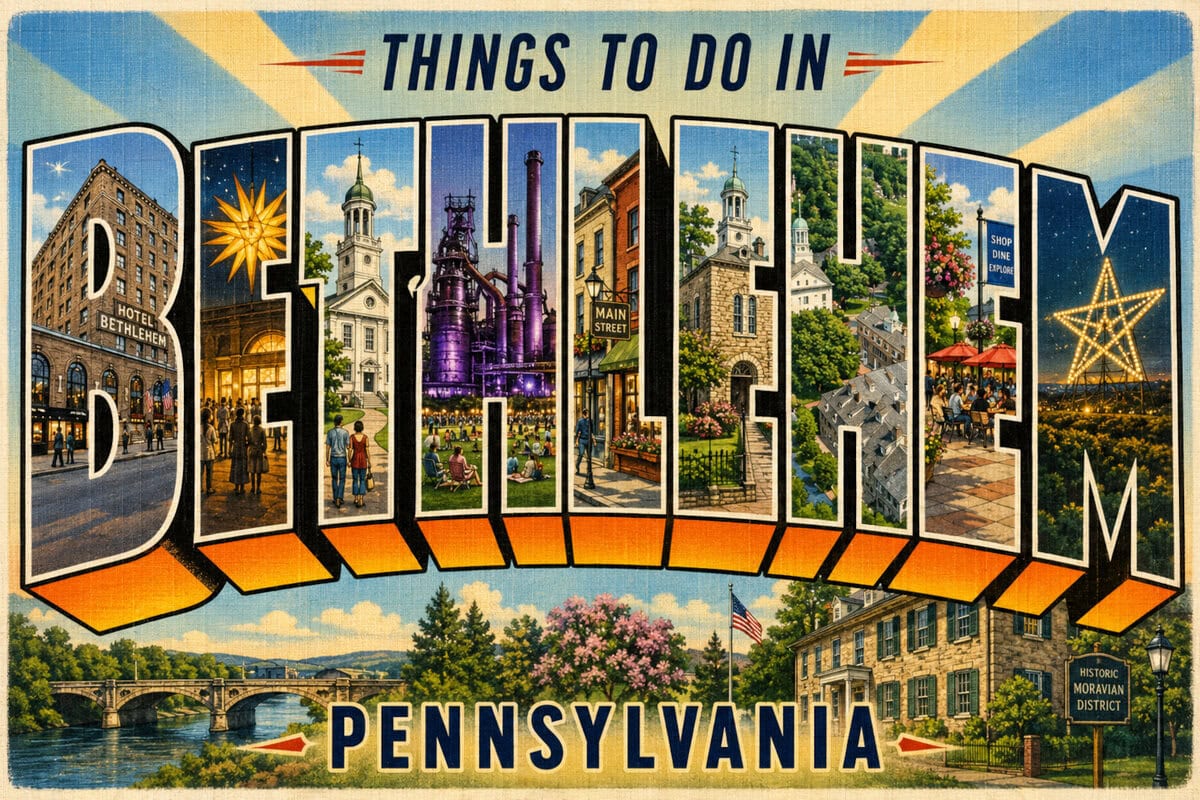
Bethlehem makes the most sense when you see both halves of its story. On the NorthSide, an 18th-century Moravian settlement survives in stone buildings, church grounds, museums, and an early industrial quarter.
Across the Lehigh River on the SouthSide, the former Bethlehem Steel plant has become SteelStacks, with blast furnaces, a raised pedestrian walkway, a museum, films, concerts, and public events.
A first visit should include one stop from each side. The Moravian sites explain how Bethlehem began; SteelStacks and the National Museum of Industrial History explain how the city later became an industrial center.
Add Main Street, a trail, a museum, or a performance according to your interests. This guide focuses on places and activities that remain useful year-round.
Musikfest, Christkindlmarkt, and other recurring events appear in a separate seasonal section so the article does not depend on what happens to be scheduled this week.
Quick picks for a Bethlehem visit
| If you want... | Start with... | Plan about... | Cost pattern |
|---|---|---|---|
| The best first-time overview | Historic Downtown + SteelStacks | Most of a day | Mix of free and paid |
| Colonial and Moravian history | Moravian Museum + Church Street + Colonial Industrial Quarter | 2-4 hours | Free outdoors, ticketed museum/tours |
| Industrial history | Hoover-Mason Trestle + National Museum of Industrial History | 2-3 hours | Free walk + paid museum |
| A free outdoor activity | Hoover-Mason Trestle, South Bethlehem Greenway, or Monocacy Way | 45-120 minutes | Free |
| A family-friendly history stop | National Museum of Industrial History or Burnside Plantation grounds | 1-2 hours | Free or paid, depending on activity |
| Shopping and a casual stroll | Main Street in Historic Downtown | 1-2 hours | Free to walk |
| An evening activity | SteelStacks/ArtsQuest program or another local performance | Varies | Free or ticketed |
| A holiday-season trip | Historic Downtown + Christkindlmarkt | Half day or longer | Mix of free and paid |
The time ranges above are planning estimates, not official visit lengths.
1. Walk the Moravian Church Settlements - Bethlehem World Heritage site
Bethlehem's historic core is part of the UNESCO World Heritage property called Moravian Church Settlements.
Bethlehem joined the expanded property in 2024.
The property links four Moravian settlements in the United States, Germany, Denmark, and the United Kingdom.
UNESCO describes Bethlehem, established in 1741, as the first permanent and best-preserved Moravian Church settlement in North America.
That status gives Historic Downtown more context than a standard "pretty old town" walk.
The street plan, communal buildings, church spaces, cemetery, workshops, and water-powered industrial area were connected parts of one settlement.
Start around West Church Street.
The most useful landmarks include the 1741 Gemeinhaus, now the Moravian Museum; Central Moravian Church and the Old Chapel area; God's Acre cemetery; the Single Sisters' House; and the Colonial Industrial Quarter along Monocacy Creek.
Historic Bethlehem Museums & Sites also has guided and self-guided tour choices.
Best for: first-time visitors, architecture, early American history, walking.
Good to know: the historic district is easy to appreciate outdoors, but entry to museums and some historic interiors depends on published hours or a scheduled tour.
2. Go inside the Moravian Museum of Bethlehem
The Moravian Museum is the best single indoor stop for understanding why the NorthSide historic district looks the way it does.
It occupies the 1741 Gemeinhaus, the oldest building in Bethlehem, and sits inside the World Heritage area.
A museum visit adds the social and religious structure behind the buildings outside.
The settlement was planned around a communal way of life, so the buildings make more sense when you see how their functions fit together.
Choose the museum if you have limited time and want one paid historic attraction.
If you have more time, pair it with a guided walking tour or the nearby Kemerer Museum of Decorative Arts.
Best for: visitors who want context rather than a photo-only walk.
Planning note: schedules change through the year, and some Historic Bethlehem properties use custom-tour days.
Check the official museum page before fixing your itinerary.
3. See the Colonial Industrial Quarter and God's Acre
Two nearby outdoor stops make the Moravian story easier to understand.
The Colonial Industrial Quarter follows Monocacy Creek below the historic core.
Early Moravian residents used the creek to power mills and support trades and workshops.
Historic Bethlehem identifies the area as an early center of organized industry, with surviving structures and archaeological remains tied to milling, tanning, pottery, and other work.
God's Acre is the Moravian cemetery near the historic district.
It is part of the same World Heritage setting and gives a quieter view of the community's religious customs and town plan.
These stops work well for travelers who prefer outdoor history to another museum.
They also fill the gap between Main Street sightseeing and a deeper guided tour.
Best for: free sightseeing, photography, walkers, repeat visitors.
4. Spend time on Main Street in Historic Downtown
Main Street gives the NorthSide portion of a Bethlehem trip an easy break between historic sites.
The compact downtown has shops, restaurants, galleries, old buildings, and access to the World Heritage district within a short walk.
One locally specific stop is the Moravian Book Shop, founded in 1745.
A short visit fits naturally into a Main Street walk because of its connection to Bethlehem's Moravian history.
Treat Main Street as part of the day rather than as a separate attraction requiring a fixed block of time.
It works well for lunch, coffee, shopping, or an evening walk after museums close.
Best for: couples, casual walkers, shopping, food stops, bad-weather flexibility.
5. Visit SteelStacks and walk the Hoover-Mason Trestle
SteelStacks sits on the former Bethlehem Steel plant on the SouthSide.
ArtsQuest now runs the 10-acre campus as an arts and culture site, with the preserved blast furnaces forming the dominant backdrop.
The easiest way to experience the industrial site is the Hoover-Mason Trestle.
The raised pedestrian walkway follows part of the old rail system that once moved raw materials through the steel plant.
Interpretive panels explain the machinery and production process, and the walkway gives close views of the furnaces.
The Trestle is one of Bethlehem's strongest free attractions because it works at two levels.
You can take a quick walk for the scale and views, or slow down and read the panels before visiting the industrial museum.
Best for: first-time visitors, photographers, industrial history, free sightseeing.
Planning note: the Trestle has regular public hours, but ArtsQuest may close it for severe weather or special events.
Check current access if it is a must-do stop.
6. Add the National Museum of Industrial History when you want the full steel story
The National Museum of Industrial History sits close to SteelStacks in a former Bethlehem Steel building.
It is a Smithsonian Affiliate and covers American industry through machinery, manufacturing, labor, and industrial technology.
The museum and the Trestle do different jobs:
- The Trestle gives you the physical scale of the Bethlehem Steel site.
- The museum explains how industrial systems, machines, and workers fit together.
- A guided steel plant site tour, when available, connects the surviving plant to the people who worked there.
If your interest is mainly architecture or photography, the free Trestle may be enough.
If you want to understand what happened inside an industrial plant and why Bethlehem Steel mattered, budget time for the museum.
The museum publishes admission prices and is generally open on a Wednesday-through-Sunday schedule, with holiday exceptions.
Because hours and prices can change, confirm them on the museum's visit page before your trip.
Best for: history fans, engineering-minded travelers, families with older children, rainy days.
7. Take a Bethlehem Steel plant site tour
A guided plant tour is the best upgrade for visitors who leave the museum or Trestle wanting more detail.
The National Museum of Industrial History works with guides, including people trained in the steelworkers' story, for walks through the plant site and along the Trestle during its tour season.
Tours cover the development of iron and steelmaking in the Lehigh Valley, the Bethlehem plant, the surrounding worker neighborhoods, and the experience of industrial labor.
This is a date-dependent activity, but it still belongs in an evergreen guide because the program recurs.
Think of it as an optional reservation rather than the foundation of your day.
Best for: industrial history fans and travelers who prefer a guide to interpretive signs.
8. Visit the Kemerer Museum of Decorative Arts
The Kemerer Museum of Decorative Arts is a smaller, more specialized Historic Bethlehem stop in the NorthSide district.
Its galleries cover furniture, paintings, ceramics, clothing, silver, period rooms, and changing exhibits.
The museum also has an extensive antique dollhouse collection, with selected pieces displayed at different times.
Choose the Kemerer if you care about design, interiors, material culture, or miniatures.
It also works well when you have already visited the Moravian Museum and want a second indoor attraction without crossing to the SouthSide.
Best for: decorative arts, design, antiques, dollhouses, rainy-day sightseeing.
9. Walk or bike the South Bethlehem Greenway
The South Bethlehem Greenway runs through the SouthSide on a former rail corridor.
The City of Bethlehem lists it as one of its main trails and linear parks, with connections to public art, play areas, and the Bethlehem Skateplaza.
This is a good counterweight to a museum-heavy day.
It also gives repeat visitors a reason to spend more time in the SouthSide beyond the SteelStacks campus.
If you are already visiting SteelStacks, use part of the Greenway as a short walk.
If you want more exercise, give it a longer block and combine it with the SouthSide Arts District.
Best for: walking, biking, public art, families, low-cost trips.
10. Get outdoors at Burnside Plantation and Monocacy Way
Burnside Plantation is a preserved farm property north of the downtown core.
Historic Bethlehem describes the 6.5-acre site as a "farm-in-the-city," with a restored farmhouse, barns, garden, orchard, corn crib, wagon shed, and other agricultural structures.
The grounds are open from dawn to dusk, while access to buildings is tied to programs, tours, or events.
That makes Burnside a flexible outdoor stop even when no special program is running.
Nearby, Monocacy Way follows Monocacy Creek and links Center City with recreation areas around Illick's Mill Road.
The City of Bethlehem also lists Sand Island's D&L corridor trail and South Mountain Park among its trail choices.
Burnside is a better pick than another downtown museum when you want green space, local history, or a slower family stop.
Best for: families, walkers, gardens, local history, spring through fall.
11. See a show, movie, or public program at SteelStacks
SteelStacks changes character after the sightseeing portion of the day.
The ArtsQuest Center has performance spaces and cinemas, while the campus hosts concerts, community programs, festivals, and other public events throughout the year.
For an evergreen itinerary, use the ArtsQuest calendar as an evening add-on after the Trestle or industrial museum.
Book a specific performer after you have confirmed the date and tickets.
This gives Bethlehem a useful day-to-night pattern: history and walking in the afternoon, dinner, then a film or performance in the same SouthSide area.
Best for: couples, evening plans, arts fans, repeat visitors.
12. Build a trip around Bethlehem's recurring seasonal events
Bethlehem has several annual events strong enough to shape a trip, but they should stay separate from the year-round attraction list.
Musikfest
ArtsQuest's Musikfest takes place in August and spreads music programming across Bethlehem.
Many performances are free, while major headline concerts may require tickets.
The festival changes normal traffic, parking, and crowd levels, so travelers visiting during it should plan for the festival rather than treat it as a small add-on.
Christkindlmarkt
Christkindlmarkt is ArtsQuest's German-inspired holiday market at SteelStacks.
It returns during the late-fall and holiday season with artisan vendors, food, family activities, and seasonal programming.
Exact operating dates change each year.
Christmas City experiences
Historic Downtown also runs holiday tours and seasonal displays.
Bethlehem's "Christmas City" identity is strongest from late November through December, when the NorthSide historic district and SouthSide market can fill an entire day.
These are recurring reasons to choose a particular season.
For a universal trip, the city's historic and industrial attractions remain the safer base plan.
The best one-day Bethlehem itinerary
For a first visit, divide the day between the NorthSide and SouthSide.
Morning: Historic Downtown and the Moravian sites
Start around Church Street.
Walk through the World Heritage area, visit the Moravian Museum if it is open, and continue toward God's Acre and the Colonial Industrial Quarter.
Move to Main Street for lunch or a coffee stop.
Allow roughly three hours if you plan to enter the museum. A faster outdoor-only walk can take less.
Afternoon: SteelStacks and industrial history
Cross to the SouthSide and walk the Hoover-Mason Trestle. Add the National Museum of Industrial History if the steelmaking story interests you.
A Trestle-only visit can fit into an hour. Museum plus Trestle usually deserves a larger block.
Evening: SouthSide or Main Street
Check the ArtsQuest schedule for a film, concert, or public program, or return to Main Street for dinner and a walk.
This plan works in any season because the core stops remain useful outside festival dates and current-weekend programming.
A two-day plan
A second day lets you slow down instead of adding distant Lehigh Valley attractions too quickly.
Day 1: World Heritage district, Moravian Museum, Main Street, SteelStacks, Hoover-Mason Trestle.
Day 2: National Museum of Industrial History, a steel plant tour if available, Kemerer Museum, South Bethlehem Greenway, or Burnside Plantation and Monocacy Way.
Families may prefer to swap the second museum for more outdoor time.
Travelers visiting during Musikfest or the Christmas season can use much of Day 2 for the recurring event.
Best things to do in Bethlehem by interest
For history
Start with the Moravian Museum and World Heritage district, then see the Colonial Industrial Quarter.
Use the afternoon for NMIH and the Trestle. This sequence shows Bethlehem before and during its industrial age.
For families
NMIH has machinery and industrial exhibits that are easier to pair with active sightseeing than a full day of house museums.
Burnside gives children room to move around outdoors, while the Greenway and Skateplaza are free.
For couples
Combine Church Street, Main Street, and a cafe or restaurant with a late-afternoon Trestle walk.
Check SteelStacks for a film or performance after dinner.
For free things to do
Walk the World Heritage district, Colonial Industrial Quarter, God's Acre, Hoover-Mason Trestle, South Bethlehem Greenway, Monocacy Way, or Burnside grounds.
Museum interiors, guided tours, and some programs cost extra.
For rainy weather
Prioritize the Moravian Museum, Kemerer Museum, NMIH, the ArtsQuest Center, and Main Street shops.
Save the Trestle, Colonial Industrial Quarter, and trails for a dry window.
Practical planning tips
Think in two visitor zones
Historic Downtown/NorthSide and SteelStacks/SouthSide contain most of the attractions a first-time visitor is likely to want.
Group stops within one zone before crossing the river. Constantly moving the car between individual sights wastes time.
Check museum days before you lock the itinerary
Bethlehem's museums keep different weekly and seasonal schedules.
Historic properties may have custom-tour days, while NMIH uses its own weekly schedule.
Confirm hours on official sites before choosing which side of town to visit first.
Keep one flexible block
Guided tours, live programs, and seasonal events can change by day.
Build the core of your trip around places you can visit independently, then plug one scheduled activity into the open block.
Expect more walking than the city size suggests
The historic district, creek paths, SteelStacks, and the Trestle are best seen on foot. Comfortable shoes matter more than a long list of attractions.
Recheck festival-period parking
SteelStacks normally has on-site parking, but major events such as Musikfest can change parking access.
Historic Downtown also uses city street and garage parking. Confirm current parking rules for the dates you will be there.
Sources and further reading
- Moravian Church Settlements - UNESCO World Heritage Centre.
- Visit Historic Bethlehem Museums & Sites - museum, historic-site, tour, and access information.
- Visit the National Museum of Industrial History - current visitor information.
- SteelStacks - ArtsQuest campus information.
- Trails and Linear Parks - City of Bethlehem Recreation.
- Burnside Plantation - Historic Bethlehem Museums & Sites.
- Moravian Book Shop - Moravian University.
- Musikfest - ArtsQuest annual festival information.
- Christkindlmarkt - ArtsQuest holiday market information.
Independent Publisher Notice
BestAttractions is an independent editorial publisher. We are not affiliated with, endorsed by, or acting on behalf of any location, business, property owner, manager, government agency, or organization described in this article. Comments posted on this page are not forwarded to, reviewed by, or acted upon by any entity mentioned in the article. For official inquiries, complaints, applications, bookings, or other requests, please contact the relevant entity directly through its official website or other verified channels.