
Standing five miles southeast of Hartsville, Tennessee, on the north shore of Old Hickory Reservoir, sits federal land bought for four nuclear reactors.
TVA ordered the plant in December 1972. At 5,140 megawatts, it was the largest nuclear station ordered anywhere in the world. By 1977, 7,000 people worked the site.
Demand forecasts fell, and TVA canceled two units in August 1982 and the last two on August 29, 1984. A1 was 44 percent complete. Nothing was ever fueled.
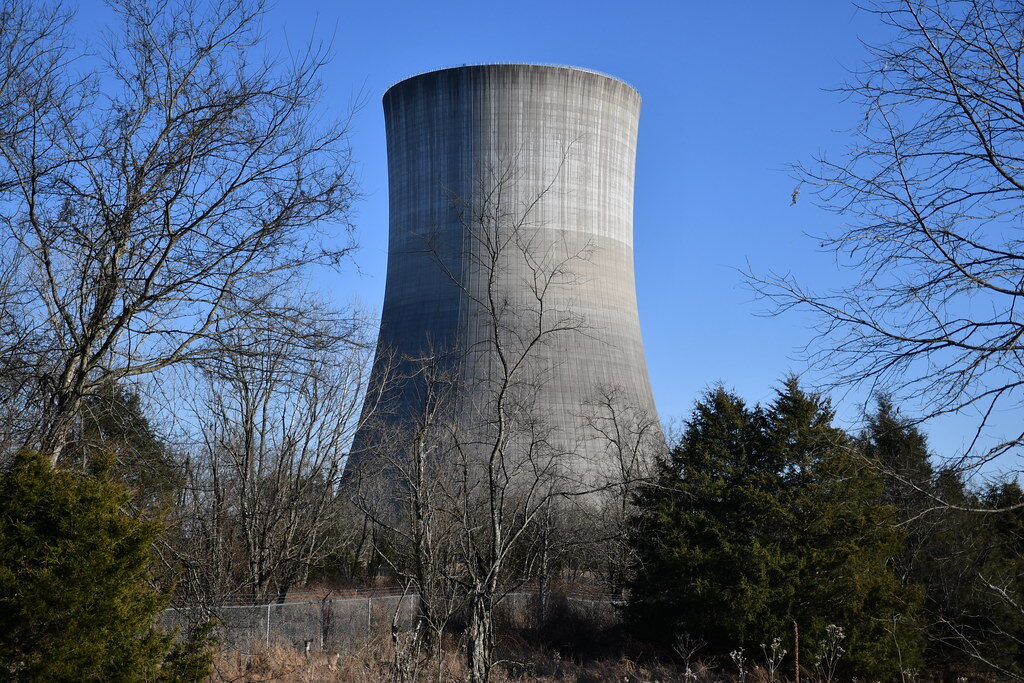
Today a prison and an industrial park hold much of the old reservation. TVA imploded the 540-foot cooling tower on September 18, 2025. No plan for that ground has been announced.
TVA ordered four reactors at Hartsville in 1972
In December 1972, TVA ordered four nuclear reactors for a stretch of farm and timber land on the north shore of Old Hickory Reservoir, five miles southeast of Hartsville, Tennessee.
Four units on one site: A1, A2, B1, and B2, in two mirror-image blocks called Plant A and Plant B. At 5,140 megawatts, it was the largest nuclear plant ordered anywhere in the world up to that point.
All four were General Electric BWR/6 boiling-water reactors, with Brown Boveri turbine generators, an odd pick for a big American job.
Design and licensing alone took years.
TVA already held 1,940 acres across Trousdale and Smith counties, 40 miles northeast of Nashville, and the Cumberland River gave four reactors the cooling water they would need.
7,000 workers and a five-county committee
TVA released the environmental impact statement on May 23, 1975, and the heavy work followed.
Trousdale County was farm country, and the land TVA bought carried hunting and a mussel-gathering tradition along the Cumberland.
By 1977 the site employed 7,000 workers, and the county was planning housing, schools, sewers, and transportation for a workforce it had no template for.
In 1975, Trousdale County joined Macon, Smith, Sumner, and Wilson counties in the Hartsville Project Coordinating Committee, set up to deal with TVA on effects spreading across all five.
Everyone assumed a permanent operating staff would follow the construction crews, the kind of payroll that holds up a county's tax base for decades.
The mussel and the hunting land
Faith and William Young intervened in the licensing, arguing that heat discharged into the reservoir would harm the pink mucket, an endangered mussel.
Other residents went after the environmental analysis on land: hunting ground, waterfowl habitat, and access to farms and woods open before TVA took over the site.
In June 1975, Linda Gentry wrote publicly about what the project would do to children's freedom to roam.
All of that came before Three Mile Island in 1979, which pushed reactor safety into a much larger national argument.
The ground held older history.
A TVA survey recorded archaeological site 40TR27 on the Duncan Tract in January 1980, and human remains representing at least 74 individuals were removed over the next two years.
TVA opened formal tribal consultation in 2019.
The forecast that fell out from under it
TVA's forecast of peak demand for January 1985 stood at 39.8 GW in the 1974 version. A year later, the same forecast read 37.2 GW.
The 2.6 GW that disappeared between them was close to the output of a large two-unit nuclear station.
By 1976, TVA had seven nuclear stations and 17 reactors planned or under construction, all of it sized for demand the agency was already revising down.
The schedule made it worse. TVA had planned on four years from start to service, and by 1976 the realistic figure was eight to 10 years.
That meant paying interest on a half-built plant for years longer before selling a single kilowatt-hour.
Four reactors at Hartsville sat inside that gap.
Buried tools and a federal review
In July 1982, TVA employees went public with a claim that construction management had ordered crews to bury surplus tools and equipment worth millions at Hartsville.
On September 23, 1982, Representative Albert Gore Jr. asked the General Accounting Office to examine TVA's response and its inventory controls.
TVA's investigative team asked four workers to mark the burial spots. Crews dug the marked areas, in places down to 10 feet.
One location stayed unreachable because a slope and marsh kept the equipment out.
What came up was scrap, plus safety goggles, belts, rulers, and hardhat liners, most of it unusable.
The finding that December: no evidence that millions in usable equipment had been buried, though small-tool accountability across TVA's system was weak.
Canceled at 44 percent complete
In August 1982, TVA canceled Hartsville B1 and B2 at 17 percent and 7 percent complete and put A1 and A2 on indefinite deferral.
Construction employment fell to a fraction of its peak, and the county also lost the permanent plant payroll it had expected.
A federally sponsored study recommended in 1983 that the five counties create an industrial-development authority.
Staff recommended canceling the deferred units in July 1984.
On August 29, 1984, the board voted to end Hartsville A1 and A2 and two Yellow Creek units. A1 was 44 percent complete, A2 34 percent.
The loss on the four reactors was put at $2.7 billion, Hartsville and Yellow Creek together.
No fuel was ever loaded, and no operating license was ever issued.
$1.7 million for 554 acres
The authority that study called for arrived on April 15, 1986, when Tennessee created the Four Lake Regional Industrial Development Authority for five counties.
In June 2002, Four Lake bought 554 acres of the former nuclear site for $1.7 million, on condition it put $1.5 million of infrastructure in within five years.
Water, sewer, gas, and a 750,000-gallon tank were in by 2005. The tract became PowerCom Industrial Center.
Nuclear nearly came back.
In September 2002, Louisiana Energy Services named the Hartsville area its preferred site for a $1.1 billion uranium-enrichment plant with 300 permanent jobs.
Opposition built, and the company moved the project to New Mexico in 2003.
ARC Automotive announced a $3 million plant with 66 expected jobs in 2014, and by 2021 the park held 14 manufacturers.
What stands on the Hartsville site now
For four decades the A1 cooling tower was the thing you could see for miles, a concrete shell 540 feet tall.
TVA called it obsolete and unsafe: people kept slipping onto the property to look at it.
On September 18, 2025, a contractor brought it down in a controlled implosion. TVA planned to crush the concrete on site for a gravel lot.
The 2,552-bed Trousdale Turner Correctional Center now sits on redeveloped ground, built for $144 million and taking inmates since early 2016.
TVA uses part of its remaining land for satellite offices, and Tennessee markets a 22-acre site inside PowerCom at $39,500 an acre.
TVA has announced no plan for the tower ground.
Many of the people driving onto the old reservation on a weekday morning clock in at the prison or at one of the park's manufacturers.
Independent Publisher Notice
BestAttractions is an independent editorial publisher. We are not affiliated with, endorsed by, or acting on behalf of any location, business, property owner, manager, government agency, or organization described in this article. Comments posted on this page are not forwarded to, reviewed by, or acted upon by any entity mentioned in the article. For official inquiries, complaints, applications, bookings, or other requests, please contact the relevant entity directly through its official website or other verified channels.