Irving Mall and the Birth of Climate-Controlled Suburbia
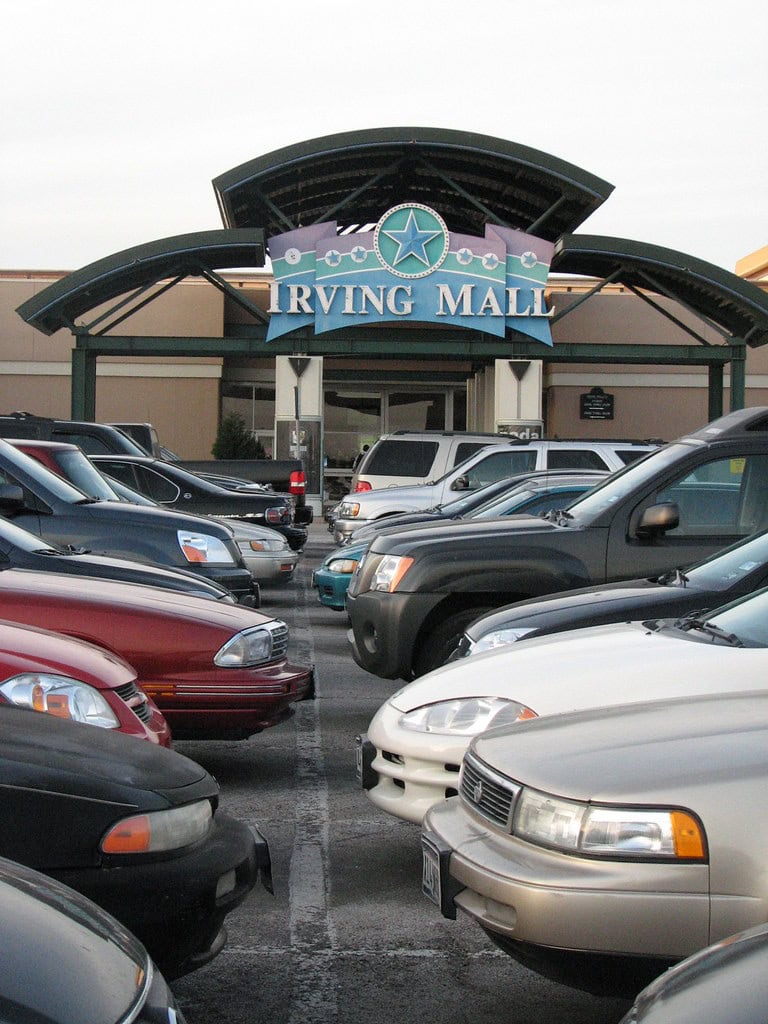
In 1971, Irving Mall opened on a flat piece of land between Airport Freeway and Belt Line Road.
Designed by Gordon Siebek Associates of Dallas, the mall had about 750,000 square feet of space for stores, parking for 4,000 cars, and made people feel that suburban life could now take place inside.
Irving, whose population was tilting toward six figures, now had a climate-controlled main street a few miles from the still-young Dallas/Fort Worth International Airport.
The anchors were the sort of names that dictated weekend plans. Titche-Goettinger, a 190,000-square-foot Dallas institution, opened in February 1971, joined that same month by a 94,000-square-foot Sears on the north end.
JCPenney followed, completing the holy trinity of middle-class aspiration.
By the time the mall held its official grand opening in August, forty-six inline stores were ready, typing out the consumer alphabet of the era: J.G. McCrory 5 & 10, Orange Julius, Waldenbooks, Chess King, Wicks N Sticks, Singer Sewing Center, Gallenkamp Shoes.
There was a cinema, too, naturally.
General Cinema opened Irving Mall Cinema I & II in 1971, proof that you could arrive in the afternoon and not emerge until well after dark, stuffed with Sun Garden Cafeteria desserts and Mrs. Stover candies.
The mall was less a building than a suburban commitment: park once, live the day.
From Titche's to Joske's to Dillard's: How Irving Mall Grew West
By the end of the 1970s, Irving Mall began to quietly show the effects of department stores joining together. Titche-Goettinger, long a Dallas stalwart and a subsidiary of Allied Stores, was rebadged as Joskes in 1979.
On paper, it was a corporate maneuver; on the floor, it meant new signage, new shopping bags, and a slightly different idea of what a North Texas woman should wear.
Irving itself kept swelling. By 1980, the city counted just under 110,000 residents, and the mall was positioned as the community's indoor plaza.
The owners responded the way mall owners did in the go-go 1980s: they built more.
In 1984, Irving Mall pushed west, adding a new wing, a food court, and two more anchors, Mervyns and a Dillard's store that had migrated from Plymouth Park Shopping Center.
For a time, the mall was anchored by JCPenney, Sears, Joskes, Mervyns, and Dillard's, a full hand of department stores that made the building feel borderline metropolitan.
General Cinema saw that movies were becoming a main attraction, so it expanded to seven screens.
Now, a visit to Irving Mall could include a quick stop at Sears, a walk through Dillard's, a burger at Charlie Brown Burger House, and a double feature at the movies.
Foley's, Barnes & Noble, and Mall's 1990s–2000s Makeover
In 1989, Irving Mall made it clear it wanted to keep up with newer regional centers. Foley's, a department store from Houston, opened as a new anchor and added its logo to the mall.
Inside, the stores were starting to focus more on soft goods, stylish housewares, and reasons for shoppers to stay longer.
The late 1990s brought a redevelopment that tried to future-proof the place.
General Cinema shifted out of its original home into the shell of a former Wilsons Catalog Showroom, and the old cinema space was reborn as a Barnes & Noble in 1999.
Having a big bookstore in the mall changed the atmosphere. People could get coffee, relax in reading chairs, and see shopping as something calm instead of rushed.
By 2002, AMC took over the movie theater, renamed it AMC Irving Mall, and made it part of a national chain.
Not every story bent upward. In 2001, JCPenney closed as part of a corporate retrenchment that cut 44 underperforming stores.
The loss of one of the original 1971 anchors felt like a small amputation. Then, in 2005, Federated Department Stores acquired May Department Stores, Foley's parent.
On July 2, 2006, the Foley's at Irving Mall shed its name and became a Macy's, while Burlington Coat Factory opened in the former JCPenney box.
Mervyn's, buffeted by its own troubles, closed that year. The mall was still full, but the cast list kept changing.
Irving Mall's Shadow History, 1990-2022
Like many malls, Irving Mall has always had two lives: the marketed one under the skylights and the unplanned one in the parking lot.
In 1990, that second life turned lethal. A man named Eddie Edwards chased his girlfriend into the lot and shot her with a .38-caliber revolver. Another man intervened, shooting Edwards in the head and killing him.
Three years later, in 1993, a gang conflict at the mall escalated into gunfire. One person shot two others, killing an innocent bystander.
The building that had promised safe, enclosed suburban life was suddenly a backdrop for the country's fraught public-safety politics, where adolescence, firearms, and asphalt met.
The pattern would repeat in a more social-media-ready form on September 4, 2022.
A man was walking toward an exit carrying a baby car seat when another man approached and appeared to swing at him. He set the seat down and opened fire.
No one was hit, but the panic rippled through the mall, captured on phones.
The incident read less like a one-off than another entry in a long ledger of parking-lot dramas that have quietly tugged at the mall's reputation.
Shoppers World, Seritage, and a Sears Goodbye
By the 2010s, the more subtle threats to Irving Mall came not from guns but from broadband. In 2012, the Barnes & Noble that had once seemed like a sophisticated upgrade closed, replaced by Shoppers World.
The swap from a national bookstore to a discount retailer was not just about leases; it was about a shrinking middle and a property adjusting to who still came through the doors.
The AMC theater underwent renovations in 2013, an investment in reclining seats and digital projection meant to keep moviegoing at least marginally competitive with streaming.
In 2014, Simon Property Group, the mall's longtime owner, spun the center off into Washington Prime Group, a separate real-estate trust charged with tending to properties that no longer fit Simon's premium portfolio.
That same year, Las Lomas Irving Banquet Halls Event Center opened on the first floor of the former Mervyns, turning a defunct department store into a venue for quinceañeras, weddings, and banquets.
Sears, one of the original anchors, entered its long goodbye.
In 2015, Sears Holdings spun off 235 owned properties, including the Irving Mall Sears, into Seritage Growth Properties, a vehicle designed to wring value out of the underlying real estate.
Sears kept operating under a master lease, but the writing was on the cinder-block wall. On October 15, 2018, Sears announced the closure of 142 stores nationwide.
The Irving Mall location went dark in early January 2019, ending nearly 48 years of continuity.
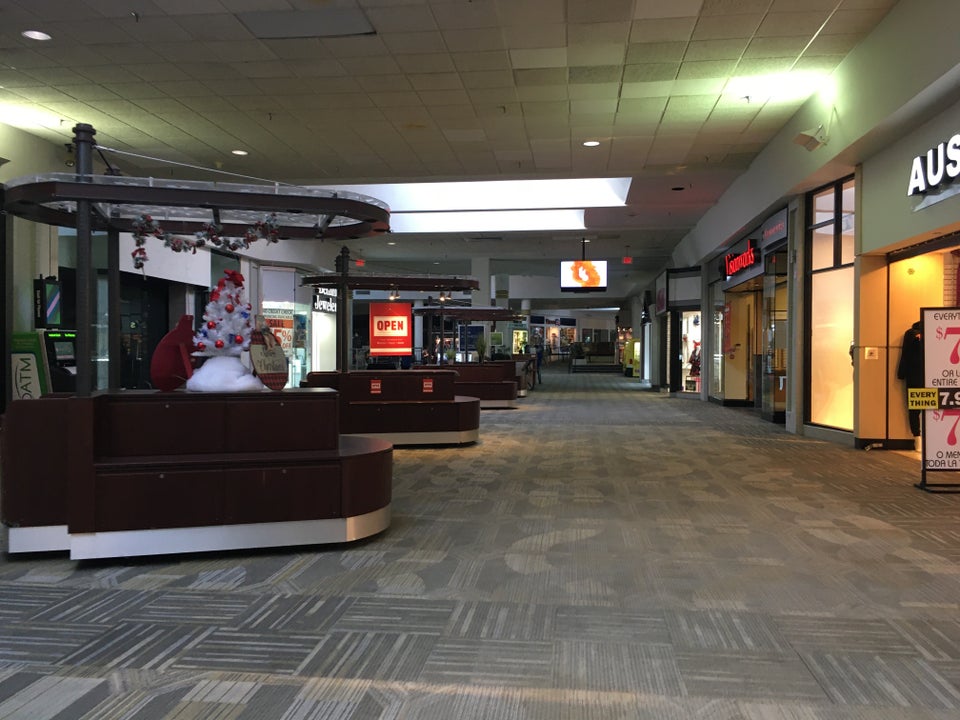
The big box at the north end became a hole in the mall's circulatory system.
Cowboy Claus, VR Arenas, and a Rezoned Mall
Despite the attrition, the mall refused to slip quietly into ruin.
As of late 2020, it could still claim more than 80 operating stores and four main anchors: Macy's, a Dillard's Clearance Center, Burlington, and Las Lomas.
DART Route 231 continued to thread along Belt Line Road, depositing bus riders at a property now subtly shifting from retail to something more hybrid: part marketplace, part community center, part void.
After Washington Prime Group filed for Chapter 11 bankruptcy in June 2021, the question was less whether Irving Mall was fragile than how it would improvise.
La Vida Fashion and Home Decor, an anchor that had tried to fill some of the empty volume, closed in 2022. Yet the calendar remained busy.
Holiday programming in 2024 leaned into specificity and charm: Photos and visits with Santa ran from November 27 through December 24 in the Burlington Center Court, with a Cowboy Claus option on select dates and a Paws & Claus pet-photo night on December 16.
The year also brought a more elaborate entertainment strategy. Zero Latency Irving, a free-roam VR arcade, set up inside Irving Mall, selling the mall as an arena for virtual firefights instead of real ones.
The city's Planning & Zoning Commission took up a request to rezone that same space for a restaurant with on-premises alcohol and indoor amusement, moving the property further away from the old model of pure retail.
Sketching a greener, slower future for Irving
In 2024 and 2025, Irving Mall became a place that felt both in decline and oddly lively. Family events continued, like a sensory-friendly Sensitive Bunny photo session on March 17, 2024.
Talley Amusements also returned from June 5 to 9, bringing a carnival with rides and midway games set up in the empty parking lot.
In early 2025, Talley was back with a Valentine-period carnival from February 14 to March 2.
A Delman Circus set up in the lot near Shoppers World from April 25 through May 5, with acrobats, motorcycle stunts, and a kids' fun zone.
Another Talley Amusements carnival was booked for late summer 2025, running August 28 through September 7.
The message was not subtle: if traditional retailers would not come, the circus would.
The giant parking fields that once existed solely to absorb weekend car surges now served as temporary fairgrounds, turning a symbol of overbuilt auto infrastructure into a revenue stream.
Indoors, VR arenas and banquet halls tried to coax life into the bones.
Beyond the boundary of its property line, Irving Mall has been pressed into duty as a studio model by people who imagine a different fate for American malls.
In the fall of 2024, a landscape architecture thesis at the University of Texas at Arlington used the mall site as a retrofitting canvas: more trees and green infrastructure in the lots, better stormwater management, mixed-use blocks, and a walkable street grid threaded into the surrounding city.
It is, for now, only a vision.
But even as carnivals rotate through and anchors hang on, Irving Mall sits under the Texas sun as an unanswered question: is this a relic being kept on life support, or a half-finished draft of whatever comes after the mall era?