
Beverly Center got a nickname most malls never earn: "the incredible bulk." And it fit. People meant the brown walls and the blank, windowless face that turned to the corner of Beverly and La Cienega.
They shopped there anyway. For more than 40 years, Angelenos mocked the building and parked in it the same afternoon, riding the escalators up the outside of it to reach the shops.
That climb is the tell. Almost every L.A. mall spreads out flat across a parking lot. This one stacks straight up, and the reason sits under the floor you park on.
The corner had a life of its own before the mall, and a busy one. The crowds who packed it back then came for something else entirely.
Before Beverly Center, ponies and a disguised oil well
Before Beverly Center went up on the corner of Beverly and La Cienega boulevards in Los Angeles, kids rode ponies there.
From the 1940s into the 1970s, the corner held Beverly Park, a small children's amusement park, with Ponyland right next door.
There was a little roller coaster, a whale-shaped ride, a carousel, pony rides, and birthday parties at picnic tables.
One working oil well on the site wore a dragon costume, so the machinery pumping under the park looked like part of the show.
David Bradley ran Beverly Park after leasing the land from an oil company.
Walt Disney brought his daughters to the park, talked amusement-park design with Bradley, and later brought him in to consult.
Bradley studied rides in Europe and helped shape Disneyland's carousel and the scale of its Main Street.
Rent climbed, the oil operation pressed in, and Bradley closed Beverly Park in 1974 after decades running it.
Ponyland held on a few more years.
By 1979 it was gone too, pushed out for the shopping center that would take the whole corner.
The ponies left. Something far heavier was coming, and the oil under the lot would decide its shape.
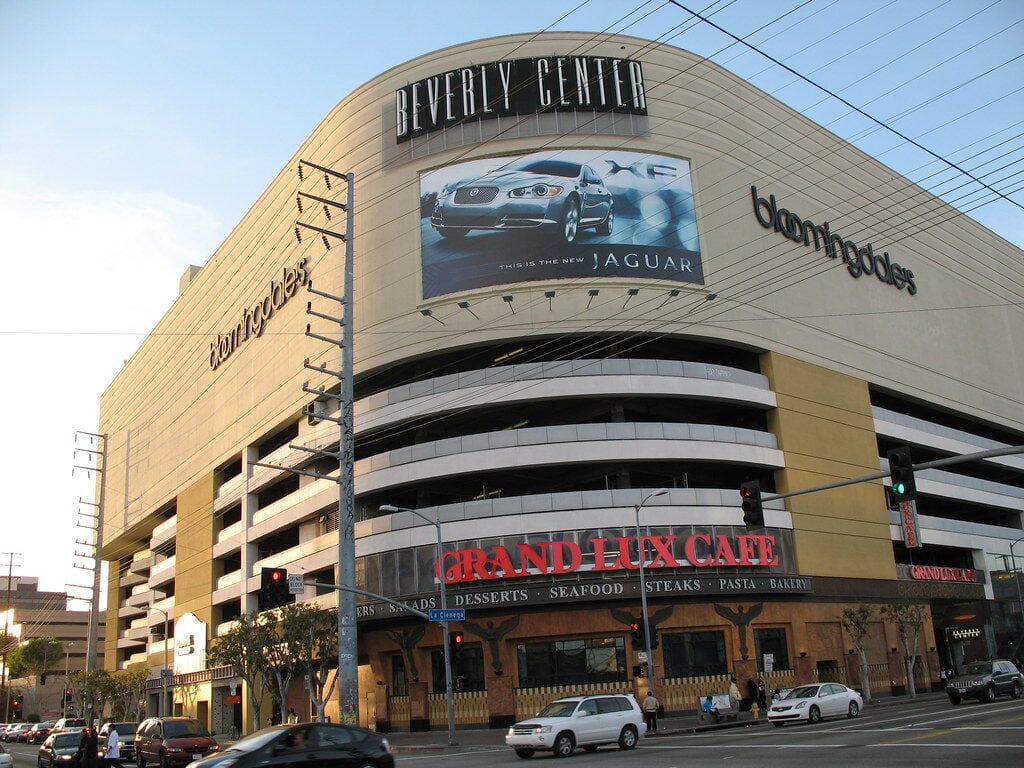
Why Beverly Center sits on stilts above its parking
The first problem was the oil field.
The corner sat over the Salt Lake Oil Field, with pumps still working, and that ruled out a basement garage.
So the developers built upward, helped along by bad soil and the math of squeezing a mall onto that site.
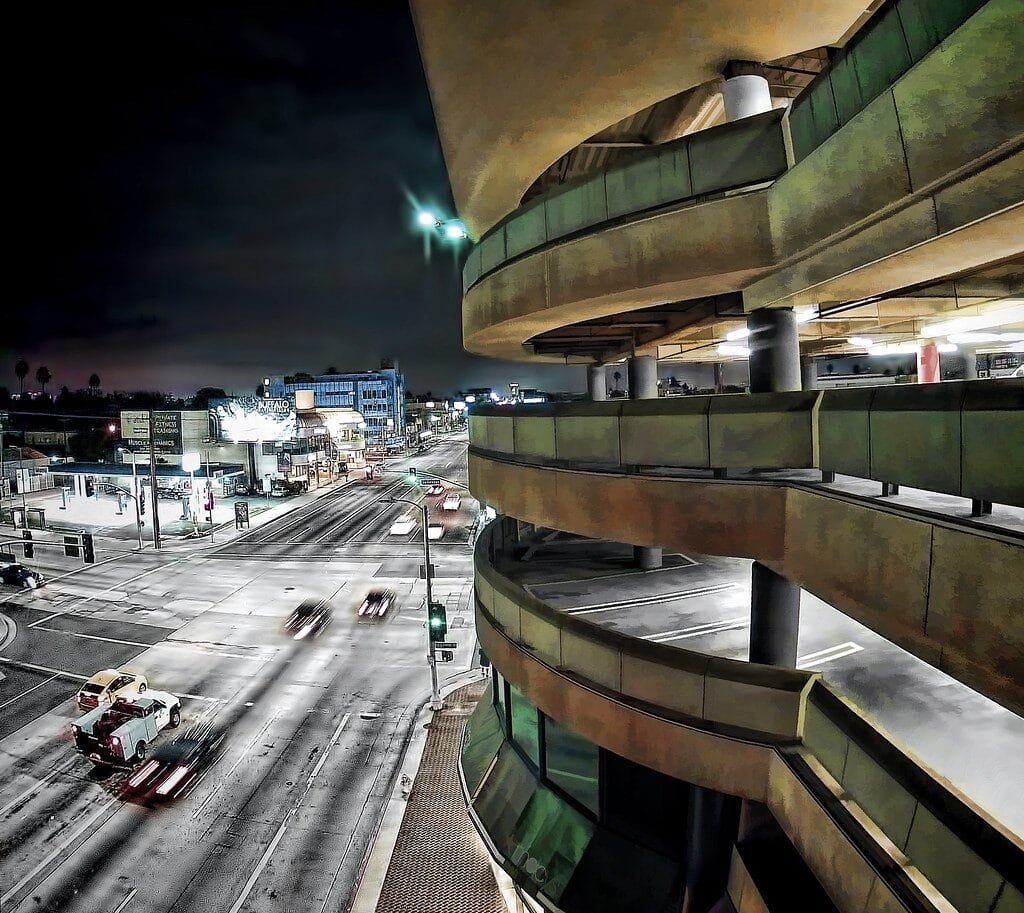
Parking went into an above-ground podium several levels tall, and the shopping floors sat on top of it, three main retail levels stacked over the cars.
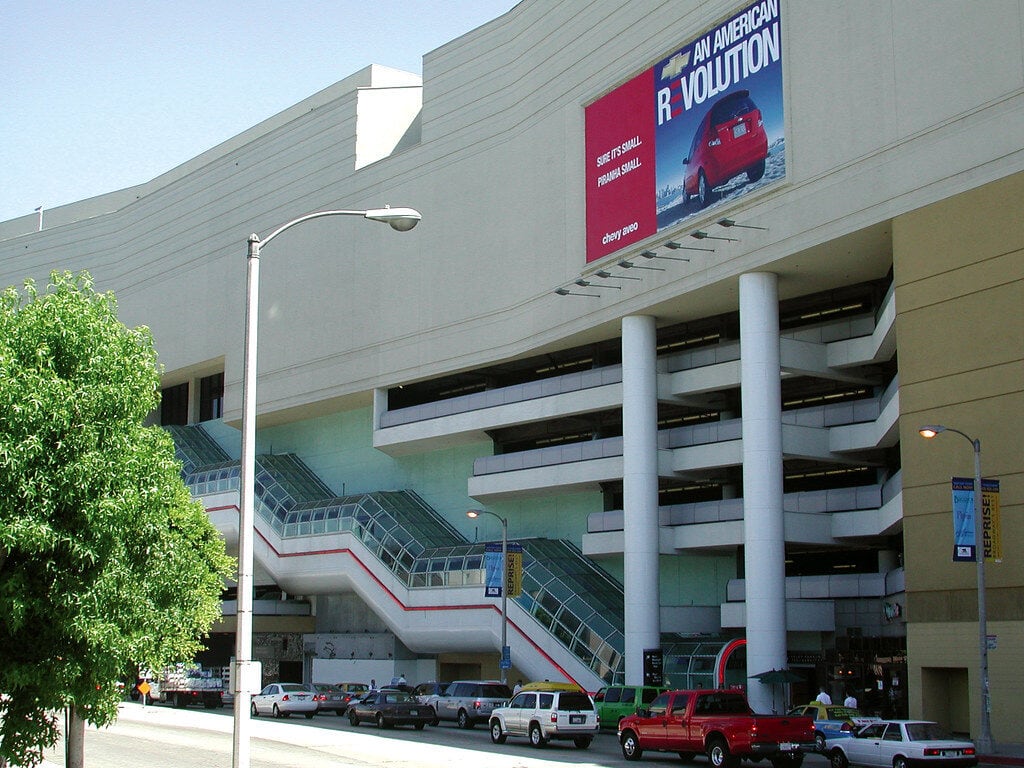
To get shoppers from street level up into the stores, they ran escalators along the outside of the building on the La Cienega side, enclosed in clear tubes and climbing the exterior where everyone could see them.
The footprint bent around what the site allowed.
People later compared the outline to a kidney bean, the result of an odd parcel, angled streets, and oil equipment that had to stay walled off from anyone shopping.
This was a strange thing to attempt in 1982: a tall, enclosed urban mall in a dense part of Los Angeles, parking below and fashion above, on a lot that was still pumping crude.
Two big department stores agreed to anchor it.
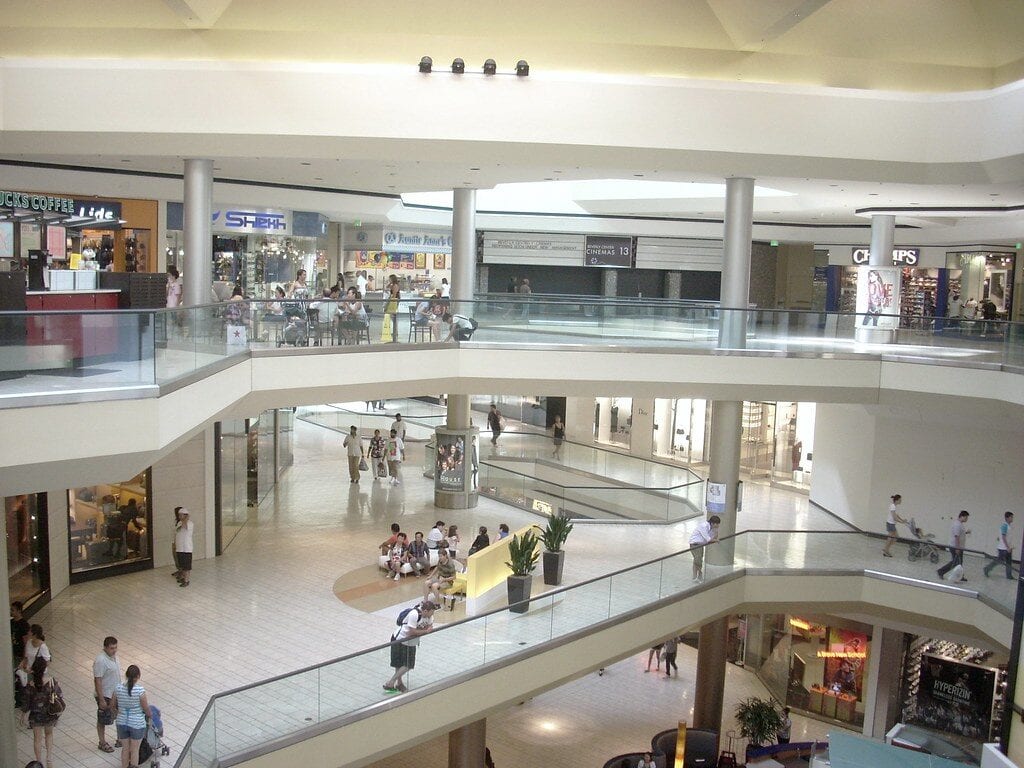
Beverly Center opened in 1982 between Rodeo Drive and Melrose
Beverly Center opened in 1982 as an enclosed regional shopping mall at 8500 Beverly Boulevard in Los Angeles, California, with Bullock's at one end and The Broadway at the other.
Around 165 stores filled the corridors between them across roughly 900,000 square feet.
The two anchors set the tone.
Bullock's carried the upscale Los Angeles name; The Broadway pulled a broader, more middle-market crowd.
The specialty shops in between leaned hard toward fashion and cosmetics.
Location did a lot of the work.
Beverly Hills sat just west with its streetfront luxury, and Melrose Avenue ran north with its boutiques and younger crowd.
Beverly Center landed between those worlds, a fashion mall more upscale than the suburban kind and more everyday than Rodeo Drive.
By 1989, it was selling near the top of Los Angeles County's big-mall rankings.
The crowds came for more than the stores.
The 14-screen cinema and the first U.S. Hard Rock Cafe
Beverly Center was built for evenings as much as afternoons.
The Cineplex Beverly Center 14 opened in July 1982 with 14 screens and fewer than 2,000 seats, one of the most screen-heavy theaters in the country at the time.
It brought in evening and weekend crowds a department store couldn't.
That same year, the first Hard Rock Cafe in the United States opened at the center.
The chain was spreading its branded restaurant-and-music spots across the country in the 1980s, and Beverly Center had the very first American one.
It pulled in tourists, Hollywood regulars, and shoppers already moving through the Beverly Hills-Melrose orbit.
Between the multiplex, the restaurant, and the two anchors, the place worked as an outing as much as a shopping trip.
For a while, the formula held.
How 'the incredible bulk' lost Bullock's and The Broadway
From the street, plenty of people didn't love the building.
Brown, blank, and huge, it turned a near-windowless face to the sidewalk, with 5 floors of parking tucked behind the walls.
Critics called it bulky and maze-like. It picked up a nickname: "the incredible bulk."
Inside, the anchors started changing names.
Bullock's became Macy's in 1996, when the regional department-store names were absorbed into national chains.
The Broadway closed the same year, and Bloomingdale's opened in its space in 1997 after a renovation, which pushed the mall a notch more upscale.
Conran's Habitat, a home-design store tied to British designer Terence Conran, opened in 1989 and closed in 1993.
Its space became Bullock's Men's Store. Design furniture out, menswear in.
The names on the doors held steady. The entertainment that had filled the place on weekends was about to thin out.
Hard Rock, the multiplex, and the food court all closed
The fun pieces came out one at a time.
The Hard Rock Cafe closed on the last day of 2006, after 24 years.
The cinema had a messier exit: it shut, reopened under a new operator, shut again, reopened under another, and finally went dark for good in June 2010.
Crews gutted it, and Forever 21 moved into the old theater space.
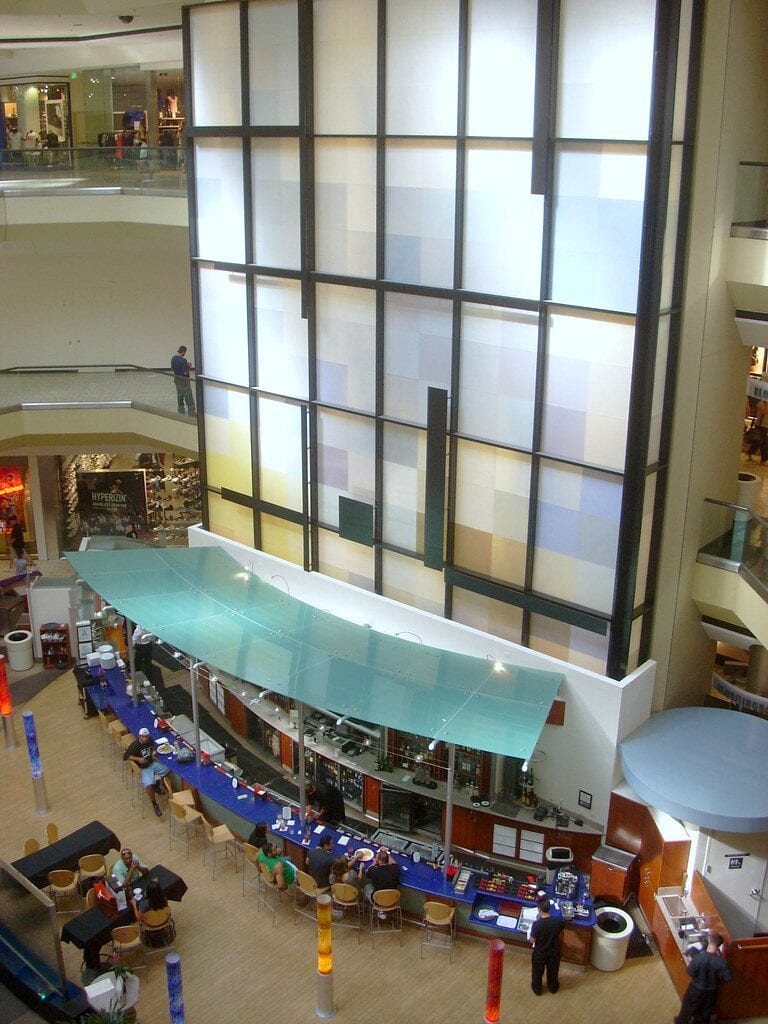
Around 2014, the enclosed food court came out, and part of that space went to a large Uniqlo.
Those moves stripped out the old reasons to stay after shopping.
The theater and food court gave way to a selling floor.
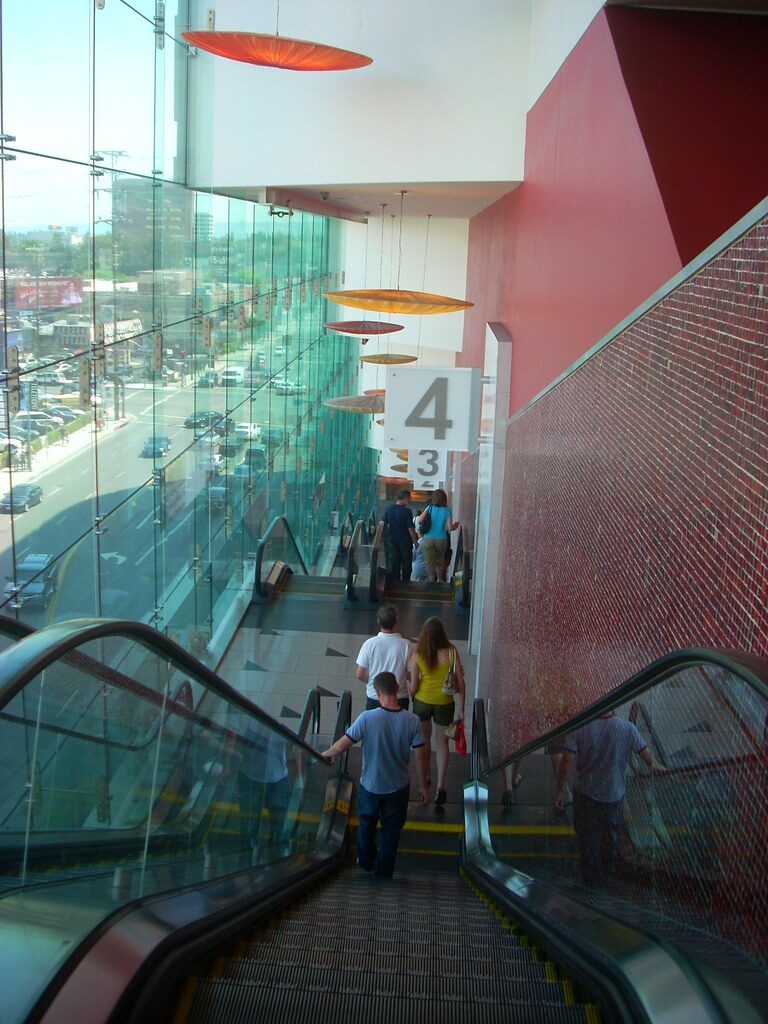
Even so, the building's signature outdoor escalators were rebuilt and modernized in the mid-2000s, the one piece of the original everyone could name.
By the mid-2010s, the building needed more than fresh tenants in tired boxes.
Its owner was about to spend half a billion dollars fixing what people saw from the street.
A $500 million renovation wrapped the bulk in white
The renovation ran from 2016 to 2018 and cost $500 million, with the mall staying open through all 30-some months of it.
The Italian firm Studio Fuksas, run by Massimiliano and Doriana Fuksas, handled the design.
The brown exterior, drawn up in the early 1980s by the Los Angeles firm Welton Becket Associates, got covered in white: textured stucco above, expanded metal mesh below, which made the old bulk read as lighter and newer from the street.
At night, programmable lighting changed how the building looked entirely.
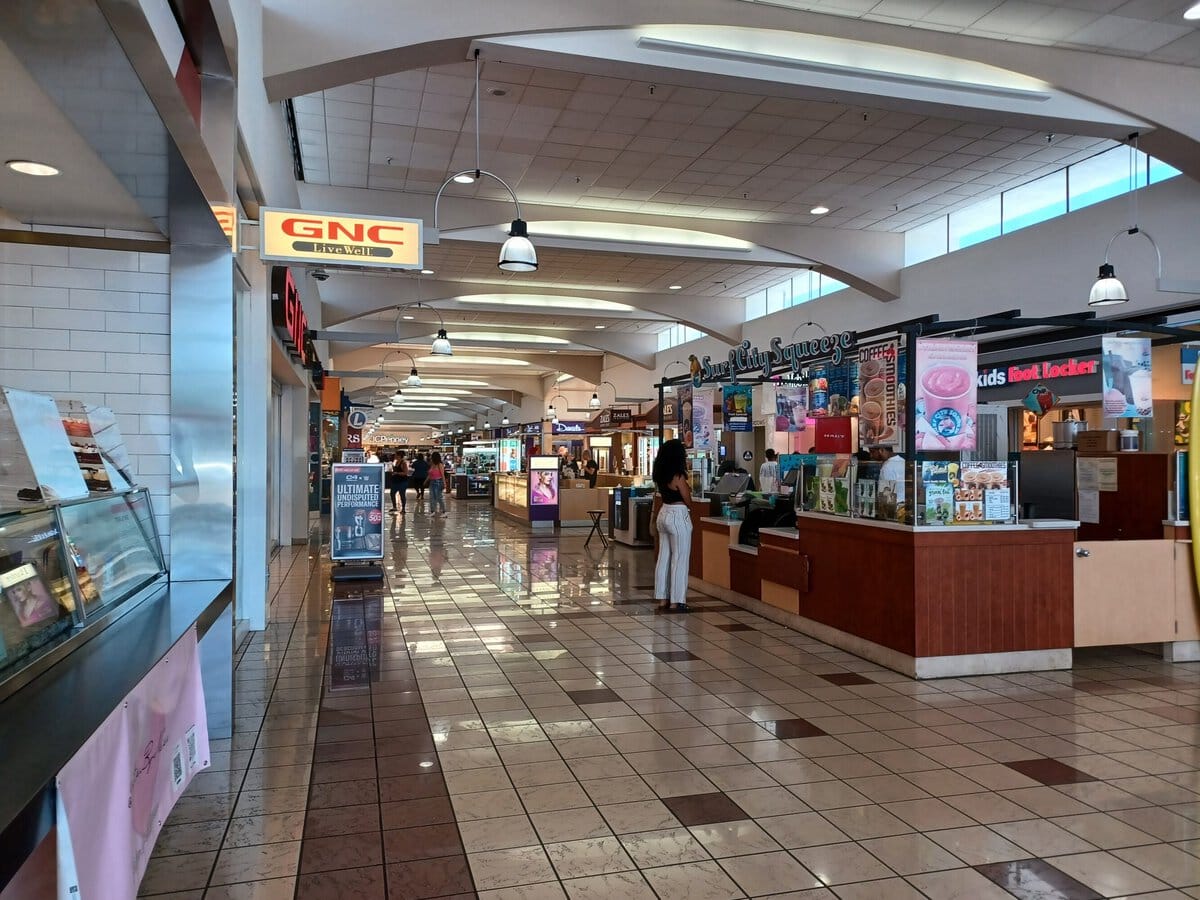
Inside, they cut a big skylight, widened the floor openings, and let daylight into a place that had felt sealed for decades.
The central Grand Court got a large LED screen and a permanent digital artwork by Refik Anadol.
New restaurant spaces opened at street level along 3rd Street and La Cienega, so some dining faced the sidewalk, and pedestrians could reach it from the street.
The tenant list moved upmarket with the building.
Apple moved into a larger store.
The largest Zara in Los Angeles opened, and The Webster, an 11,000-square-foot luxury-fashion shop, was on the way.
The look was settled. Who owned it was not.
From Taubman to Simon, and the stores that kept leaving
Beverly Center started with Sheldon Gordon and E. Phillip Lyon, then brought in A. Alfred Taubman, who became the principal owner and developer.
Taubman ran it for decades and bought out its partners' minority stake in 2004.
Then the bigger landlord arrived.
Simon Property Group agreed to buy Taubman's company, and after a 2020 court fight and a renegotiated price of $43 a share during the pandemic, Simon took control that December.
The mall closed in March, reopened for in-store shopping in late May, closed again when indoor malls were rolled back, and finally reopened in October.
In late 2025, Simon bought the last slice of Taubman it didn't already own.
Beverly Center became one mall inside the country's largest mall company.
Meanwhile, the competition had changed.
Across La Cienega, the Beverly Connection had opened back in 1989 as a plainer power center next door.
Over time, it became the big-box and off-price counterweight to Beverly Center.
Then The Grove arrived with an open-air, walk-the-street layout that drew the crowds Beverly Center used to own.
Westfield Century City rebuilt itself into a luxury rival.
Online shopping cut into routine clothing trips.
And the stores kept turning over: Forever 21, which had taken the old cinema, closed in early 2025.
Who shows up at Beverly Center now, and how they get there
Today Beverly Center is still open, still anchored by Bloomingdale's and Macy's, and still stocked with fashion: Louis Vuitton, Gucci, Prada, Apple, Sephora, Zara.
At the end of 2025, it was 93.8% leased across 842,200 square feet.
Newer names keep arriving too, among them Miniso, Psycho Bunny, and the first U.S. boutique from London's Swaine.
The newer tenants are a different kind.
A Lucky Strike with 22 bowling lanes opened on the ground floor, in the spot where Macy's menswear used to be.
A gym took space on the ground floor too, opening first as Gold's Gym before EoS Fitness took over.
On the 8th floor, a 45-minute Titanic virtual-reality experience opened where shoppers once browsed, though it is temporarily closed now.
The crowd that comes now does more than shop.
Some bowl, some work out, and when the VR attraction is running, some board a sinking ship in VR.
And as of this spring, some arrive by subway: in May 2026, Metro's D Line opened the Wilshire/La Cienega station nearby, with Beverly Center named as a destination it serves.
Trains run underground to the neighborhood now.
The oil under the lot once made underground parking impossible, pushing the whole mall up onto an above-ground garage in the first place.
The subway found a way down anyway.
Independent Publisher Notice
BestAttractions is an independent editorial publisher. We are not affiliated with, endorsed by, or acting on behalf of any location, business, property owner, manager, government agency, or organization described in this article.
Comments posted on this page are not forwarded to, reviewed by, or acted upon by any entity mentioned in the article.
For official inquiries, complaints, applications, bookings, or other requests, please contact the relevant entity directly through its official website or other verified channels.