
Glendale Galleria did the thing enclosed malls were not supposed to be able to do: a competitor opened directly across the street, and the older mall stayed open anyway.
The rival was The Americana at Brand, an open-air center with apartments and a lawn that arrived in 2008 on the other side of Central Avenue.
It eventually took Nordstrom, the anchor that had defined the Galleria's 1983 wing for nearly three decades. The Galleria's owner had fought the project in court before it was built and then watched a marquee tenant walk across the street to it.
Survival here was not stubbornness. It cost a covered-over interior, replaced anchors, and a rebuilt entrance pointed straight at the place that beat it for Nordstrom.
Glendale Galleria: The Mall Where Panda Express and Apple Began
The first dishes sold under the Panda Express name came from a counter inside Glendale Galleria in 1983, where the founders of the Panda Inn restaurant built a fast-casual version of their sit-down menu that grew into one of the largest American Chinese chains.
Four years later, the first Disney Store opened in the same mall, a short distance from the company's Burbank studios, and became the template Disney repeated nationwide.
On May 19, 2001, Apple opened its first two retail stores on a single day. One stood at Tysons Corner Center in Virginia. The other stood on West Broadway in Glendale.
For a regional shopping center, that is a dense run of national debuts, and it marked the Galleria as a place where retailers tried ideas before taking them anywhere else.
How Glendale Galleria Was Built Into Downtown, Not a Freeway
Glendale built the mall on purpose and built it downtown.
The city's Redevelopment Agency was created in 1972 to reverse deterioration and disuse in the central business district, and the Galleria project area was drawn that same year.
In March 1973, the agency approved a $75 million regional shopping center; preliminary drawings appeared in July, and the agency spent 1973 and 1974 acquiring land.
The decision that shaped everything afterward was inserting the mall into the existing street grid near Brand Boulevard, Broadway, Central Avenue, and Colorado Street, rather than dropping it on open ground beside a freeway like most malls of the era.
Parking came first in the literal sense: a groundbreaking for a 4,000-space structure was held in October 1974, two years before the shops opened.
The architect was Jon Jerde, who later designed Horton Plaza, CityWalk, and Westside Pavilion, and who treated the mall as a central gathering place for the city.
Later accounts linked that thinking to Ray Bradbury's idea of rebuilding Los Angeles around places where people came together.
Glendale Galleria's 1976 Opening and Its Four Anchors
The mall opened in stages through 1976. Buffums and The Broadway opened in August, the enclosed shops and Ohrbach's followed in October, and JCPenney opened in November.
The official opening date is October 14, 1976.
The four anchors read like a directory of mid-1970s Southern California retail: Buffums, an upscale chain out of Long Beach; The Broadway, the large Los Angeles department-store name whose parent helped develop the project; Ohrbach's, another department-store nameplate; and JCPenney, the national middle-market anchor.
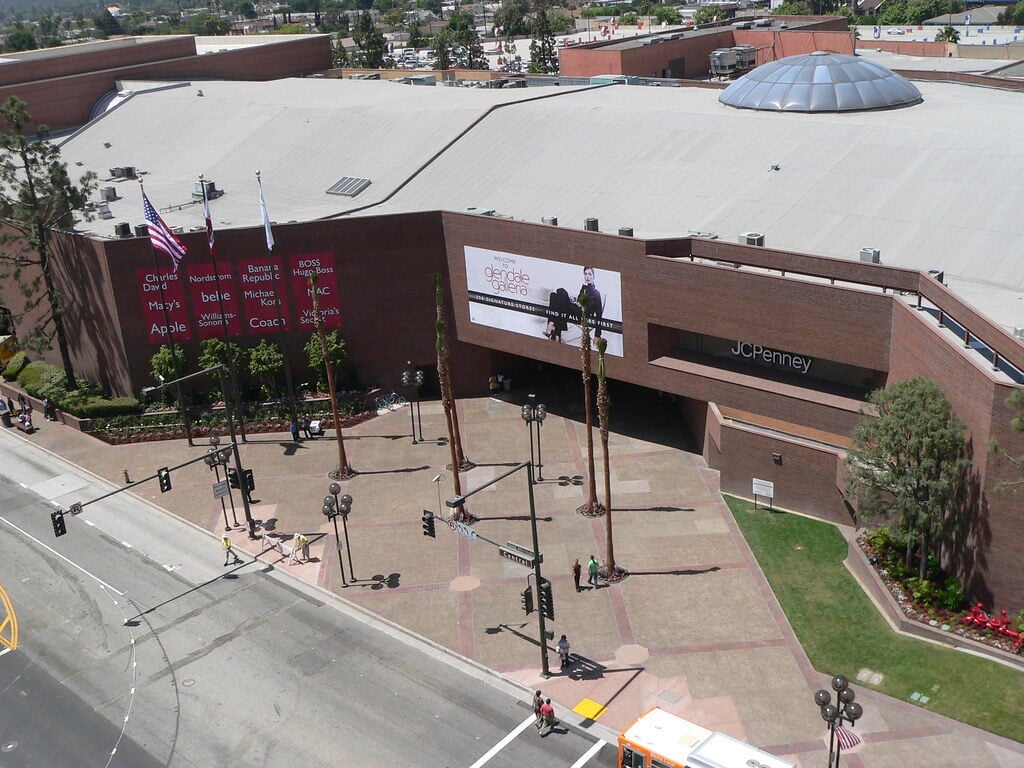
From the street, the building was solid brick with little glass, an enclosed and inward-facing design that pulled shoppers across three levels of courts and escalators instead of showing them anything from outside.
That was the point. A 1970s regional mall sold the interior, the parking, and the anchors, not the view from the sidewalk.
Galleria II and the 1983 Wing That Brought Nordstrom
Nordstrom arrived in September 1983, when a new wing called Galleria II opened on the eastern side of the complex and added Mervyn's alongside it.
The expansion moved the Galleria up a tier.
Nordstrom gave it a stronger department-store draw than its original mix, and the larger floor plan let it compete with malls across the San Fernando Valley and the Pasadena area.
The City Council had endorsed adding two department stores in June 1982.
This was also the wing and the year that opened the first Panda Express counter, and the period when the Galleria became a destination for teenagers and weekend crowds as much as for department-store shoppers walking between anchors.
The $415 Million Sale and the Bankruptcy That Followed
A bigger expansion was announced and never built.
In July 1988, a co-owner proposed enlarging the mall from 1.38 million square feet to 2.28 million, a plan that would have made an already super-regional center even larger.
The city and the owner talked it over for most of a decade. In 1999, they dropped it.
Ownership itself changed hands repeatedly, passing through Donahue Schriber, Cigna Corp., and a New York pension interest, until the mall went up for sale in 2002.
General Growth Properties completed a $415 million purchase that December through an even split with the New York State Common Retirement Fund.
At the time, the center held roughly 250 stores across 1.5 million square feet and sold $525 per square foot a year, 60 percent above the industry average, which is why it commanded the price it did.
General Growth's tenure brought trouble. The company, by then GGP, filed for Chapter 11 protection in 2009 in one of the largest real estate bankruptcies in the country's history, and emerged in November 2010.
By the time it emerged, the building looked its age, and the Mervyn's box had sat empty for years.
The Americana Rivalry and the Cheesecake Factory Verdict
The competition arrived across the street.
The Americana at Brand was approved by the City Council in 2004 and narrowly approved by voters in a referendum the same year, over the opposition of the Galleria's owner, which fought the project through environmental-review litigation.
Appellate rulings cleared the way in late 2005, and the open-air center opened in 2008 directly across Central Avenue, with apartments, a central lawn, restaurants, and entertainment the enclosed Galleria could not match.
The fight turned costly.
A jury found in 2007 that the Galleria's owner had tried to interfere with The Cheesecake Factory's lease at the rival project, awarding $74 million plus $15 million in punitive damages, a total near $89 million.
In 2009, General Growth settled with the competing developer's company for $48 million and ended the appeal.
Then came the loss that stung most: Nordstrom, the anchor that had defined the 1983 wing for nearly three decades, announced in 2011 that it would move across Central Avenue to The Americana.
The 2012-2013 Renovation That Covered the Brick
Even aging and carrying an empty Mervyn's box, the mall drew more than 26 million visitors a year by 2011, with about $500 million in sales and $660 per square foot, which is why it was worth saving.
The answer to the open-air rival next door was not to tear the roof off.
The 2012-2013 renovation, budgeted at $57.5 million for common areas and part of more than $100 million in spending overall, kept the enclosed mall and changed almost everything a visitor could see.
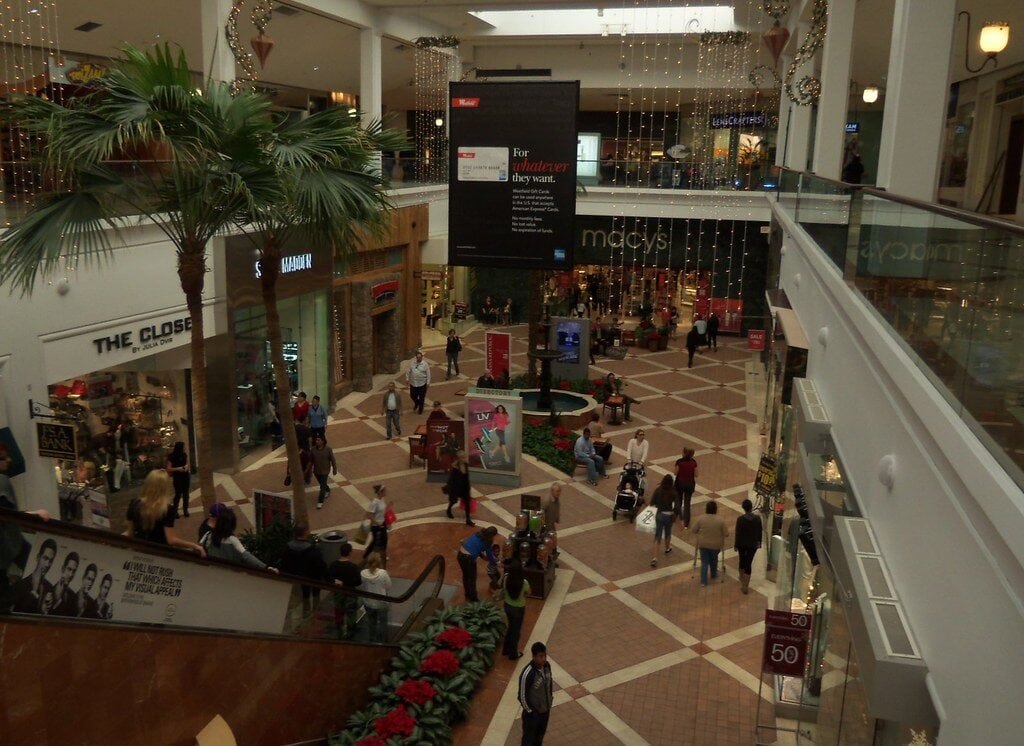
The dark brick that had defined the interior since 1976 was covered or removed. New flooring, lighting, glass handrails, escalators, and a new elevator near the JCPenney court replaced the older finishes.
The Central Avenue entrance facing The Americana was rebuilt with outdoor dining, a black-and-white facade of glass and stone, and a new "G" mark, turning the side that once stared at brick toward its competitor.
The food court and restrooms were remodeled. The bigger move was filling old department-store boxes with new uses.
| Anchor | What replaced it |
|---|---|
| The Broadway (1976) | Converted to Macy's in 1996 |
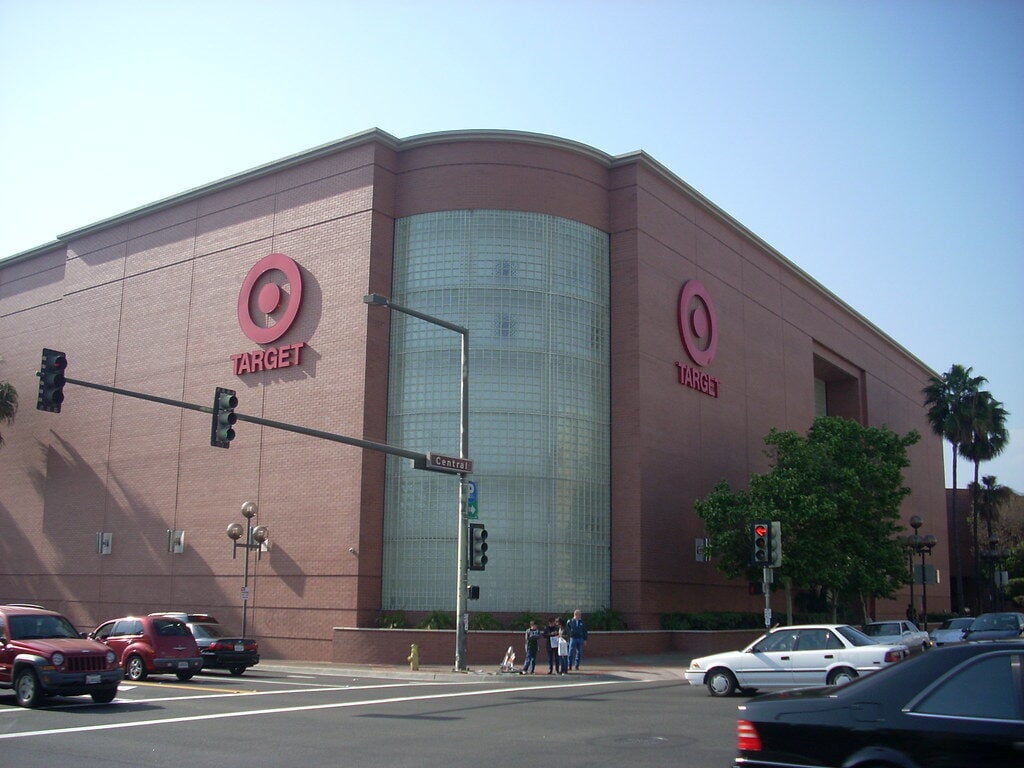
| Buffums (1976) | Robinsons-May in 1993, then Target in 2007 |
| Mervyn's (1983) | Bloomingdale's opened on November 8, 2013 |
| Nordstrom (1983) | Dick's Sporting Goods in 2015, and later EōS Fitness |
| Ohrbach's (1976) | Closed as the mall evolved |
Target opened in July 2007 in the former Robinsons-May space at the southwest corner, occupying 180,000 square feet across the chain's first three-floor store.
Bloomingdale's took the long-empty Mervyn's box near Brand Boulevard and Broadway, opening on November 8, 2013, after roughly 60,000 square feet of Galleria II was cleared and tenants like Daniel's Jewelers and Skechers were relocated.
Dick's Sporting Goods opened in part of the former Nordstrom space on October 30, 2015, and a gym filled another part, now run by EōS Fitness.
Pandemic Closures and the JCPenney Sale That Collapsed
The mall closed in March 2020 during the first pandemic shutdown, reopened in late May when Los Angeles County allowed indoor retail again, and shut its indoor operations a second time in July 2020 during the summer case surge, when it moved dining out into the parking areas.
The strangest recent chapter belongs to JCPenney, one of the few anchors still operating in its original 1976 footprint.
In July 2025, a trust holding JCPenney real estate signed a binding agreement to sell a 119-property portfolio, including the Glendale store at 1169 Glendale Galleria, to an affiliate of Onyx Partners for $947 million in cash.
The sale fell apart.
The buyer failed to close by the December 26, 2025, deadline, the trust kept $2 million of the $5 million deposit and pursued the other $3 million, the buyer sued, and as of March 2026, the matter remained unresolved, with the trust's dissolution pushed to April 30, 2026.
Tenants kept shifting around it: Anthropologie crossed over from The Americana, FP Movement opened, and Urban Outfitters launched a new store format here in October 2025.
What's Gone From Glendale Galleria, and Why It's Still Open
What is gone is easy to list: Buffums, Ohrbach's, The Broadway, Mervyn's, and Nordstrom, the last now sitting in plain sight across Central Avenue at the rival the Galleria's owner had fought in court.
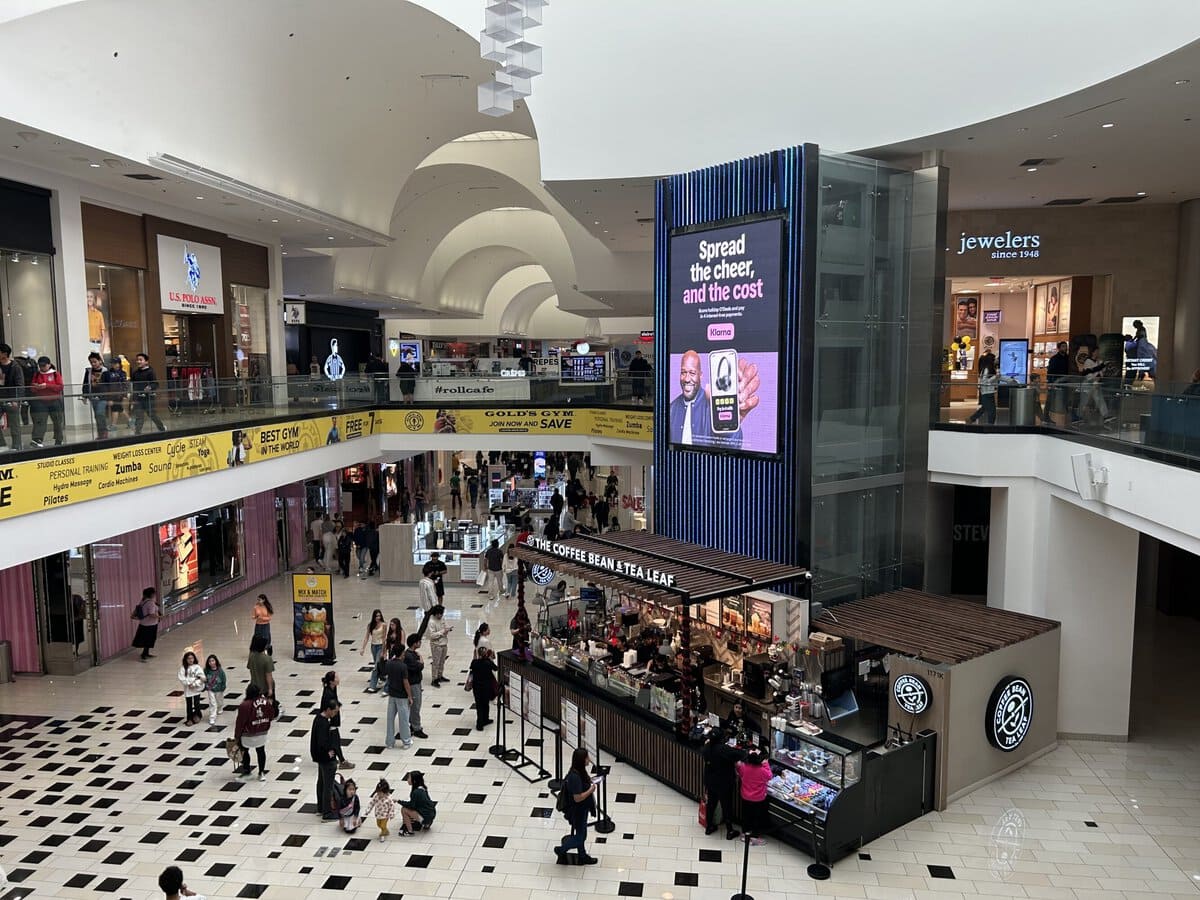
What remains is the enclosed three-level mall itself, more than 1.3 million square feet at 100 W. Broadway, still anchored by Macy's, JCPenney, Target, Bloomingdale's, and Dick's Sporting Goods, with free customer parking in two garages and Class A offices attached.
The redevelopment pressure in downtown is real, but it points to the nearby former Sears site, not the Galleria.
In January 2026, Brookfield revived the old GGP name, so the mall that opened as a redevelopment project now operates under GGP Retail branding again.
There is no movie theater inside.
People still come for what they came for in 1976: the anchors, the free parking, and a climate-controlled interior to walk through, now with the orange chicken counter that started one chain and the Apple Store that helped start another.
Independent Publisher Notice
BestAttractions is an independent editorial publisher. We are not affiliated with, endorsed by, or acting on behalf of any location, business, property owner, manager, government agency, or organization described in this article. Comments posted on this page are not forwarded to, reviewed by, or acted upon by any entity mentioned in the article. For official inquiries, complaints, applications, bookings, or other requests, please contact the relevant entity directly through its official website or other verified channels.