
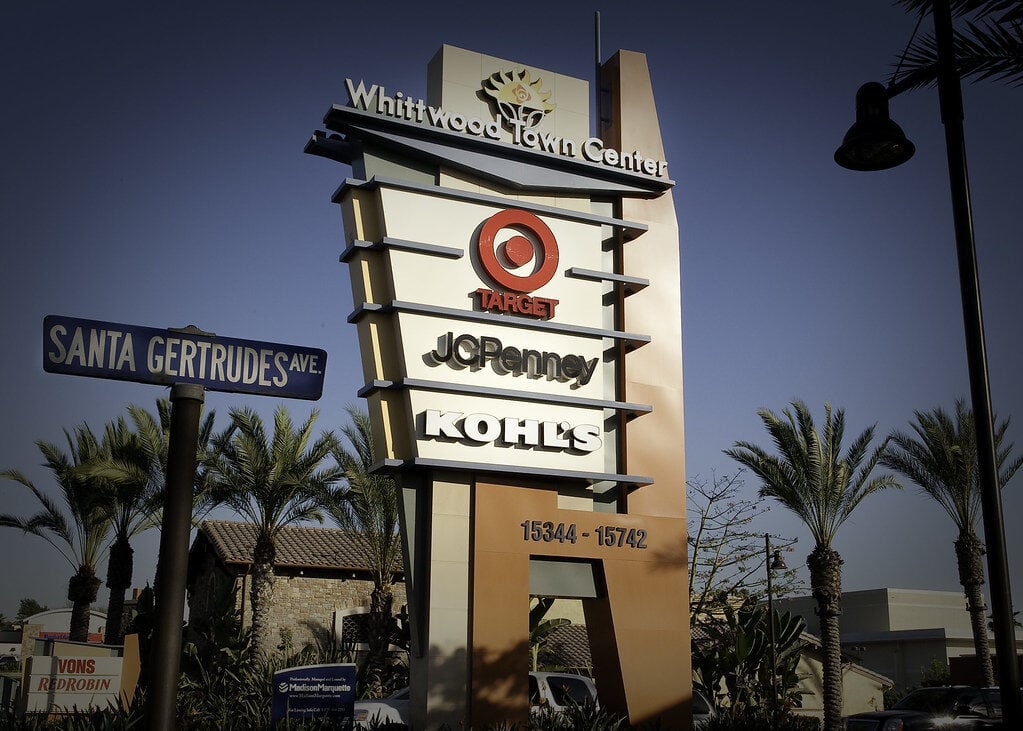
JCPenney opened at Whittwood Center on January 21, 1960, at the corner of Whittier Boulevard and Santa Gertrudes Avenue in eastern Whittier, California. It is still there.
In the intervening over 65 years, the property around it was expanded, enclosed, demolished, and rebuilt from scratch. JCPenney stayed on the site.
Whittwood Town Center now covers 66.4 acres and has changed its physical form three times while keeping its name and its corner.
Every other anchor from JCPenney's early years is gone. The Broadway lasted 35 years. Boston Stores closed the same month The Broadway did. Mervyn's outlasted both and still closed. The enclosed mall that they once anchored no longer exists.
What that kind of continuity has meant for Whittwood, and whether JCPenney can survive what the property's owners are now proposing, is the question Whittwood has not yet answered.
From Empty Fields to Whittwood Town Center's First Stores
On February 1, 1956, ground broke on a large tract of East Whittier land at Whittier Boulevard and Santa Gertrudes Avenue.
The area was unincorporated Los Angeles County at the time, shifting from orchards and low-density land into a postwar suburb filling fast with families.
By October 4 of that year, a 39,000-square-foot Vons opened, and shoppers from the surrounding neighborhoods had somewhere new to go.
Security First National Bank followed two weeks later. By November, Sav-On Drug, Gallenkamp Shoes, Gullotti Ross Optometrist, and a handful of apparel shops had joined them.
The man behind the project was developer John Lusk, based in Irvine, with mid-century retail architects Herman C. Light and Pasadena firm Ainsworth and McCleman shaping the buildings.
The layout was built entirely around the car: wide parking fields, storefronts facing outward, and no roof over the pedestrian areas.
Nobody called it a mall. It was Whittwood Center, and it was designed for a neighborhood that did not yet fully exist.
By 1958, it had 44 operating stores, including a two-level W.T. Grant of about 28,000 square feet, a Jolly Roger Restaurant, Sherwin-Williams, Graue's Bakery, and enough shops to fill a morning errand list without leaving the property.
The complex covered around 325,000 leasable square feet with parking for roughly 5,000 cars.
The Broadway and JCPenney Anchor the New Regional Draw
On January 21, 1960, a one-level JCPenney of about 43,500 square feet opened at Whittwood, giving the center its first true department-store anchor.
Construction on The Broadway began the following month. The Broadway branch, designed by Charles Luckman and Associates, was three stories and about 134,000 square feet. It opened in February 1961.
With The Broadway in place, Whittwood competed for the same customers as older downtown retail districts in Whittier and Montebello.
The same year it opened, the City of Whittier annexed the East Whittier area, adding more than 28,000 residents and placing Whittwood inside city limits for the first time.
Entertainment arrived on July 14, 1964, when Bruen's Whittier Whittwood Theatre opened as a single-screen movie house in the west parking area.
The theater gave the property an evening and weekend draw beyond grocery and department-store trips. It ran for roughly two decades before closing in January 1987.
Whittwood's Major Expansion and the Push Toward Enclosure
In December 1970, an expansion was announced that would add more than 300,000 square feet of retail space and fundamentally rework the original layout.
Vons moved out of its original supermarket building in June 1971 and relocated to a new freestanding building of about 31,000 square feet.
The original Vons structure was demolished to make room for a much larger JCPenney.
The replacement JCPenney opened on April 25, 1973, at about 182,800 square feet on two levels, more than four times the size of the 1960 store it replaced.
JCPenney's brand presence at Whittwood was uninterrupted, but the building that would carry it through every later phase of the property is the 1973 store, not the original.
The 1960 JCPenney space was then taken over by Myers, which opened on May 2, 1974, and was rebranded as Boston Stores by early 1976.
Whittwood now had three department-store anchors: JCPenney, The Broadway, and Boston Stores.
In March 1978, a second round of changes began.
Pasadena architecture firm McClellan, Cruz, Gaylord and Associates oversaw an enclosure and expansion project that added about 160,000 square feet of retail, reconfigured the cinema component, and brought in 18 new stores.
The enclosed Whittwood Mall was dedicated on November 17, 1979. On November 2, 1981, a two-level Mervyn's of about 87,000 square feet opened.
Twelve days later, a 14-bay food court called the Food Park opened in the east wing.
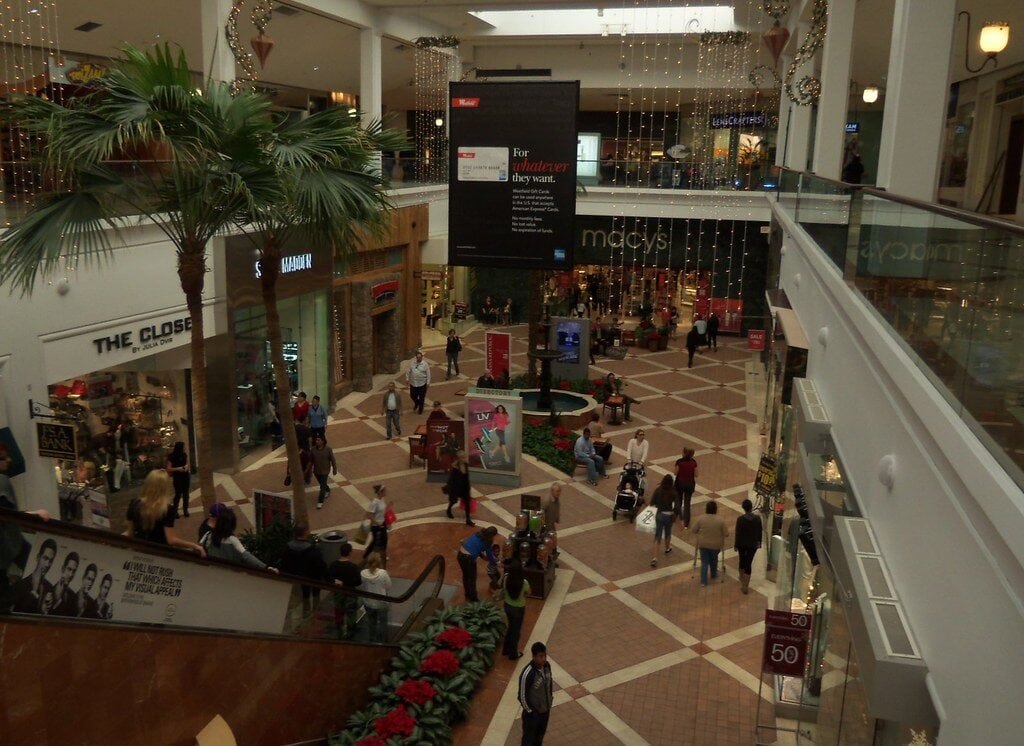
Whittwood now had four department-store anchors, interior corridors, and a food court.
A Mall in Crisis: The Double Anchor Closure of 1996
February 1996 was the month Whittwood's enclosed-mall identity collapsed. Boston Stores closed. The Broadway closed. Both in the same month, in the same mall. The Broadway had operated at Whittwood for 35 years.
Its parent company, The Broadway chain, had been absorbed into Federated Department Stores' portfolio, and the Whittwood branch did not survive the consolidation.
The losses were not isolated. Whittwood faced competition from Puente Hills Mall, Brea Mall, Whittier Quad, Whittier Downs, and La Mirada Center.
Newer shopping centers had been built with formats that smaller enclosed malls could not match.
The 1987 closure of the original Whittwood Theatre had already removed the property's evening entertainment draw, and although Krikorian Whittwood Cinema 10 had opened on November 23, 1990, it too would close in 2001.
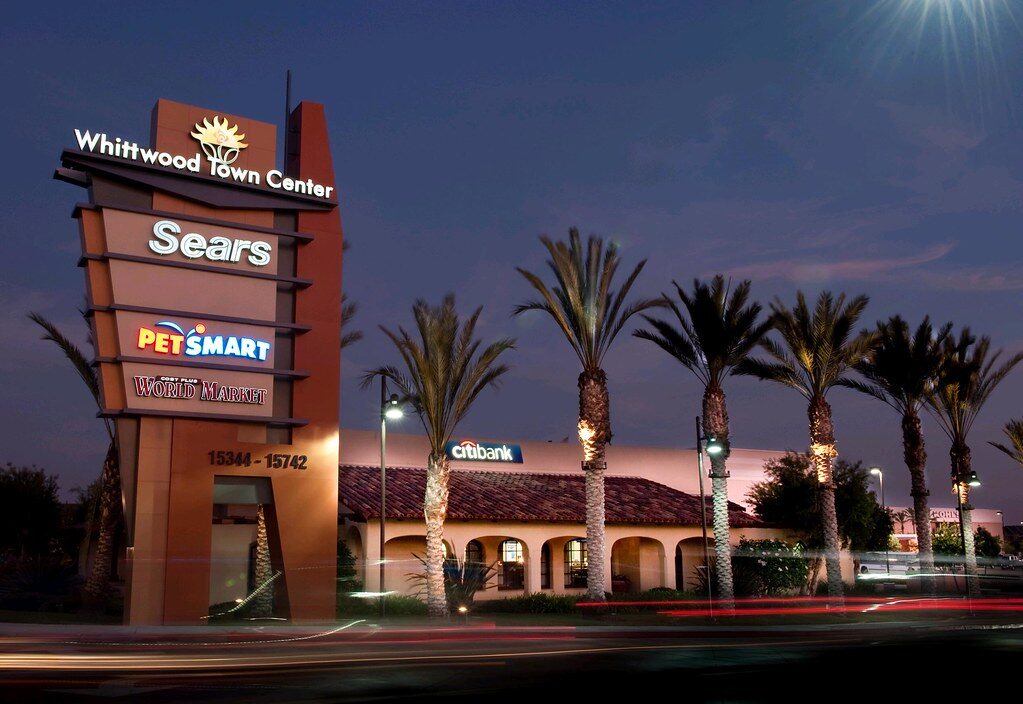
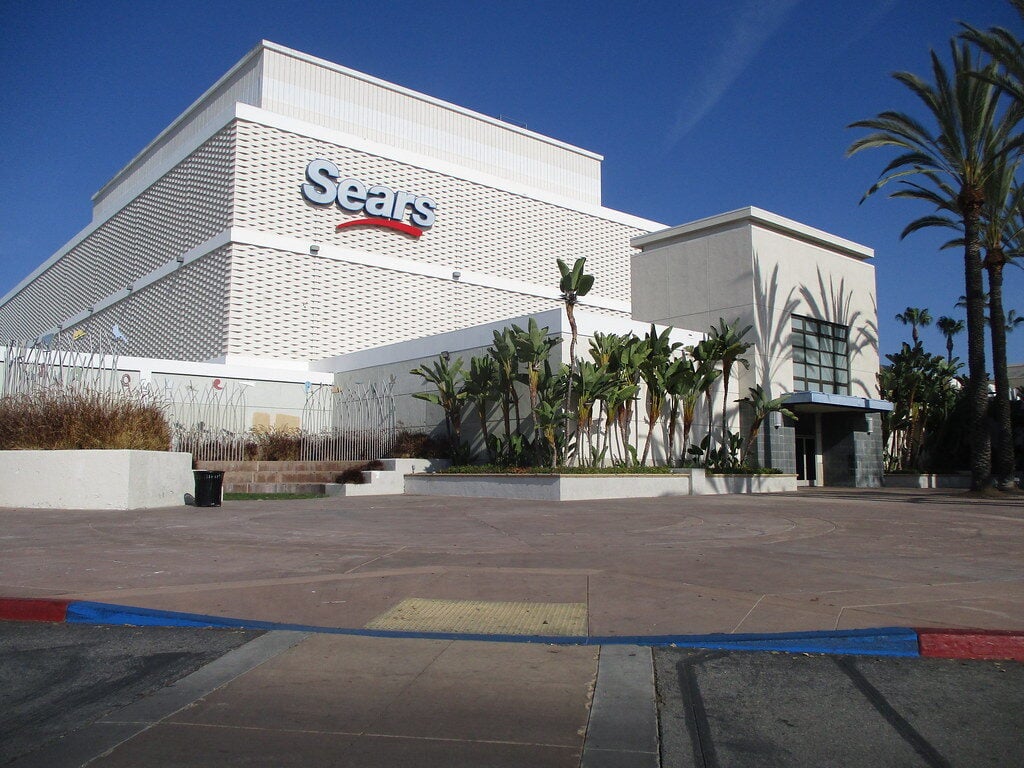
Sears took over the former Broadway building and opened on November 2, 1996, giving the west anchor position a new occupant.
But the loss of two department stores in the same period left large interior sections of the mall underused, and no single tenant replaced the foot traffic both had generated.
By the early 2000s, Whittwood was a candidate for demolition rather than renovation.
The enclosed-mall format that the 1979 dedication celebrated had lasted barely two decades before the commercial logic that created it reversed.
Tearing It Down: The 2000s Redevelopment into an Open-Air Center
In April 2002, LNR Property Corporation and Hopkins Real Estate Group acquired the property and moved toward a complete redevelopment.
The City of Whittier adopted the Whittwood Town Center Specific Plan on September 30, 2003, allowing up to 900,000 square feet of commercial retail and up to 150 residential units.
By July 2004, most of the enclosed mall had been demolished. Sears, Mervyn's, JCPenney, and the Vons strip-center area were kept standing.
A northeast block of stores survived briefly until the Sav-On/CVS relocated to a new outparcel, then came down as well.
Target opened on October 9, 2005, in a one-level store of about 142,000 square feet. PetSmart, Old Navy, and restaurant pads followed as the new open-air layout took shape.
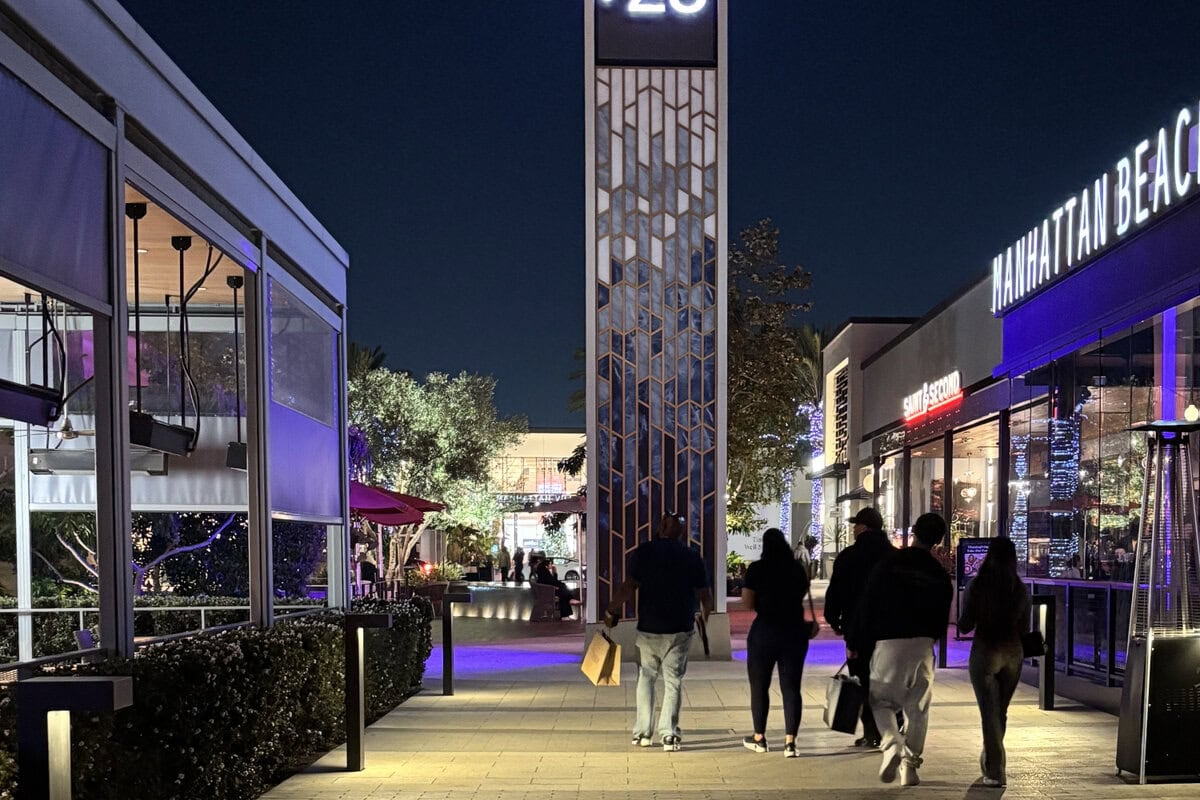
Plazas, walking paths, and landscaped common areas replaced the interior corridors and food court.
The project added about 40,000 square feet of new gross leasable area and produced an open-air retail environment of roughly 785,700 square feet.
Housing arrived with it. The southwest part of the site became 114 single-family, semi-detached residential condominium units on about 6.1 acres.
An earlier plan had allowed up to 150 units, but easement constraints reduced the final count. The redeveloped property was sold to Morgan Stanley in 2007.
Ownership Changes and the Sears Closure
Mervyn's closed at Whittwood in December 2008, after surviving the de-malling of the property. Kohl's opened in the former Mervyn's space on September 30, 2009.
In October 2014, a joint venture involving DDR Corp. (formerly Developers Diversified Realty) and a Blackstone Realty Partners affiliate acquired the center.
Three years later, in November 2017, Kimco Realty Corporation bought Whittwood Town Center for $123 million, roughly $159 per square foot.
Sears, which had occupied the former Broadway building since November 1996, continued operating through the ownership transitions, the demolition of the enclosed mall around it, and the complete transformation of the property into an open-air center.
Going-out-of-business signs appeared at the Sears location in July 2025. The store, operated by Transformco, was closed by the end of that month.
The former Sears building is now the most prominent vacant structure on the property.
On July 8, 2025, the Whittier City Council approved a $335,000 reimbursement agreement with the property owner covering public infrastructure improvements, including sidewalks, drainage, and traffic signals.
What Whittwood Town Center Looks Like Now
The current center covers about 66.4 acres and 783,200 square feet of open-air retail. Anchors and major tenants include Target, Kohl's, JCPenney, Vons, PetSmart, Old Navy, CVS Pharmacy, and 24 Hour Fitness.
The tenant mix runs from Chick-fil-A, Chipotle, Panera Bread, and Red Robin to Massage Envy, Club Pilates, Western Dental, and Miracle Ear.
The property recorded 6.6 million visits in 2025. Within a 3-mile radius, the surrounding population is about 173,800 people with an average household income of roughly $142,500.
The property also includes a bus transit hub and internal drives that connect the retail areas. KRC Property Management I, Inc., a Kimco subsidiary, handles leasing and property management.
JCPenney has been present through every phase of the property's history: the 1960 opening, the 1973 expansion into a far larger building, the enclosed-mall years, the 2000s demolition, and the open-air rebuild.
Vons is the only tenant with a longer claim on the site, present since the original 1956 opening, though it moved into a later freestanding building.
A 30-Year Redevelopment Framework for Whittwood's Future
A 2022 proposed change to the Whittwood Town Center plan would lower the maximum commercial space from 900,000 to 600,000 square feet and increase the maximum number of homes from 150 to 1,350.
The proposed 600,000-square-foot commercial program includes about 379,000 square feet of retail, 47,000 square feet of cinema space, 30,000 square feet each of grocery and fitness, and 114,000 square feet of restaurant and food uses.
Up to 300 hotel rooms are included in the framework.
The environmental review process began on November 9, 2022. A public scoping meeting was held on November 30, 2022.
The review covers aesthetics, air quality, cultural and tribal resources, transportation, noise, greenhouse gas emissions, and more than a dozen other issue areas.
The project sponsor is Whittwood 1768, Inc., affiliated with Kimco Realty.
The Sears, JCPenney, and Kohl's boxes are identified as possible future transition areas if those large-format tenants cease to operate productively.
The Sears closure in 2025 made that decision urgent for one of the three.
The complete phased development is expected to happen over about 30 years, with demolition, new infrastructure, and new buildings scheduled based on real market needs.
JCPenney, Kohl's, and Target are now among the big operating stores whose ongoing presence will shape how the next phases of Whittwood's redevelopment move forward.
Independent Publisher Notice
BestAttractions is an independent editorial publisher. We are not affiliated with, endorsed by, or acting on behalf of any location, business, property owner, manager, government agency, or organization described in this article.
Comments posted on this page are not forwarded to, reviewed by, or acted upon by any entity mentioned in the article.
For official inquiries, complaints, applications, bookings, or other requests, please contact the relevant entity directly through its official website or other verified channels.