
Victoria Gardens is an open-air town center in Rancho Cucamonga, California, built on 174 acres of former vineyard land in the western Inland Empire region of San Bernardino County.
The center is located at 12505 North Mainstreet, near the I-15 and I-210 highways that pass through San Bernardino County toward Los Angeles.
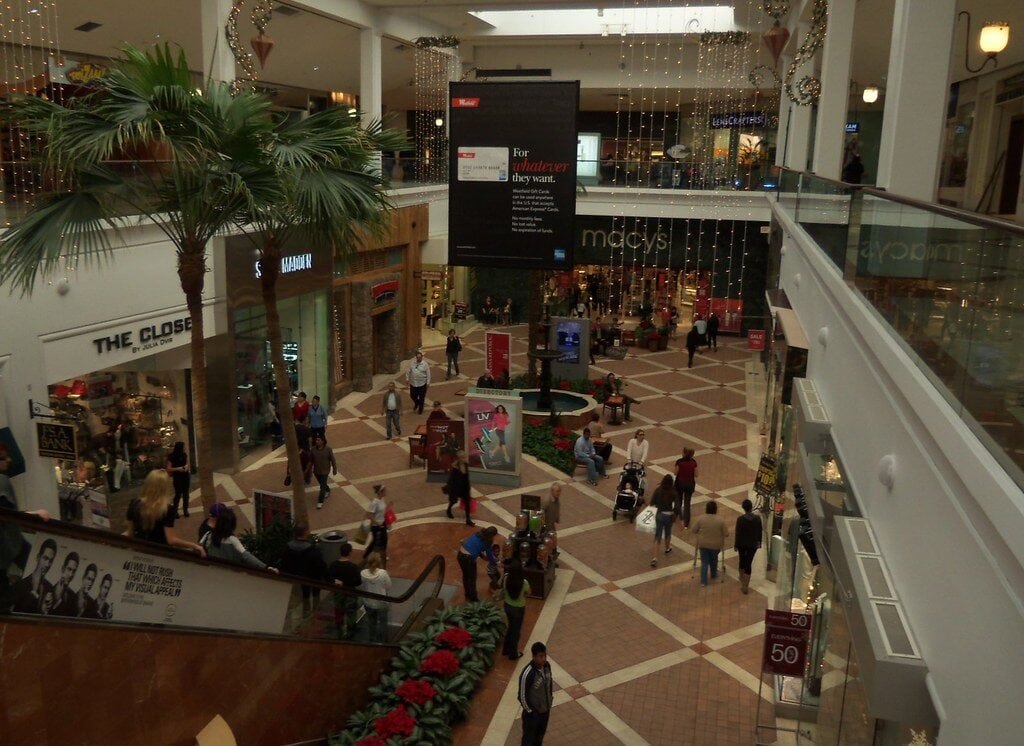
It serves Rancho Cucamonga and the surrounding Inland Empire communities with retail, dining, and cultural uses - anchored by Macy's, AMC Theatres, Apple, Nike, and the on-site Victoria Gardens Cultural Center.
Victoria Gardens opened in October 2004. The property was sold in March 2026 for $530 million and brings in over $1,100 per square foot in yearly retail sales.
Victoria Gardens and the Street That Was Never There
The main street at Victoria Gardens was invented. There was no settlement here, no historic commercial row, no old town to restore.
Just 174 acres of land in the eastern end of Rancho Cucamonga - much of it vineyard for generations - and a city that needed a downtown it had never actually had.
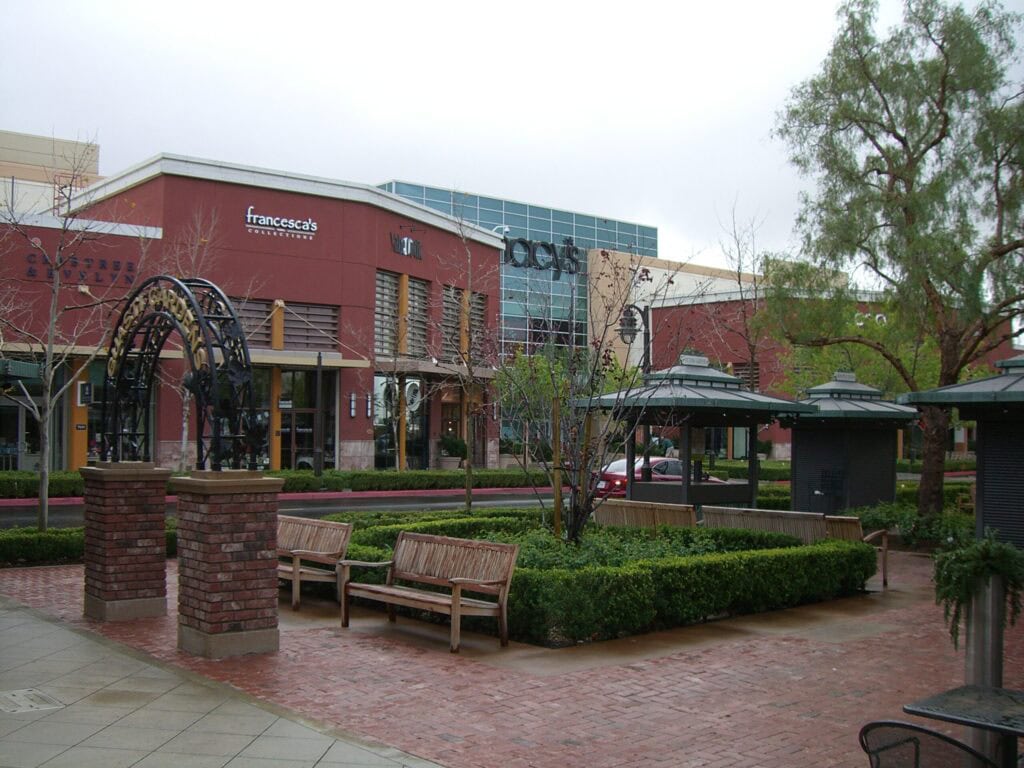
Walking through it now, you pass the Apple store, the Cheesecake Factory, and a shaded plaza where parents sit while children run around.
At first glance, it feels natural rather than designed. The streets are not all the same width. The paving changes every few blocks.
The buildings look like they were added over many years, with different styles replacing each other over time. In fact, this effect is intentional.
The master plan relied on an "imagined urban history," shaping the architecture to make it seem as if a farm road slowly turned into a town center, then a retail street, and finally a cluster of anchor stores, over a century that never really happened.
Rancho Cucamonga was incorporated in 1977. From its first years, city leaders wanted a focal point - something that could serve as a civic and commercial center for a place built as sprawl.
The eastern portion of the city had the land. A local farmer had been running a vineyard there.
For more than two decades, the city tried to put something on that ground and kept failing. The street at Victoria Gardens is the third attempt at the idea.
The first fell apart before a single foundation was poured, and the second evolved into the project that was eventually built.
The Mall That Never Got Built in Rancho Cucamonga
In 1983, the city signed an agreement with the Hahn Company to build an enclosed regional mall on the site.
By that point, enclosed malls were the standard answer to the question of how to anchor a suburban city - Montclair Plaza was already drawing shoppers from the region, and Ontario Mills would not open until 1996.
The Hahn plan kept moving forward for years in practical ways, though it took ten years to officially end.
Local infrastructure costs were higher than the project could handle. Changes in retail were affecting which tenants could agree to new stores.
Then the early-1990s recession came and wiped out any remaining progress. By 1997, the land was back with the city. In early 1999, the city started over.
It reissued a request for qualifications - still framed around a two-story enclosed regional mall - and interviewed seven developers, including Forest City, Westfield, the Jacobs Group, and the Lewis Group.
Forest City folded into the Lewis proposal during the process. In September 1999, the city selected the Forest City-Lewis partnership.
Almost immediately, the concept changed. Forest City concluded that another enclosed mall would be too close in format to Montclair Plaza and Ontario Mills to compete effectively.
The proposal shifted to an open-air, pedestrian-oriented mixed-use center with civic uses built into the plan.
The city that had spent sixteen years trying to build a mall was now planning something it had never had before.
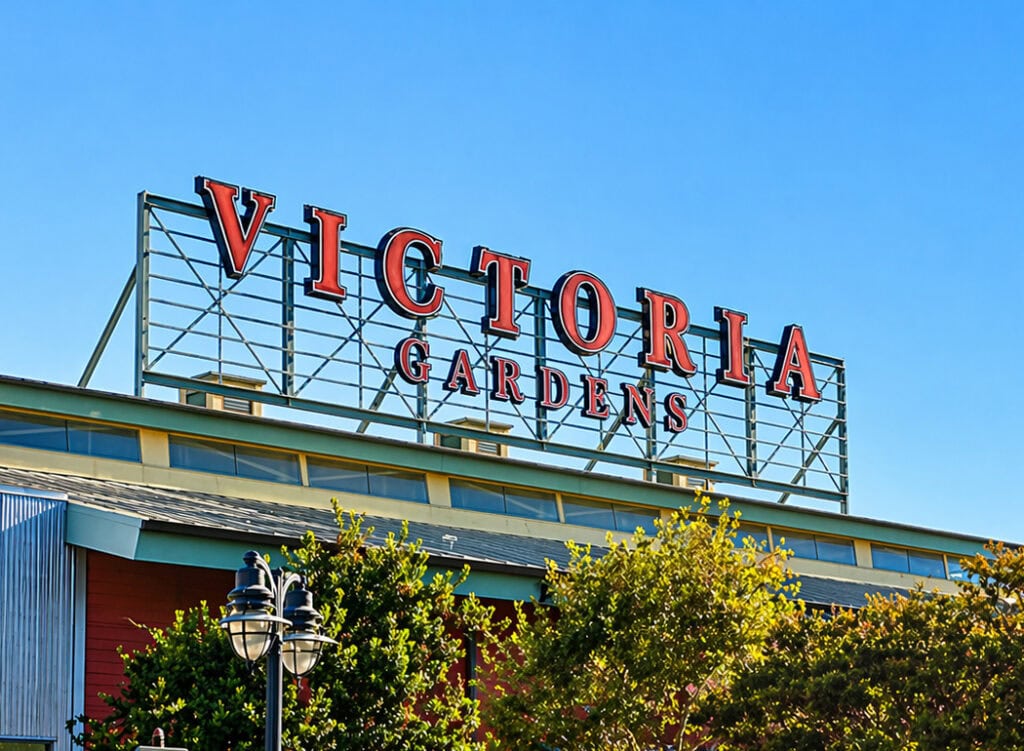
The Scale of the Victoria Gardens Plan
The site assembled for the project covered 174 acres: 147 controlled by the redevelopment agency, 18 of undeveloped land, and 9 of former street right-of-way.
The city certified the environmental impact report on February 20, 2002, and entered into a Development Agreement the same year.
The numbers in the original plan were large. Ultimate buildout was projected at about 2.45 million square feet of retail, office, and civic uses, plus up to 600 multifamily residential units.
The overall development cost came to about $234 million - $188 million in direct private costs, $27 million in land funded by the redevelopment agency, and about $19 million for special infrastructure.
The construction loan was $130 million. The public financing structure was unusual.
The city transferred the site to Forest City for $1, about $13 million below market value, and built in a "look-back" mechanism that would allow the city to recover subsidy value if the project outperformed its targets.
Phase I broke ground in September 2003. Construction started the following month.
The design called for 12 different paving surfaces, multiple landscaping treatments, varied street widths, and architecture by four separate firms - each contributing to the appearance of a town that had accumulated buildings over time rather than been assembled in a single campaign.
Opening Day and the Early Performance at Victoria Gardens
Victoria Gardens opened on October 28, 2004. Its main anchors at launch were Macy's, a Robinsons-May building, and JCPenney.
An AMC theatre opened on-site later that year. A police substation also opened on-site before the end of that year.
By 2006, 94 percent of the retail space was occupied. Average annual sales reached about $570 per square foot. Income before expenses was more than $26 million.
Net operating income was not made public, but performance was strong enough that the project was already being used as a national example of mixed-use town center development.
From the city's point of view, the results were clear. Victoria Gardens brought in more than $5 million each year in combined sales and property taxes.
The redevelopment agency's investment had an estimated internal rate of return above 16.5 percent.
Over 30 years, the agency expected to receive more than $167 million in total revenue from the project.
The economic impact showed up quickly. Within two years, Victoria Gardens had created 3,000 full-time and part-time jobs. It also helped add more than 500,000 square feet of new retail space on nearby parcels.
What had been agricultural land became the main commercial driver of one of the Inland Empire's largest cities much faster than expected.
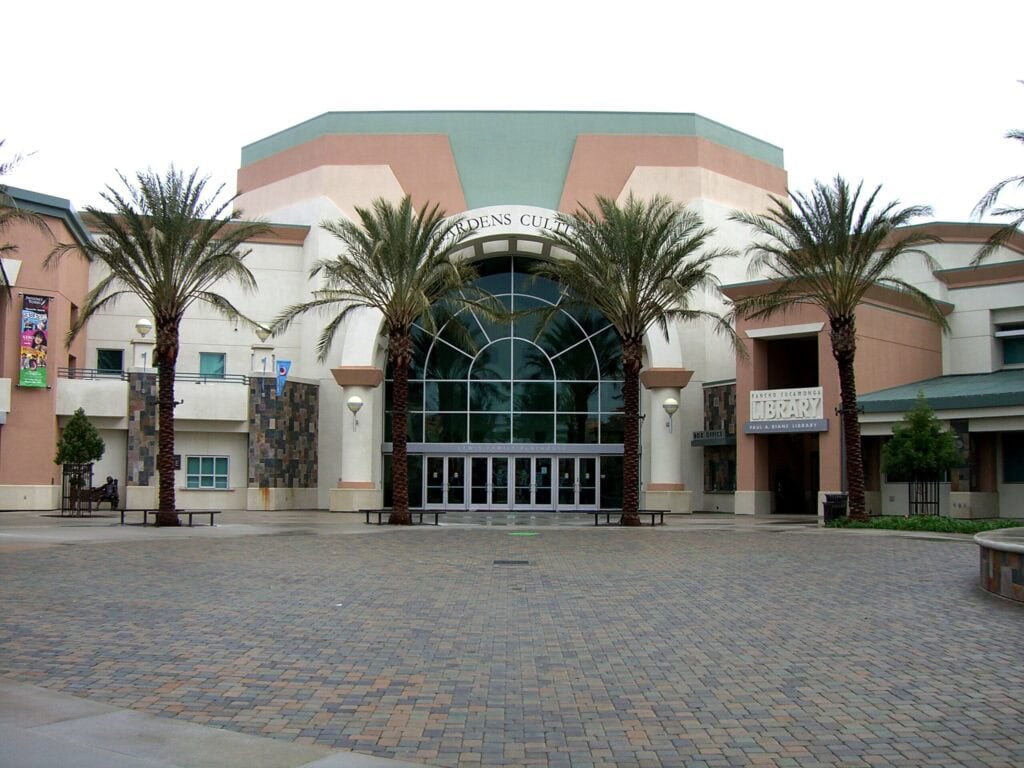
The Cultural Center That Made Victoria Gardens More Than a Mall
The Victoria Gardens Cultural Center was built as a core part of the project, not added later. Construction contracts were awarded on August 18, 2004, about ten weeks before the retail district opened.
The center received its certificate of occupancy on August 14, 2006, and opened to the public five days after that.
It opened as a true civic complex. The Paul A. Biane Library took one of the main spaces. The Lewis Family Playhouse, a full performing arts venue, filled another.
Funding for building the library came from a mix of public funds, grants, developer participation, and private partnerships.
Private fundraising also played a role. The PAL campaign - Promoting Arts and Literacy - began in 2003 to support the Cultural Center.
Over its first seven years, it raised nearly $6 million. This helped frame the project as more than a shopping area with added public space.
Instead, the Cultural Center was treated as a major civic and cultural anchor within the broader development.
The center has kept evolving. In May 2024, the city opened the Randall Lewis Second Story and Beyond at the Biane Library, an 8,000 square foot discovery space for children and families.
On April 16, 2026, the redesigned Bank of America Imagination Courtyard opened with added shade structures, more seating, a better sound system, and updated landscaping.
Two decades after opening, the Cultural Center continues to be expanded and improved.
Bass Pro and the Expansion Wave Around Victoria Gardens
Before the Cultural Center received its certificate of occupancy, Bass Pro Shops broke ground on a 180,000 square-foot Outdoor World store on land near the Victoria Gardens site.
The date was May 10, 2006. The store opened in July 2007 as the first Bass Pro Shops location in California.
By 2010, the opening of both destinations between 2004 and 2007 had produced more than 3,500 permanent and part-time jobs and more than half a million square feet of additional commercial development on adjacent properties.
The Bass Pro location was significant in a particular way. Victoria Gardens had been designed as a walkable, experience-oriented town center with civic uses built in.
Bass Pro was a single-use destination box of the kind Victoria Gardens had deliberately been designed not to be.
The two developments worked well together instead of competing.
Victoria Gardens brought in families looking for outdoor shopping and cultural experiences, while Bass Pro attracted sportsmen and other visitors to its large destination store.
By 2010, the area around 12505 North Mainstreet had become one of the densest retail clusters in San Bernardino County.
A Master Plan Redrawn: The 2018 Amendments
The master plan was never intended to freeze at the 2004 configuration.
By 2018, about 53 percent of the commercial-retail, office, and civic uses within the plan area had been built, along with about 36 percent of the planned residential units.
The remaining acreage stayed in the plan but moved on a slower timeline.
In June 2018, the city approved a formal amendment. The most concrete change involved a vacant 5.33-acre parcel north of the Cultural Center. That parcel had been zoned residential.
The amendment changed it to civic-parking use, cleared the way for a future parking lot or parking structure, and permitted a police substation on the same land.
At the same time, 95 dwelling units were reallocated to the Main Street area of the plan.
The amendment also clarified the ongoing civic framing of the project. Victoria Gardens Master Plan documents describe the development as the heart of the Victoria Community and the new downtown for Rancho Cucamonga.
The 2018 update reinforced it - a city actively choosing, fourteen years after opening day, to protect the civic and cultural functions at the center of the district rather than convert available land to more retail or residential use.
The 5.33 acres went to public parking, not to another anchor tenant.
The $530 Million Sale and What It Reveals
The deal closed on March 13, 2026. Redwood West and Panattoni led the buyer group, with Prime Finance and Prism Places also participating. The price was $530 million.
At closing, roughly 160 retailers and restaurants occupied the property, which was 98 percent leased.
Annual visitation was close to 15 million. Retail sales topped $1,100 per square foot, compared to $570 in 2006, the earliest comparable number.
The new owners committed over $50 million to improvements such as landscaping, signage, common areas, and tenant mix changes.
The operating address remained 12505 North Mainstreet, and the site footer now names Prism Places.
In the early and mid-2020s, Victoria Gardens generated about 18 to 20 percent of annual sales-tax revenue in Rancho Cucamonga.
That amounted to roughly $6.4 million to $7.9 million each year. City budget documents consistently listed it as the highest taxable-value property in Rancho Cucamonga.
The Hahn Company walked away from the site in the early 1990s because of infrastructure costs and a declining retail market.
More than three decades later, the same land sold for $530 million.
Notable Milestones
1983 - Site tied to an enclosed regional mall plan with the Hahn Company
1997 - Land returned to the city after the original mall plan stalled
September 1999 - Forest City and Lewis were selected to develop the project
February 20, 2002 - The master plan for Victoria Gardens was approved
February 20, 2002 - Environmental review was certified, and the development agreement was executed
September 2003 - Phase I broke ground
October 28, 2004 - Victoria Gardens officially opened
August 19, 2006 - Victoria Gardens Cultural Center opened to the public
July 2007 - Bass Pro Shops Outdoor World opened near Victoria Gardens
June 20, 2018 - Master plan amendment approved for future civic-parking use and related changes
May 2024 - Randall Lewis Second Story and Beyond opened at the Biane Library
March 13, 2026 - Victoria Gardens sold for $530 million to a new ownership group
April 16, 2026 - Redesigned Bank of America Imagination Courtyard reopened at the Cultural Center
Independent Publisher Notice
BestAttractions is an independent editorial publisher. We are not affiliated with, endorsed by, or acting on behalf of any location, business, property owner, manager, government agency, or organization described in this article.
Comments posted on this page are not forwarded to, reviewed by, or acted upon by any entity mentioned in the article.
For official inquiries, complaints, applications, bookings, or other requests, please contact the relevant entity directly through its official website or other verified channels.