
La Habra Marketplace is located at a major corner on West Imperial Highway near Idaho Street in La Habra, California, where more than 100,000 vehicles pass the site on a typical day.
The open-air center covers 37 acres and contains roughly 375,000 square feet of leasable space. It serves shoppers from northern Orange County and nearby communities in southeastern Los Angeles County.
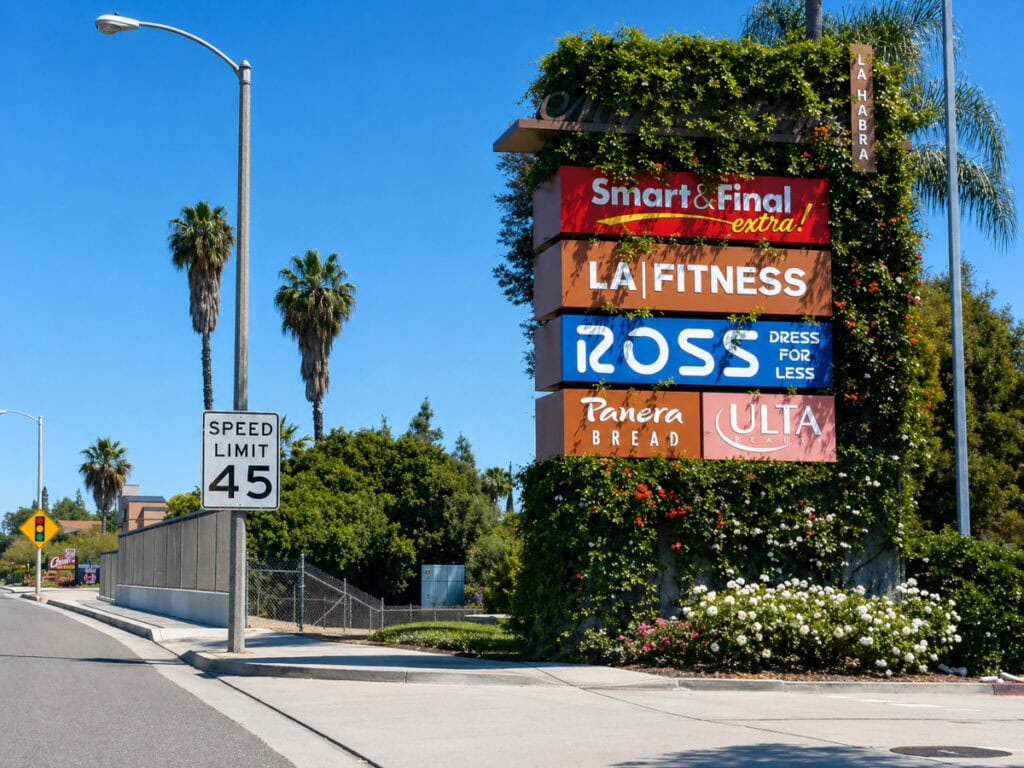
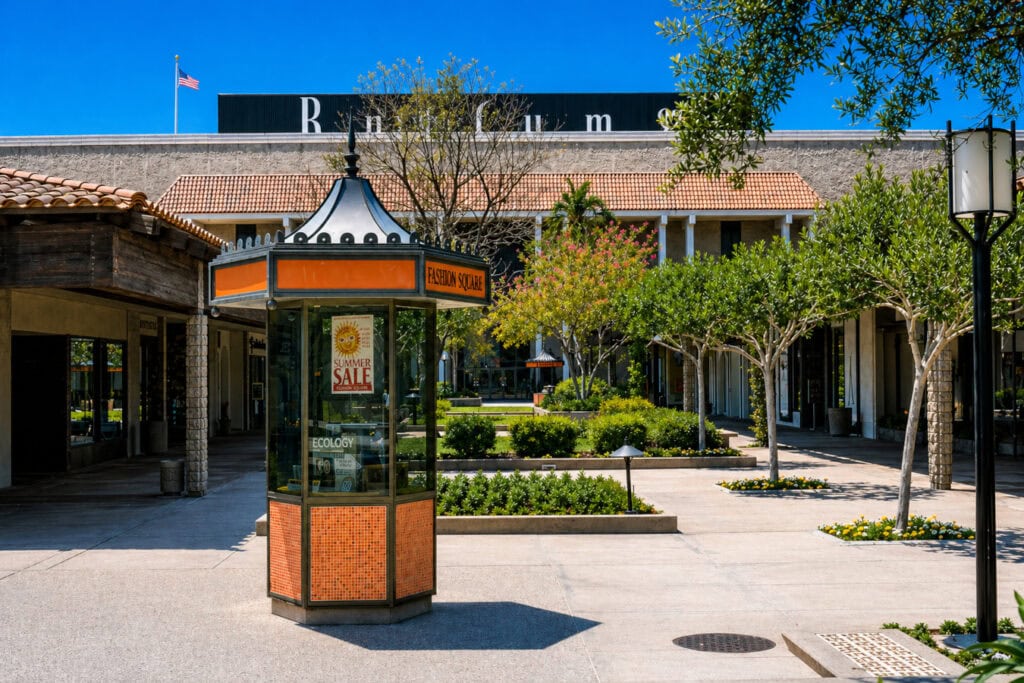
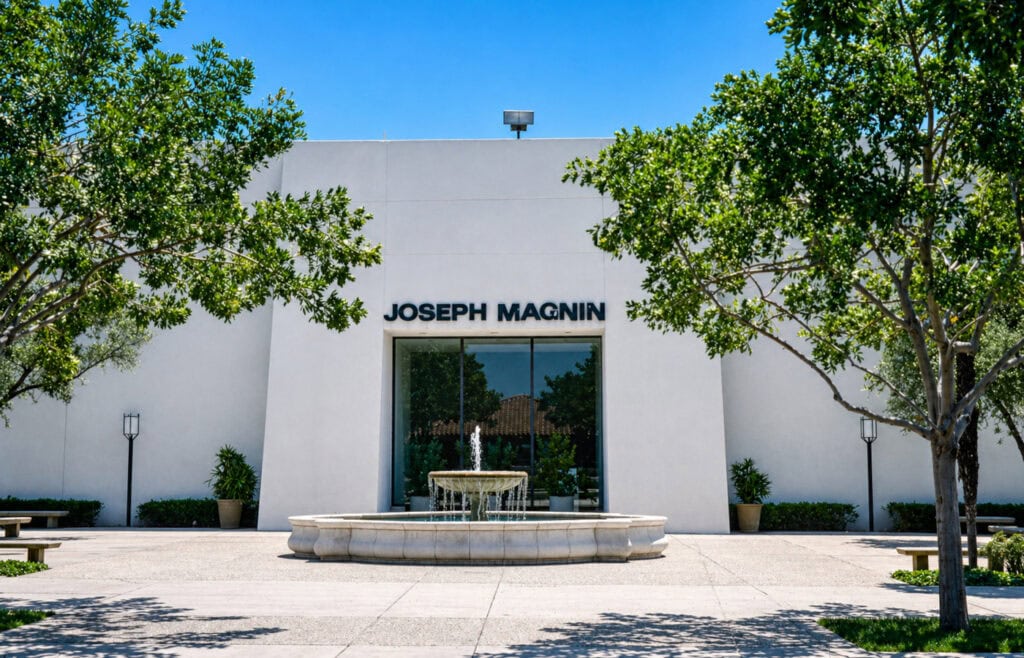
Its story begins in August 1968, when the site opened as La Habra Fashion Square, a regional open-air center anchored by Bullock's, Buffum's, Joseph Magnin, and a carefully assembled lineup of specialty retailers, built for two freeways that were never constructed.
Over the following decades, the original department-store anchors were replaced by cinema, fitness, grocery, discount retail, restaurants, and everyday services, which now make up the center's tenant mix.
La Habra Marketplace Began With Bullock's and Big Plans
Imperial Highway and Beach Boulevard once carried a promise that never arrived.
In September 1966, crews broke ground on a 40-acre retail project meant to draw shoppers from La Habra, northern Orange County, and nearby Los Angeles County communities.
The name was La Habra Fashion Square.
The site was chosen when two planned freeway projects were expected to improve access to the area.
Those freeways were not built, and the center spent the next decades depending on surface roads, traffic lights, and the daily flow of Imperial Highway and Beach Boulevard.
La Habra Fashion Square opened in August 1968 as an open-air regional shopping center - not an enclosed mall.
It was built around department stores, specialty shops, banks, restaurants, and a later cinema. The original development cost was $14 million.
The center had 460,800 square feet of leasable area and eventually held 52 stores and services. Bullock's stood at the center with 271,000 square feet.
Buffum's added 120,000 square feet. Joseph Magnin gave the property another fashion-focused anchor.
A gala benefit opening took place on August 10, 1968. Bullock's opened on August 12.
La Habra Fashion Square Opened Around Department Stores
Bullock's made La Habra Fashion Square feel larger than the city around it. The store carried the upscale role in town, and no other La Habra department store matched it in later years.
The early tenant mix followed the fashion-center model of the late 1960s.
Silverwoods, Draper's, Judy's, B. Dalton, Hickory Farms, See's Candy, Slavick's Jewelers, United California Bank, Crocker-Citizens Bank, Fiddler's Three, Don Paul, and Lyons all fit into the original plan.
A shopper could buy clothing, books, candy, jewelry, restaurant meals, and banking services in one open-air place. The center was built for full shopping trips, not quick errands.
Bullock's also mattered to La Habra's budget. By 1992, when its closure was scheduled, the store employed 150 retail workers and served as a major sales-tax source for the city.
Other Bullock's functions at the site included corporate offices, a print shop, fur storage, alterations, and return-to-vendor work.
Buffum's gave the property a second major department-store anchor, and Joseph Magnin sharpened the fashion identity.
Fashion Square Theatres Added Night Traffic in 1969
The four-screen Fashion Square Theatres opened on August 27, 1969, adding an evening use to the shopping center one year after its first stores opened.
Department stores and banks served the daytime customer base. The movie theater brought visitors after work and after dinner. As a result, the center was not limited to retail purchases and sales counters.
The cinema was also one part of La Habra Fashion Square that continued while other sections changed. When the original retail format weakened, the theater use kept its value.
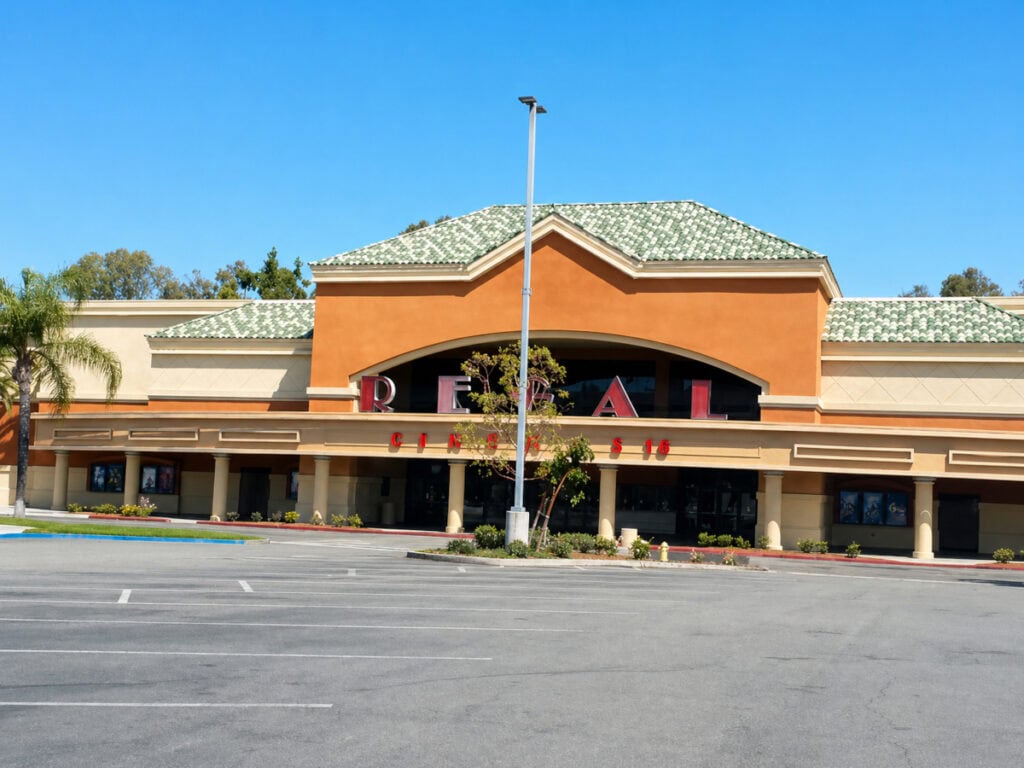
The four-theater complex was later replaced by Regal La Habra, which opened in April 1999 at 1351 West Imperial Highway with 16 screens and became one of the new anchors of La Habra Marketplace.
That change matched the property's later mix of entertainment, restaurants, grocery shopping, fitness, discount retail, and services instead of the earlier department-store focus.
The current Regal space is 59,800 square feet.
Freeways Never Came, and Regional Malls Pulled Shoppers Away
La Habra Fashion Square expected freeway access that was never built.
The planned access would have made the center easier to reach from a larger area, but the property remained dependent on Imperial Highway and Beach Boulevard.
Those roads had heavy traffic, but they did not give the center the same regional reach as malls served by freeways.
Competition increased during the 1970s and 1980s. Whittwood Center, La Mirada Center, Puente Hills Mall, Brea Mall, and other retail destinations drew shoppers away from older open-air centers.
Enclosed malls provided climate control, larger tenant lineups, and a stronger regional customer base.
By 1985, La Habra Fashion Square generated $27.8 million in taxable retail sales.
It ranked 13th among 14 Orange County regional shopping centers and last in sales per square foot among 48 Southern California regional centers, at $51 per square foot.
South Coast Plaza reached $190 per square foot, and Santa Monica Place reached $221.50.
By 1987, 11 specialty-store spaces were vacant, and the smaller-shop portion of the property showed the clearest signs of weakness.
A Divided Property Faced Sale Pressure in the 1980s
The center's ownership was split by the late 1980s. Federated Department Stores owned the Bullock's parcel.
The Buffum's parcel had separate ownership. Another interest controlled the specialty-center portion and related buildable space.
A large portion of the center changed hands in late 1985 for more than $14 million, covering 14.4 acres, 175,000 square feet of buildable area, and the specialty-store section.
By 1987, the owner of that portion was trying to sell for less than the purchase price, and a discount-oriented or promotional retail concept had entered the discussion.
The old department-store center no longer matched the strongest retail pattern around it.
Newer enclosed malls had taken the fashion-center role, and older open-air centers across Southern California were moving toward large-format stores, service uses, entertainment, and discount retail.
La Habra Fashion Square followed that path through vacant shops, weaker sales, and separate ownership interests - still valuable because of its corner, but no longer viable in its original form.
Demolition Turned Fashion Square Into La Habra Marketplace
The Buffum's building was demolished in May 1990.
During the first phase of redevelopment, the project removed the mid-section of the original La Habra Fashion Square, while Bullock's, the theater, and several smaller outparcels stayed in place.
The redeveloped property became La Habra Marketplace. Its design used large retail boxes, surface parking, pad buildings, and store entrances oriented toward parking fields, rather than the 1968 fashion-center layout.
New stores opened from December 1990 through April 1991. Early tenants in the redevelopment period included Service Merchandise, Ross Dress for Less, and Drug Emporium.
The name "Marketplace" reflected the revised retail concept. Fashion was no longer the organizing identity of the center.
Bullock's remained on the site for a short period, but the surrounding property had already shifted to the new format. The La Habra Bullock's closed in August 1992.
Bullock's Came Down, and the Old Mall Era Ended
The old Bullock's building occupied a large piece of the former Fashion Square site. In 1995, La Habra approved a plan to complete the redevelopment of La Habra Marketplace.
The former Bullock's had anchored a 15-acre part of the original development - a section that had also included Buffum's, small clothing stores, restaurants, banks, and the movie theater.
The 1995 plan called for large-format retail and service uses, with expected tenant categories including sporting goods, housewares, electronics, office supplies, shoes, and clothing.
The final rebuilt center was expected to involve at least $20 million in investment. The Bullock's building was demolished in 1995, ending the physical presence of the department-store era.
Four years later, the 16-screen Regal opened in April 1999, giving La Habra Marketplace an anchor that fit the post-mall period.
The center's main draw shifted to cinema, fitness, grocery, discount apparel, hobby retail, restaurants, pet retail, beauty, medical, dental, and personal services.
DJM Capital and New Financing Reworked the Center Again
DJM Capital acquired La Habra Marketplace in 2004. The property had 372,000 square feet at that time, and the purchase price was $76.9 million as part of a larger Southern California retail portfolio transaction.
By 2012, the center was 98 percent occupied, with Sports Authority, Ross, and Regal as major tenants.
In 2013, La Habra Marketplace became part of a four-property Southern California retail recapitalization: the La Habra loan amount was $70.6 million, and the broader portfolio financing reached $185 million.
In 2019, the property received $101.3 million in non-recourse bridge debt tied to capital improvements, tenant improvements, leasing commissions, and continued repositioning.
The center was 96 percent leased at that time. The 2019 work included a new pad building at Imperial Highway and Beach Boulevard, with Starbucks and Jimmy John's lined up for that corner.
The theater lease extension was tied to cinema improvements, including a wraparound screen feature.
Today's Marketplace Runs on Errands, Food, and Traffic
The present La Habra Marketplace remains single-level and open-air at 37 acres and 375,000 square feet.
The largest spaces show how far the property has moved from its Fashion Square years: Regal occupies 59,800 square feet; Esporta takes 50,300; Hobby Lobby 44,100; Ross 25,900; Sprouts 25,300; and Smart & Final Extra, 25,000.
The remaining tenants cover a wide range of categories. Beauty and personal care is represented by Ulta Beauty and European Wax Center.
Dining options include Red Robin, Chick-fil-A, Wendy's, Starbucks, Board & Brew, The Kebab Shop, Niko Niko Sushi, Cocori K-Food & Pub, Aloha Stacks, Tous les Jours, and Crumbl.
Retail includes Famous Footwear, Carter's, OshKosh B'gosh, MINISO, and Petco. Services include Pacific Dental, Verizon, and See's Candy. A 10,700-square-foot junior-anchor space remains available.
The location still depends on movement through the intersection. Recent leasing data gives South Beach Boulevard 53,800 cars per day and Imperial Highway 51,800 cars per day.
The center also hosts public events - among them the La Habra 5K Centennial Run on March 8, 2025, and the La Habra Races Family Fun Run, scheduled for March 14, 2026.
The Restricted Parking Parcel Stayed a Parking Lot
A remaining piece of the redevelopment period continued to serve the same use. The parcel is a 2.8-acre parking area inside La Habra Marketplace and contains 122,000 square feet.
It is used as a surface parking lot. A grant deed recorded on June 27, 1990, required the property to be used, improved, and operated only as a parking lot.
The parcel later became part of a surplus land and disposition process. Because of the legal restriction, it qualified as exempt surplus land.
In 2023, it was offered as a commercially zoned parcel within the shopping center.
Its assessed land value was $3.7 million. Its assessed improvement value was $520,000. Its total assessed value was $4.2 million. These assessed values did not produce a high sale price.
The sale process opened in October 2023 and closed in November 2023. It received three offers. In December 2023, the La Habra Planning Commission confirmed that the acquisition matched the General Plan.
On December 18, 2023, the City Council approved the purchase for $57,500, plus broker fees of $2,900. The total appropriation was $60,500.
The City of La Habra now owns the parcel that anchored the parking field of a 1968 fashion mall, a 1990 redevelopment, and a 2020s open-air center.
Notable Milestones
1966 - Groundbreaking began for La Habra Fashion Square at Imperial Highway and Beach Boulevard.
1968 - La Habra Fashion Square opened as an open-air regional shopping center anchored by Bullock's, Buffums, and Joseph Magnin.
1969 - Fashion Square Theatres opened, adding a four-screen cinema to the center.
1985 - The center ranked near the bottom of Orange County regional shopping centers in taxable retail sales and sales per square foot.
1987 - Vacancy and weak sales led owners to consider a discount-oriented redevelopment strategy.
1990 - Major demolition began, including the removal of the Buffums building and central mall sections.
1990-1991 - La Habra Marketplace began opening with new large-format tenants, including Service Merchandise, Ross Dress for Less, and Drug Emporium.
1992 - Bullock's closed, ending the original department-store anchor era at the site.
1995 - The former Bullock's building was demolished as part of the final redevelopment phase.
1999 - Regal La Habra opened as a modern 16-screen cinema anchor.
2004 - DJM Capital acquired La Habra Marketplace.
2013 - The center was included in a Southern California retail recapitalization.
2019 - The property received major financing for improvements, leasing costs, and continued repositioning.
2023 - A deed-restricted parking parcel within the center entered a public sale and city acquisition process.
2025 - Retail space at La Habra Marketplace was actively marketed for lease, including a junior-anchor vacancy.
2026 - Cocori K-Food & Pub received approval for beer and wine sales at the center.
2026 - La Habra Races Family Fun Run was scheduled at La Habra Marketplace.
Independent Publisher Notice
BestAttractions is an independent editorial publisher. We are not affiliated with, endorsed by, or acting on behalf of any location, business, property owner, manager, government agency, or organization described in this article.
Comments posted on this page are not forwarded to, reviewed by, or acted upon by any entity mentioned in the article.
For official inquiries, complaints, applications, bookings, or other requests, please contact the relevant entity directly through its official website or other verified channels.
I worked at Bullocks back in 1968 and there was a little boutique right outside of it, but I can’t remember its name. It was kind of pricey. I moved further inland (Ontario) and didn’t even realized it had closed and changed. Thanks for all your info!
Bullock's in 1968 must have been a striking place to work. Many people still talk about how that store anchored the mall and gave it a certain shine.
I can remember taking our young daughters to “Breakfast with Santa” at the Bullocks La Habra Fashion Square in late 1970’s and into the Early 1980’s.
You were at the main store, in a way. La Habra was the last and biggest of Bullock's four "Fashion Square" malls, after Santa Ana, Sherman Oaks, and Del Amo. It was also the only one they built with a movie theater inside. So those Santa mornings happened at the most advanced version of the idea Bullock's ever created.