
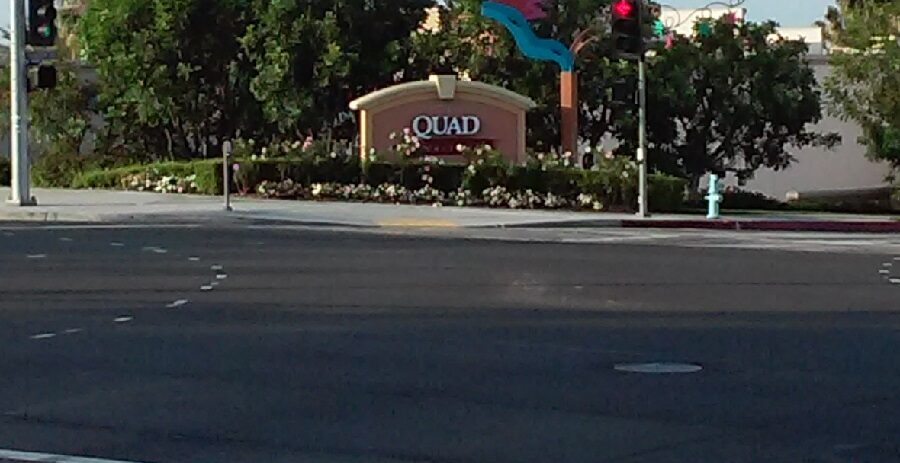
The Quad at Whittier was named for a four-sided open-air concourse that no longer exists, enclosed decades ago and demolished after that. Yet, the name still appears on storefronts along Whittier Boulevard today.
Two Mornings in March 1953
The Shopping Bag supermarket opened first, on March 12, 1953, with 33,900 square feet on the corner of Whittier Boulevard and Painter Avenue.
Then the next morning, Ezra Hinshaw and store manager Jack Powell and a Chamber of Commerce man named Ralph Thynnes came out for the opening of a two-level, 43,000-square-foot Hinshaw's department store right next door.
Two consecutive mornings, two anchor stores, and suddenly, southeast Whittier had something it hadn't had before.
Benjamin Clayton built it. He was out of Pasadena, working under the Clayton Foundation, and his idea wasn't a strip center but a quadrangle.
Four sides of storefronts wrapped around a pedestrian concourse, open to the sky, so shoppers moved through a center space rather than just along a flat row of glass.
The name came from that shape, and it stuck for seven decades even after the shape itself was gone.
Ground broke June 4, 1952.
By the time the doors opened, the postwar suburbs of Los Angeles County were expanding fast, and everyone was building: Lakewood Center before the Quad, Whittier Downs Mall northwest of it in the mid-1950s, Whittwood Center southeast in 1956, Stonewood in Downey in 1958.
A dense competitive ring formed around the Quad almost immediately.
What the Quadrangle Held
Barker Brothers Furniture. Heck's Men's Shop. Crown City Mattress. Westbrook Yardage. A 29,600-square-foot W.T. Grant variety store.
These were the early tenants alongside Hinshaw's and Shopping Bag, filling out a mid-century retail mix that covered most of a suburban family's weekly errands in one trip.
F.C. Nash arrived in November 1954, a two-level, 30,000-square-foot department store tied to Nash's of Pasadena, with related stores in Alhambra and Arcadia.
Nash's of Whittier was incorporated July 6, 1954, which suggests the speed of that whole postwar build-out: incorporation in summer, open by fall.
Between May and November 1955 Hinshaw's added 31,000 square feet, going from 43,000 to 76,000, and new parking went in south of the building, capacity now around 2,500 cars.
Then in October 1961 Vons built a freestanding 30,500-square-foot supermarket on the property and took over the grocery anchor role from Shopping Bag.
The old Shopping Bag space got folded into Hinshaw's as Hinshaw's Budget Store. Re-grand opening May 3, 1962.
Hinshaw's was now 101,000 square feet, a department store that had absorbed a supermarket's entire footprint and was still expanding.
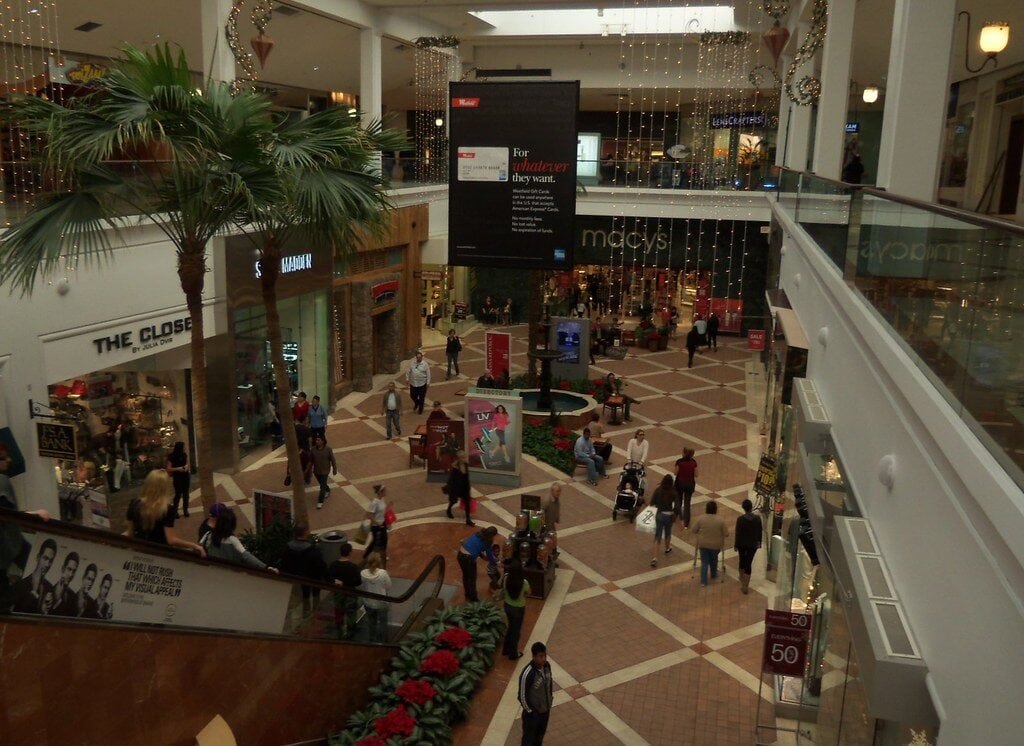
The open quadrangle ran until the early 1970s when the original concourse got enclosed and climate-controlled, grand reopening June 2, 1973.
Twenty years of outdoor shopping, gone. Now it was an interior mall like every other interior mall.
May Company and the Years the Quad Was Actually Regional
In August 1965, May Company California opened 248,000 square feet at the Quad in its own building, freestanding, sitting as a shadow anchor rather than threading into the original concourse.
It came with a Maymart discount floor, a May Company Auto Center, and a three-level parking garage that held 1,400 cars.
May Company was one of the big Los Angeles chains.
Its arrival pushed the Quad further into regional territory, the kind of place worth driving to from outside Whittier, adding a major destination department store to a center that was already more than a grocery stop.
Combined with Hinshaw's, with Vons by the early 1960s, and later with Thrifty Drug and The Akron (which opened September 21, 1978, adding another 66,000 square feet), the Quad by the late 1970s held what a city's commercial life is made of.
The 1978 tenant list is worth reading slowly:
- May Company, with its Terrace Room restaurant, Maymart bargain floor, and beauty salon
- Hinshaw's, with the Trolley Stop Restaurant inside it, Brice Travel Service, and Vanity Fair Beauty Salon
- Vons
- Thrifty Drug
- The Akron
- Austin's menswear
- Bank of America
- Barron's Pharmacy
- Berean Book Store
- C.H. Baker Shoes
- Discount Fabrics
- Edie Adams Cut & Curl
- Hardy Shoes
- Harris & Frank
- Hartfield's
- Hatch's Cards & Gifts
- Heck's
- Holland House Cafeteria
- Hudson's Jewelers
- Kusel's Poultry
- Lady Miriam's
- Leeds Qualicraft Shoes
- Mother To Be Shop
- See's Candies
- Whittier Quad Stationers
- Raymond D. Winnen Optometrist
- Zales
That's one shopping center. The Quad at its peak reportedly drew nearly 450,000 regular shoppers from a five-mile radius, and looking at that list it's not hard to understand why.
How a Mall Goes Quiet
Whittier Boulevard was the problem, or part of it.
Commercial strip development filled in along the corridor outside the Quad with freestanding buildings right at street level, easy to see from the car, easy to pull into, and the Quad's interior concourse sat behind its own parking field, requiring a deliberate turn that a lot of drivers just didn't make.
Visibility was poor and circulation was awkward. The mall was hiding from the street that fed it.
May Company closed in late 1986. Fifty-five percent of the mall went vacant more or less immediately. The Terrace Room closed. The Maymart floor closed.
The 1,400-car garage was mostly empty. Hinshaw's and Vons were still there but the interior had lost what made it worth crossing the parking lot for.
A $2 million renovation started in March 1987, designed by McClellan Cruz Gaylord & Associates of Pasadena, developed by Michael Pashaie, planned in phases across a 670,000-square-foot center, with landscaping, limited demolition, and new circulation.
It was still in early stages when October 1, 1987 arrived.
The Whittier Narrows earthquake. The May Company parking garage collapsed. The store area was badly damaged. The renovation that was supposed to save the mall was already obsolete.
Demolition
The plan after the earthquake was not to restore the old Quad.
Whittier's Redevelopment Agency adopted new guidelines in March 1988; Schurgin Corporation acquired the property from Golden West Properties that same year; the replacement moved through Schurgin and Ahmanson before GMS Realty of Carlsbad came later.
The goal was simpler than saving anything: get retail back, get the sales-tax revenue flowing again.
The May Company store and its collapsed garage came down. Most of the enclosed concourse came down.
The Hinshaw's building, less damaged than the rest, stayed, and Hinshaw's itself stayed open inside it, operating in what had become a partially demolished mall, until January 1992.
Then Hinshaw's closed too, and the last piece of the original Quad as it had been was gone.
What opened starting November 1990 was a different thing entirely. No indoor concourse. No Trolley Stop. No Terrace Room. Open-air, large-format, surface parking, storefronts facing the lot: a power center.
The quadrangle that named the place had been enclosed in 1973 and demolished after 1987, and now there wasn't even the memory of the shape left in the architecture.
The New Tenants
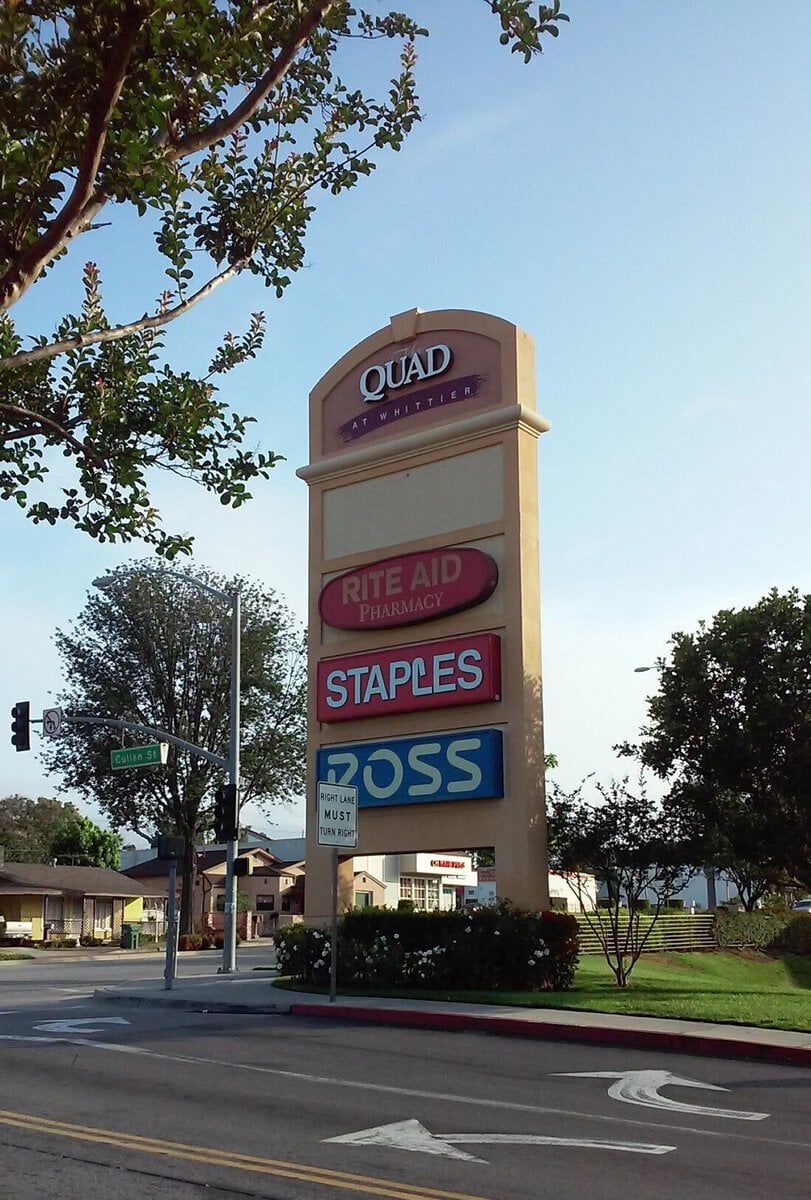
Ralphs replaced Vons as the grocery anchor in November 1990. Ross Dress for Less: 25,700 square feet. T.J. Maxx: 25,000.
Burlington Coat Factory moved into 87,400 square feet across two levels in the old Hinshaw's building, the same walls that had held Hinshaw's Budget Store, which had itself absorbed the original Shopping Bag space.
Staples took 17,200 square feet.
Then over the following years came Michaels, Old Navy, Marshalls, Petco, Dollar Tree, Rite Aid, Famous Footwear, and eventually Five Below, with Olive Garden, Chili's, Baja Fresh, and Chuck E. Cheese on the restaurant pads.
Roughly 443,500 leasable square feet when the redevelopment was fully built out. About 49 store spaces.
Not a mall anymore but a place where people bought discount clothes and craft supplies and pet food and groceries. More durable into the 2000s than the enclosed-mall model had been.
Ralphs held the grocery anchor until 2015, when it closed. Vallarta Supermarkets opened in August 2015 in that same space, serving a heavily Latino trade area, and became the center's new daily-needs core.
The Corner Coming Apart
Burlington Coat Factory closed in 2024.
It had been in the old Hinshaw's building since the 1990s rebuild, about twenty-five years in walls that had also held Hinshaw's and before that Shopping Bag, a building whose retail life reached back to 1953.
After Burlington, the space went vacant. Then Rubi's, a local restaurant that had run at the Quad for 29 years, lost its lease and closed April 18, 2025.
Staples was left as the last business operating on that corner of Whittier Boulevard and Laurel Avenue.
In May 2025 Rite Aid added its 8508 Painter Avenue location, at the Quad, to a bankruptcy filing covering 151 store closures across ten states.
Brixton Capital announced January 28, 2026 that it had acquired The Quad at Whittier for $100 million. Nine buildings, 314,600 square feet, 25.4 acres, 95.6% occupied at closing.
Major tenants in the acquisition materials: Vallarta, Marshalls, Ross, T.J. Maxx, Dollar Tree, Petco, Michaels, Five Below, Burlington.
Burlington was still listed despite the local closure reports, which tells you something about how real estate materials and local reality don't always sync.
Plans announced in February 2026: common-area upgrades, outdoor improvements, a push toward food-and-beverage tenants.
Available spaces started at 706 square feet, with 15,178 square feet total available and a maximum contiguous block of 11,565.
What the City Wants to Do with It
Whittier's 2021-2029 Housing Element put the Quad on a list it probably didn't expect to end up on: major mixed-use opportunity site.
The full property is 30.8 acres across nine parcels. Conservative housing estimate at 30 units per acre is 739 units. At 60 units per acre under MU-3 zoning the number approaches 1,500.
The southeast corner is the most specific target, 3.3 acres near an underused parking structure, flagged in a previous planning cycle for 79 lower-income units, where the city described owner interest in converting commercial space to housing.
Less than a mile away, Five Points has been identified as a future transit-oriented node tied to the Metro Eastside Corridor Phase 2 planning process.
By 2022 Whittier was holding People Mover stakeholder meetings as part of a local circulator study that would connect Uptown, Whittier College, PIH Health, and the Quad.
No construction timeline confirmed. None of it built yet.
Still There
Vallarta is open. Ross is open. The parking fields fill up.
The name Quad is still on the storefronts though the four-sided open-air concourse it referred to was enclosed fifty years ago and demolished thirty-five years ago.
Holland House Cafeteria is gone. The Trolley Stop inside Hinshaw's is gone. The Terrace Room inside May Company is gone. Kusel's Poultry is gone.
See's Candies is gone from this location, anyway. The three-level parking garage that collapsed in 1987 is a surface lot now.
The Hinshaw's building is still standing, holding whatever tenant cycle brings next, after Burlington left its walls empty in 2024.
Rubi's ran 29 years in that center and then it didn't, and Staples was the last one on that corner.
What the Quad does in 2026, groceries, discount clothes, pet food, household basics for a dense suburban trade area near two freeways, is not so different from what Shopping Bag and Hinshaw's were doing for southeast Whittier on those two March mornings in 1953.
The building around it has been built and enclosed and demolished and rebuilt. The function turned out to be the durable part.
Independent Publisher Notice
BestAttractions is an independent editorial publisher. We are not affiliated with, endorsed by, or acting on behalf of any location, business, property owner, manager, government agency, or organization described in this article.
Comments posted on this page are not forwarded to, reviewed by, or acted upon by any entity mentioned in the article.
For official inquiries, complaints, applications, bookings, or other requests, please contact the relevant entity directly through its official website or other verified channels.