
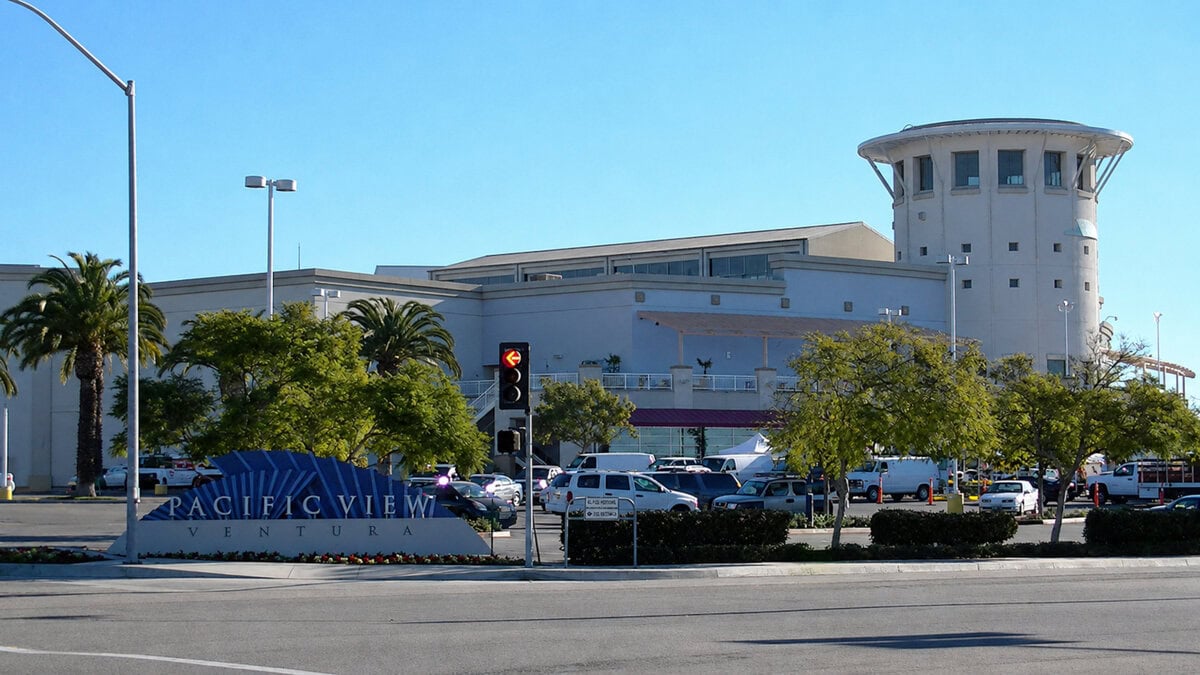
Pacific View Mall has operated under at least four names and been physically rebuilt twice since it opened in 1963.
That is not a sign of stability.
It is a record of how often a place has had to change to keep its doors open.
The mall is located in Midtown Ventura, east of the city's older downtown, and has served Ventura County shoppers for over sixty years as a department-store center, an indoor shopping area, and now a mix of shopping, fitness, dining, and entertainment.
The open-air concourse is gone.
The campanile tower that once gave the original center its public identity is gone.
So are The Broadway, Robinsons-May, Circuit City, and Sears, each replaced by something the original plan never expected.
What the place became is a long record of additions, demolitions, and replacements.
Buenaventura Center's First Anchor: The Broadway, 1963
The Broadway held its dedication at the end of September 1963 in a three-level building of custom concrete brick, marble, and tinted glass.
Outside, the open-air concourse ran toward a center-court tower, a campanile structure that gave the complex a civic-retail identity beyond a simple strip center.
Ground had been broken fourteen months earlier, on August 14, 1962.
Broadway-Hale Stores, then one of Southern California's prominent department-store operators, partnered with Santa Barbara developer Gordon L. MacDonald to build the center on a large site in Midtown Ventura, near the Ventura Freeway corridor and east of the city's older downtown.
The site was chosen for its freeway access, its potential for large surface-parking fields, and its position to pull shoppers from across Ventura County rather than only from the immediate neighborhood.
A Regional Plaza Takes Shape (1964–1965)
The broader shopping center opened in November 1964, when the first group of specialty stores opened around the open-air pedestrian concourse.
Early tenants included a two-level F.W. Woolworth, apparel shops, gift stores, and service tenants.
A North Mall section held a supermarket and home-furnishing stores.
The South Mall section later included Joseph Magnin, which opened in March 1965.
J.C. Penney arrived in November 1965 in a large two-level store of about 204,000 square feet, completing the early anchor structure of the center.
With two major department stores, peripheral retail in multiple directions, and surface parking surrounding the whole property, the center became a countywide destination.
The name shifted over the years: Buenaventura Center, Buenaventura Fashion Center, Buenaventura Plaza.
All of them drew from the city's formal name, San Buenaventura.
The Esplanade opened in Oxnard in 1970, with its first mall stores opening in March and completion following in November, giving Ventura County a second major regional mall competitor.
Buenaventura remained open-air for another decade.
Buenaventura Gets a Roof: The 1983 Enclosure Project
Work began in April 1983 to enclose the open-air mall.
The project cost about $15 million.
The main concourse received a Teflon-coated fiberglass roof that sealed the space against weather while keeping daylight in the interior.
The renovation also added about 40,000 square feet of new tenant space and introduced a food court.
The renovated center was dedicated in November 1983.
Enclosed malls were outcompeting open-air centers by the early 1980s, and the fiberglass roof gave Buenaventura a climate-controlled interior without converting it into a fully sealed box.
The food court added during that project reflected a broader design shift: keep shoppers on-site longer, give them a reason to stay after one anchor visit.
The open-air center that shoppers had walked through for nearly twenty years was now a covered mall.
Buenaventura Mall: Renovation and a New Name
A second major construction period began in February 1989 and continued into the early 1990s.
Crews worked on center court, wing corridors, ceilings, flooring, new entrances, lighting, planters, and common areas.
Parts of the mall remained open while work was underway.
Entrances were closed. Parking areas were blocked off for construction staging.
In August 1990, the property's name officially changed from Buenaventura Plaza to Buenaventura Mall.
The renovation added glass ceiling treatments, skylights, parquet-style flooring, tile planters, sconces, and larger entryway features; the bones of the building dated to 1963 and 1964.
Word spread during this period that a second level might eventually be added, which set expectations that the mall would not fulfill for another decade.
The 1990s Expansion Battle That Almost Stopped the Mall
The mid-1990s expansion plan called for two new department stores, a full second level, and more than 400,000 square feet of added retail on the 58-acre site.
To finance the required street improvements, the developer would spend about $12.6 million upfront and be reimbursed over 20 years from new sales-tax revenue the expansion generated, with total repayment potentially reaching about $32.3 million.
That arrangement drew opposition.
Critics pursued a citizen initiative to block the city from entering any such tax-sharing agreement, and without it, the expansion was considered economically unworkable.
Oxnard raised separate concerns: the planned anchors, Sears and Robinsons-May, were also operating at the Esplanade, and their departure would reduce Oxnard's retail sales-tax base.
Environmental and design appeals followed on traffic, air quality, noise, water, school impacts, and landscaping.
Residents near Dunning Street raised concerns about construction scale, perimeter walls, and neighborhood buffers.
The dispute stretched over years of litigation and political friction.
A Macerich subsidiary acquired Buenaventura Mall in December 1996 as part of a three-mall transaction that also included Fresno Fashion Fair and Huntington Center; the combined sale price was about $125 million.
With Macerich in direct control, the project moved past its delays.
Pacific View Mall Opens After a $90 Million Rebuild
The Broadway had become Macy's in 1996, completing a broader Southern California department-store consolidation.
Macerich rebuilt the mall in phases from 1998 through 2001, at a cost of about $89 million to $90 million.
Large sections of the one-level enclosed center were demolished and replaced with a two-level structure.
The project added a new J.C. Penney building, a new Sears building, an expanded Macy's building, a reused former J.C. Penney building converted for Robinsons-May, a new food court, additional specialty stores on both levels, escalators and interior vertical circulation, and a multi-level parking garage.
The new J.C. Penney opened on March 1, 1999.
Sears opened in its new building, about 120,000 square feet, on November 13.
Robinsons-May opened in the former J.C. Penney space on November 19.
On November 15, the center was rededicated as Pacific View Mall.
The store count rose from roughly 80 in the old one-level mall to about 120 to 140 stores and services in the redeveloped property.
The redevelopment was projected to generate about $250 million in annual sales and add roughly $1.5 million in annual city sales tax.
Oxnard had feared exactly this outcome: both Sears and Robinsons-May left the Esplanade for Pacific View.
The Esplanade later declined and was demolished.
Anchors Come and Go: From Robinsons-May to Ross
Robinsons-May closed in spring 2006 after Federated Department Stores acquired the May chain and retired the brand.
Target opened in the former Robinsons-May building on March 9, 2008: a mass-merchant anchor where a department store had been.
Circuit City closed in March 2009 during that chain's national liquidation, leaving a large vacancy in the North Mall area.
By mid-2011, Trader Joe's, Staples, and BevMo had opened in the reworked North Mall space.
Staples later closed, and Ross Dress for Less replaced it, opening in July 2021.
Sears lasted longer than Robinsons-May, Circuit City, and Staples.
It had opened at Pacific View in November 1999 and was listed for closure in November 2019, part of a national round of store closings announced that month.
Going-out-of-business sales began in December 2019.
The store closed by February 2020.
The two-level Sears building that Macerich had constructed only twenty years earlier was now gone as an anchor, leaving the largest former department-store box at the mall vacant at a moment when few retailers were looking to fill 120,000 square feet.
Round1, YUU, and What Pacific View Mall Looks Like Now
The former Sears building is being converted into Round1 Bowling & Arcade and YUU Japanese Food Hall.
The project covers more than 55,000 square feet.
Round1 will include 12 bowling lanes, billiards, private karaoke party rooms, and an arcade with American and Japanese games.
YUU will offer ramen, udon, specialty pizzas, okonomiyaki, takoyaki, and gelato.
Tenant-improvement plans were issued in June 2025, and both tenants were announced as under construction in March 2026, with an opening expected in the middle of 2026.
As of May 2026, Pacific View's total gross leasable area stands at 884,000 square feet, with occupancy at 80 percent.
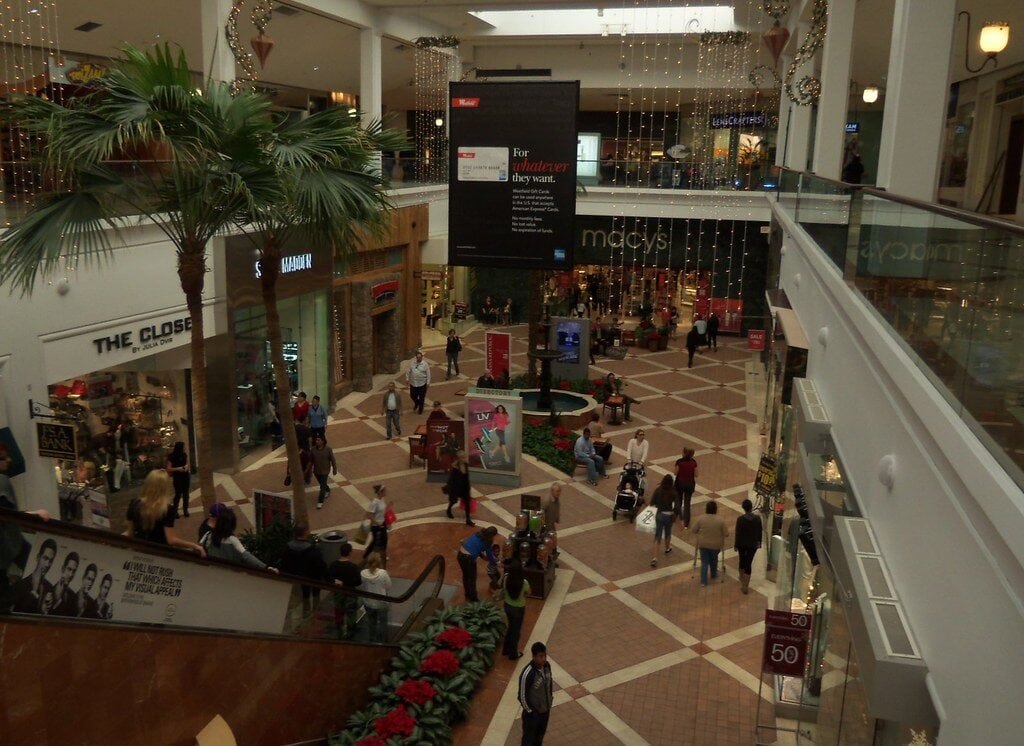
Macy's, JCPenney, Target, Ross Dress for Less, 24 Hour Fitness, Trader Joe's, BevMo, Sephora, and Victoria's Secret are among the current anchors and major tenants.
California Pizza Kitchen, Red Robin, Wood Ranch, Panda Express, and a range of food-court and quick-service operators fill the dining areas.
The tenant mix has shifted from the department-store and fashion-chain structure of the 1999 peak toward fitness, food, services, off-price retail, and entertainment.
The Mall's Next Question Is the Land Around It
Ventura's General Plan process has designated the Five Points/Pacific View Mall area for long-range replanning.
A City Council discussion in September 2023 covered preferred land uses for the area.
Public surveys showed strong interest in adding housing, entertainment, and mixed uses to the site.
The city's Housing Element progress tracking, updated in August 2025, identified the mall area as a location already allowing residential development up to six stories and 75 feet, and set a 2026 target for development standards to accommodate up to 800 residential units.
No demolition of the existing mall is underway.
The Broadway became Macy's. JCPenney moved into a new building.
Robinsons-May closed. Sears closed. The open-air concourse is gone.
What remains is a two-level enclosed mall at 3301 East Main Street, with a bowling-and-ramen project taking shape in the old Sears box, and shoppers still arriving from across Ventura County.
Independent Publisher Notice
BestAttractions is an independent editorial publisher. We are not affiliated with, endorsed by, or acting on behalf of any location, business, property owner, manager, government agency, or organization described in this article. Comments posted on this page are not forwarded to, reviewed by, or acted upon by any entity mentioned in the article. For official inquiries, complaints, applications, bookings, or other requests, please contact the relevant entity directly through its official website or other verified channels.
interesting article, but I question your timeline and list of initial shops.
Thanks for the feedback! I appreciate your insight on the timeline and shops and will verify info.
Turn this mall back to a strip mall. Was way more easier to walk about.
Thanks for the suggestion! Turning it back into a strip mall could be a good move for easier access.
I DO NOT HAVE SMALL CHILDREN N THE GRAND KIDS ARE ADULTS NOW, HOWEVER A BOWING ALLEY IS A GREATFAMILY RECREATION. IT WILL BE UTILIZED. GOOD LUCK
That is the strength of this kind of venue. Round1 is designed around several activities rather than relying on bowling alone, which gives different age groups a reason to use it.