
Ovation Hollywood is a retail and entertainment complex in the Hollywood area of Los Angeles, in Los Angeles County.
It stands at the corner of Hollywood Boulevard and Highland Avenue, directly above the Metro B Line Hollywood/Highland station, which links it to the wider rail system.
The 387,000-square-foot retail complex offers shops, restaurants, and entertainment for both locals and the many tourists who visit the Hollywood Boulevard area each year.
It opened in November 2001 as Hollywood and Highland, on the former site of the 1902 Hollywood Hotel, and sits along one of the busiest sections of the Hollywood Walk of Fame.
The Elephants Are Gone, But the Corner Never Stops Trying
The two white elephants weighed more than 13,000 pounds each.
They sat on top of stone columns flanking a massive archway in the center of a Hollywood shopping mall, staring out over the heads of tourists who came mostly to take photos of the TCL Chinese Theatre next door.
They had been there since 2001, modeled on a prop from a 1916 silent film, hauled in as the centerpiece of a $615 million development that the city of Los Angeles had staked its Hollywood revival on.
In 2021, a crew removed them in the middle of a $100 million renovation. Nobody held a ceremony.
What replaced them is a mural by a Los Angeles artist named Geoff McFetridge, painted on the archway where the elephants used to stand.
The complex is now called Ovation Hollywood.
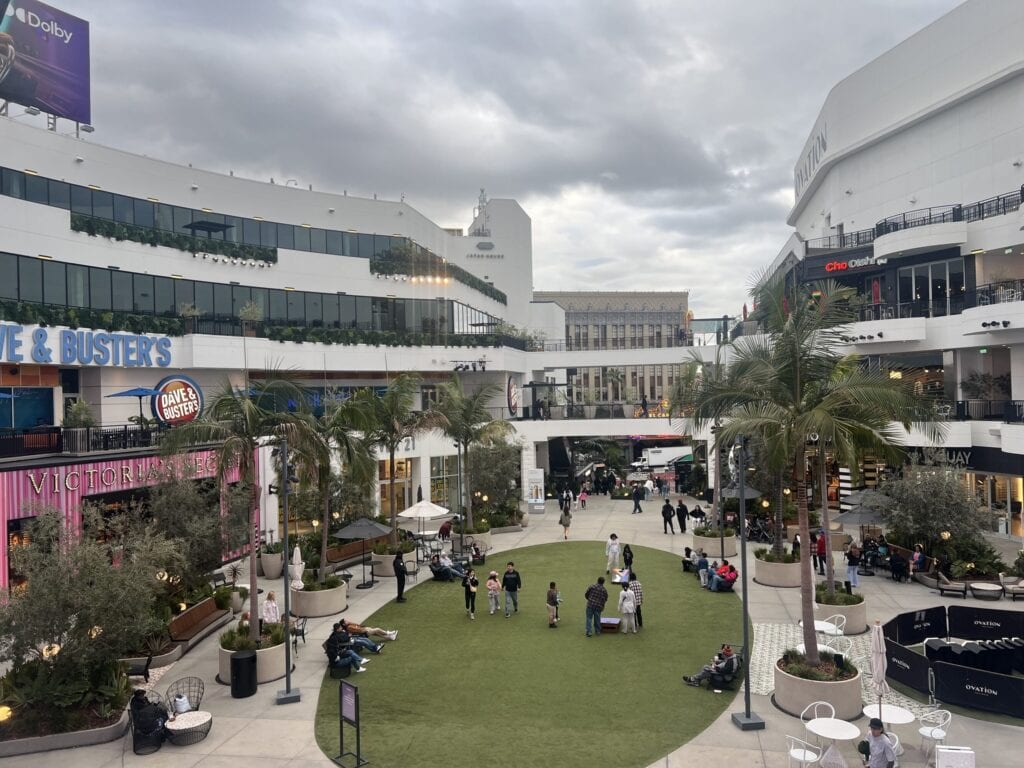
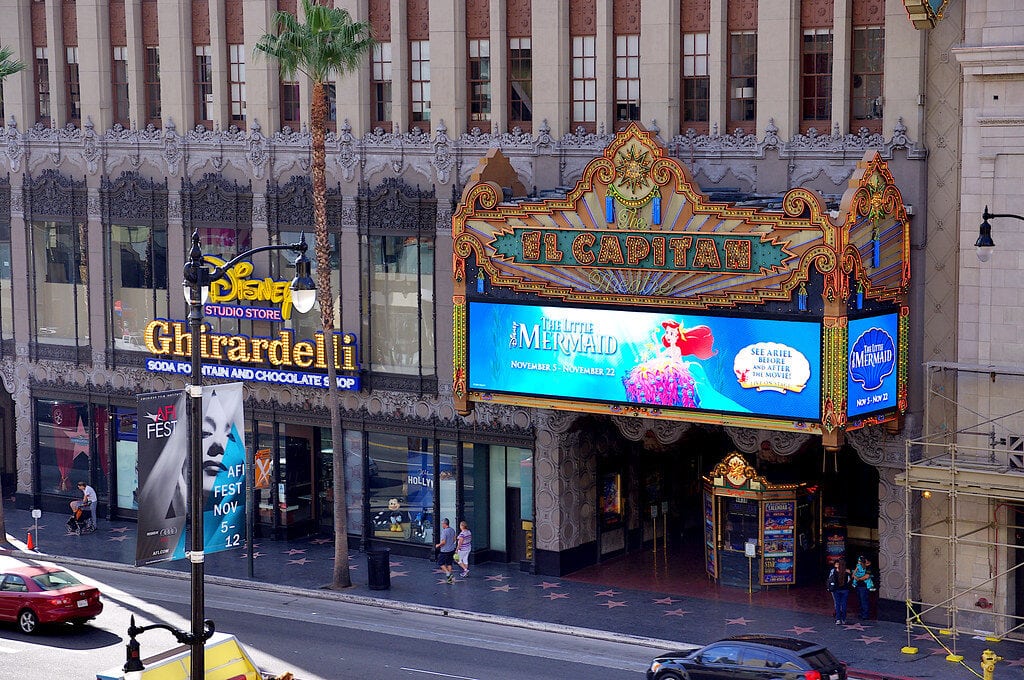
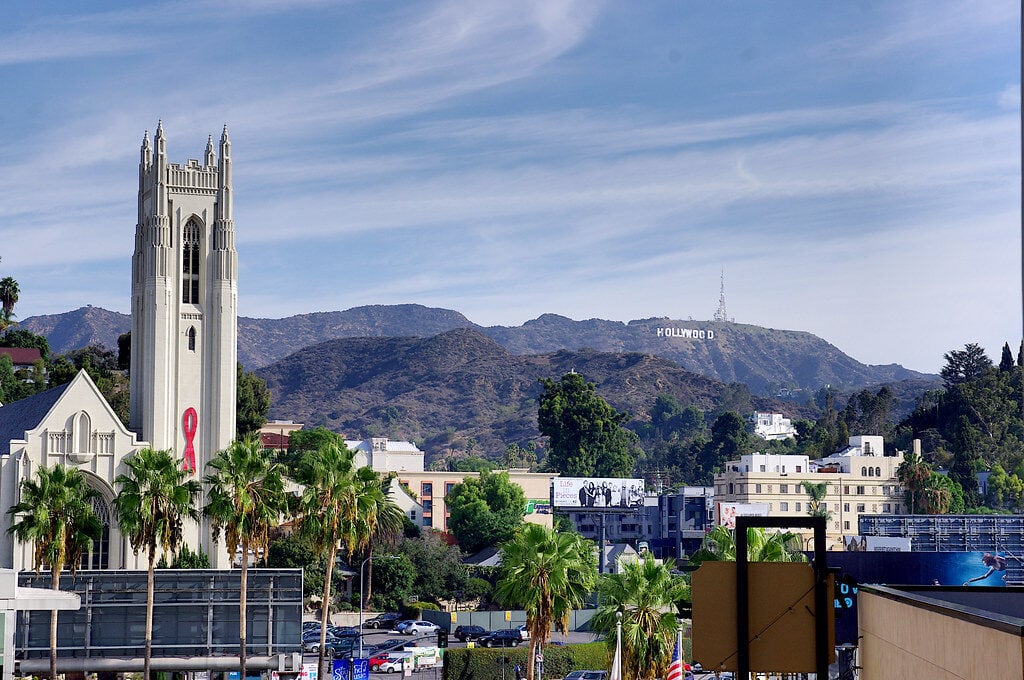
It sits on the same 7.6-acre site it has always occupied, above the Hollywood and Highland Metro station, beside the Dolby Theatre, across Hollywood Boulevard from the El Capitan Theatre, with the Hollywood Sign visible from the upper floors on a clear day.
The Walk of Fame runs along its entire southern edge.
The Loews Hollywood Hotel has 628 guestrooms and suites inside the same development. Wolfgang Puck runs his regional headquarters out of it.
The Oscars Governors Ball fills the Ray Dolby Ballroom after the Oscars each year, until the Oscars announced they are moving to the Peacock Theater in 2029.
It is currently under receivership management with occupancy at 69 percent.
The Hollywood Hotel Opened Here in December 1902
Prospect Boulevard was the name of the street when the Hollywood Hotel held its opening reception on December 19, 1902. The city had not yet renamed it Hollywood Boulevard.
Architects Dennis and Farwell designed the hotel in Mission Revival style, with a wraparound porch and landscaped grounds planted to draw people toward the intersection of Prospect and Highland, which was at that point the edge of a small, semi-rural town.
Motion picture companies moved into the surrounding neighborhood by the 1910s.
Through that decade and the 1920s, the early film colony used the hotel as a social base. Directors, producers, and performers moved in and out of its rooms.
It operated for more than fifty years. In August 1956, it came down. On the cleared footprint, a twelve-story building went up for the First Federal Savings and Loan Association of Hollywood.
A small shopping center and surface parking lots filled the rest of the block. Those structures stood for four decades, until 1998, when they were demolished to make way for Hollywood and Highland.
Hollywood & Highland: The $90 Million Public Bet Behind a $615 Million Project
The Community Redevelopment Agency of the City of Los Angeles put at least $90 million into the project in 1998 - $60 million toward an underground parking garage and $30 million toward a live-broadcast theatre intended to permanently relocate the Academy Awards to Hollywood Boulevard.
Developer TrizecHahn took a 55-year lease on 1.35 acres of Metropolitan Transportation Authority land at $492,000 per year, with rent increases built in every five years and four optional 11-year extensions at the back end.
Workers excavated 650,000 cubic yards of earth, poured 72,000 cubic yards of concrete, and installed 12,000 tons of steel.
The six-level underground parking structure held 3,002 spaces across roughly 1.1 million square feet.
The Rockwell Group, Altoon Partners, and Ehrenkrantz Eckstut and Kuhn Architects shared the design work. The project was sited directly above the Red Line station.
Hollywood and Highland opened on November 9, 2001, with about 70 shops and restaurants, a 179,000-square-foot theatre with 3,600 seats, and a 25,000-square-foot Grand Ballroom.
The Kodak Theatre and the Return of the Oscars to Hollywood Boulevard
The roughly 3,400-seat theatre was built in large part to bring the Academy Awards back to Hollywood.
The ceremony had spent years at venues nowhere near the boulevard that bears the industry's name, and the city had put $30 million in public funds specifically toward a theatre that would fix that.
In 2002, the Academy Awards were held at the Kodak Theatre, inside Hollywood and Highland, for the first time.
The theatre's entrance tower, designed by David Rockwell, rose above Hollywood Boulevard as a formal gateway. The Grand Ballroom hosted the Governors Ball the same night.
The Kodak naming rights did not survive. After Kodak filed for bankruptcy protection in 2012, the theatre was renamed the Dolby Theatre.
The stage is 120 feet wide and 75 feet deep. Wolfgang Puck Catering holds the exclusive food and beverage contract.
The theatre is within Ovation Hollywood. It has hosted the Oscars since 2002, except in 2021.
Curbed Named It the Ugliest Building in Los Angeles in 2007
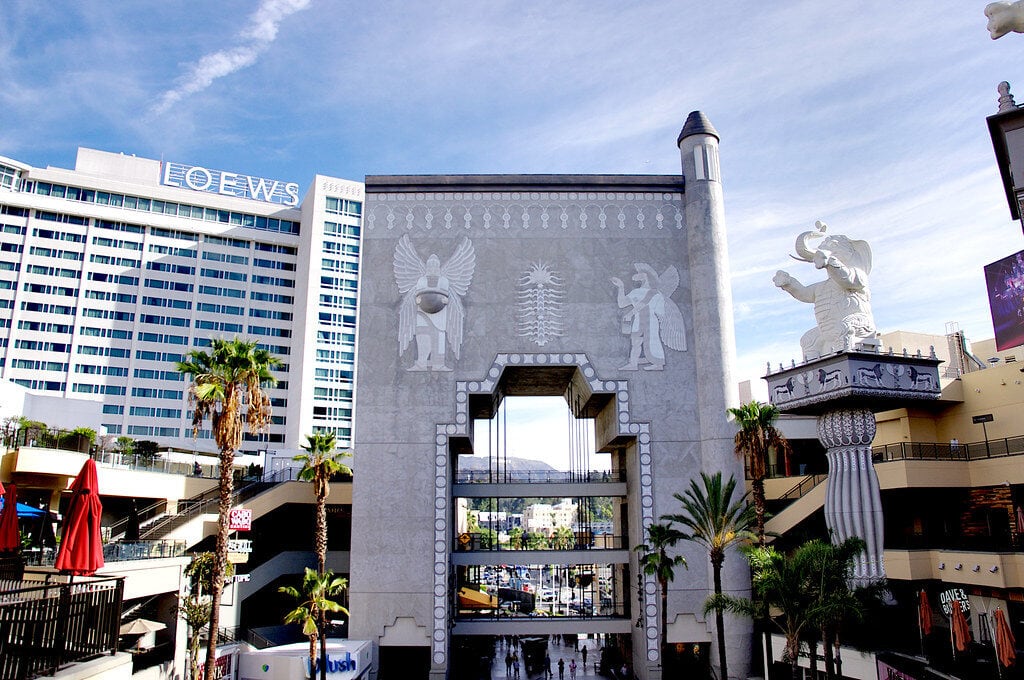
TrizecHahn had commissioned a stylized recreation of the set D.W. Griffith built for his 1916 film "Intolerance" - the massive Mesopotamian palace sequence that required one of the largest sets ever constructed in early Hollywood.
The two elephant sculptures on their columns, the oversized archway, and the three-story open courtyard were modeled on Griffith's original rather than built to the same dimensions.
Visitors standing in the Babylon Court could get a rough sense of how large the film set had been.
In 2007, Curbed L.A. ran a contest for the ugliest building in Los Angeles. Hollywood and Highland won.
The publication cited the visual confusion of the design, the blank wall the complex presented to pedestrians along Highland Avenue, internal circulation that left visitors unsure where anything was, and a general collision of architectural styles across the facade.
In 2002, the city entered into a Development Agreement to extend special exemptions from Los Angeles billboard ordinances for an additional 20 years, despite objections from some residents and neighbors.
Then-City Councilman Eric Garcetti, representing the Hollywood district, supported the extension. He was elected mayor in 2013.
CIM Bought Hollywood & Highland in 2004 for About $200 Million
Trizec Properties sold its stake in Hollywood and Highland to CIM Group for more than $200 million in early 2004, less than three years after the complex opened.
CIM aimed to reduce the center's reliance on tourists and make it more useful for local residents in Los Angeles.
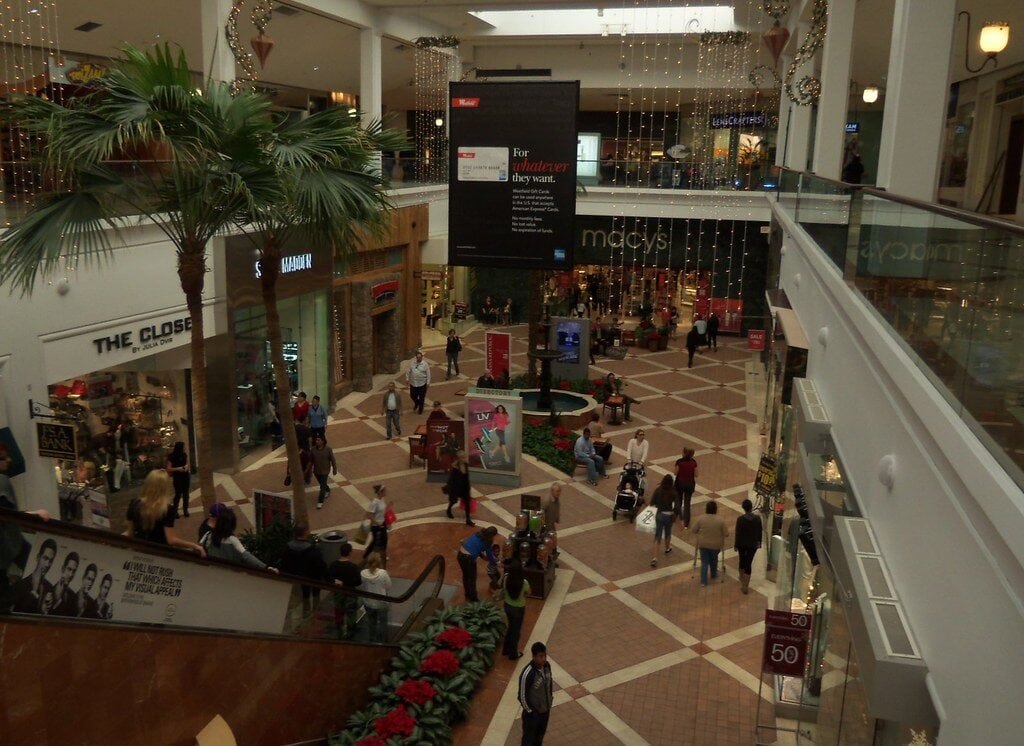
Changes included adding escalators from Hollywood Boulevard up to the third-floor courtyard, improving lighting, installing video screens, and bringing in tenants aimed more at local residents.
The escalators and updated signs were completed in 2005. In 2004, a studio inside the complex hosted Ryan Seacrest's daily show "On Air With Ryan Seacrest." That studio space was later used by Revolt TV.
The site drew heavy foot traffic from nearby attractions like the TCL Chinese Theatre, the Hollywood Walk of Fame, and events at the Dolby Theatre.
Even with those crowds, it was hard to turn visitors into steady retail sales during CIM's fifteen years of ownership. In 2019, CIM sold the property to DJM Capital Partners and Gaw Capital USA for $325 million.
The Renovation Removed the Elephants and Added 100,000 Square Feet of Office Space
DJM Capital Partners and Gaw Capital USA completed their $325 million purchase in 2019. The Dolby Theatre was not included in the deal.
Work on the public areas of the mall started in 2021 and lasted about 23 months. Gensler led the redesign, and RSM Design handled wayfinding and placemaking graphics.
The Babylon-themed design elements were removed in 2021. Crews took out the elephant statues and the faux-Mesopotamian decorations.
The main archway was updated with a mural by Geoff McFetridge. The color scheme changed to mostly white.
The project also added new landscaping, clearer signage, wider walkways, and a more open central plaza, replacing the original Babylon Court.
The renovation turned former dining areas into office space, adding about 100,000 square feet of offices on the upper floors.
The complex was renamed Ovation Hollywood in March 2022. It reopened in 2023. Foot traffic increased by 110 percent compared to 2022, bringing in about 500,000 more visitors.
New tenants included Cafe de Leche, Tacos Neza, The Win-Dow, BOPOMOFO, and Kookaburra Lounge.
By June 2024, a $211.3 million loan on the property had moved to special servicing as it approached maturity default. Occupancy stood at 77 percent in 2023 and fell to 69 percent by December 2024.
Spinoso Is Running the Property Now, and the Oscars Leave After 2028
Spinoso Real Estate Group took over as receiver, property manager, and leasing agent for Ovation Hollywood in May 2025.
The site includes 463,000 square feet on 7.6 acres. It attracts about 25 million visitors annually and sits above the Hollywood/Highland Metro station.
Key anchors include Sephora, Hard Rock Cafe, Foot Locker, Lucky Strike, Dave and Buster's, JAPAN HOUSE LA, and the TCL Chinese Theatre.
La Popular opened there on September 22, 2025. The Mexico City restaurant has views of the Hollywood Sign from its dining room.
The property was valued at $257 million in March 2025, down 24 percent from its $338 million valuation in 2019.
In 2026, the Academy of Motion Picture Arts and Sciences and AEG announced that the Academy Awards will move to the Peacock Theater at L.A. Live starting with the 2029 ceremony.
The Dolby Theatre will continue hosting through 2028 and has hosted the Oscars there since 2002, except in 2021.
Independent Publisher Notice
BestAttractions is an independent editorial publisher. We are not affiliated with, endorsed by, or acting on behalf of any location, business, property owner, manager, government agency, or organization described in this article.
Comments posted on this page are not forwarded to, reviewed by, or acted upon by any entity mentioned in the article.
For official inquiries, complaints, applications, bookings, or other requests, please contact the relevant entity directly through its official website or other verified channels.