
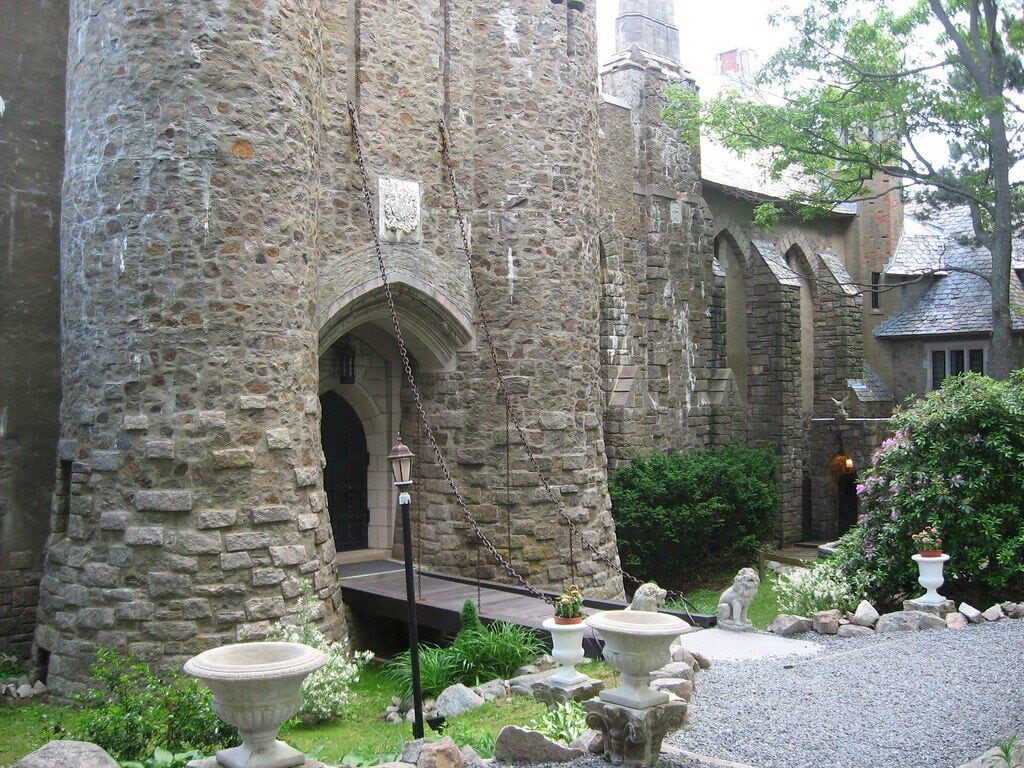
Standing on Hesperus Avenue in Gloucester, Massachusetts, sits a stone castle above the Atlantic. The inventor John Hays Hammond Jr. built it between 1926 and 1929 and called it Abbadia Mare.
He set genuine medieval and Renaissance fragments into new concrete and masonry, then had the new work carved and distressed to match.
Hammond had no children. In February 1965 the castle passed to the Catholic Church, which gave it up 10 years later. A nonprofit has run it since February 3, 1975.
Today the doors open daily at 9:00 a.m. The tower is under repair, and the Great Hall organ is being restored chamber by chamber.
Hammond Castle began as a different building
In November 1923, the Boston firm Allen & Collens drew John Hays Hammond Jr. a castle: a narrow tower house 120 feet tall, planned for his family's summer estate at Lookout Hill in Gloucester, Massachusetts.
Hammond was an inventor. In 1914 he had steered the vessel Natalia from Gloucester to Boston by radio from shore.
By 1924 he wanted a stone building that would outlast his inventions, and he cut the tower's planned height to 87 feet.
He was also courting Irene Fenton, a Gloucester artist, and his mother objected.
Hammond left the estate and bought a rocky oceanfront parcel a mile south, at what is now 80 Hesperus Avenue.
The thin tower didn't suit the new ground. The design came back lower and much wider, and construction began in 1926.
New concrete, carved to look worn out
Building went on until 1929, and nearly everything holding the place up was modern: concrete, masonry, timber.
A large share of the labor went into hiding that.
Crews beat and scarred fresh wood and stone.
On the poured-concrete spiral stair, workers carved and polished shallow depressions into the treads to imitate the wear centuries of feet would have left.
In the courtyard, new plaster and framing were distressed so they'd sit beside three genuine French village storefronts without an obvious seam.
Hammond was abroad for part of the first building season, and an engineer from his laboratory ran the site.
Nobody walking through was supposed to notice where the old stone stopped.
A green pool nine feet deep, with weather
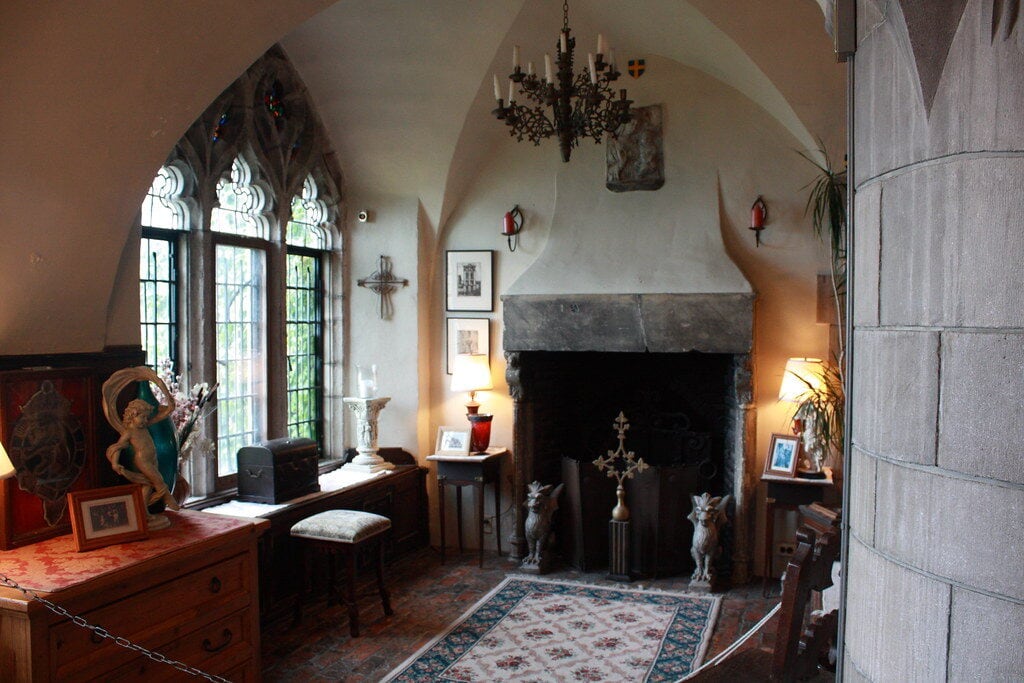
The Great Hall runs almost 70 feet: timbered ceiling, rose window, a large French fireplace, galleries, and the pipe organ.
Hammond had the stone shaped with acoustics in mind, so sound research was built into the room before anyone played in it.
The courtyard was the stranger space.
Its pool holds 30,000 gallons and drops to almost nine feet, and Hammond had the water dyed green so nobody could judge the bottom.
He also ran lighting, steam, and water pipes that could fog the courtyard or produce artificial rain. The rain watered his tropical plants.
The round library's dome carried sound across the room.
One guest room had concealed controls and unusual doors, and hidden passages connected parts of the building.
Gershwin played here, Disney screened Fantasia
The museum organization was incorporated in 1930, and the castle opened to visitors while the Hammonds were still living in it.
Household rooms, working laboratories, medieval stone, and purpose-built stage effects all shared the same building.
George Gershwin performed there. Walt Disney held a private screening of Fantasia in the Great Hall.
John D. Rockefeller Jr. came through while planning the Cloisters in New York.
On September 9, 1948, Marcel Dupré gave an organ concert that was recorded live, and the museum has since digitized and released it.
Hammond kept working the whole time: radio control, acoustics, recording, television, guidance systems for the military.
The building carried two subjects at once.
Some of the medieval pieces aren't medieval
Plenty of the old material is exactly what it looks like.
An archway in the courtyard is 11th-century tufa, said to have come from a church at Ravello.
A carved child's sarcophagus dates to around AD 290 to 310, and Hammond used it as a diving platform at the pool.
A Flamboyant Gothic portal left the Château de Varaignes in France when it was sold in the late 1920s, and the town lost track of it.
Researchers from Varaignes identified it at Hammond Castle in 2014.
Other objects moved the opposite way.
Hammond bought a marble Virgin and Child relief as a Renaissance work; the museum now catalogs it as modern, connected to the sculptor Alceo Dossena, whose output was sold through dealers as older art.
The Church gave up Hammond Castle in 1975
On February 12, 1965, the castle stopped being a home.
Hammond had no children, and the property passed to the Catholic Church under the Archdiocese of Boston, led by Cardinal Richard Cushing, a friend of his.
Hammond wasn't Catholic. His collection was full of Christian medieval material.
The Church ran the museum for about a decade, then withdrew. Keeping an exposed coastal building open cost money whether anyone visits or not.
On February 3, 1975, Hammond Museum, Inc. took responsibility for the property.
The castle had gone onto the National Register of Historic Places on May 8, 1973.
It's often called a National Historic Landmark. It isn't one; Gloucester's two are Beauport and the schooner Adventure.
A $750,000 sale, and a casket that had to move
Salt, wind-driven rain, and freeze-thaw cycles work on the stone every winter, and old fragments sit inside newer walls, so water threatens the structure and the collection at once.
In December 2007 the board approved the sale of a parcel beside the castle for $750,000.
Another parcel on the other side held Hammond's mausoleum and was also headed for sale, so the nonprofit went to probate court for permission to move him.
It came in October 2008.
On November 24, workers took his steel casket out of the seaside crypt, broken into during the 1980s, and reinterred it in a 4,200-pound bronze vault inside the walled cat garden.
The museum has leaned on public grants, including $135,000 from the city in December 2019 to replace the courtyard's cracked glass roof.
The organ has been silent for two decades
Every round of tower work found the same problem: water in the masonry had reached the interior plaster and the organ chambers.
The organ's more than 8,000 pipes sit in seven chambers inside that tower, so each chamber's walls can't be repaired until its pipes and components come out.
It hasn't played since the 2000s.
The 2026 phase costs $404,000 and covers two chambers: pipes restored, walls replastered, everything put back.
The other five are staged through 2029, the year the finished castle turns 100.
The museum stays open while the work goes on, daily from 9:00 a.m. to 3:30 p.m. Ticketed visits reached 75,000 in 2024, and Gloucester residents get in free every Tuesday.
A 1920s house built for one couple now takes that traffic while the repairs run around it.

Independent Publisher Notice
BestAttractions is an independent editorial publisher. We are not affiliated with, endorsed by, or acting on behalf of any location, business, property owner, manager, government agency, or organization described in this article. Comments posted on this page are not forwarded to, reviewed by, or acted upon by any entity mentioned in the article. For official inquiries, complaints, applications, bookings, or other requests, please contact the relevant entity directly through its official website or other verified channels.