
Hot Springs National Park makes more sense once you stop expecting a wilderness-first park.
Its defining experience is the meeting of thermal water, historic bathhouses, downtown streets, and wooded hills.
Congress first protected the hot springs as a federal reservation in 1832; today, the best first visit still starts with the water and the buildings created around it.
That means you do not need a long attraction checklist. Start with Bathhouse Row and Fordyce, decide whether you actually want to soak, then choose how much walking, hiking, or viewpoint time fits your visit.
Quick picks for your first visit
| If you want... | Start with | Add if time allows |
|---|---|---|
| The essential first visit | Fordyce + Bathhouse Row | Grand Promenade |
| The thermal experience | Fordyce + visible springs | A bath at Buckstaff or Quapaw |
| Easy outdoors | Bathhouse Row + Grand Promenade | Scenic drive or overlook |
| More hiking | Historic core in shorter form | Peak Trail or a longer trail combination |
A visitor with only a few hours should protect the first row.
A full day gives you room to add a soak or a more substantial outdoor block without rushing the park's historic core.
Start with Fordyce and Bathhouse Row
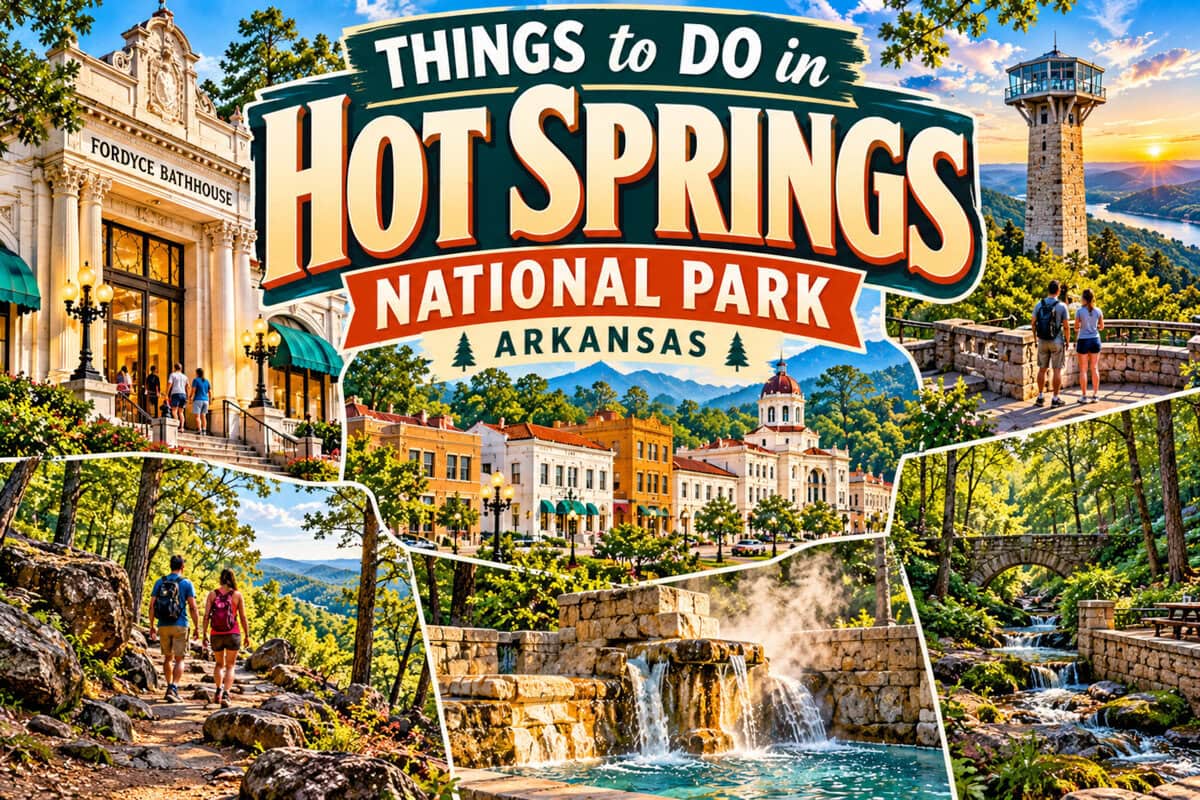
The Fordyce Bathhouse is the best orientation stop because it shows what "taking the waters" once meant.
The restored building has three main floors and a basement, with marble bath halls, stained glass, treatment spaces, historic furnishings, and exhibits on the use of thermal water.
Seeing those rooms first makes the rest of Bathhouse Row easier to understand.
Outside, the Row contains eight surviving bathhouse buildings constructed between 1892 and 1923. Do not treat them as eight separate attractions.
Walk the district as one historic landscape, noticing how the formal architecture sits directly below the wooded slope of Hot Springs Mountain.
This is also where the park's thermal story becomes physical.
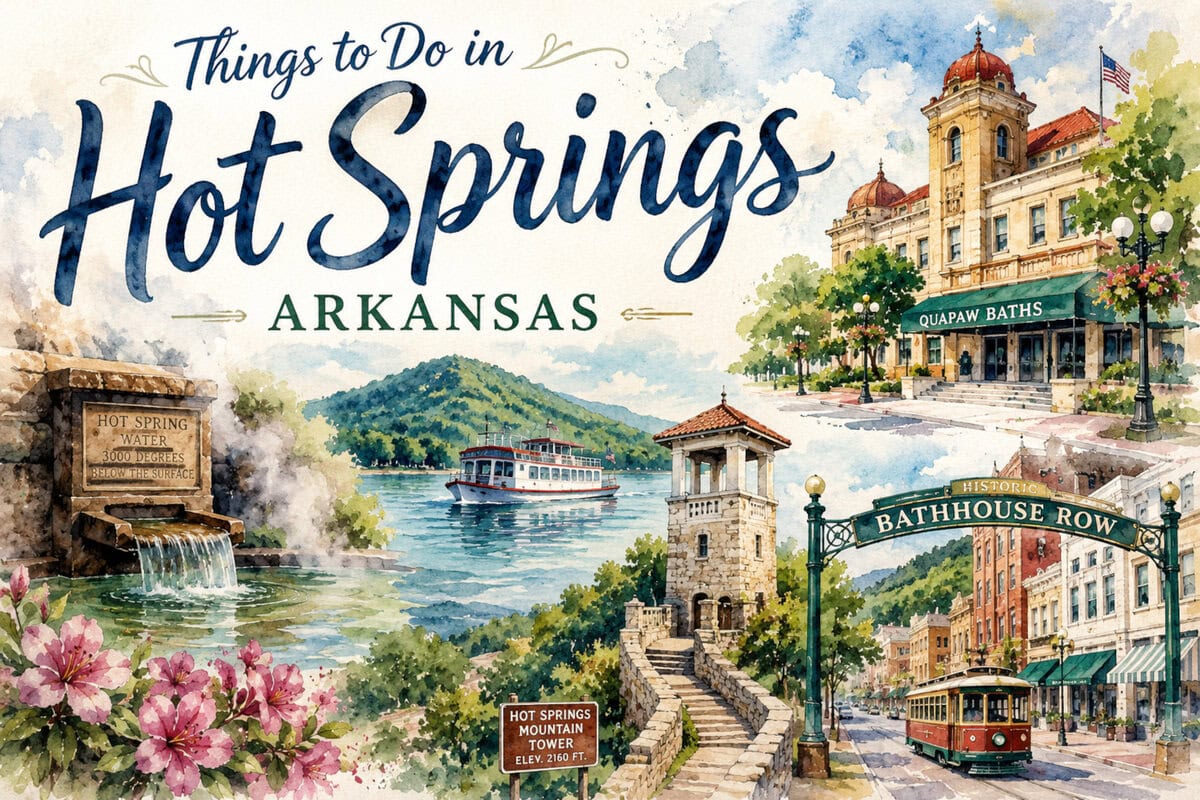
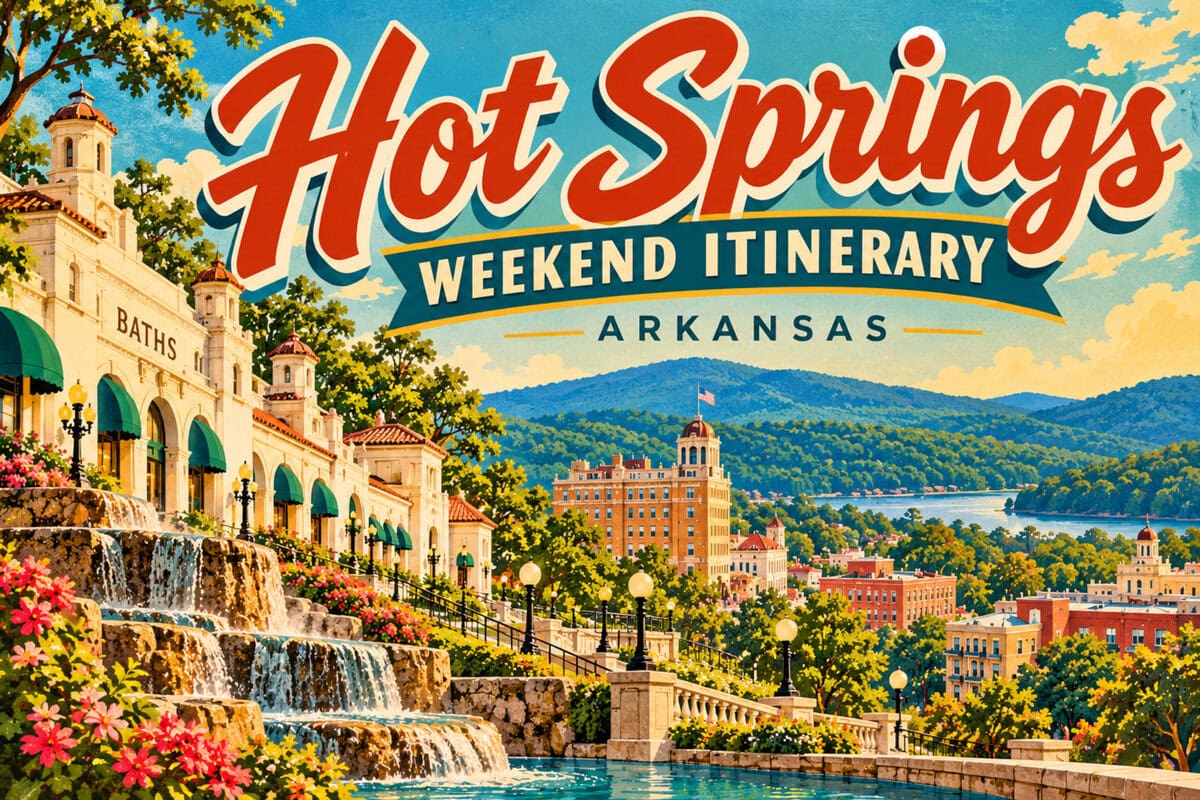
The Hot Water Cascade on Arlington Lawn and other display springs let you see thermal water above ground.
The water emerges much hotter than a normal swimming pool, so the visible springs are for observing or touching only where the park allows-not for outdoor soaking.


Decide whether you want to see the water or soak in it
"Visit the hot springs" can mean very different things here.
You can understand the park without booking a bath, but soaking can become the most memorable part of the visit if thermal bathing is one of your reasons for coming.
| Experience | What you actually do | Best fit |
|---|---|---|
| See and learn | Fordyce, Bathhouse Row, display springs, fountains | Short visits, history-first travelers |
| Traditional bath | Guided historic-style bathing at Buckstaff | Visitors who want the old bathing ritual |
| Thermal pools / spa | Public pools or private thermal services at Quapaw | Visitors who prefer a more modern soaking experience |
There is no outdoor soaking in the park's natural springs. Full thermal-water immersion on Bathhouse Row is offered through Buckstaff and Quapaw.
Their service formats, eligibility rules, hours, and booking systems can change, so check the current bathhouse information before building the rest of your day around a soak.
If bathing is not your thing, skip it without guilt. Fordyce, the Row, and the visible thermal features still explain the park's central story.
Walk the Grand Promenade before deciding how much to hike
The Grand Promenade is useful because it connects the historic district with the outdoor side of the park.
The paved half-mile route runs above Bathhouse Row and provides access toward several mountain trails.
It works well for visitors who want greenery and elevation without committing to a real hike.
For more effort, Peak Trail is a compact but noticeably steeper option.
It climbs from near the Grand Promenade toward Hot Springs Mountain Tower; its roughly 0.6-mile length gains about 400 feet, so "short" does not mean flat.
If hiking is one of your main reasons for visiting, the Hot Springs and North Mountain network lets you combine multiple interconnected trails.
Sunset Trail is a different commitment again: it belongs in a hiking-focused visit, not a default first-timer checklist.
The key is to choose an outdoor level rather than simply adding "hiking" to the day.
Match the park area to the experience you want
| Park area | Best for | Treat it as |
|---|---|---|
| Bathhouse Row / Fordyce | Thermal history, architecture, orientation | First-visit core |
| Grand Promenade / Hot Springs Mountain | Easy walk, short hike, viewpoints | Natural extension of the core |
| Gulpha Gorge | Camping, picnicking, trail connections | Extra for a longer park visit |
| West Mountain / longer trails | More sustained hiking and quieter scenery | Hiking-first choice |
This boundary matters because many Hot Springs travel lists mix the national park with Garvan Woodland Gardens, lakes, Oaklawn, museums, and other city attractions.
Those may be worth doing during a longer Hot Springs trip, but they are not necessary to experience the national park itself.
Add a viewpoint only if the view matters to you
Hot Springs Mountain Tower gives you a broad panorama without requiring a long hike.
You can drive toward the summit area or reach it from the trail system, then use the tower's elevator to reach the observation decks.
It is an optional scenic payoff, not part of the irreducible park core. If you already want to hike, a trail and overlook may give you enough scenery.
If hiking is limited, the tower and scenic mountain roads can add elevation and views with less physical effort.
That same logic should control other optional stops: add an activity because it solves a specific job, not because another list called it a must-do.

What fits if you only have a few hours?
With roughly one to two hours, focus on Fordyce, Bathhouse Row, and the visible thermal-water features.
Add part of the Grand Promenade if your pace allows.
With half a day, keep that core and choose one meaningful extra: a thermal bath, a short hike, or a viewpoint.
With a full day, you can combine the historic core with both a thermal experience and a stronger outdoor block, but there is still little reason to chase every trail, overlook, bathhouse, and secondary park area.
The first things to cut are the second viewpoint, a long trail that does not match your priorities, and anything outside the park that has slipped onto the list.
Adjust the visit for mobility, weather, and kids
Hot Springs is unusually forgiving if substantial hiking is not possible.
The Bathhouse Row walkway is paved, Fordyce is accessible, and the Grand Promenade has ramp access from selected points.
The promenade itself is paved and has benches, making it a more useful outdoor option for many lower-mobility visitors than the steeper mountain trails.
Families should check current bathhouse age rules before promising a soak to everyone.
For children who would rather move than spend a long time with exhibits, keep Fordyce focused, use the Row as the history lesson, and add a short walk rather than another indoor stop.
Rain does not erase the park's value because Fordyce and thermal bathing remain meaningful.
In summer heat, do the harder trail portion earlier and save the historic or soaking portion for later.
Practical decisions before you go
| Decision | Check before arrival | Why it matters |
|---|---|---|
| Thermal bath | Current service, age, health, booking, and hours rules | A soak can control the day's timing |
| Trail choice | Distance, grade, surface, alerts, weather | Short trails can still be steep |
| Mobility route | Ramp location, surface, benches, total distance | “Accessible” does not describe the whole route |
| Tower / scenic road | Current hours, fee, road conditions, visibility | The view is optional and weather-dependent |
The park works best when you make those choices before arrival and leave the rest flexible.
Frequently asked questions
How much time do you need in Hot Springs National Park?
A few hours are enough for Fordyce, Bathhouse Row, and the basic thermal-water story.
Half a day lets you add one larger experience; a full day is better if you want both soaking and meaningful hiking.
Can you soak in the natural hot springs?
Not outdoors. The park directs visitors to active Bathhouse Row facilities for full thermal-water immersion.
Is Hot Springs National Park good for hiking?
Yes, but set the right expectation. The park has wooded mountain trails ranging from short downtown-adjacent climbs to longer trail combinations.
Its strongest identity, however, remains the combination of thermal history and urban-to-forest access rather than remote wilderness.
What can I skip on a short visit?
Skip a long trail, second viewpoint, or broader Hot Springs city attraction before cutting Fordyce, Bathhouse Row, and the thermal-water core.
Key sources and further reading
- Hot Springs National Park - Plan Your Visit
- Hot Springs National Park - Hot Springs and North Mountain Trails
- Hot Springs National Park - Accessibility
- Buckstaff Bathhouse - First-Time Visitor Guide
- Quapaw Baths & Spa - FAQs
- Hot Springs Mountain Tower - Official Site
Independent Publisher Notice
BestAttractions is an independent editorial publisher. We are not affiliated with, endorsed by, or acting on behalf of any location, business, property owner, manager, government agency, or organization described in this article.
Comments posted on this page are not forwarded to, reviewed by, or acted upon by any entity mentioned in the article.
For official inquiries, complaints, applications, bookings, or other requests, please contact the relevant entity directly through its official website or other verified channels.