
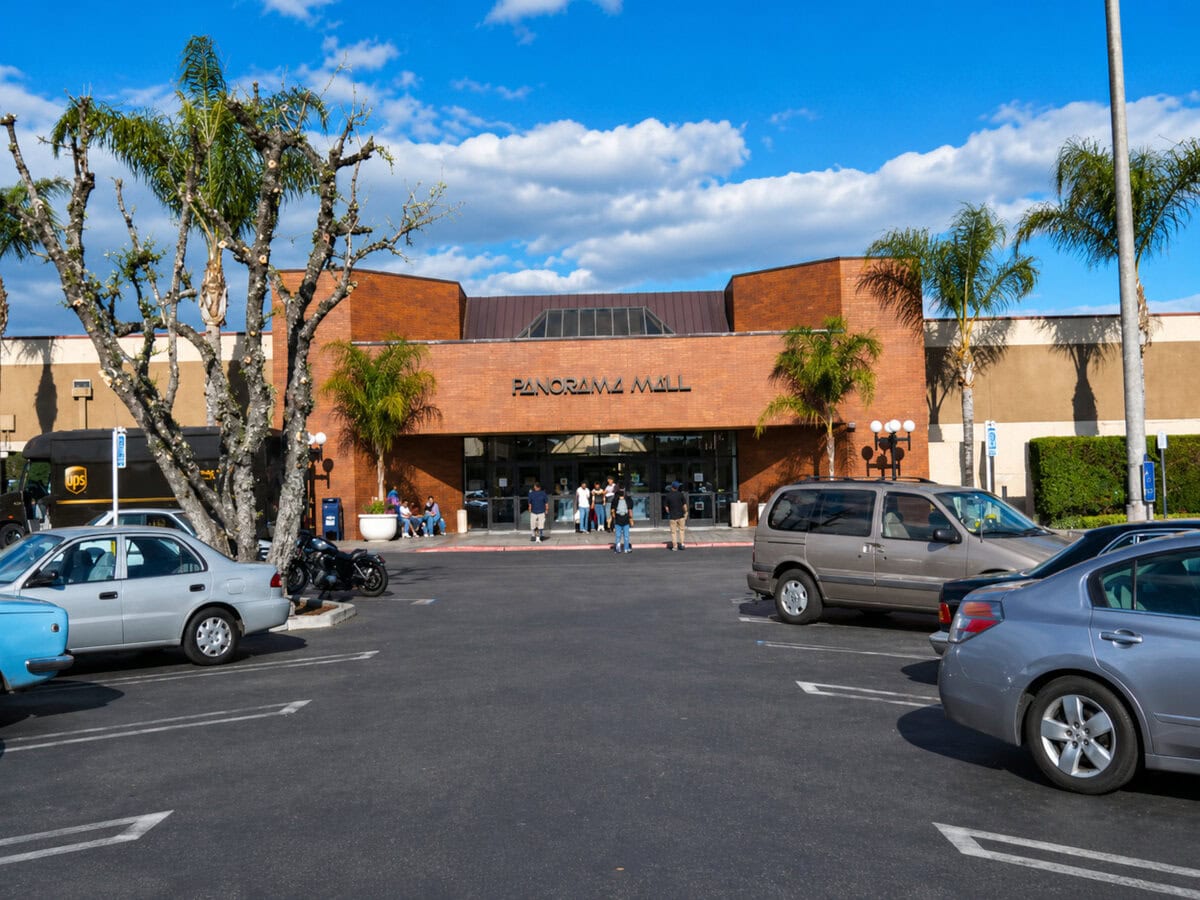
Panorama Mall is an enclosed shopping mall in Panorama City, in the northeast San Fernando Valley section of Los Angeles.
It began in 1955 as an open-air strip of shops beside a large Broadway department store and was roofed over into an indoor mall in 1980.
A few things set it apart. It once anchored a district that promoted itself as the first center with four major department stores.
It later held the first multi-level Walmart in the United States, opened inside the old Broadway building.
Today it is proposed for replacement by a mixed-use project of more than 5 million square feet, with apartments, a hotel, and towers up to 30 stories tall.
Panorama City was planned before the mall opened
Between 1947 and 1952, Kaiser Community Homes built about 3,000 houses in Panorama City, in the northeast San Fernando Valley, using prefabrication methods its companies had refined during the war.
The houses were modest, and the streets curved. A General Motors assembly plant had started production south of Roscoe Boulevard by late 1947, so the new residents had factory work close to home.
Fritz B. Burns and Henry J. Kaiser planned the district around homes, nearby jobs, medical care, and shopping in one part of the Valley, so families would not have to cross it for daily errands.
Large-scale shopping came after the first homes and factory jobs, and it arrived with its customers already in place: young families, veterans, and the people building cars a few blocks south.
Van Nuys Boulevard ran along the west side of the original tract and through the commercial center, one of the Valley's main north-south routes.
That location helped shape much of what came after.
Panorama City's 1955 opening and the Broadway anchor
The Broadway-Valley shopping center opened on October 10, 1955, as an open-air strip next to one large store.
The Broadway department store carried it: a three-story building of 226,000 square feet designed by Welton Becket and Associates, one of Southern California's major midcentury firms.
The strip beside it held 89,000 square feet of smaller shops. The layout followed the standard regional-shopping format of the period: one large anchor, smaller shops, drive-up access, and a shared surface lot.
The early lineup was full of names a 1955 shopper would know: Silverwoods, Mandel's, Kinney Shoes, Lerner's, and Woolworth.
No roof covered the walkway. People parked, walked the strip in the open air, and went into Broadway, which was large and modern enough to pull shoppers on its own.
Broadway set the pattern for what came after. The later anchors went up around it, each in its own building, surrounded by the parking fields that defined the district.
How Panorama City got four department stores by 1964
Many suburban centers of the era had one anchor, maybe two. Panorama City had four within a decade. J.W. Robinson's opened on June 27, 1961, aimed at shoppers who wanted a higher-end store.
Montgomery Ward opened that September in a two-story building of 154,500 square feet, adding a national general-merchandise and catalog retailer.
Ohrbach's came on October 7, 1964, a two-story store of 115,000 square feet on 7.5 acres, built with sculptured concrete panels that emphasized the structural frame.
It cost $5 million. With Ohrbach's open, the district called itself the first center with four major department stores, and the wider Panorama City Shopping Center featured more than 100 stores.
The commercial core sat close to the tract houses, the GM plant, and local medical offices, so residents could shop, work, and keep appointments in the same part of the Valley.
The four stores stood as separate buildings with their own lots, tied together by a shared name and a shared idea about how the Valley would shop.
The 1980 enclosure that made it Panorama Mall
By the late 1970s, the open-air center had aged, and larger Valley shopping centers had pulled regional shoppers elsewhere, especially Northridge Fashion Center.
The Sherman Oaks Galleria arrived in 1980, and Sherman Oaks Fashion Square would later follow the same enclosure trend. In 1979, Macerich and a mortgage-investment partner bought the mall and began its next act.
The next year brought the change that gave the place its lasting shape. Macerich spent $7 million to enclose and remodel the mall, add more shops, and connect the building directly to Broadway.
The outdoor strip became an indoor corridor.
The work also put a stainless-steel sculpture, formed as intertwining rings, inside the new mall as a focal point, the kind of touch malls used then to give an enclosed corridor some civic feel.
Anchor closures: Ohrbach's, Robinson's, Broadway, Ward
The department-store district that made Panorama City exceptional came apart one store at a time. Ohrbach's went first, sold in September 1986.
Its building became the Valley Indoor Swap Meet, which put a different kind of seller and a different kind of shopper inside the same concrete shell.
Robinson's closed in 1987, and its building was torn down in 1995.
Broadway closed in 1996, ending the anchor that had opened the center in 1955. Montgomery Ward closed in 2001 when the national chain went under, and its site later became a separate redevelopment parcel.
Woolworth, one of the original 1955 tenants, was gone by the time Curacao opened in its old space in 1995.
In 1986, before most of those closures, the mall still held 54 shops and three large department stores and took in more than $68 million in sales.
It ranked 40th among 61 regional malls in Los Angeles and Orange counties. Northridge Fashion Center, with 137 stores, ranked fifth.
La Curacao, Walmart, and a new kind of anchor
When La Curacao opened at Panorama Mall in 1995, its grand opening drew a crowd of more than 40,000 people.
Shoppers spilled into the parking lots and surrounding streets until fire officials shut the event down for safety.
The store sold electronics, appliances, and furniture, offered credit, ran Spanish-language customer service, and handled transactions for customers with family in Latin America.
It served the neighborhood the Valley had become.
Walmart followed in May 1998, taking over the empty Broadway building. It was the first Walmart in the City of Los Angeles and the first multi-level Walmart in the country.
Walmart had already been pushed away from a nearby Van Nuys Drive-In proposal by traffic objections, and reusing a closed department store gave it a cleaner way in.
The two stores drew overlapping but distinct shoppers, and traffic rose as people used both.
By the late 1990s, the district mixed a national discount store, a Latino-oriented hard-goods anchor, the nearby Valley Indoor Swap Meet, and small shops around the old mall core.
La Curacao shortened its name to Curacao in 2012.
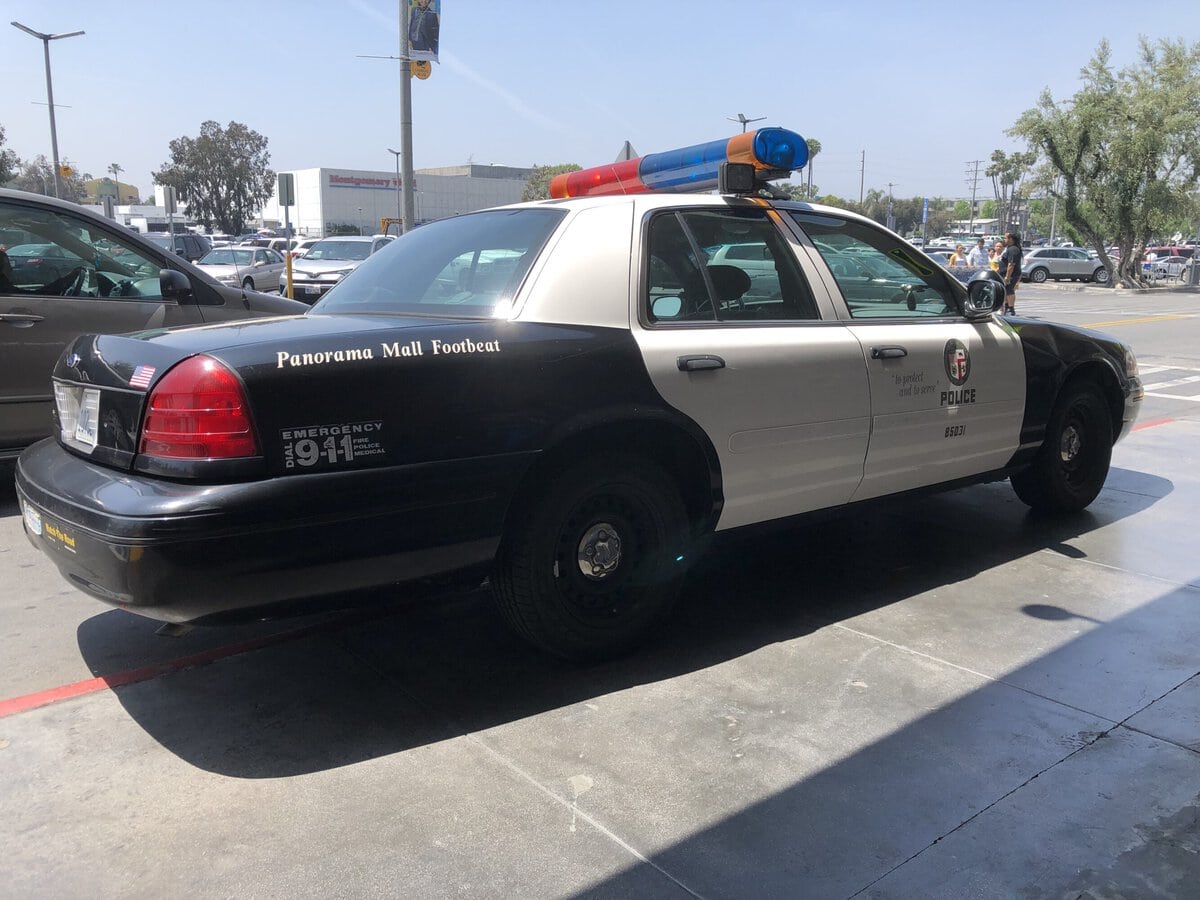
Primestor's plan to replace the mall entirely
Primestor Development bought Panorama Mall from Macerich in November 2015, in a deal reported at $90.9 million.
The sale left out the Walmart building, even though Walmart was one of the site's anchors, a hint that Primestor was buying more than a conventional enclosed mall.
The proposal is called Panorama City Center.
It would demolish the mall, two fast-food restaurants, the Walmart building, and the surface parking, then build a mixed-use district of more than 5 million square feet on 19.8 acres.
It would add up to 3,544 apartments, a 120-room hotel, retail, restaurants, entertainment including a cinema, office and medical-office space, and buildings up to 30 stories and 350 feet tall.
The horizon is long. City filings projected construction in phases over as long as 20 years, with full operation in 2043.
Primestor projects a first phase with up to 800 apartments, including income-restricted units, and lists 2028 as the projected completion date for that first phase.
Who gets to stay as Panorama City Center moves ahead?
Primestor began talking with community groups in 2016, before the project had entered its later public-review phase, and the meetings turned formal as the plan moved forward.
Sessions through 2022 and 2024 covered building heights, density, plazas, parking, construction impacts, housing affordability, local hiring, and accessibility.
Some met in the mall itself, others at the Panorama City Branch Library and Panorama High School.
The hardest question is who gets to stay. Existing tenants would be offered first-come, first-served opportunities for space in the new project, with time to decide whether to remain or move.
That matters here because many tenants were small, local-serving businesses in a dense, heavily Latino neighborhood.
Panorama Mall is not the only old commercial site being remade nearby. The former Montgomery Ward site became The Icon Panorama, now planned with more than 600 residences and 60,000 square feet of retail.
The earthquake-damaged Panorama Tower on Van Nuys Boulevard was bought in 2015 for renovation. The pressure on the mall is part of a wider rethinking of central Panorama City.
What Panorama Mall is in 2026, and what comes next
Curacao is gone. The company closed its Panorama Mall store during the redevelopment period because of major construction there, and sent customers to its Northridge location.
That removed one of the anchors that had defined the place since the 1990s.
Walmart still runs in the old Broadway building at 8333 Van Nuys Boulevard, open 6 AM to 11 PM daily. The Valley Indoor Swap Meet still operates inside the former Ohrbach's.
The mall still keeps regular store hours, and by 2026 its tenants included Osaka Japan, The Buffalo Spot, Kebab House, and House of Khan's, alongside empty suites offered for lease.
The property had 66 stores, with 17 spaces available.
A Metro light-rail line is under construction along Van Nuys Boulevard, set to open in 2031, and it is expected to run past the mall's front edge.
The pressure on the site comes from the land itself: a low-rise, parking-heavy parcel on a corner where a rail line is about to make redevelopment more attractive.
What opened in 1955 to give a new suburb somewhere to shop now waits between its enclosed past and a 30-story plan that would clear the mall site away.
Independent Publisher Notice
BestAttractions is an independent editorial publisher. We are not affiliated with, endorsed by, or acting on behalf of any location, business, property owner, manager, government agency, or organization described in this article. Comments posted on this page are not forwarded to, reviewed by, or acted upon by any entity mentioned in the article. For official inquiries, complaints, applications, bookings, or other requests, please contact the relevant entity directly through its official website or other verified channels.