Katy Mills Arrived as Shoppertainment
Katy Mills opened on October 28, 1999, after nearly three years of land negotiations, annexation work, financing agreements, construction, and local opposition.
The Mills Corporation selected a large tract south of Interstate 10, where native prairie and wetlands bordered Pin Oak Village and Falcon Point.
Early plans described a 1.6 million-square-foot mall, about 200 stores, a 30-screen theater, and hundreds of surrounding acres reserved for hotels, restaurants, offices, recreation, and other commercial uses.
The completed center was smaller, but still enormous.
It opened with roughly 1.2 million square feet of leasable space, a 20-screen AMC theater, Bass Pro Shops, Burlington Coat Factory, Saks Fifth Avenue Off 5th, Rainforest Cafe, Sun & Ski Sports, Old Navy, Books-A-Million, Bed Bath & Beyond, and a broad collection of outlet, discount, dining, and entertainment tenants.
More than 500,000 people attended the four-day grand opening, generating preliminary sales of about $16.2 million.
Mills marketed the formula as "shoppertainment." Katy Mills was not organized around a conventional hierarchy of full-line department stores.
It was designed as a regional day-trip destination where shopping, restaurants, movies, games, and theatrical architecture worked together to keep visitors inside for hours.
A Giant Loop Designed as an Attraction
The physical plan supported that ambition.
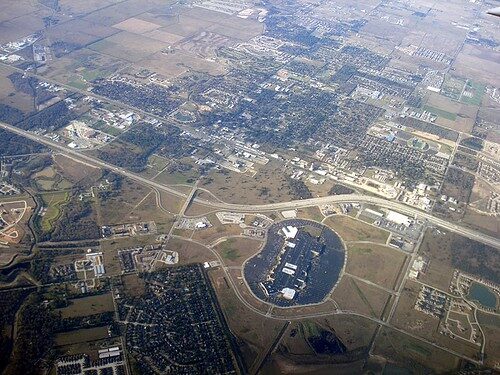
Katy Mills was built as a single-level enclosed loop, with large tenant boxes around the perimeter and smaller stores facing the interior corridor.
Visitors could enter through any numbered entrance, walk in either direction, and eventually return to their starting point without reaching a conventional dead end.
The route was divided into themed zones marked by changing colors, floor patterns, signs, lighting, sound, sculpture, and oversized decorative figures.
The original interior was unmistakably a late-1990s Mills project.
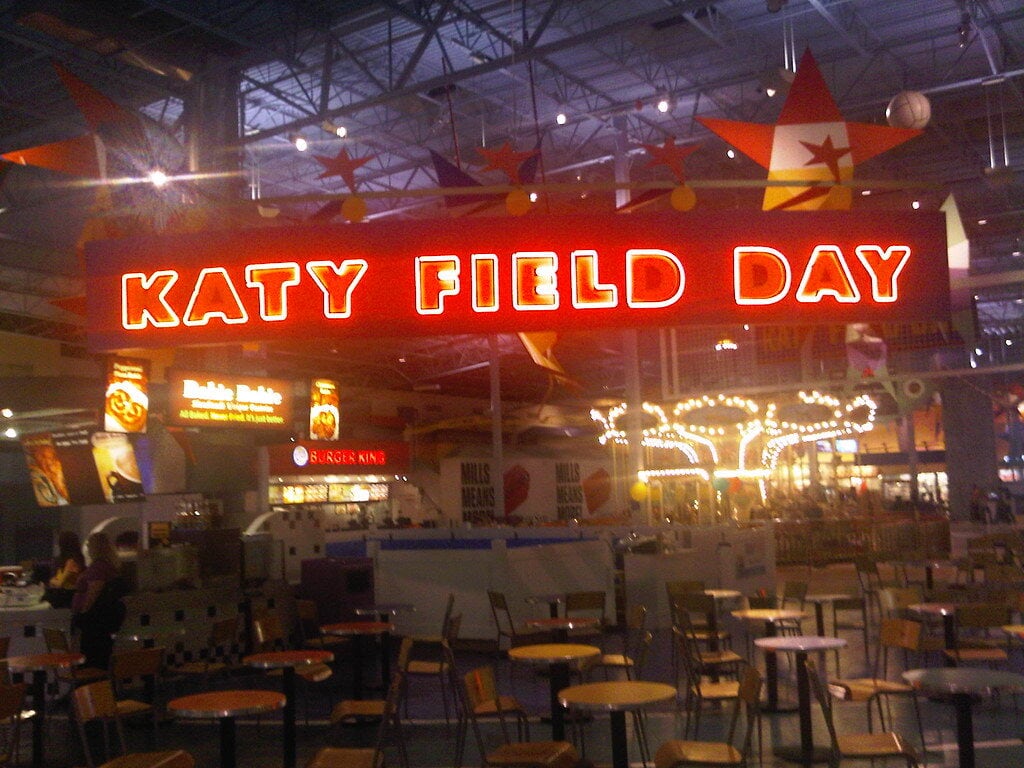
Bright primary and secondary colors covered walls and floors.
Large stars, murals, suspended objects, mascot-like figures, music, and video screens competed for attention.
The central dining area, called Katy Field Day, used an athletic-field theme with sports imagery and a scoreboard.
The building was part of the entertainment rather than a neutral container for stores.
The mall's large tenants reinforced that idea.
Bass Pro Shops, Rainforest Cafe, AMC, Jillian's, and other attractions could draw people who were not primarily looking for clothing.
The mix also reduced Katy Mills' dependence on traditional department-store chains whose failures later destabilized many regional malls.
The center still faced large vacancies when national tenants collapsed, but no single department-store lineage defined the entire property.
Public Finance Reshaped Growth in Katy
Katy Mills was privately developed, yet its arrival depended on public boundary and infrastructure decisions.
Part of the site lay within Houston's extraterritorial jurisdiction.
In 1997, Houston sold Katy the taxing and annexation rights to 408 acres for $1.25 million.
Mills advanced the purchase money, while Katy moved to annex a wider project area and establish a tax-increment structure for roads, utilities, bridges, drainage, and public facilities.
The arrangements drew resistance from nearby homeowners.
Residents objected to traffic, lighting, and the speed with which agencies handled a project unprecedented in scale for the small city, while the site's wetlands raised separate environmental questions.
Mills also pledged $200,000 to the Katy Prairie Conservancy.
The donation helped the group purchase a rice farm elsewhere, but the transaction became controversial because the seller was related to Katy's city administrator.
Officials rejected accusations of wrongdoing, while critics argued that the relationship created an appearance problem.
The economic consequences were substantial.
By 2019, Katy Mills was reported as the city's largest employer and property taxpayer, with about 3,200 workers.
The taxable value of the mall and nearby commercial property rose sharply, while hotels, restaurants, Walmart, entertainment businesses, and other development spread around the Interstate 10 corridor.
Tax-increment revenue helped finance roads, utilities, and public facilities, including the Leonard E. Merrell Center.
The mall did not create every later project, but it redirected a major share of Katy's commercial growth toward the land south of the freeway.
Shopping Days Became Family Traditions
The scale of the opening showed that Katy Mills was built for a market much larger than the historic City of Katy.
Its longer legacy, however, came from repeated family use rather than opening-weekend crowds.
A family could combine outlet shopping with a meal, a movie, a visit to Bass Pro Shops, or the spectacle of Rainforest Cafe without leaving the building.
The one-level circuit kept those activities connected, while the themed zones gave children and adults recognizable markers along an otherwise very long route.
Some opening-era businesses lasted for decades.
Bass Pro Shops, Burlington, AMC, Rainforest Cafe, Sun & Ski Sports, and Books-A-Million provided visible continuity even as other tenants disappeared or moved.
Mall management said that 31 original tenants were still operating during the 2024 anniversary.
That count was a management claim rather than an independent audit, and it did not mean every business remained in its original suite.
Still, the survival of several large 1999 tenants gave Katy Mills a visible line back to its opening year.
Harvey Turned Parking Into Relief Space
Hurricane Harvey exposed a civic function that was never part of the original retail plan.
In 2017, the enormous parking fields became emergency support space.
Austin Pets Alive and volunteers established a temporary animal-rescue operation for pets separated from owners, surrendered by displaced households, or found after the flooding.
The operation required crates, food, veterinary care, intake areas, and room for volunteers and vehicles.
A joint Texas and FEMA disaster recovery center opened in the parking lot on September 11, 2017.
It provided in-person assistance to residents and businesses seeking help after Harvey and remained there until February 20, 2018, when the agencies moved the operation to another nearby commercial property.
The same automobile-oriented scale often criticized in suburban development made Katy Mills useful during the emergency.
It had highway access, open land, a familiar address, and enough capacity for temporary facilities and large numbers of visitors.
The mall later acquired a more permanent public-safety role.
Katy Police had operated an earlier substation there from 2002 to 2011 and reopened a mall substation in 2019.
A new substation was formally dedicated inside the mall on April 23, 2022.
Police officials described it as a base for working with tenants, assisting visitors, and serving the growing entertainment district around the property.
Katy Mills remained privately controlled, but its size and centrality allowed it to function repeatedly as civic infrastructure.
Simon Modernized Away the Old Colors
The original developer did not remain in control.
The Mills Corporation expanded rapidly, then encountered accounting, debt, and development problems.
Simon Property Group and Farallon Capital acquired the company in 2007.
Simon took over management at Katy Mills through its joint venture with Farallon, while KanAm retained its minority stake.
Simon later acquired Farallon's portfolio interest.
By 2022, the ownership split remained 62.5 percent Simon and 37.5 percent KanAm.
A major modernization followed in 2018 and 2019.
Interior work replaced much of the colorful flooring, stars, themed structures, and dense decorative elements with neutral finishes, brighter lighting, new seating, charging stations, digital directories, updated dining areas, and a clearer gathering space outside AMC.
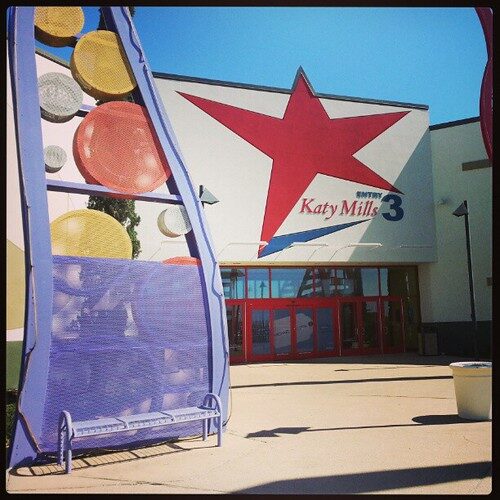
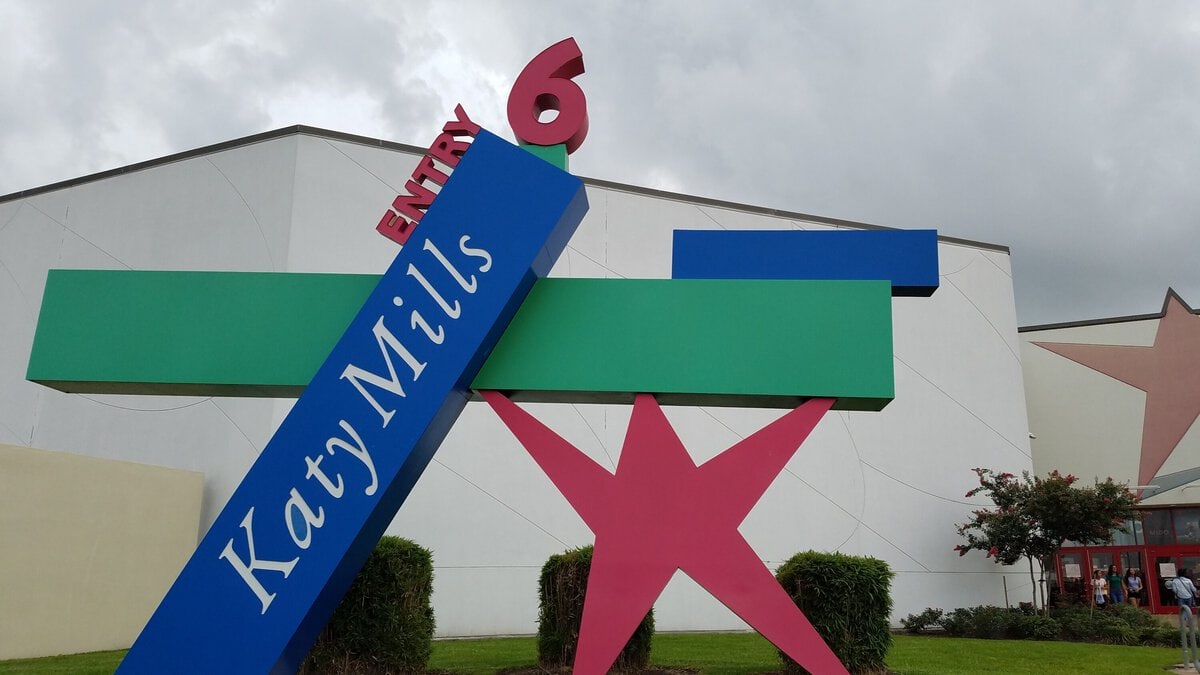
Exterior crews renovated all eight public entrances, added large illuminated numbers, improved walkways and landscaping, and replaced older entrance structures.
Mortgage records later attributed about $21.5 million in direct property spending to the interior and exterior work.
The renovation made storefronts easier to read and brought the center closer to Simon's contemporary outlet format.
It also removed much of the design that had made the mall recognizable in 1999.
The oval corridor, numbered entrances, and large perimeter boxes survived, but much of the original visual world did not.
The property remained financially productive.
Katy Mills closed from March 18 through April 30, 2020, and reported sales fell from $307 million in 2019 to $243 million in 2020.
Sales recovered to $320 million in 2021 and $324.4 million for the 12 months ending March 2022.
A July 2022 refinancing placed a $130 million loan on a property appraised at $394 million.
Katy Mills Keeps Replacing Its Parts
As of July 2026, Katy Mills remained an operating indoor outlet and entertainment center rather than a property scheduled for demolition or mixed-use replacement.
Simon continued to market more than 175 stores, although its promotional pages did not always reflect the latest bankruptcy-related closures.
The current and recent lineup included long-running attractions, national outlet brands, restaurants, and newer experiential tenants.
Primark opened on November 20, 2025, giving the mall a large new international fashion tenant.
Slime Faktory opened in March 2026, Swarovski followed in May, and Skechers relocated within the mall.
Johnston & Murphy was announced for fall 2026.
These changes showed active leasing, but they did not establish a current property-wide occupancy rate.
The most consequential recent loss was Saks Fifth Avenue Off 5th.
The opening-day outlet had closed permanently by July 2026, after Saks Global entered Chapter 11 and reduced most of its off-price business.
Its departure ended a 26-year run and created a vacancy in one of the mall's original anchor spaces.
A Texas accessibility filing also described a privately funded P.F. Chang's renovation in an existing 6,820-square-foot suite, with planned work from February through September 2026.
The filing listed the project as "Review Complete"; it did not establish how much construction, if any, had occurred by July.
Katy Mills has survived by repeatedly refilling and rebuilding the same shell.
The loop still carries shoppers past large boxes, restaurants, movies, and family entertainment, but the strongest traces of 1999 are now structural rather than decorative.
What remains is not the original mall preserved intact.
It is the original circulation system, still working beneath a succession of new surfaces and tenants.